Forest of High Adventure sandbox campaign

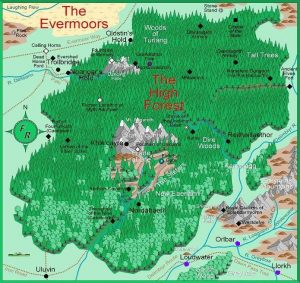
The Forgotten Realms were my first campaign setting back when I first got into RPGs and while I eventually got put off by its kitchen sink approach I still have some fondness for The North. The North is maybe 5% of the area of Faerûn but can stand as a complete setting on its own. The Sword Coast has become the default region for Forgotten Realms material and I believe the de facto officially supported region in 5th Edition for good reasons. While I don’t have a strong yearning to revisit this setting, I am still very fond of the High Forest in particular. I really got into RPGs when I played on a Neverwinter Nights server set on the eastern edge of the High Forest and eventually became one of the GMs and senior level designers. And my first steps into worldbuilding began with an attempt to take the hinted at past of this region and expand it into a proper playable setting. Eventually I dropped the connection to the Forgotten Realms entirely and now over a decade later it led to the Ancient Lands in its current state. But I always was a bit disappointed that I never got to run a campaign that goes really deep inside the forest and has the players explore its ancient mysteries.

I had planned to start a new Ancient Lands campaign next winter, but by now “next winter” has become “this winter” and its going to be delayed until next spring. And with still a good amount of time ahead, I still have not entirely commited to what I am going to run. Earlier this week I read a great recent post by the Angry GM about making wilderness travel more fun. And though I had last planned to do something simple and episodic, it put the sandbox bug back into my ear. I had written about a workable travel system for pointcrawling in the wilderness a while back which is quite similar, but as usual Angry made a great improvement over it by making it work without prepared precise maps. A pointmap was to be a compromise over a hexmap, but being able to track travel times and random encounters without a highly detailed map is even better. And unlike with a pointmap it’s really easy to handle a party getting lost.

In previous attempts to make a sandbox I found it very efficient to simply grab a bunch of old modules that fit the theme and put them all together on a map. One that came to mind was Hellgate Keep, which is set on the edge of the High Forest. And that got me the idea to use the whole High Forest chapter from The Savage Frontier as the base for my sandbox. It’s the original inspiration for my Ancient Lands setting and as such pretty much everything from it fits perfectly into it. While the North in later publications is a nice place, I think the original version from The Savage Frontier is by far the coolest. It’s classic 80s Jaquays goodness that still has a nice lingering Judges Guild smell. I am not exactly sure why, but the next time the region was described all the best places where destroyed and the most interesting characters dead. And a lot of it is great sandbox material:

    • Hellgate Keep: An old elven fortress city overrun by demons and their half-demon and undead minions. It’s not just a dungeon but a city, and one way too powerful to assault head on. Not really suited for a dungeon crawl but in a sandbox it can get a lot more interesting to visit.
    • Nameless Dungeon: This ruin of an underground stronghold has been closed off and put under heavy guard by elves after adventurers found some magic weapons and armor there. Later books provided an explanation for this odd behavior by making it the long forgotten prison of elven sorcerers who had consorted with demons to usurp the throne of an ancient realm. And now they are waking up and some have already escaped into the forest. I really quite like this one.
    • Blue Bear Tribe: This barbarian tribe has fallen under the control of their evil shaman who is a disguised hag in league with the demons of Hellgate Keep. They were banished from their ancestral shrine by its spirits for their evil ways and are unable to find it again.
    • Tree Ghost Tribe and Grandfather Tree: Some of the Blue Bear tribesmen have split of from their kin and renounced their evil ways. They hope to become worthy again in the eyes of the spirits and rediscover the location of the giant magical tree that they worship.
    • Star Mounts, Endless Caverns, and Stronghold of the Nine: The Star Mounts are a mountain range of incredible hight and somewhere below them are the Endless Caverns that lead into the Underdark and hold the bones of a huge dragon whose treasures have never been found. Not far away is the Stronghold of the Nine, the base of a group of famous heroe who have been turned mad by an evil artifact they discovered and begun to turn the castle into a battlefield fighting each other.
    • Citadel of the Mist: A magic castle that is home to a powerful sorcerer who is one of the main opponents of Hellgate Keep and ally of the treants that live in the nearby forests.
    • Lost Peaks: Mountains that are said to hold the Fountains of Memory that show visions of the past.
    • Dire Woods: A strange part of the forest that is much larger on the inside than the outside and somewhere near its center lies the ancient city Karse, which holds the giant undead heart of a demigod sorcerer.
    • Ruins of Decanter: An old mine that is crawling with monsters created by sorcerers of old and left to their own devices, but recently an illithid known as the Beast Lord is bringing them under his control.

There are also some other places in the Savage Frontier that can easily be transported into the High Forest and fit very well into it.

  • Cave of the Great Worm: This huge cave is home to a tribe of barbarians who are led by an ancient benevolent giant reptile. Would fit well into the Star Mounts.
  • Gauntlgrym: An ancient dwarven city that was famous for its wealth but was lost for unknown reasons. It supposedly can be reached from the Cave of the Great Worm and would be well placed under the Star Mounts so it can be reached through the Endless Caverns as well. I say its mysterious fate is something inspired by the Dead Trenches from Dragon Age and Dead Space!
  • Lonely Tower: A tall tower with no visible doors and windows standing in a huge circular clearing in which no plants grow. It’s the home of a alchemist sorcerer from another world.

That’s a lot of great sandbox material, but to make my work easier I also want to add some classic modules that make for great additions.

  • Against the Cult of the Reptile God: I’ll make it Against the Cult of the Succubus Princess and it should provide a great introduction for the demonic forces of Hellgate Keep.
  • Hellgate Keep: This module describes the keep after its destruction but provides a lot of information on how it looked and what was going on when it was still there. It includes the half-demons Kaanyr Vhok, Aliisza, and Sarya Dlardrageth, who all could be interesting NPCs.
  • The Forgotten Temple of Tharizdun: I love this thing. I’ve wanted to run this for a long time and always felt that it would work best if the players have no idea what kind of crazy awaits them beyond the empty gate of this black ziggurat. It’s perfect as a random location that is spotted in the distance as the party is travelling through the wilderness on their way to somewhere.
  • Rahasia: This one lends itself very well to be adapted to tie in with the Nameless Dungeon. Instead of a chaotic priest randomly finding the spirits of three elven witches in a temple, it can be one escaped half-demon from the Nameless Dungeon trying to resurrect his daughters who were killed in the uprising and whose spirits he stored in the basement of his mansion before he was captured and imprisoned. Or he’s a loyal minion who is resurrecting his mistresses who had a somewhat flawed plan to avoid falling into the hands of the attacking elves.
  • Escape from Meenlock Prison: I had so much fun the first time I ran it and meenlocks make for great creepy fey monsters.
  • Sons of Gruumsh: A straightforward but interestingly build dungeon that is occupied by three warlords believed to be blessed by their god. Would make great opponents for the tanarruk of Hellgate Keep.

Additional ideas include making Gauntlgrym inhabited by derro who are descendants of the original inhabitants and making the local orc tribes enemies of Hellgate Keep who want to take revenge for their people being taken to create the demonic tanarruk. Good factions are the key to a great sandbox and there are already a good dozen of them with none of them necessarily attacking the party on sight but all of them having lots of enemies and potential allies.

So much material and I’ve not really lifted a finger yet. This is about four hours of thinking what existing material I can use to make my own sandbox. I am still going to make this an Ancient Lands campaign, but I think most changes will be primarily cosmetic. There are different gods and races aren’t exactly the same, but overall I think it will be still very recognizably the High Forest.
A hazy idea for a new OSR magic system

Work hours have been a bit chaotic this month, with frequent evening hours and weekend workdays, so I have not really spend much of the long hours of tinkering with ideas that usually lead to me writing things. But all the overtime hours will get me a lot of shorter workdays after Christmas and there’s not really much to do in a gardening store in January anyway. There’s a lot of ideas floating in my mind that I want to pursue further on lazy afternoons and loudly proclaim my conclusions.

Right now I am occupying my free periods during the day with thinking about adapting my new idea for a magic system to an OSR rules system. Which actually turned out a bit more tricky than I thought.

The main concept is that all characters have an amount of spellpower that is calculated by adding the modifier from Wisdom to the number of levels in the mage class. A 4th level mage with a Wisdom of 16 would have a spellpower of 6 (4+2). Any time a spell is cast or a ritual performed, there is a chance for a missfire based on the character’s current spellpower score. At the end of the casting the spellpower score is reduced by a certain number. Dabblers in magic have a high chance of misfires when performing rituals (which does not require any specific character class) but so do even experienced mages who have already cast several spells that day. I like the concept but don’t have any good idea for how to calculate the chance of failure and how to make a die roll to check for a missfire.

I also think about having three categories of magic. Spells, which take one round to cas; incantations, which take 1 minute to cast; and rituals, which take 1 hour to cast. Only characters of the mage class can learn spells and incantations of limited numbers, but rituals are open to anyone who gets his hands on the instructions. However, I found that I have really very few ideas for traditional spells that would fit with my image of how magic performs in action.

One interesting oddity I noticed a few days ago is that all the effects I wanted my old magic system to do no longer fit with the new system. And a good number of things I deliberately chose to exclude seem highly appropriate for the new system. (Except teleportation, which is still out.) My old approach was highly inspired by Star Wars and Avatar, which spells being extensions of the body and mind. Now I feel much stronger drawn to witchcraft and sorcery that focus on dealing with external supernatural beings. Having just read Hellboy again (a review is one of the things I want to write) probably had a huge impact on that change of mind.

Kickstarter starts for Astonishing Swordsmen & Sorcerers of Hyperborea 2nd Edition

Astonishing Swordsmen & Sorcerers of Hyperborea is getting a second edition and the Kickstarter campaign has started last week and is going until 30. November.

wi7t00

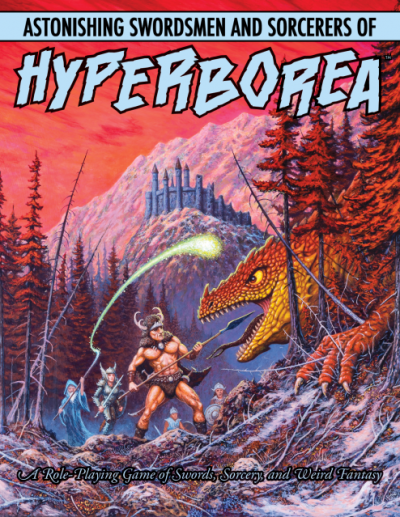
AS&SH was my first OSR game, performing the impressive feat of presenting the rules of AD&D in a way I was actually able to understand. I eventually moved on to B/X and Lamentations of the Flame Princess, but it’s still one of my favorite games and it has a lot more to offer than just game mechanics. The same but more sounds like a pretty good deal to me. But I have to say the new art alone is enough to get me sold. Just look at the new cover!

I’ve not given any money to kickstarter projects before with money being tight, but now that I am starting my first regular fulltime job next month the situation has changed. And AS&SH is the perfect first thing to throw money at. It’s a bit of a gamble to give money for a yet nonexisting thing, but the first edition was already really good and I gladly do my part in having more really good Sword & Sorcery games on the market and inspiring people to give them a try or add their own content to what’s already out. (Which I think could still be a lot more.)

My thoughts on Crypts & Things

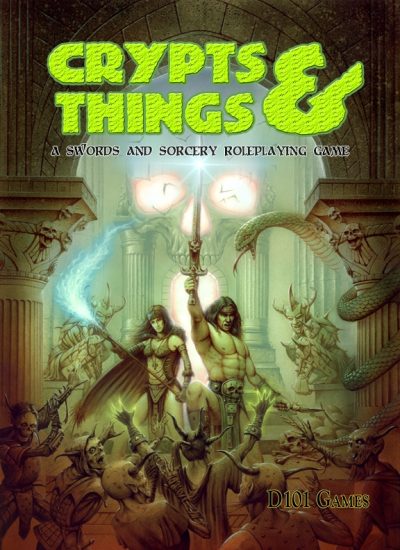
Just a couple of days ago I got very excited about finally being able to get a look at Crypts & Things, which I’ve often seen praised as a fantastic Sword & Sorcery take on OSR games.

190299

But I have to admit that very quickly after starting to read, my enthusiasm for it went down very fast. Crypts & Things is not a bad game and it’s certainly more Sword & Sorcery than other OSR games, even more than Astonishing Swordsmen & Sorcerers of Hyperborea. But my feelings on it are that it’s not a particularly impressive game and that it follows a concept of Sword & Sorcery that is exclusively Conan and Conan-clones, which is perhaps the dominating view among OSR players.

At ita base, Crypts & Things is Swords & Wizardry with a couple of variant rules and new mechanics. I’m very unimpressed with S&W to begin with and pretty much all the shortcomings I see in it apply to C&T as well. There are however a couple of nee ideas that I quite like. In C&T, bonuses for high ability scores are the same as usual, but penalties for low scores never get greater than -1.
The effect is almost the same of rolling 2d6+6, which I wrote about last month. This makes characters that are good at many things, but not really bad at anything, which fits Sword & Sorcery very well.

C&T has its own classes, of which the Fighter,Sorcerer, and Thief are pretty much as usual. Fighters get access to various weapon skills as they advance but the bonuses are so small that it just seems to add complexity for no real benefit. What I quite like however is that the thief’s skills are not exclusive to thieves. All characters can make a skill check based on their character level, but each class gets a +3 bonus to activities that fit their archetype. The barbarian is a new fourth class that turned out not to be another berserker as you usually see in D&D, but actually a lighter warrior with better wilderness skills. Filling the very same role as my Scout class for LotFP. Of course, I consider this a goo idea as well.

There are also five special classes including an elementalist but also lizardman and serpentman characters which can be used as NPCs or might be allowed for players in some campaigns.

Next there’s 11 pages of tables to create randomly generated character backstories.I’ve never been a fan of any such things.

A big difference to S&W is the spell list for sorcerers which consists mostly of magic-user spells and a few cleric healing spell. It’s still the regular D&D spells,which I find particularly unsuited for Sword & Sorcery. These spells are in three groups and classed as white gray,or black magic. They function very much the same but casting a white magic spells alerts demons that are close by and black magic spells can increase a character’s corruption. Interesting idea for a new mechanic, but I think this is an area where C&T falls flat to me.

Corruption is a cool concept in Sword & Sorcery, but in C&T it simply accumulates unti the character gets a mutation that seems mostly cosmetic. Kt feels overly bare bones to me.

Same thing with Sanity. You get insanity points as the game progresses and once you got too many the character goes mad and is out of the game.

Then there is also Luck, which is basically a regular action point mechanic with not much else to it from what I can see from my brief reading.

These are all concepts that are implicitly present in much Sword & Sorcery (particularly the hammy Clonan type) and that could be quite interesting to have in the game, but the mechanics presented here all strike me as very bare bones, bland, and also somewhat boring. I know I am a very tough customer when it comes to variant mechanics for simple games, but neither of these three makes me want to see it in action. I applaude the intend, but the execution isn’t doing anything for me.

All in all, Crypts & Things strikes me as a game that should work well and that I would play without complaints if invited to it, but I don’t really see anything in it that would make me want to run it instead of Lamentations of the Flame Princess. You can see that it’s made for Sword & Sorcery, but doesn’t seem to be any more suited for it than any other generic OSR game.

War Cry of the Flame Princess: Hit Points and permanent injuries

Like many people, I am not a big fan of having PCs be perfectly fine with 1 hp remaining and instantly dead when they are at 0 hp.

My approach to hit points is to not regard them as wound points but as stamina points. A succesful hit means that the target suffers minor scratches and bruises that interfere with its ability to succesfully deflect or dodge attacks and avoid serious injury. When a character runs out of hit points the extortion becomes too high and he slips, suffering a serious wound. It’s an abstraction like any way you can think of hit points, but I think it’s the best approach to have the fiction of the adventure match the rules of the game.

But the bigger challenge is how to handle the situation of a PC being reduced to 0 hp. I have a big dislike of the complex dice rolling and multiple modifiers of third edition and AD&D and I certainly don’t want to go through anything like the trouble of multiple successive rolls to stabilize and recover while having negative hit points. A much simpler approach is this:

When an attack deals more damage to a character than he has hit points left, the remaining points of damage are compared to his Constitution score. If the points of damage in excess of the current hit points is greater than the Constitution score, the character is dead. If not, the character is only unconscious for 10 minutes and permanently loses 2 points of Constitution. This loss of Constitution represents a lasting injury that neither surgery nor magic will ever fully reverse. While unconscious at 0 hp, any further damage will automatically kill the character. A character who regains consciousness is unable to fight or do other tiring activities until brought to 1 hp or more through resting or magic.

There are no saving throws or Constitution checks. Death and permanent injury are always automatic. In my past campaigns characters running out of hit points was always very rare already. Adding a significant chance to negate the effects only makes it even more unlikely that something bad will happen to a character. (Though running Sword & Sorcery dungeon crawls will probably increase casualties in my next campaign a lot.) I had considered to randomly determine whether the ability loss affects Strength, Dexterity, Constitution, or Intelligence, but with hit points already representing the ability to continue fighting I don’t think it’s necessary.

I like this solution since it’s both somewhat realistic in regard to actual battle injuries, and it also matches the habit of many Sword & Sorcery heroes to be left for dead with grievous wounds. As in Yojimbo or A Fistful of Dollars, being almost dead is nothing that a week of rest can’t heal, even if it leaves a lasting mark. With a Constitution score of 2d6+6, this gives a character about three to seven opportunities to cheat death before being too crippled to continue, though it might be worth considering retirement much earlier than that. It’s a lot more forgiving than the standard rules for death, but it’s still something that players really will want to avoid.

Crypts & Things Remastered is out

Since yesterday the new revised edition of Crypts & Things is out as pdf. (Print version will be available next week.)

190299

I got interested in the game two years ago, but very annoyingly the revised edition had just been announced and the pdf pulled from sale, so I never got a chance to take an actual look at it.

OK ,do you like OSR Rules?
Conan?
Lovecraft?
Are you prepared for a game without Clerics?
Still with me?
Then boy Oh boy do I have the game for You!
From D101 Games, written by Newt Newport
PDF is $13 from Drive through/Hard copies available directly from D101 Games
Powered by Swords and Wizardry (OD&D Clone)
The Middle Aged One

And it’s under 12€.

i-dont-need-it-meme

I totally do need it.