Why exploration works as a game

Numerous keyboards have been worn out on ENWorld over the last month with endless discussions about why exploration in D&D is so bad, why it doesn’t work, how it could be made to work, and that it would work if people just were to actually use the rules that are already there. Obviously, the vast majority of people are arguing from the perspective of 5th edition, which is why that discussion never seems to go anywhere. My conclusion after having run a 5th edition campaign for half a year was that this game doesn’t actually know what it wants to be, or to be more precise, the writers of the Dungeon Master’s Guide don’t understand how RPGs work in the first place. Lots of 5th edition players in the discussion keep repeating the point that exploration is one of the three main aspects of the game. Because the books say it is. But it’s not. It hasn’t been part of the rules since 3rd edition came out over 20 years ago, and it wasn’t included in the rules because D&D as a brand had lost interest in by the mid 80s. I believe what people want is something that resembles the vague stories they’ve heard about the games played by earlier generations that preceded them, but 5th edition just isn’t made for that. Contrary to the designers’ insistence.

One opinion I came across yesterday was something along the line that random encounters are not viable stakes for exploration challenges, because when you have a fight it’s switching to combat and is no longer exploration. And that exposes a fundamental flaw in the underlying assumptions that all these discussions build on. Exploration and combat are not two separate game modes, and neither are social interactions. Or at least, they must not be separate game modes for exploration to work. You can have a pure combat RPG. D&D has proven that for the last 20 years. You also can have a pure social RPG. There are plenty of those around. But exploration just by itself does not work as an RPG. Or at least, I’ve never hear of any such a thing existing.

Exploration, combat, and social interactions are not three game modes that come packaged in a bundle. In a good roleplaying game with an exploration focus, they are components in a unified system, and so entangled that you can’t look at them separately to understand how they work. I would say that the threat of combat is not just a viable component to have stakes in exploration, but a necessary requirement. At least when you’re envisioning a game with warriors and wizards descending into the lairs of monsters and get into lethal fights.

Now here’s the actual point I want to get to: Somewhere else in the several discussions someone talked about how characters exploring a dungeon can simply use some spells to check everything for possible traps before getting close to them and that the game (5th edition) gives players all the tools to do just just, and how that’s why exploration doesn’t have any meaningful threats like combat does. (Might actually have been the same person who said combat can’t be a threat of exploration because then it’s no longer exploration.)

This had me realize why exploration in D&D from the first 10 years is exciting and works as a primary gameplay loop that get people to come back forever. When exploring a dungeon, one option you have is to do everything extremely carefully. Always check everything for traps, never step on anything without poking it with a 10 foot pole, use magic to always scout ahead, always have everyone healed to full hit points, and rest as often as it takes to always have your spells ready. But if you try that, you’ll inevitably get killed by the 5,000 wandering monster checks you have to make. This is not a viable approach. The other option is to just be quick. Kick open every door and charge straight in and attack everything that moves. This approach simply gets you just as dead, only much faster. It’s not a viable approach either. And that’s the main tension that makes classic dungeon crawling work. You have to be both swift and careful, two needs that directly oppose each other. This is a problem with no optimal solution. And that means every single turn is a challenge and a gamble.

That’s how exploration works as an exciting game.
Ideas on using Notice in Worlds Without Number

One of the additions that Worlds Without Number adds to the common oldschool structure is skills. The system for skills is not bad. Basic skill checks are 2d6 plus the appropriate attribute modifier, plus the character’s level in the respective skill for the task. Skill level can be as high as 4 at 9th level, but with the way the cost for each skill level increases each time, I don’t think you’re going to see that often, except maybe for skills like Stab or Magic, which are not usually used as skill checks but rather as modifiers to attack rolls or how much magic a Mage can use per day. I think +2 and the the occasional +3 added to attribute checks is the most that will be commonly encountered in the wild.

However, one of the skills is Notice, which is something that is usually considered one of the big things that make newer D&D editions unsuitable for classic dungeon crawling, which in the defense of Worlds Without Number, it never claims to do. The GM tells the players the things in a room that are immediately obvious, and then it’s up to the players to ask the right questions to find the things that are not immediately obvious. “You can not roll dice to avoid playing the game.”

Worlds Without Number does not specify when Notice checks are supposed to be made, but after some pondering, I’ve decided that there’s still ways to both make the skill work and also make it worthwhile to put points into for players. One approach is to make the target number of a Notice check to “notice something unusual” very high. I would consider a character with a +2 Wisdom modifier and a +3 skill bonus to be highly specialized, and quite likely the highest total modifier that players might actually be able to field in play. Maybe a total of +6, but that’s probably really it. With a +5 bonus, a character would have a 28% chance to make a difficulty 14 check. A character with a more modest +3 would only have a chance of 8%. That doesn’t seem too bad.

But to still make players work for their progress, I’d add the following rules to making a Notice check to find hidden things: Since searching an area is a group activity, I’d only allow a single check for the whole group, with the highest modifier of any characters in the party. They don’t get four or five checks to maximize their chances of someone rolling a 12. Also, I am thinking that this method can only discover a single hidden thing. So the players better search the place as well as they can before they make that roll. You don’t want to waste it on something that you could have found yourself with two more minutes of thinking. Making a Notice check should be the the final gamble after the party has given up on finding anything else themselves.

Another way to use Notice checks is when it comes to surprise. Worlds Without Number only addresses surprise in regards to one character waiting in ambush to attack another character. In which case it’s a Notice check against a Sneak check. It doesn’t mention how you’d do that with groups of characters (if everyone rolls, it’s boils down to the defenders’ best Notice roll against the attackers’ lowest Sneak roll), and it also doesn’t go at all into the situation where wandering monsters just happen to stumble into the party entirely by accident.

The regular surprise system in B/X is rolling 1d6 for both sides, and on a 1 or 2, that side is surprised. (Both sides can be surprised, and neither side can be surprised.) This roll could instead by made by having both sides make a Notice check, rolled by the character with the highest modifier. Monsters and generic NPCs in Worlds Without Number usually have a +1 or +2 modifier in whatever skills they would likely to be good at. I think Notice checks to determine surprise should always fall under that. Players would easily have a +2 or possibly +3 advantage over the creatures they encounter, and since 2d6 give a normal distribution, that’s really quite big. But this can be addressed by tweaking the difficulty of the check.

In B/X, the chance to become surprised is 1/3rd, so the chance to detect the other group is 2/3rds. Since most monsters and guards in Worlds Without Number have a skill modifier of +1 or +2, setting the default difficulty to detect a group of adventurers exploring a room to 8 gets the closest to those 2/3rds odds. PCs will regularly have higher modifiers to that, since they also get to add their Wisdom modifiers to their check. But monsters prowling the dark tunnels of a dungeon are much less noisy, so to detect them, the difficulty should be a higher 10. And if you have really sneaky creatures prowling in the dark, that difficulty can increase to 12.

Now you might be wondering: “Why do this much more complicated approach to get basically the same result?” That is a good question, Timmy. If I’d design a game from scratch, I just wouldn’t bother with a Notice skill in the first place. And as GM, I totally have the option to just modify the rules and kick out Notice entirely. But each small change you make to the system comes with a cost when it comes to recruiting players when you’re not in the position to tell your existing group that this is what you’re going to play from now on. Getting players for a more obscure system (that is, everything that isn’t D&D 5th edition) is not quite trivial to begin with. Having a somewhat well known and highly regarded name like Worlds Without Number helps a lot in that regard, but when that’s your way to lure in players to your campaign, many of them will show up to play Worlds Without Number. And every change you make to the default rules slightly decreases the enthusiasm people will have to join your campaign. There’s already a good number of changes I am making to the system, like ditching a couple of foci, two of the magic traditions, and completely overhauling the High Magic spells. I’m ditching much of the weapons and armor lists and the whole equipment modification system. All of this adds up to make the game less of what people think of when you ask who wants to play in a new Worlds Without Number campaign. A change like this doesn’t really change anything on the player facing side of the game. They still can get their Notice skill and all the foci that give bonus skill levels to Notice, and they are still going to make plenty of Notice checks while they play the game. Even players who know  the rules might not even notice (huh huh) that anything has been changed at all.

Re-associating exploration speed

Many rules in OD&D and B/X look very weird on paper, when you approach them as “new rules” that are added to what you consider a typical Dungeons & Dragons system. Giving XP for picking up treasure instead of fighting enemies is perhaps the most famous of them, but there are plenty others, like encumbrance, random encounters, or reaction rolls. But I think the purpose of all of these in a greater exploration system has become fairly well reestablished, and I believe I’ve written quite a bit about all of that already.

But one of the things that to me still stands out among these is the unexpected way in which movement outside of combat is handled. In Basic/Expert, the default movement rate for characters exploring a dungeon is 120 feet per 10 minutes. That’s 12 feet per minute, or about one step every 8 seconds. The rules explain that this doesn’t actually mean characters are moving that slowly. What happens is that the characters are carefully searching their environment and drawing reasonably precise maps. Dungeon has become a fairly generic term for any complex of passages, but I think the original idea of what a dungeon is like was less strolling through a castle and more exploring a cave. While very few dungeons are actually natural caves and most have long been used as regular passages by humanoid inhabitants, cave explorers often only manage to progress 300 to 500 meters per day, or say 1,200 feet. If they are at it for 10 hours per day, that’s 120 feet per hour. Even if the PCs are heavily encumbered and have their speed reduced to a quarter, that’s still faster than cave explorers. So maybe not actually a ridiculously low speed.

But where things start feeling strange is when encumbrance comes into the picture. In B/X, encumbrance reduces your encounter speed from 40 feet per round to 30, 20, and eventually 10 feet. And the same modification is also applied to exploration speed. When you take, on average, one step forward every 8 second, you spend almost the entire time of exploration not actually moving forward at all. Heavy loads slowing your movement to half or even a quarter is somewhat believable (maybe the characters are literally dragging heavy bags of loot behind them). But that also reducing the speed at which you can look and poke at things the same way is a cognitive disconnect. It’s a dissociated mechanic. A party with more heavy gear making slower progress makes sense, but representing this through reduced movement speed doesn’t feel very plausible.

However, B/X already has a small, seemingly mostly forgotten rule, that can be adapted for the purpose. Part of the rules for exploration movement is that after every 5 turns of exploration, the party must rest for 1 turn or the characters suffer a -1 penalty to hit and damage from exhaustion. Of the eight retroclones I have, only one carried over this rule. It just seems pretty pointless when you can assume characters are already getting sufficient rest for their legs during the regular exploration turn. And maybe people are right to throw this one out, but I think it’s a great place to apply penalties for encumbrance during exploration instead of reducing speed.

Instead of reducing the movement rate during an exploration turn  to 90 or 60 feet, you can instead increase the rate for required rest to resting for one turn after every 3 turns or every 1 turn of exploration. This seems like a huge decrease of time actually spend on making progress, but because of how the math works out, this system actually makes parties progress somewhat faster than under the default rules. Which is fine with me. Numbers in D&D have never been an exact science anyway and are always simplified approximation. Being 10% faster than by the book isn’t going to break anything. But I feel that this change makes it much easier for players to intuitively grasp why their characters are making slower progress with heavy loads and don’t have to accept it as something that just is because the rules say so.

Return of the Mapper for online games?

Have you heard the good message of our savior Gus L? I learned entirely by accident that he didn’t stop writing RPG stuff but instead has been sharing new stuff on his new site All Dead Generations for the past three years. All the stuff on the site is about what he calls Classic Dungeon Crawling, which is basically OD&D and early Basic D&D, and how that style of Dungeon Crawling is an exploration fantasy game and not a combat fantasy game. A fantastic resource that I recommend to everyone, though it comes in hefty chunks that take quite a while to chew on.

After my overall pretty great D&D 5th edition campaign last year, I was throwing the towel on trying to make dungeons work, because I just could not figure out how to make a dungeon an interesting place that is not simply a warehouse for nonsensical puzzles. All the advice I was coming across on that front was “Well, sometimes funhouse dungeons can be fun.”But now, after 20 years as a GM, I finally get dungeons!

I have seen the light!

Dungeon Crawling and exploration in general isn’t just an aspect of an RPG, it’s even more a system of multiple mechanics than I previously had realized. Treating the whole dungeon as one big puzzle that will reveal the safest ways to the best treasures when figured is a great focus draw players engagement with the campaign. Especially when there’s no plot and characters don’t get shiny new toys every time they level up.

Part of solving that puzzle often is to fully grasp the layout of the dungeon and gain the ability to pinpoint the likely locations of possible shortcuts or otherwise completely inaccessible areas. Gus mentions that having players draw the map themselves is particularly bothersome in online games, where the GM can’t peak at a player’s pencil drawn map to spot obvious misunderstandings of his descriptions. (Minor errors in dimensions are desirable though.) But I took a quick look at Roll20 and found that at least in this case, this thing is actually very easy to do.

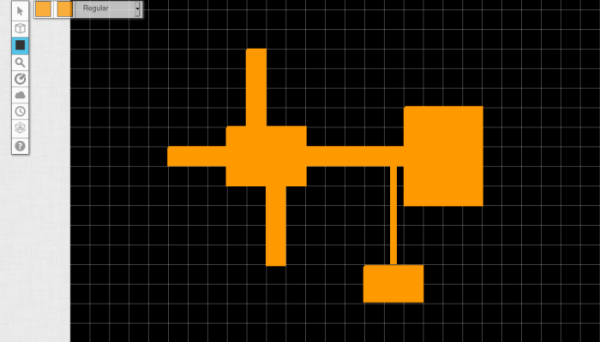
Roll20 has the paintbrush tool, which also has a shapes tool that draws rectangles by simply clicking and dragging. As a lifelong diehard user of pencils and grid paper, I think this is actually a lot easier and quicker than drawing lines around squares with a pencil. To correct errors, you can just click on one of these shapes and delete it, without any messing around with erasers. Now I’m definitely going to bring back this aspect of the game in my Great River Campaign. At least giving it a trial run. I’ve been told that there isn’t a function like this in Fantasy Grounds, but I’ve never used that myself. Which seems like a shame, since this is something really simple and basic. Though I guess when you do your mapping like this, you might not be bothering with something as fancy as Fantasy Grounds.

A picture says more than a thousand awkward words

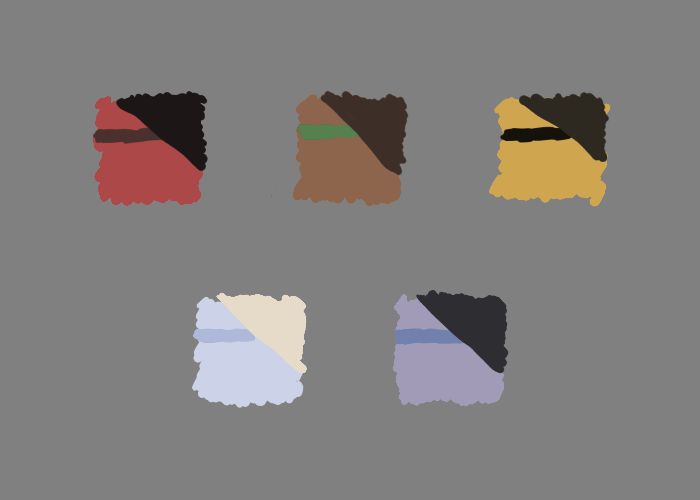
Tired of trying to explain to your players the coloration of the peoples inhabiting your setting, and not having any illustrations to show them what you really mean them to look like?

Make a simple color palette and show it to them.

This rally isn’t anything fancy and there might be better ways to display the colors, but this is a fairly painless quick and easy way to it clear to players what I mean when I tell them that the Murya of Kaendor are “red”. That red!

A proposal for a river navigation mechanic

Most RPGs I’ve seen mention about navigation that when you’re following a road or river, you automatically get to your destination eventually, and you only need to make rolls for navigation if you’re going cross country or across the ocean.

Yeah. Kind of. But not really.

If you’re on a river and your destination is to just go downstream to the coast or a city you know to be further down the river, then there’s really no way you can get lost. But things look completely different when you’re trying to go up a river and you come across forks where you have to pick going left or right.

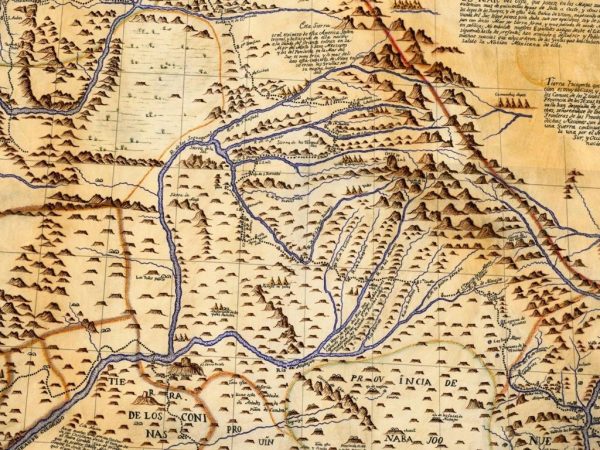
I’ve been on a couple of canoe tours throughout my life, and I’ve been doing the navigation on most of them. Though I have to say that was on very easy rivers in Germany, on waters that have regular traffic and existing infrastructure and very good maps. And we were going to destinations that had been selected by people who knew that those routes would be very easy to follow even to amateurs. And even then, I’ve had many cases where I really had no clue if that big branch to the right is the already the third big branch to the right we need to take, or if one of the branches we already passed looked much bigger in person than it does on the map. The map has an accurate scale on it, but with no means to monitor your exact speed, that’s still only of limited help. Now imagine that deep in the wilderness, following a map drawn by someone with no access to aerial photography or surveying tools.

In my rivercrawl campaign, going to a site will almost always consist of going upstream all the way to your destination. And since all wilderness travel will be along rivers, going with the “you can’t get lost when you follow a river” approach isn’t going to cut it. (Though conveniently, getting back to base at the end of an adventure will be very easy, and going with the current also a lot faster.) Something else is going to be needed.

Making a complete map of an entire river system spanning hundreds of miles with all its little side arms really isn’t practical. You could theoretically let players give it a shot on a blank hex map with very small hexes, but I think that would be very tedious and not feel like it reflects the kind of maps actual river explorers would be using for their notes.

Instead, I want to go with an entirely skill check based system to navigate through the networks of small side branches that fork of from the main waterways that are depicted on the main overview map. My own GM map only shows branches up to the third order, and I intend to let players find their ways on those without navigation checks. It’s only for the rivers even smaller than that that this system comes into play.

Maps are items that characters can find or sell that have instructions on how to reach certain hidden places from an easily recognizable and unmistakable landmark. Every map has a dificulty based on it’s quality. Using a very good map is an easy task, while using a poor quality is a very hard task. The difficulty is further modified by how far the destination is from the clearly identified reference point on the main rivers. Since I have all my travel times in increments of 10 miles, (1 mile per hour times 10 hours per day), I increase the difficulty of the navigation check by +1 for every 10 miles that you try to follow the map.

If the navigation check is a success, the party reaches the destination in the shortest time possible given the distance and their travel speed. If the check is a failure, they still get to their destination, but for each number that the check fell short of the difficulty, the travel duration is increased to require one additional random encounter check. I do three random encounter checks for each day of travel, plus one check per night. So missing the difficulty by three adds a whole day on the water searching and backpaddling, and you also get another night to rest and potentially have another encounter before you arrive at your destination. Since I usually have random encounters at a chance of 1 in 6 for every check, getting two or three checks added to the journey generally shouldn’t be much of a problem. But for journeys deeper into the smaller rivers, having someone with a good navigation skill and paying for high quality maps can become really appreciated.

The fun part comes with the additional use for navigation checks to make your own maps of the unknown rivers you explore. These maps can be very important if you want to find a place again after having left it, and can be sold to other characters. To make such a map, a character makes a navigation check. The quality of the map and the difficulty to use it depends on the result of the navigation checks. For Worlds Without Number, I’ve decided to make it 20 minus the navigation check result, with the minimum difficulty being 6.

WWN makes skill checks with 2d6, so I think it’s a great idea to let the player roll one of the d6 either open or in secret, and the other d6 gets rolled by the GM. That way the player has a clue for the final quality of the map, but can not be certain how accurate it really is. The ultimate difficulty for using the map remains secret for the GM, at least until the players trying to navigate with the map have reached the destination and will have found out for themselves.

For players going to discover unknown sites by going into these small rivers blindly, one simple approach would be to simply roll a d20, and the result is the number of random encounter checks until the party finds either a small randomly generated site or a larger site whose exact location on the river has remained undefined until a party randomly discovers it. Since you might always need a monster lair or pirate camp if players try to track randomly encountered enemies back to their hideouts, it’s a general good idea to have a couple of those ready at hand anyway. And players can be required to tell the GM that they plan to go on a random exploration a few days before the game.