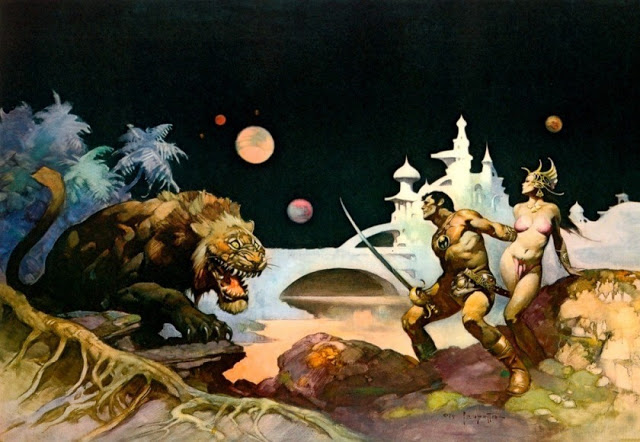
Planet Kaendor House Rules for Basic Fantasy

You know what the world really does not need? Another B/X retroclone. Well, I think it kid of does, but I know that nobody wants to see it. So instead, I am simply going to present my own adjustment to Basic Fantasy. BF has always ranked among my favorite retroclones of choice because it’s very close to the original B/X by Moldvay and Cook while at the same time using the sane rational system to attack rolls and armor class. I know the later is trivial to slap on any iteration of D&D, but I am petty about my hate for a resolution mechanic that is objectively bad and done wrong, so that’s counting a lot to me. BF is also very cleanly laid out and easy to read, and the whole thing is free so you can just hand out pdf copies to anyone you like.

Below is a list of all my modifications to Basic Fantasy that reflects my own impressions of actually having read Howard, Moorcock, Leiber, Moor, and Smith, rather than going by the grimdark Heavy Metal Album cover interpretation of what Sword & Sorcery is really about.

Characters
  • Roll 3d6 six times to generate six ability scores, but assign the six numbers to whichever attributes you like.
  • There are no racial modifiers and adjustments. PCs from all peoples just use the character classes as the are.
  • Characters get the maximum possible hit points at 1st level.
  • The character classes are warrior (fighter), thief, scholar (magic-user), and wilder (see below). Characters can be warrior/scholar or thief/scholar as by the Basic Fantasy rules for elves. (The XP to gain a level are the same as the XP for both classes combined, and the character gets whatever hit dice, attack bonus, and saving throws are better, as well as all spells and thief skills for the level.)
  • Maximum level for all PCs and NPCs is 10th level.
  • The thief skills all use a d20 instead of a d100 (since it’s almost always 5% steps anyway). They also start with considerably higher success chances at 1st level, but increase slower to be again identical to the odds in Basic Fantasy at 10th level.
  • The wilder class has the XP requirements and attack bonus as a warrior, d6 hit points, the thief skills move silently, climb sheer surfaces, hide in shadows, and hear noise, as well as track, and exceptionally good saving throws. (Based on the B/X halfling class.)
  • All characters can use any weapons and armor. Scholars can cast spells in light armor, thief/scholars can cast spells in medium armor, and warrior/scholars can cast spells in all armor.
  • Characters can establish a stronghold at any level. Money is the only limiting factor.
Equipment and Encumbrance
  • Encumbrance is counted in the number of items a character carries instead of pounds. If the number of items is greater than the character’s Strength score, the character is lightly loaded. If the number is greater than three times the character’s Strength, the character is heavily loaded. (Light armor counts as 2 items, medium armor as 4 items, and heavy armor as 5 items.)
  • Up to 100 coins count as one item.
  • Shields provide a +2 bonus to AC instead of +1.
  • The default metal for weapons is bronze. Special blades made from iron function as silver weapons for the purpose of harming creatures resistant or immune to normal weapons.
Experience
  • There are no adjustments to XP based on prime requisite ability scores. (Neither 5% nor 10% makes any noticeable dent in the advancement speed and are just a cause of confusion and errors.)
  • XP for defeating enemies are based on the original numbers from B/X. Characters also get one XP for every gp worth of treasure they bring back from a ruin. (One of the few thing that Basic Fantasy really got wrong.)
  • Reward money for completing tasks in ruins also counts as treasure for calculating XP. Turns out this is not a house rule but a default mechanic of the game.
  • Magic items also count as treasure for calculating XP.
Combat
  • Combat is done using the B/X initiative system for group initiative. (The other thing Basic Fantasy really got wrong.)
  • Poison attacks do not kill instantly. Instead, a poisoned character makes a saving throw against poison every round or takes the indicated amount of damage. Once one of these saving throws succeeds, no damage is taken and the poison ends.
  • Energy drain works just as it does in B/X. You get hit, you lose one level.
Magic
  • Spellcasters do not have to announce the spells they cast before initiative is rolled for the round. (A rule that only exist in Cook Expert, but not Moldvay Basic, BECMI, or the Rules Cyclopedia, and really complicates things.) Spellcasters who were hit in the first phase of the round can not cast spells in the second phase, but otherwise act normally.
  • Spellcasters have separate “preparation slots” and “casting slots” in equal numbers. Spending a casting slot to cast a spell does not remove it from the preparation slot. The same number of spells can be prepared and cast as by default, but spells are not forgotten after casting.
  • The Scholar spell list combines magic-user and cleric spells, but does not include a range of different spells, such as cure light wounds, continual flame, raise dead, magic missile, fireball, fly, ice storm, and wall of fire, to make magic a more elusive and mystical force.
The Scholar class for Planet Kaendor

As I am falling again deeply into the B/X hole, I have once again found myself having to deal with the question what I want to do about the issue of Clerics. Planet Kaendor is ultimately my own take on Sword & Sorcery, and with the passing of (many) years, I am seeing more and more the meaning and relevance of the typical conventions of this particular style of fantasy. Early on, I was all in for various (A)D&D-isms, like having elves and gnomes, goblins and gnolls, dragons, powerful elemental magic, other planes to visit, and a classical pantheon of gods. That’s all long in the past by now and I’ve fully accepted our Lord and Savior Robert Howard into my heart. And I really find myself enjoying the abstract magic of Moorcock and Smith much more than magic missiles and fireballs.

Finally getting a good picture of what I want gods and spirits to be in my setting (I never had really made a decision on this aspect in all the years), it’s really become clear that clerics don’t have a place on Planet Kaendor. Temples and priests are cool, as are barbarian shamans, but a clear separation of arcane and divine magic just doesn’t make any sense in the context of the supernatural forces that shape the setting. (Which will be the topic of a different post.) My main concern had been how the game would change if you no longer have clerics in the party who can cast healing spells and the players will only rely on healing potions. But when you look at how much healing spells they can actually provide in B/X, it’s really not that much. No spells at all at 1st level, and even well along into a campaign at 7th level, it’s still only two first level spells and one fourth level spell. And you might want to sometime cast other spells than just cure wounds as well. So I think when you’re not too stingy with healing potions as the GM, there should be no real disruption from the lack of clerics.

The most interesting alternative approach to priests that I’ve seen is from the Conan d20 game, which is build on top of a D&D framework. It only has a single full spellcaster class called the scholar. What spells they learn and how they present themselves in public is entirely up to them. Sorcerers and witches are obviously scholars, but so are priests and shamans. They don’t get their magic powers from their gods, but through the same arcane study as everyone else. Priests may claim that they get their magic powers from their gods, and might even believe it, but except for rare cases of divine intervention, it’s all their own doing. That’s an approach I feel is right for Planet Kaendor as well.

The Scholar class is really just the default magic-user with a different spell list. In any other regard, it’s really identical, including hit points, attack chances, saving throws, and number of spell slots. I’ve never been a fan of spell slots as it’s too obviously a game mechanic and not an abstraction to represent a plausible magic system in game terms. But I really don’t want to work out a completely new magic system myself. The most convenient solution for me is the one that was introduced in the 5th edition of D&D. Casters really have two separate sets of “preparation slots” and “casting slots”. You prepare spells as you would always do, but when you cast them they don’t disappear for the rest of the day. You’re still limited in the number of spells you can cast by your casting slots, but you’re not limited to cast a spell only once per day, or forced to prepare it in two slots if you want to be able to cast it more than once. It solves the weirdness of spells being forgotten without actually requiring any modifications to the classes themselves.

Since I want to cap character levels at 10th, the list only goes up to 5th level spells, but of course you could always expand it to 6th level spells as well. It’s mostly spells from Basic Fantasy, which are almost identical to B/X, but I also included a few from OSRIC as well.

1st level spells
  • Cause Fear
  • Change Self
  • Charm Person
  • Command
  • Darkness
  • Detect Magic
  • Entangle
  • Hold Portal
  • Light
  • Protection from Demons
  • Read Languages
  • Remove Fear
  • Resist Cold
  • Sleep
  • Spider Climb
  • Ventriloquism
2nd level spells
  • Blindness
  • Charm Animal
  • Detect Demons
  • Detect Invisible
  • Detect Thoughts
  • Invisibility
  • Knock
  • Locate Object
  • Mirror Image
  • Fog cloud
  • Phantasmal Force
  • Resist Fire
  • Silence
  • Sorcerer Lock
  • Speak with Animals
  • Slow Poison
  • Stinking Cloud
  • Web
3rd level spells
  • Clairvoyance
  • Darkvision
  • Dispel Magic
  • Growth of Animals
  • Haste
  • Hold Person
  • Invisibility, 10′ radius
  • Protection from Demons, 10′ radius
  • Protection from Normal Missiles
  • Slow
  • Speak with Dead
  • Striking
  • Suggestion
  • Water Breathing
4th level spells
  • Bestow Curse
  • Charm Monster
  • Confusion
  • Growth of Plants
  • Hallucinatory Terrain
  • Polymorph Other
  • Polymorph Self
  • Remove Curse
  • Shrink Plants
  • Sorcerer Eye
  • Speak with Plants
5th level spells
  • Animate Dead
  • Cloudkill
  • Conjure Elemental
  • Contact Higher Plane
  • Dispel Demons
  • Feeblemind
  • Hold Monster
  • Insect Plague
  • Slay Living
  • True Seeing

But why, tho…?

As I have whinged about here many times over the years, the biggest difficulties for me about the preparation for new campaigns has always been finding some kind of decent motivation for why the PCs should care about the main threat or antagonist of the campaign, in a way that gets the players invested beyond the basic “Well, that’s what the GM wants us to do”. I’m not a fan of this type of typical campaign and find it much more interesting and rewarding when the players take the oar and pick the direction they want to sail in next. Most often the excuses that pass as motivations are “we’re the heroes and that’s what heroes do” or “someone’s paying us to do it”. Both of these work, of course, for a basic game, but I always aspire to have my campaigns to be something more than that.

But you can absolutely overthink these things, too! After some not very impressive attempts at setting up campaigns in which the characters are motivated by a desire to rediscover the lost history and arcane secrets of the land, I decided to go back to the basics and embrace classic Sword & Sorcery instead of trying to do something clever and original about it. In the end, actually playing is the whole purpose of the entire exercise. Exploring new ways of what a hero can be in fantasy today and going is better left to other forms of creative outlets. What a game needs to be first and foremost is playable.

While conventional wisdom (that is, ultra-orthodox purists) tells us that Sword & Sorcery is never about assaulting the Dark Lord in his castle from where he is trying to conquer the world, an awful lot of classic Sword & Sorcery stories actually do conclude with the heroes assaulting a powerful evil sorcerer in his castle and putting an end to his plans to conquer the world (or at least the kingdom). It’s just that the hero doesn’t do it for the purpose of saving the kingdom or its people. (Unless it’s Conan, who literally does that in The Hour of the Dragon.)

I really quite like the idea of having a Sword & Sorcery campaign with the goal to defeat an evil sorcerer and had a very interesting conversation about how I could come up with decent motivations for the PCs. And the best suggestion I got was basically “let the players decide”.

At first the whole thing felt a bit backwards, because it goes completely against the common storytelling conventions of RPGs, where you begin with the player as ordinary schmucks doing regular adventure stuff, and hopefully by the end of the first adventure the true nature and goal of the campaign will be revealed. But you really don’t have to. Nothing is stopping anyone from starting a new fame with the pitch “We’re going to play a campaign in which you play characters who have all sworn to find and kill Wangrod the Vile.” That actually sounds a lot more exciting than the usual “we’re going to play a game in which you play adventurers and the story will be revealed later”. Nobody will be disappointed that you spoiled something that would be revealed within the first 5% of the story. That’s what people in the business call “the premise”.

Doing so allows you as a GM to prepare a lot of material in advance, but also leave it up to the players to decide who their characters will be and what their motivations are. You set up the goal, but the players create the motivation. Motivations that they care about and that feel interesting to them. You could of course prepare what the motivations of the PCs will be and tell the players to create characters around that. But if a player isn’t really feeling the excitement for that motivation, that doesn’t work out that well. As it concerns the story and events of the campaign, the motivations of the PCs don’t really matter. As long as the players keep working on the goal to confront and kill Wangrod, things will play out the same way.

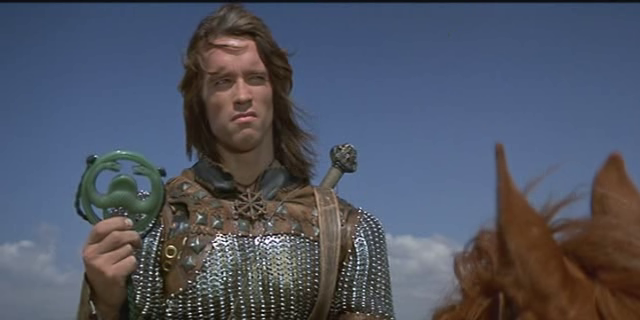
Conan the Barbarian might actually be a really good reference for how such a campaign could be structured. When Conan is freed and sets out to find Thulsa Doom, he has no idea where he is or even who he’s looking for. The only clue he has is the standard carried by the warriors who raided his village. First he tries to make a deal with a witch who seems to know something about the symbol, but that ends up getting him nowhere. Then he raids the snake temple looking for more clues, and finds the emblem which tells him he’s on the right track. After the raid, he’s taken to the king who reveals that he’s also an enemy of the sorcerer and finally gives Conan a name. Because he wants his daughter back from the snake cult, he provides Conan with the information where to find the sorcerer and things play out from there. I think that could be a really cool structure to be used for a campaign. The players make their character tailored to be seeking an evil sorcerer and defeating him for whatever reason. Information about who exactly the sorcerer is, where they can find him, and how they can defeat him can be very good motivations to go on all kinds of otherwise unconnected adventures. And information of this kind can be put into the possession of basically every NPC, which makes this structure very flexible. If one adventure doesn’t work out and they don’t get the information there were promised, they can always get it somewhere else. If they leave one adventure for later, you can always just switch around what specific information the respective NPCs have to share to keep the flow of the ongoing investigation. You’re also not strictly married to any specific length for the campaign. When things seem to drag on, you can always have the NPCs give out bigger chunks of information, and should everyone want to make the campaign longer, you can throttle down the rate of progress that is made with each adventure. And even with the sorcerer dead, it doesn’t have to be the end of the campaign. Along the way the players might well have made many friends and new enemies that can be worth coming back to once the original goal has been completed.

Just when I thought I was out, they pull me back in…

Back when I finished the Inixon campaign half a year ago, I wrote that I am done with Dungeons & Dragons and that it just isn’t what I am looking for in a game. I neither like the baggage of assumptions about the world that players bring to a new campaign (to no fault of their own), nor the encounter and XP treadmill. But even back then, I did leave myself a door open that I wouldn’t rule out running a game using some variant or another of the Basic/Expert edition. The mechanical problems are mostly something specific to the d20 system that no tweaks and overhauls ever manged (or even tried) to solve, and the worldbuilding baggage comes from the AD&D tradition. When I actually read B/X for the first time six years ago, the thing that stuck out to me the most was how different it all felt from all the D&D I had known.

When I was taking a break from the whole Bronze Age and Sword & Sorcery fantasy for a while, I always knew that I would be coming back to it. Do something that feels more like Conan and Elric than my last campaign, with stronger influences from Morrowind and Barsoom. My plan was to either go with Barbarians of Lemuria or some kind of PtbA hack. But here I am, and that thing is starting at me again.

Come on… You know you want to…

Look at my Works, you Mighty, …

When I wrote my first post outlining the purpose and goal of my latest worldbuilding efforts, I got a lot of replies, including this interesting link from Oliver Simon to a great academic article about the role of the environment in Conan: Exiles. It gave me a couple of great ideas for Planet Kaendor and I made some notes for a new post, and then completely forgot about it for the next six weeks while writing other posts I had already planned. Of my three notes, I only remembered the meaning of the first one, and I had to reread both the entire article and my post that led to it being recommended to me to figure out the second. And I still have no clue what idea the third note was supposed to be about. Don’t be me! Take better notes when you get great ideas for your own work.

The article takes a look at the open world survival game Conan: Exiles as a horrifying analogy of the cruel exploitation within human economic activity. While many of these survival games have the killing of other player characters and the looting of their equipment and resources as a key gameplay element, this game uses the well established and accepted norms of the Hyborian Age to take it to a much more grotesque level. Not only can you loot the possessions of your slain foes, you can also butcher their dismembered corpses for meat and crafting materials. Nonplayer characters can be taken alive and made slaves, that are a hugely important resource for expanding your own base. And some magical powers require human sacrifice to attain. Other people are reduced to “human resources” in the most literal sense. They are commodified as tools to be exploited for your own quest for wealth and power.

Being basically a sociological paper, it’s not an easy read, and the first part is crammed full of attributed quotations of other writers that don’t really add to the topic and mostly seem to be there to pad out the references list at the end to boost academic credibility. But after that it goes into how the environment with its ruined buildings, abandoned weapons and tools, and human remains also tells a story of how economic exploitation build the fallen civilizations as well.

I didn’t expect Marx and Derrida to contribute to my worldbuilding, but I guess stranger things have happened. One passage in particular really got me thinking about how I can give the ruins that fill the environment of Kaendor a more meaningful presence in the actual game instead of being irrelevant pieces of lore in some file.

Faithful to Howard’s original Conan stories, the landscape is one which Derrida would have recognised as being distinctly hauntological; it is a world scarred by its past. This environment is shaped by forces which still have agency but no agent, generating effects which exert great power over the player’s experience of and interaction with their surroundings.

Agency without an agent. Now that’s an expression that really appeals to me. In this case, we have to treat agency as different from the concept of player agency in roleplaying games, which is the ability of players to make choices about the actions of their characters that meaningfully affect the outcome of the developing story of the game. Without an agent, there are no choices that are being made or actions that are being taken. Instead we have the idea here of choices that were made and actions that were taken long ago by the long dead builders of the ruins that led to the creation of the current environment. The choices were made many centuries ago, but their consequences still affect and constrain the options that are open to the player characters in the present. The idea is that the ruins are not simply featureless and inert stones that litter the surroundings, but active entities that challenge and threaten the intruding explorers.

(At this point I want to apologise for falling into academia speech and getting abstractly philosophical. Four years in cultural studies do this to you. It comes automatically and leaves it marks on you forever.)

As a simple example, take an ordinary arrow trap that shots an arrow when someone steps on a certain part of the floor. To quote the endlessly poetically and quotable Darkest Dungeon:

Curious is the trap-maker’s art… his efficacy unwitnessed by his own eyes.

A trap is not simply a feature of the environment, even though many games treat them like that. An actual trap is not simply just there. It is there because someone made a choice and took action to put it there. With an intent to kill. The builder of the trap does not know who will fall victim to it, and the people it injures will most likely have no idea who caused them harm. In a ruined dungeon, the builder will have died centuries before the victims were born. But still, one person exercised agency to cause serious harm to another person. The agent is long gone, but the effects of the agency are present in the present.

It is not just traps. Every artificial obstacle that characters encounter is there because someone put it there with intent. Every constructed tool or weapon they find is in its place because someone made it for a purpose and put it in its present location as a consequence of choices and actions. And this even carries over to much larger scales. Planet Kaendor is conceptualized as a world in which the natural environment is outside of the control of mortals. Whatever they do in their attempts to shape the world that surrounds them will quickly be negated once the wilderness returns. But things look very different when it comes to the marks left behind by unnatural sorcery. A charred wasteland of ash haunted by ghouls attacking careless travelers surrounding a ruined city does not exist randomly. Its existence is the consequence of choices made by a sorcerer long ago. A consequence that directly affects the characters in the present. And the natural world in Kaendor is often directly controlled by spirits, who can exercise their own agency as well. Though being essentially immortal, this does not fall under the agency without agent. They are merely agents with an invisible presence, but I think the overall effect is quite similar.

The key idea that is presented here (indirectly) to worldbuilders is to create environments for adventures that are not simply passive and interchangeable backdrops that maybe have a couple of unusual but random backgrounds in them. Instead, they should give indications that obstacles and useful finds are the result of someone’s deliberate exercising of agency. Bad things don’t exist in the present at random. They exist because someone in the past wanted it or did a careless mistake. There was a purpose behind it and it was someone’s fault. And that someone’s presence should still be felt as a malevolent force seeking the destruction of any intruders, or a shade lingering among the ruins of its crumbled dreams. Of course this might not be a universal requirement for all fantasy environments. But I had written about looking for ways to give ruins and magical places are more active role in my world, and this article provided great insights on how I could be moving closer to that goal.

All the mentions of cannibalism also got me some interesting idea for ghouls, which have been a favorite of mine since I encountered a new take on them in Dragon Age, and have held a very important position in my deliberations about the nature of the supernatural in Kaendor basically from the start. But those deserve an entire post of their own.

All these moments will be lost in time…

Despite my expectations, I actually stumbled across a great idea for my Planet Kaendor reworking yesterday, shortly after writing the last post.

I’ve had a long on-again, off-again relationship with Sword & Sorcery campaigns. I’m absolutely a huge fan of Conan and Kane, but generally enjoy reading them in small portions. For long term campaigns, the typical bleakness and violence seems like a bit too much for me, and when you descend down into the abyss of Sword & Sorcery fandom, you get quickly swept up in the currents of hyper-violent grimdark orthodoxy. Which in my opinion is considerably more extreme and intellectually hollowed out than the tales of the great masters ever where. Yes, they always were violent, reveled in (implied) debauchery, and had elements of horror. But the popular perception today is like a copy of a copy of a copy that only captures the most extreme expressions of black and white and losing all nuances.

But I digress.

The piece of advice for S&S campaigns that I came across was a reminder that the stories are usually highly episodic and the heroes begin each new adventure in a completely different place, with all the gains from their last undertaking already lost and forgotten. Which was put in direct opposition to the infamous quote from Gary Gygax that “YOU CAN NOT HAVE A MEANINGFUL CAMPAIGN IF STRICT TIME RECORDS ARE NOT KEPT”. I never was a fan of Gygax and his ideas of adventures and gamemastering (*boo*, *hiss*, I know…), but this piece of advice I always found very compelling. And I did rigorously apply it during the Inixon campaign, though that turned out to not have made any difference because we never went through with managing long expeditions into the wilderness from a fortified base camp.

But now that I think about it, this is really an approach to managing time that works in direct opposite to the aesthetic goal of making the world feel unmoored in time, with no real sense of either the past or the future. The rest of the world is not keeping track of what happened before, then why would the hero. The inevitability of all their deeds being forgotten and leaving no lasting legacy is supposed to be part of the setting’s tone.

To take it a step further, you could not just stop using a calendar (even though I made such a cool one) but also forgo keeping detailed records what the players did entirely. Taking notes about what is currently going on in the current adventure is of course still a good practice, but once it is wrapped up and the campaign moves on to the next adventure, you can discard them and rely entirely on your own fallible memory. When the players ask who exactly an NPC was who they supposedly had been talking to some adventures earlier, just shrug your shoulder and tell them that their vague memories of those encounters are probably reasonably close enough to what really happened. Don’t try to help them remember. At this point it doesn’t matter anymore anyway and whatever they can agree on now becomes the new reality. Even if as the GM, you still remember what really happened.