RPG Review: Spears of the Dawn

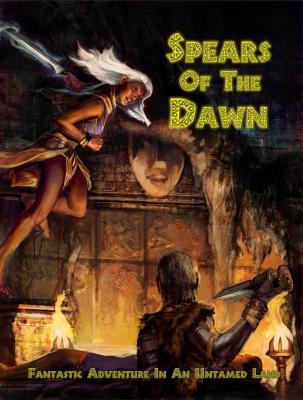
Spears of the Dawn is another small sandbox setting by Kevin Crawford, who also did the excelent Red Tide setting. While Red Tide uses a great number of elements from Chinese and Japanese culture, Spears of the Dawn is strongly based on various cultures of West Aftica. The book consists of roughly three parts: A complete roleplaying game, the Spears of the Dawn campaign setting, and advice on running sandbox games. These are not clearly divided into three section though, and it’s probably best to read the whole thing even if one only intends to use certain elements of it. It’s made clear in the introduction that this book is meant to be mined for ideas and its elements disassembled and repurposed as any GM sees fit. Like Red Tide, it is more of an example of how a great sandbox setting can look like and how you make one.
110293The Setting

The setting presented in Spears of the Dawn are the Three Lands. Two centuries ago the empire of the Nyala was close to conquering all of the other five kingdoms of the Three Lands and when the king of Deshur was forced to retreat with his remaining army into the desert he discovered the means to make himself and his followers into Eternals. The Eternals are powerful undead who neither age, nor need to eat or drink, but maintain their youth and heal any wounds through the eating of human flesh. For over a hundred years the Eternal invaded the lands of the Five Kingdoms and causing the empire to fall apart. Eventually the emperor of Nyala accepted that the other four kingdoms were no longer under his control and instead created an alliance of equals to destroy the Eternals and put an end to the terror of the Sixth Kingdom. The Five Kingdoms where victorious and the Sixth Kingdom no more, but they were unable to destroy all of the Eternals as some of them escaped into the wilderness and continue to exist in hiding to this day. In the fourty years that have passed since then, the fate of the new Five Kingdoms has remained uncertain. There is peace now, but the former subjects of the Nyala still have resentments against their former masters and there are still many bands of raiders and new settlements created by refugees from the war are not always getting along well with their neighbours. The last emperor had anticipated that some of the Eternals might escape from the armies of the Five Kingdoms and created a group of warriors, shamans, and sorcerers called the Spears of the Dawn, who were given the duty to hunt down the remaining Eternals and destroy any lingering trace of their evil. With the empire being no more and Nyala being only one kingdom among others, the Spears of the Dawn lack any real leadership or organization. However, with the threat of the Eternal and other evils still around, there are always more people who take up arms and wander the Five Kingdoms to destroy them. With many elders still remembering the terror of the Eternals well, these warriors against evil are highly respected and stand somewhat outside of the normal tribal politics and regular social classes.

It’s a nice compact setting, though I am feeling a bit ambivalent about the post-colonial character of the Five Kingdoms. I would consider my knowledge of African politics and social issues only slightly above average and tribal affiliations and great class inqualities appear to be indeed an important factor in regional and social conflicts. However, to a large degree these conflicts are the result of the British and French colonial empires and their sudden disappearance that left many regions in administrative chaos. Using contemporary Real-World conflicts as a template for a fictional medieval African-inspired setting seems a bit problematic to me. It’s not exactly a respectful treatment of a cultural region and its people to focus on one of their darkest periods which was primarily caused by outside forces. However, Spears of the Dawn doesn’t reduce the African theme of the setting to only that element and there is a lot more than that. And it isn’t like precolonial Africa was all happy paradise. There has always been as much tribal war and violence, as well as slavery and exploitation of lower social classes in Africa as in all the other continents of the world. When empires fell apart in Europe, the result was always just as ugly. So I am inclined to give this setting a pass in this regard. While I probably would have stayed clear of that aspect myself, the way it is treated here seems pretty well balanced and I think you have to actually know what to look for to notice any real world similarities at all. Continue reading “RPG Review: Spears of the Dawn”
Things I still plan to review

This list is actually getting longer instead of shorter because I constantly forget that I wanted to write reviews for these. Hopefully I get around to do them someday not too far in the future. And if you want to, you can bug me about them still being late. That usually motivates me quite a lot. ;)

  • A Princess of Mars
  • Atlantis: The Second Age
  • Barbarians of Lemuria
  • Conan (Comic)
  • Dark Sun Campaign Setting
  • Death Frost Doom
  • Demon’s Souls
  • Gargoyles
  • Heavenly Sword
  • Hellboy
  • Knights of the Old Republic (Comic)
  • Metal Gear Solid
  • Mirror’s Edge
  • No Salvation for Witches
  • Pitch Black
  • Primeval Thule
  • Red Tide
  • Riddick
  • Seirei no Moribito
  • The Savage Frontier
  • The Witcher 2
  • Thief: The Dark Project
  • Trawn Trilogy

This looks even worse that I thought. oO

Criminal Organizations in the Ancient Lands

When I started collecting lists of all the stuff from other great fantasy settings which I would like to include in my Ancient Lands world, I also made a short list of cool criminal organizations. There are some pretty cool and interesting ones out there, like the Shadow Thieves and Zhentarim, the Dark Brotherhood, Black Sun and Czerka Corporation, the Shadow Broker, and a whole lot of others. But a very important part of good worldbuilding is to keep the whole setting coherent in its premise. And now that I started to really give some thought on the criminal organizations I had floating around as broad outlines, I noticed that most of them really don’t fit this kind of setting.

The Ancient Lands are a world that is primarily wilderness, inhabited by tribal people in small villages with only a few larger cities, which are still relatively small compared to those of other fantasy worlds. Having a Gnome Mafia in such a setting doesn’t really make much sense in such a setting once you start looking a bit closer. Each clan has its own small territory and is effectively controlled by a single extended family that rules without any interference from outside forces. There usually is not even a king and certainly not any state that tells them what they can and can’t do. As long as the minor families don’t revolt, the clan leaders can do whatever they want. At the same time the clans are small enough that the leaders are personally aware of anyone who is stirring up trouble and when someone commits crimes against other people of the clan, the chief can simple have them exiled or executed and that’s the end of it. The chiefs personal croonies might be abusive bullies, but that only makes the chief a tyrant who still is officially in charge.

Which leaves the cities and major towns, but those aren’t actually that big either and there isn’t a lot of them as well. In a city of ten two twenty thousands, you can’t really be building a criminal empire without becoming one of the rulers of the city and spreading out over multiple cities is also not particularly practical. There is also the question of what criminal organizations would do. In a Sword & Sorcery setting the only purpose to smuggle anything would be to avoid taxes, but usually nobody cares what weapons, poisons, and drugs you are selling. And tax evasion isn’t really a terribly villainous crime.

But there are still plenty of people who make money with violence while not being part of the official governments.

Cartel Merchants

In most cities of the Ancient Lands, nobody cares which kind of dangerous goods you can buy at the market or in shops. However, there are some people who care a lot about who may sell which goods or not. If any kind of goods is sufficiently rare, some merchants always try to get a monopoly on them. Be it certain rare drugs, spices, poisons, gems, or other precious materials, usually there’s a small number of rich merchants who control virtually the entire trade with them and they go to very great length to protect their monopolies. These merchants are only losely organized but include those who produce, transport, and sell the goods. Anyone small stores in the cities and towns who are found to sell those goods without getting them from the big merchants who claims the local monopoly on them will quickly be visited by some of his croonies who will make sure it’s not going to happen again.

Smuggling illegal goods by the city guards isn’t really a thing in the Ancient Lands, but secretly circumventing the cartel monopolies can bring just as great profits. However, the price for getting caught is usually much higher as well.

hyboria_hyrkaniansOutlaws

In a tribal society outlaws are not simply people who break the law, but those who have been exiled for whatever reason and cast out whithout the protection of any clan or city. In a world with no courts and no police outside the cities (and even there they are mostly confined to the richest neighbourhoods), the only thing that protects you is the certainty that someone will avenge any crime commited against you. Without a clan to back you up, you’re fate depends entirely on your skill with your weapon. At the same time, nobody can be held responsible for your actions if you commit any crime or cause any damage and you don’t have to worry that anyone else is going to suffer for your offenses. So even people who don’t want to rob or murder you still won’t trust you because there isn’t any reassurance that you will behave. There are really only two possible lives for outlaws, which are becoming a hermit in a place where nobody will find you, or becoming a bandit.

Occasionally warriors down on their luck will try to ambush travelers on the road for a bit of money and food, but outlaw bandits are a whole different class of criminals. These men and women often band together for mutual protection against anyone who might want to rob or enslave them and while many of them have been exiled for some crime commited against their clans, an equally large number were born into these gangs. Even if they have not commited any crimes themselves, nobody believe that these outlaw children could be trusted to be honest and behave either. With almost no other clans or merchants willing to trade with them, bands of outlaws often survive by robbing travelers and caravans on the few roads that cross the vast stretches of uninhabited wilderness of the Ancient Lands. Most of them have their own hidden villages somewhere in the wild, where they keep their loot and their families and slave grow some meager crops and keep a few goats and pigs. Not all outlaw bands are necessarily evil or murderous, but they all know that everyone fears and mistrusts them and don’t take kindly to most strangers. Other outlaws might find a home among them, but all bandits know that they can’t trust anyone, especially each other.

koxinga2Pirates

Pirates are very similar to the outlaw highwaymen that ambush caravans on the roads, but their territory is the sea and the major rivers of the Ancient Lands. Not all pirates are outlaws and many crews are simply warriors of poor clans that are unable to support themselves with whatever resources their homes offer. Coastal and river pirates often make their own small boats which they use to board merchant ships, while sea pirates mostly use ships they have captured from Keyren, Takari, and Mayaka traders. River and coastal pirates defend their territory against competitors as fiercely as highwaymen, but the sea pirates often roam very large stretches of sea for many months and generally avoid fighting with each other. There are several known pirate ports in the islands of Suvanea in the Inner Sea and the outlying islands of Halond to the north, where pirate ships make stops to make repairs, take supplies, and also trade the treasures they captured.

Fences

Both highwaymen and pirates keep a good part of their spoils to bring back home and share with their families, but usually a large amount of the booty consists of things that have relatively little practical value to them. Since they can’t really visit the great markets in the cities and towns without raising questions, they need the help of merchants who don’t have any reservations about trading with thieves and murderers. As the pirates and bandits don’t have a lot of choice where to sell their loot, these goods are often traded well below their actual value, resulting in a huge profit for the merchants. Very often these fences are the same merchants who also control the monopolies on certain goods.

Street Gangs

In the cities and larger towns there are also always some minor criminals who make a living by stealing and robbing people in the streets at night. There is rarely more than a few dozen of them in any place except for the very largest of cities, but often they band together in groups of just a small handful of thieves who each carve out their own territories and drive out any other thieves that might try to compete with them. Too many thieves in any area only make the guards patrol more frequently and keeps rich people off the streets at night, so that’s bad for business. Larger gangs might be able to extort some money from small merchants in the poorer parts of town and in some cities where the guard has no real presence outside the rich neighborhoods they effectively rule the streets themselves. When they get powerful enough it often gets more profitable for them to stop robbing people at night entirely and instead collect a fee from the residents for their service of keeping the streets clear of other gangs or drunk sailors. Such neighborhoods are often actually safer than those which are patrolled by the guards, but only as long as one is paying the local gangs their share. There are rarely more than two or three such large gangs in any major cities, and usually only one in smaller towns. Two gangs in the same town usually don’t last very long.

Bringing prehistoric fantasy worlds to life

Work on my Ancient Lands setting is coming along nicely and not only do I have all the components parts ready, but also got names for almost all of them. Unless you tried building a fictional world and create a compendium of all the main groups, places, and creatures, you won’t believe how terribly difficult that last part is. Making names is easy, making names that are not total garbage and sound completely made up is unbelievably hard work. And it doesn’t get easier when you get to make some 200 of them that are supposed to come from half a dozen different language families.

Now that I know where all the places are, who lives there, what their relationships with each other are, and what kinds of environments and creatures make up the world outside the settlements, the next step is both much more complex, but I think also easier. A fantasy world is not a map with names on it, but it is all about the people who live in that world and how they interact with each other. How do they behave, what do they believe, what to they want, what do they fear, what do they opposose, who has power, of what kind is that power, how do they live, how do they fight? Take the first half hour of Star Wars for example: You don’t know who any of these people are, what those places are you see, and what everything is about. But it’s still a very evocative setting, just from seeing the people interact with the world around them and each other. (Star Wars is also what I consider to be one of the greatest examples of the effective use of archetypes: The moment you see Darth Vader you know exactly what kind of character he is, and the imperial uniforms make it perfectly clear what type of Empire this is. Nobody has to say it, it’s clear because you’ve seen people like these countless times before, and you’re meant to recognize them.) In Fantasy, it is very common to do things the standard way, which means the popular image of the European middle ages. Connor Gormley wrote some interesting thoughts on why this isn’t necessarily a bad thing at Black Gate a while ago. But the Ancient Lands is specifically meant to not evoke images of a medieval world, but instead aims to feel prehistoric. The reason I think it’s also easier than chosing the elements that you want to put into your world is that from this point on you’re actually staring to thing of people and events and the possibilities now are based on the things you already have in place and don’t come purely from a vacuum.

The idea of a “prehistoric time” is a bit blurry. Originall the term refered to the periods of human civilization and culture from which we have no historic records. Only archeological finds and reports from later times, but no documents in which those people wrote down what happened during their own time. The “historic period”, as least as far as Europe, the Mediterranean, and Mesopotamia are concerned, is generally divided into Antiquity, the Middle Ages, and Modernity (which really just mean old age, middle age, and current age), while the “prehistoric period” is split up into the Stone Age, Bronze Age, and Iron Age. Antiquity is generally considered to start with the rise of the classical Greek civilization around the 5th century BC. (Which is convenient, as Antiquity also ends around 500 AD and the Middle Ages last to about 1500 AD, making it easy to remember.) It was a reasonably good idea to classify past human civilizations, but by now we know how to read Egyptian, Akadian, and Hittite and those people wrote quite a lot, so that we now have a lot of historic documents from the Bronze Age. So technically, it’s not really “prehistoric” anymore. But really, the main concern here is fantasy fiction, so when I use the term prehistoric, I mean the Stone Age, Bronze Age, and Iron Age. But even those terms are not perfect, as different parts of the world developed different technologies at different times or skipped some entirely. Southern Africa went straight from the Stone Age to the Iron Age, and it would be completely justified to say that people in Central America went straight from the stone Age to Modernity, skipping four of the six perioids completely.

And when I say “Stone Age”, I particularly mean the Late Stone Age, or Neolithic. Neolithic people didn’t have metal technology, but they were a far shot from being cave men. The Neolithic begins with the development and rise of agriculture, when people stopped wandering around hunting for food, but settled down in farming communities. And those could get quite sophisticated, with the Inca and Aztecs being great examples of how much you can do without metal technology. Conveniently for us, the move towards agriculture took place about 8,000 BC, which means from the start of human civilization to now it has been roughly 10,000 years. Always a good guideline for considering how much time passes between different periods in your fictional world.

Continue reading “Bringing prehistoric fantasy worlds to life”

Voting for Gemmell Awards has opened (last week)

With all the feather ruffling about the Hugo Awards and the mud slinging and bitch slapping about what the awards should stand for, I mentioned at Black Gate that the people who want space adventure books over socially thoughtful science fiction could simply make their own award without getting into indignified fights with the Hugo people. For example there have been the Gemmell Legend, Morningstar, and Ravenheart Awards for heroic fantasy for a few years, which to my knowledge have been very well received by fans of this type of fantasy.

And as someone has pointed out to me, the voting phase for this years Gemmell awards has just opened. You can just go here and vote for the works you enjoyed the most. Unfortunately, I have to admit that I haven’t read any of those on the lists, as I don’t really read a lot and most of it are old classics.

Though I am currently reading Blood of Elves, which I didn’t know got the first Legend award in 2009. (Even though the Polish version had been released 15 years earlier, but whatever. It’s a really cool book.)

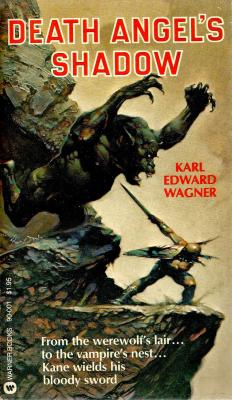
Book Review: Death Angel’s Shadow

I think I first read about Karl Wagners Kane a few months ago at Black Gate, and I thought it sounded very interesting. Stories of a true anti-hero whom many consider to be a monster, who is both a great swordsmen and very powerful sorcerer, yet still a character of great depths and deep reflection. I’ve read the story Undertow in The Sword & Sorcery Anthology and while not great, ot really made me want to read more of Kane.

Death Angel's Shadow
Death Angel’s Shadow

So I picked up Death Angel’s Shadow, which is the first collection of Kane stories I am aware of, but that doesn’t have to mean that these are also the first written ones, and I believe they actually are not. So who is this Kane? He is a very muscular and skilled swordsmen, but that is where the similarities with Conan already end. Both Kane and Wagners writing are a very different story from Howards classic barbarian hero and his countless imitations.

Kane was not a man easily mistaken for another. His red hair and fair complexion, his powerful bearlike frame set him apart from the native Chrosanthians in a region where racial features leaned to dark hair and lean wiriness. And his rather coarse features and huge sinewed hands did not make him too exceptional from the mercenaries displaced from the cold lands far to the south. It was his eyes that banded him as an outsider. No man looked into Kane’s eyes and forgott them. Cold blue eyes in which lurked the wild gleam of insanity, hellish fires of crazed destruction and bloodshed. The look of death. Eyes of a born killer.

Kane is an immortal who has traveled the Earth for countless centuries, cursed by ancient gods to never find any peace in death. He is a great warrior, but also a very powerful sorcerer and through the centuries has ruled over many different lands and made his name known throughout most of the world as a tyrant, conqueror, and bandit. He is a man who is feared, and expects to be feared, and has no illusions or guilt about the death and attrocities he brought upon the world. Yet what we see of Kane, at least in this book, is not a mindless raging killer, but a man of many different aspects. Continue reading “Book Review: Death Angel’s Shadow”