A simple mechanic to assemble a posse

The Old World is a setting in which money and treasure plays only a minor role as there just isn’t a lot you could buy with it. In a campaign, even the best types of armor are trivially cheap while magical objects are valuable beyond measure and not something that can be bought or sold. And since most trade takes the form of barter, there aren’t really many coins around to begin with. It’s a world that runs on obligations, favors, and debts. It makes little sense to track the contents of the PC’s purses in such a campaign.

However, there is one aspect of playing a B/X style campaign that I very much like, but which falls through the gaps when you have no money, and this is the hiring of mercenaries. When numbers and tactics matter much more than individual armor class, hit points, and attack bonus, being able to bring a bunch of archers and spearmen to a fight makes a huge difference. And I am a big fan of the Combat is War approach to battles in RPGs. It’s not about showing your personal abilities, but about making the fight as unfairly tipped in your favor as possible. Any good battle is won before the fighting even starts. (Of course this would be boring, but players always have limitless potential to plan really badly, which then makes it all the more exciting when they suddenly have to improvise.)

Hiring such reinforcements doesn’t really work in a game where there is no money. But you can still always assemble a posse.
the_militia_by_pervandr-d46r27s

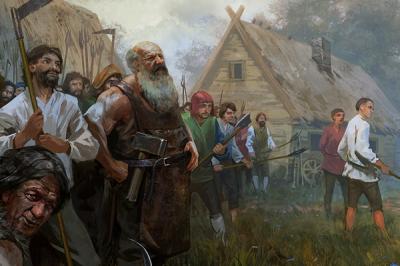
In an Old World campaign, most adventures take place in villages or small towns where the PCs are staying in the home of the local chief to help reinforce his warriors for the protection of the community. These settlements are always very Wild West in character and all of them have numerous people who have weapons and know how to fight. If the players need additional manpower to drive bandits from the area or bring down a dangerous beast that has been seen nearby, there’s always a pool of potential helpers. The players might either ask the chief to give them some of his men as backup to protect the village, or they can make a call for volunteers in the great hall or the main square. Either way, the outcome is the same.

I am always a fan of making sub-systems as simple and easy to remember as possible and making them well integrated with the already existing rules. So this really isn’t anything particularly fancy or special beyond the initial idea.

To gather a posse, one character in the group rolls 2d6 and adds his Charisma modifier to the roll. Using the LotFP rules, I am also adding the character’s attack bonus to the roll, but for other systems you can add the character’s level for fighters and half the character’s level for any other class. This reflects that more people will be willing to go into combat behind a leader who knows what he’s doing when it comes to fighting.

The result of the roll is the number of level 0 NPCs who come forward as volunteers, or are ordered by their chief. If the posse is gathered to defend the community from an immenent attack, or to hunt down a particularly vicious criminal, the number might be doubled. However, the number should usually not exceed 10% of the total population of the community. (Any major NPC who has a personal interest in the PCs plan might also come along.)

The base Morale score for the posse is 7, modified by the Charisma modifier of the leading PC. If the warriors are fighting for the safety of their homes, Morale can be increased by +1 or +2. If the party leads the posse into seemingly suicidal situations or attempts a needlessly reckless plan, an apropriate penalty to Morale should apply.

The posse is gathered only for one specific task. Once the task has been acomplished or resulted in a failure, it will disband and the warriors return home. If at the end of the task the players want to continue to a new task, a new recruitment roll has to be made. (Obviously a higher result than the current number of warriors will not make the posse increase beyond its current size.)
The true origin of alignment?

I never made a secret of my opinion that the introduction of alignment in Dungeons & Dragons was one of the biggest mistakes ever made in the history of RPGs and that we’re all suffering from it to this day.

A few years ago I made an attempt to find out what alignment was originally meant to represent, since you probably won’t find any two rulebooks that agree on this rather important question. In the Original D&D game, alignment is just there without any comment or information what it means and what it is for. Holmes Basic and Moldvay Basic remained very fuzzy about what it means and AD&D didn’t really clear up anything either. This is where my research ended, assuming that alignment had just been thrown in at an afterthought because Michael Moorcock had it in his stories and it was cool. But as far as the evidence went, there had never been a clear concept of alignment. Only the interpretation of people who were just as baffled by the terms as all the other players.

But today I came across this interesting quote, which was apparently written by Dave Arneson himself.

We began without the multitude of character classes and three alignments that exists today. I felt that as a team working towards common goals there would be it was all pretty straight forward. Wrong!

“Give me my sword back!” “Nah your old character is dead, it’s mine now!”

Well I couldn’t really make him give it to the new character. But then came the treasure question. The Thieves question. Finally there were the two new guys. One decided that there was no reason to share the goodies. Since there was no one else around and a +3 for rear attacks . . .. well . . Of course everyone actually KNEW what had happened, especially the target.

After a great deal of discussion . . . yes let us call it “discussion” the culprit promised to make amends. He, and his associate did. The next time the orcs attacked the two opened the door and let the Orcs in. They shared the loot and fled North to the lands of the EGG OF COOT. (Sigh)

We now had alignment. Spells to detect alignment, and rules forbidding actions not allowed by ones alignment. Actually not as much fun as not knowing. Chuck and John had a great time being the ‘official’ evil players. They would draw up adventures to trap the others (under my supervision) and otherwise make trouble.

Finally, finally! there appears to be an explanation of what alignment was supposed to be and what it was created for. A very simple “stop fighting each other and play as a team!” It didn’t work and the creator himself admits that it was a mistake.

Why it ended up in the eventually published product anyway, I really do not know. But we’re still having regular “Should the Paladin fall Mondays” all over the internet to this very day.

Unified spaceship weapons for Star Wars d6

As much as I like the D6 system and its approach to space combat, the weapons that they put on the ships for Star Wars are total chaos. Terms are used completely inconsistently even though the stats are generally pretty consistent. About 90% of the time. And then occasionally you run into a gun that has the same range in “space units” as regular other guns of that type but 20 times as much range in “atmosphere units” for no reason at all. Since I am a huge fan of consistency, I made the following list of standard guns found on the vast majority of ships. Continue reading “Unified spaceship weapons for Star Wars d6”

The key to great monster design?

One of my favorite parts about roleplaying game is the creation of new monsters. Sometimes you look at a monster and think “I want to do something just as great”, but since there are already literally thousands of fictional creatures that have been made up by writers in the past 100 years, it always seems very difficult to come up with something that doesn’t look like an almost-copy of something else.

I’ve been looking over a lot of monsters from RPG monster books, videogames, and movies over the last years and found that really outstanding monsters are no accidents. If a monster becomes popular with fans or even a famous part of culture is not entirely up to luck and there are some things they pretty much all have in common and do not actually require being a creative genius.

The first discovery I made is that great monsters are never about their looks or their abilities, but about their behavior. Perhaps let’s call this Yora’s First Law of Monsters: “Monster behavior is more important than appearance or powers.” Yes, the alien from Alien looks really cool and it certainly helps for making it famous, but what makes it so great in the movies is not what it can do, but how it acts. The actual powers are not very interesting at all. It is fast, kills with a bite, and its blood is acid. As monster abilities go, that is very basic and even rather bland. It becomes a great monster because of the way in which the characters of the movies interact with it. It climbs on ceilings, sneaks around silently, and waits in the dark for the perfect opportunity to strike. It doesn’t actually fight very well and is quite easily killed in a direct confrontation. But it doesn’t allow you to face it in a direct confrontation and that’s what makes all the difference.

Going through some Dungeons & Dragons monster books again yesterday, I discovered Yora’s Second Law of Monsters: “Great monsters have a backstory.” With monsters in movies and novels, a great part of the plot is about revealing the story behind the monster and discovering its origin. It’s not very pronounced in Alien, but it’s still there. The eggs in the derilict ship, the dead pilot, the attack on Kane, and the eventual emergence of the alien are all clues that are hinting on the creature to be much more than just a regular alien animal. Someone once transported a whole shipload of those eggs and must have been aware of what they are, but was still unable to contain the threat. That hints at something more going on and that in turn makes the creature itself much more interesting. At the Mountains of Madness introduced two of Lovecrafts most famous creatures, and it’s really all a big mystery story about revealing their parts in a much larger picture. A a counter example, Robert Howard had Conan fight a lot of big dangerous monsters in his stories, but none of them ever really made it big. They are just scary looking things with teeth and slimy tentacles. They work for the stories, but they don’t inspire at all. Worms of the Earth is often mentioned as one of his best stories and the worms work well for the plot, but it doesn’t really seem as if there would be much more to them than that. One creature that Howard created did make it big. The serpentmen from Kull. The yuan ti from Dungeons & Dragons and the naga from Warcraft are among my favorite monsters, but they are really just remakes of Howards serpentmen. Other than taking the shape of humans with the lower body of a snake, they have almost nothing in common with the creature from Asian myth. And what makes the serpentmen different from most other monsters Howard created? They have a backstory. They have goals, they have motivations, and they are integrated in the history of the world.

This seems particularly important to me when creating new monsters for roleplaying games. When you read through monster books, the vast majority of the creatures are just very bland. They have an appearance, some abilities, and very often that is it. Two sentences about the kind of environment in which they live does not suffice to make them cool or interesting. Because there’s no plot hooks in that. What are you supposed to do with a big flying white snake that makes ordinary objects come to life? It has a look, it has powers, but what does it do? When it comes to having players confront a monster in a game, I made the observation that very often reputation makes a huge difference. A telepathic monster that can stun people with its mind might be interesting and challenging to fight. But that’s usually nothing compared to “Holy Shit! It’s a mind flayer! We’re so screwed…” Surprising the players with something completely unexpected is nice sometimes, but just as often you’re getting a lot of excitement if the players are already aware of the creatures reputation. If you create a new creature that is yet unknown, try to put a lot of hints about what it can do and make the other people of the game world be terribly afraid of it. Nobody is going to get super exited about the news that there is a pack of weird critters at the edge of the village that is known as a nuisance. Have the villagers get into a total panic because they have heard many stories about the creature and they don’t believe anyone could possibly save them. That is going to get the players a lot more excited as well.

Idols for Sword & Sorcery BECMI

Reading in the Dungeons & Dragons Rules Cylopedia today, I got reminded of the relics again, which had been introduced in the Companion Set. In B/X and BECMI, only humans can take the cleric and thief classes. All dwarf and halfling characters and NPCs have the abilities of fighters and all elves the abilities of both fighters and magic-users. AD&D made the concession that these demihuman races can have NPC clerics, but in the Basic and Expert sets they have no access to cleric magic at all. To get them access to healing magic and protection against undead, the Companion Set introduced the relics. For the elves, the relic is a Tree of Life, for the dwarves it’s a magic force, and for the halflings a magic fire bowl.

Each relic has a single keeper, who is a regular NPC of that race, but who has access to special powers provided by the relic. He is able to cast spells that heal wounds, cure blindness and disease, neutralize poisons, and identify magic items. In addition to that, the relic is constantly using the Turn Undead ability of a 15th level cleric with a radius of 360 feet. Which is powerful to turn everything except for lichs and instantly destroys everything up to and including vampires. The keeper can use the spells almost unlimited, but every time he does the radius of the Turn Undead area shrinks by 5 feet and only returns by 5 feet per day. So the keeper has a very strong incentive to always try to keep the power of the relic close to its maximum and not cast cure serious wounds on every little bruise.

151217For my Ancient Lands setting I’ve never been happy with clerics, as their abilities really don’t fit as stand-ins for tribal shamans at all. Keepers are a totally different story though. They recieve their powers from a specifc object tied to a specific place, which serves as a conduit for divine powers. And it has a strong resemblance to many animistic religions and traditions. In the technical terms of antropology, the relics are idols. They are physical objects in which the divine force resides and which priests and worshipers visit in person to communicate with the deity. It is a temporary or permanent home of the deity and in some cases it’s actual body. I belive even in Greek religion it was believed that the deity is actually present in the statue that represents it in its temple. In other places, these idols are natural features, like mountains, springs, or unusual large trees or rocks.

In the RC, all elven relics are Trees of Life and all dwarven relics forges, and they all grant the same spells to their keepers. But that really doesn’t have to be that way. Not only can you easily change the appearance of each relic, you can also easily add a few more spells to their reportoire. Also, the Turn Undead effect could be replaced with a different power that is permanently active. The wonderful thing about it is, that it works at every level. It works for a small village shrine that simply has an idol for the spirit of the lake that lies next to it, and you can also have an idol inside a huge temple within a large city, which channels the divine power of the sun to the high priests. By chosing different appearances and powers for each idol, every local cult becomes unique and can have quite different means to protect itself against harm. Instead of a Turn Undead aura, the keeper could be given the ability to raise ring of growth of plants with a 360 feet radius around the idol, to raise and lower an impenetrable wall of briars as it is needed. You could have a shrine in a fortress that constantly puts a bless spell on any defenders on its walls. An a deranged cult that worships a horrific entity from the Underworld might have an idol that utterly defies description. In wilderness locations, an idol could take the form of a magic spring, a waterfall, or a giant tree. Or really anything you can imagine.

I think these idols probably work best if you don’t have any cleric characters at all in the setting. I personally would allow mages to learn cure light wounds as a 2nd level spell and neutralize poison as a 4th level spell, since player characters tend to get into trouble far away from any settlement and you generally don’t want to have the party constantly commuting back and forth during adventures. But any other cleric spells, like restoration, cure blindness, and raise dead, should only be available as miracles granted by the gods if a ritual is performed before their idol. And since most of these gods would just be relatively minor spirits of the land, not even all of them might be able to perform all of these. To raise someone from death, it wouldn’t be out of place to have the party travel to visit the archdruid at the oldest tree in the heart of the forest, or to descent into the Underworld to find an ancient shrine where a powerful demon is being held imprisoned.

Starting at high Hit Points

One peculiar thing about Dungeons & Dragons, and especially in the older editions, is that characters at first and second level are extremely fragile because they have very little hit points and even a single hit by a pretty minor foe can easily lead to instant death, even if the character had been uninjured. A common reason I’ve seen people give for this is the idea of “Zero to Hero”, where you start as an absolute nobody with no skill at all and have to work your way up to become someone. But at some closer examination, that is not really the case. First level fighters are already elite warriors who are standing well above all regular soldiers, mercenaries, bandits, and other professional full-time warriors, many of which have been at that job for years or decades. Except for commanders, all soldiers in B/X or AD&D are simply “Normal Men” or “0 level men-at-atms”. A first level fighter has a better chance to hit, better saving throws, and also has a Constitution score that can get him additional hit points. You’re not a nobody, you’re already starting as someone who has come farther than all regular people will ever get.

As characters go from 1st to 2nd level, their average hit points double, and depending on how your dice fell, they might even tripple. Yet enemies are still dealing pretty much the same damage, so that is a huge jump in your odds to survive. In some recent games, like Barbarians of Lemuria, Dragon Age, and Atlantis, hit points for starting characters are handled quite differently. You start at a pretty decent number but then increase your maximum number of hit points only at a relatively modest pace. I wonder how that would change D&D?

One simple idea would be to reduce the type of hit die by one step for each class and then give all characters a number of bonus hit points equal to twice the maximum hit die result. An AD&D thief would start with 8+1d4 hp (9-12) instead of 1d6 hp (1-6) and a figher with 16+1d8 hp (17-24) instead of 1d10 hp (1-10). If you leave the amount of damage dealt by enemies unchanged this should change gameplay at lower levels quite significantly. Ignoring healing spells and potions (which 1st level parties would have almost no access to), staying power would increase about an average of four times. As you go to higher levels, that initial boost becomes increasingly less significant and you probably wouldn’t notice the difference between 9d10 hp (average 50) and 9d8+16 hp (average 56). If survival at low levels becomes significantly easier and groups can take on much larger numbers of enemies, but you got almost no difference at higher levels, it also quite likely would change the perception of how high-level play becomes either easier or harder.

However, that would mean that 1st level characters are able to deal with much larger numbers of low-level monsters at once, and I am not sure if I’d want them to be that heroic. One solution would be to also give all the monsters bonus hit points. Perhaps equal to the maximum result of one hit die (8). That would mean one on one fights are unlikely to end at the first hit and usually take two or three to win. This would be closer to what the games I mentioned above are doing.

I’d really like to try that out and see what happens.