I’ve been playing RPGs for almost 20 years now, most of it as a gamemaster. And the one thing that has always bothered me the most, with every single campaign, was to find a way to get the first couple of adventures going in a way that doesn’t feel terribly implausible and forced. When a new campaign starts and the characters are more or less blank canvases, your only practical options are having a dungeon sitting right outside town and the players checking it out because they know that’s what they are supposed to, or to have a random stranger approach them and offer payment for getting a thing or rescuing someone. It just really doesn’t feel believable that people would trust this to unknown vagabonds instead of joining forces with others from the community. It is more reasonable at higher levels, but 1st level PCs are not much more capable than a posse with spears and bows led by a halfway capable leader.
I think to some degree, this is a personal problem. It’s something nobody else ever seems to worry about and players are completely happy to run with when they are dropped into a new campaign. But it always bothers me a lot and I feel it’s the primary reason why it always takes me so long to get a new campaign started.
But after all this time, I finally got the solution. And it’s really stupidly simple.
The characters may be more or less blank slates at the start of the campaign and completely new to the area they know nothing about yet, but that doesn’t mean they had no existence before the start of the campaign. Even if the players don’t know about them, the characters will have friends, relatives, and acquaintences outside their nondescriptive native villages.
It makes little sense to try to get help with very sensitive things from random strangers of dubious appearance. But things change completely when they come with personal recommendation. The letter from a distant relative might be a bit cliched, and I wouldn’t use it myself. But you can very well have the party arrive in a random, looking for a place to rest while making new plans, and randomly meeting people from their previous life. And these might just be the people who right now happen to need some tough and smart guys to help with a serious problem. To them, seeing their old pals showing up out of the blue at just this moment, would be a blessing from the gods.
I don’t know why I never thought of this before. It’s terribly simple, but compared to most generic low-level adventure hooks it’s amazingly elegant. The best thing about this is that it should work with every adventure ever written. You can always insert a minor NPCs whose only role is to introduce the quest starter to the players.
I really wish I had thought of this 15 years ago.
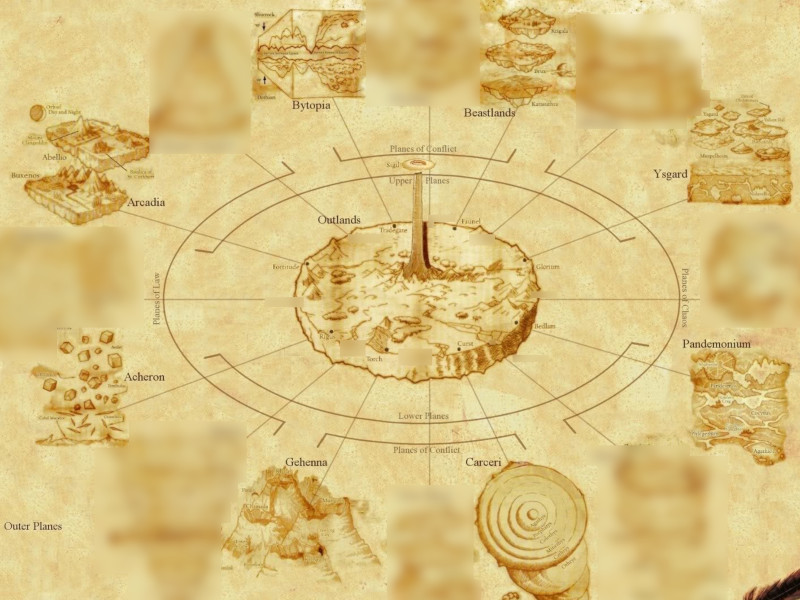 I admit, Bytopia and Arcadia still look pretty bland and boring in the Lawful Good corner. But then, I don’t think Celestia and Elysium ever did any better. But I do think that you could do something interesting with players having to do errands in Arcadia and the place feeling slightly too lawful for being balanced in its lawful goodness. After all, this is where the Harmonium has its main base, and these berks aren’t quite known for their politeness and ompassion.
 Hemra
Hemra

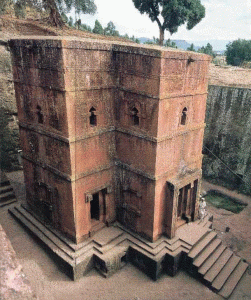

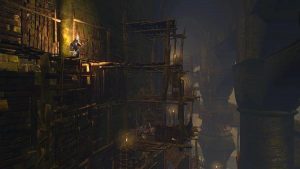
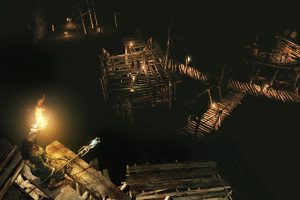 The floorplan consists of 29 vaults that are 30 x 30 meters at the base and between 120 to 180 meters in height. To not go insane with the maps, the platforms and bridges are arranged into 5 levels. To hold up the roof, there are also 4 solid “towers” of 30 x 30 meters in the corners, which have 10 internal levels of rooms, and 4 in the center of the building that have 12 levels.