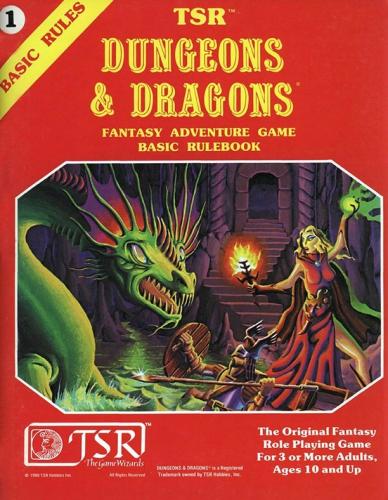
Back when I finished the Inixon campaign half a year ago, I wrote that I am done with Dungeons & Dragons and that it just isn’t what I am looking for in a game. I neither like the baggage of assumptions about the world that players bring to a new campaign (to no fault of their own), nor the encounter and XP treadmill. But even back then, I did leave myself a door open that I wouldn’t rule out running a game using some variant or another of the Basic/Expert edition. The mechanical problems are mostly something specific to the d20 system that no tweaks and overhauls ever manged (or even tried) to solve, and the worldbuilding baggage comes from the AD&D tradition. When I actually read B/X for the first time six years ago, the thing that stuck out to me the most was how different it all felt from all the D&D I had known.
When I was taking a break from the whole Bronze Age and Sword & Sorcery fantasy for a while, I always knew that I would be coming back to it. Do something that feels more like Conan and Elric than my last campaign, with stronger influences from Morrowind and Barsoom. My plan was to either go with Barbarians of Lemuria or some kind of PtbA hack. But here I am, and that thing is starting at me again.
While many people have tried writing long, expansive pieces about advanced techniques to run games and improve your gamemaster abilities, most of the best and most useful suggestions actually seem to come from very short posts. They are things that are so simply that there just isn’t much to say about them and no real point in elaborating on them with complex examples.
The rooms tend to start with a brief descriptor like “crammed storeroom” or “cluttered library.” I like this sort of overloaded room title stuff. It orients the DM immediately to the type of room to come and puts them in the right frame of mind to receive the description information following. You’re already thinking about a cluttered library and imagining it when you start to scan the description and I believe that helps to leverage the description to more than it is.
Boom. What an insight! I’m probably not the only person who reads tenfootpole but never buys any published adventures. That dude knowns how to build adventures, because he keeps reading and reviewing hundreds of them even though almost all turn out to be pretty terrible. And I think he’s exactly right on this one:
Start the description of a new room with “This is a [adjective] [room].” and then point out the interesting and relevant features.
This is stupidly simple to the point of being trivial. But if it were obvious, then everyone would already be doing it, and it would be in the GM section of every RPG. But it’s not. There are so many examples both in published adventures and written advice for new GMs in which the GM goes down a long list of details that obvious make a room a kitchen, while going out of his way to mention the word kitchen. And then the players are supposed to go “Oh, I think this might be a kitchen” and the GM can smile smugly and say “It looks to you like it could be.” This whole exercise is pointless. It accomplishes nothing. All that it does is provide more noise to drown out the signal. It’s not like players stop caring after three sentences of description. It’s simply that the average human brain can only process so much verbal information to construct a mental image from it. As a GM, you have a limited capacity for information that you can communicate in a description of a room or NPCs. You want to get as much useful information into that as you can and not waste anything on useless data. A good description should have as positive a signal to noise ratio as you can get.
Starting a description with an evocative adjective is perfect for that purpose. That one adjective provides a context for everything that comes after it. If I begin the description of a kitchen with being “filthy”, then the players will envision every knife, pot, and plate that I mention to be grimy and dirty and covered in who knows what without having to waste more of my precious limited words. By establishing a general tone for the room first, the players are able to imagine an appropriate space to which they can then add any further features that will be mentioned. Listing all the important features first and then trying to establish an overall feel and tone for the whole scene in front of the player will require me to wax on poetically for much longer than simply using a single good adjective at the very start.
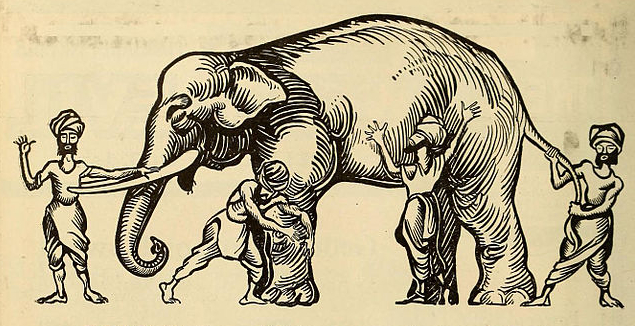
What you don’t want is to get six disconnected features that the players all have to hold in their mind and then bring together into a single image. Instead of blind people describing the part of an elephant they are touching, begin your description with the big picture and zoom in. Start with a terrifying giant beast charging at you, then bother with mentioning its grey skin, huge head, and giant tusks.
It’s generally frowned upon in RPG circles to describe things to players in ways that mention how the PCs feel or what they do. (Which still doesn’t stop this from happening way to often.) And while this is generally right, you can go too far and be needlessly obtuse. Yes, evocative adjectives generally include some kind of qualitative judgement. When you call something filthy, overcrowded, cramped, or lavish, this can be a subjective opinion. But to a large extend, such things are not particularly controversial to say. There generally is a pretty good consensus about these things, so using them in discrptions for what the characters see does not intrude on the players’ agency to a meaningful extend. Telling the players “This is a filthy kitchen” is a very different thing from telling them “This kitchen is so filthy that it makes you feel nauseous and wanting to turn away in disgust.” Players might envision their characters as someone who is unaffected by filth and gore or feels offended more than disgusted. But even in those situations, the characters probably would not dispute that the place is filthy. Stick to adjectives that describe what is materially present, rather than feeling, and you should be fine. “Filthy” describes the room. “Disgusting” is more descriptive of the observer.
What I really like about this method is how stupidly simple it is. When you plan out a location and make notes for the individual rooms, you can put the primary adjective right into the description. Don’t label it as the “kitchen” but as the “filthy kitchen”. And when it comes to the players reaching the room and you pull out your notes to tell them what they see, simply start with reading out the name of the room. “This is a filthy kitchen.” I don’t think there’s any other method to describe rooms, people, or important object that gives you this much payoff from just a single word.
After I had my initial idea that Night City with its districts and gangs could be an interesting setting for an alternative Blades in the Dark game, I soon decided that I’d actually rather run something more along the lines of Apocalypse World. Blades’ system of fighting for turf really only makes sense if you want to play aspiring crime bosses, but doesn’t fit for parties who simply want to secure their neighborhood or megabuilding. Apocalypse World is in many ways based around the idea of the players establishing themselves as a powerful force in a post-apocalyptic wasteland, even though it doesn’t say so outright, which I think is a better approach for up and coming lowlifes in a cyberpunk city.
And after several days of fiddling around with Apocalypse World to replace the psychic powers with a hacking system, I discovered that someone else had already done something similar many years ago, and turned it into a full game and a proper book.
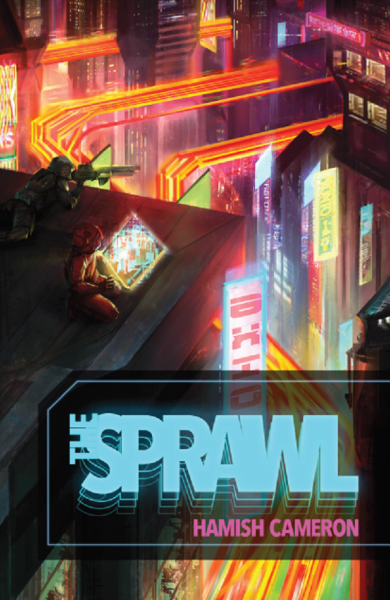
If you are familiar with Apocalypse World, then The Sprawl immediately shows that it’s a very close descendant. There are of course many different games that use the underlying dice mechanic and principles of Apocalypse World, but this game is much closer to the first game that started it all than for example Dungeon World or Blades in the Dark. The Sprawl is the first other game I’ve seen that retains most of the basic moves from Apocalypse World mostly as they are. The names have been changed to a style that (the author assumes) have a more cyberpunk feel, but you still have the Go Aggro and Seize by Force moves that make conflict scenes in Apocalypse World so unique. The playbooks for different character types are all completely different from those in Apocalypse World, and while I think the Hardholder and Chopper could have been really fun in a cyberpunk setting, the ten playbooks of The Sprawl really cover all the character archetypes you could ask for in a cyberpunk game very well.
The Sprawl seems to be particularly well suited for a game set in Night City and I’ve seen people even describe it as an unofficial PtbA version of Cyberpunk 2020. The names are different, but it does have playbooks to play a Ripperdock, Media, or even Rockerboy. I looked at the new Cyberpunk Red once and was immediately “yeah, no thanks”. Even though I find the setting quite compelling (as genetic cyberpunk as it is), I really am way past the point where I want to deal with a four page flowchart to get all my little +1s here and +2s there. Those things don’t help getting invested in the story and spontaneous going with the flow of a chaotic action scene. They do the opposite. PtbA rules really are the way to go for the kinds of games that I actually have an interest to run.
Unfortunately, The Sprawl suffers from the same problem that almost all PtbA games seem to have. The bad example set by Apocalypse World that has been slavishly copied by anyone else. The game attempts to make the rules filled with style by using elaborate slang everywhere it can when a normal, self-explaining word would have done the job. I don’t know why the mechanic for hoping that an ambulance reaches you before you die is called “Acquire Agricultural Property”. Apparently it’s a joke on “Buying the Farm”, but I am a German fluent in English. I don’t know what that expressions means either, or what it has to do with dying. How am I supposed to explain this rules to players who are just as clueless? It’s only the most annoying example, but the issue is persistent throughout the whole book. Which, when you are trying to explain a very unconventional game system that is completely different from mainstream games, is bad!
One thing that I’ve seen people criticize rightfully is that The Sprawl presents a system for doing jobs for hire and does it in a way that implies that all the game will ever be is “Mister Johnson of the Week”. Get a job, prepare for the job, do the job, get paid for the job. And repeat until everyone gets too bored to continue. That seems like a good system for a couple of casual one-shots, but not for an ongoing campaign. But the mechanics as written actually work for a much wider scope than this. Since the real currency in The Sprawl is not money but reputation, there’s nothing stopping the PCs from giving them “jobs” themselves, or doing something for others for free. And almost all roleplaying adventures in any genres consist of an initial investigation followed by an infiltration. Looking for a friend who’s been having trouble with a gang really is no different from being hired to look for someone else’s friend who’s been having trouble with a gang. The PCs still pull of the same heroic and leave behind the same chaos in their wake, so their street cred should be affected the same way too. Calling the first and last phases of the cycle “get the job” and “get paid” creates the false illusion that it’s really about the exchange of currency. Which it is not. I think that The Sprawl is actually much more versatile than it Mission Structure falsely implies. Because as I said, even in a sandbox campaign, you always have the same cycle of establishing what the PCs want to do, preparing for it, doing it, and then raking in the spoils. To run The Sprawl as an open-world sandbox, one does not really need to make any changes to the rules. All it takes is a more open approach of what fiction the mechanics can represent. It only happens rarely, but The Sprawl is one of the very few games that I read and want to run as they written, without immediately having a number of house rules in mind before I’ve reached the end.
One thing that has always been left very unclear about Vampire: The Masquerade (maybe in part deliberately) is the question of the scale at which the vampire society of a given domain exists. To some degree, the concept of the World of Darkness is pulling in two opposing directions. On the one hand, the game has for a very long time been promoted as “a game of personal horror”. Horror is inherently dependent on a sense of isolation and vulnerability, and the rulebooks make it clear throughout all editions that vampires are generally solitary loners who usually don’t want to have much to do with each other. But on the other hand, it’s also really big on the concept of Clans as interconnected organizations in conflict both with each other and among themselves in a global struggle that spans centuries. And on top of that are even older vampires that hide in the shadows and pull the strings of hundreds of unwitting pawns who consider themselves to be the lords of the night. So what is it? Bleak isolation or tightly knit families?
The Camarilla consists of seven clans, and while not every city would need to have a strong presence of all seven, I think most players and GMs would want to have all of them represented in their campaigns to t least make them options for player characters. Then each clan also has elders of the 7th or 8th generation, while the default generation for PCs is 13th, which are the most common vampires. And there’s also a growing number of vampires of the 14th and 15th generation in recent decades. That means that clan would have members of 6 to 9 different generations. Even if you have only one vampire per generation per clan, you’re already starting with about 50 vampires. That is a pretty large community.
Population Sizes
Quite early on, a rough estimate was mentioned that the Camarilla considers 1 vampire per 100,000 humans a good number to not cause any occasional killings by vampires to raise suspicion or interest. The number is widely dismissed as not being really based on anything, but it’s the only number there is. Combine it with 50 vampires that inhabit a domain, and you would need an urban area of 5 million humans. (City borders are a human administration thing, vampires only care where the rural country side starts.) And when you look at the US, Canada, and Mexico, where most of the published material for the game is set, you get 11 urban areas that lie above that number (in the mid 2010s). For smaller vampire communities of 20 to 50 vampires, you get another 20 domains. That actually seems pretty workable.
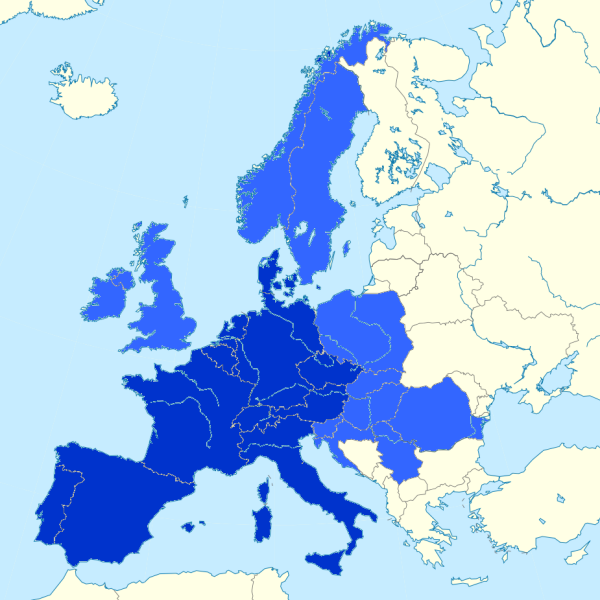
“Europe”: The dark blue area has a similar population to the United States. The light blue area is similar to Canada and Mexico together.
However, things get wonky when you apply the same assumptions to Europe. As it turns out, the population in Europe is more evenly spread out. Even though the balance between urban and rural population is about the same (~80/20), European countries tend to have more mid-sized cities instead of a few giant ones. In an area with a comparable population of humans, there are only 5 urban areas that pass the 5 million people mark, and another 14 above the 2 million people mark. That would mean that America could maintain +50% more vampire communities of at least 20 vampires, and more than twice as many communities of at least 50 vampires. And with the Cainites having been established in Europe ten times longer than in North America, that just feels wrong. Europe should be the heart of the Western Vampire World.
However, there is another important difference. As the saying goes “In Europe, a hundred miles is a long distance. In America, a hundred years are a long time”. The area from England, through the Low Countries, Western Germany, and to Northern Italy has a population like the US East Coast but at only a third the length. Getting from one major city to another can be a lot quicker than getting from the outskirts to the city center during high traffic in a lot of places. I think for campaigns set in Europe, there needs to be a different image of what the domain of a prince looks like. Instead, you could have domains consisting of dozens of smaller cities that all can support only one or two vampires each. Or a prince who holds dominion of four cities that are each home to half a dozen vampires. In the most densely inhabited areas, there is very little empty space that could truly be considered rural by American standards.
Age Distribution
Another interesting topic is the matter of generations. As the books explain, when the vampires decided to go into hiding and disappear from the human world at the end of the Middle Ages, it became a necessity to move to the cities, where more people would be out on the streets after night, and stories of attacks and death seen as nothing that unusual. While a vampire can easily survive by feeding on just a few dozen humans, doing so without ever noticing a pattern of strange sightings and disappearances requires hiding among thousands of humans. So even while the human population in Europe increased significantly over the centuries, the number of vampires would not have risen with them and remained stagnant, if not even decline as killed vampires were not replaced in already overcrowded cities. And it was in this context that some vampires chose to try their luck with risking the highly dangerous journey to the New World.
The vampires with the most to gain by migrating to America would have been the ones with the least to loose. Which in the society of the Camarilla means the youngest one. The new Masquerade and threat of werwolves in the countryside made vampires mostly confined to cities, and the laws created by the Camarilla elders to ensure that no infighting among vampires would raise the suspicions of mortals also just happened to protect the interests of the same elders against young upstarts trying to get their own slice of the pie. Those 8th generation elders who are now princes in America would still have been neonates less than a century old when they first came to the colonies, to later be joined by a slow trickle of 9th and 10th generation vampires.
While Europe saw a significant population growth in the last two centuries, the boom in North America at the same time was on a considerably different scale. From 1870 to 2000, the population in Western Europe roughly doubled in size. In the same period, the population of the United States increased eight times. Much of it driven by new immigration. But in my own opinion, that migration of humans would not have been mirrored by an equal migration of vampires. Crossing the open ocean on a ship, crammed with hundreds of people for weeks is extremely dangerous, and even when you get to your destination you start with no contacts and no shelter. Instead, the growth of the American vampire population would have come from local vampires creating new fledglings in large numbers. Even if the oldest vampires of the 8th generation want to create new childer, they would only be 9th generation themselves. And most new vampires would be created by younger vampires who had no childers yet of their own. It’s easy to see the ranks of 11th, 12th, and 13th generation vampires explode alongside the human population.
In Europe, the situation would be different. Almost all the 6th and 7th generation vampires would have stayed in their well established domains, together with a majority of 8th generation vampires. So my view is that in Europe the total amount of Elder vampires is several times larger than in America. But since we are comparing two areas of similar human populations with similar degrees of urbanization, the total amount of all vampires would be the same. At the same time, with human population growth being only a quarter the rate as in America, the growth of the vampire population would have been much more limited as well. Quite likely Europe would have been overcrowded by old vampires at the same time as America had huge potential for growth, so the vampire population in Europe might not have grown at all. I can totally see many European princes decided that keeping the vampire population the same while the human population doubles makes maintaining the Masquerade much less stressful. The books talk about American neonates being miffed at not being able to create new fledglings any time they want. In Europe, it would be so much worse. However, at the same time, with larger numbers of old vampires of older generations, there is still much more possibility of new vampires being added to older generations. In America, the few 8th generation elders can always only create a new 9th generation vampire. In Europe, a 6th generation vampire might still get the idea to have one more 7th generation childe to raise for the next couple of decades. This of course continues further down the line, with 9th and 10th generation fledgling being just as likely as 13th or 14th generation ones.
In Summary
I think there’s a good case for approaching vampire society in Europe quite different from how vampire society in America is described. In Europe, the urban development is more conductive to spread out and decentralized domains than the monolithic metropolis surrounded by a ring of suburbs.
The idea that there are a tiny number of elders and a large majority of neonates also doesn’t have to stay true in Europe. Populations that are roughly one third elders, ancilla, and neonates each absolutely makes sense.
While it’s not necessary, and arguing demographics and sociology in a game about undead monsters is pointless, I think it would actually be quite interesting to have America and Europe be distinctively different. I already talked about how the typical urban decay with street gangs and burning cars does not really feel right for a darker and twisted Germany. Having different regions feel actually different is much more interseting and exciting than simply switching all KFCs for Nordsees.
On the Reeperbahn, late half past one
If you got a girl, or got none
You will have great fun, that’s the way it’s done
On the Reeperbahn, late half past one
Who never in one cozy night
Strolled past the Reeperbahn’s lights
Is a sorry sod, ’cause he knows you not
Oh my Saint Paul’s, my Saint Paul’s by Night
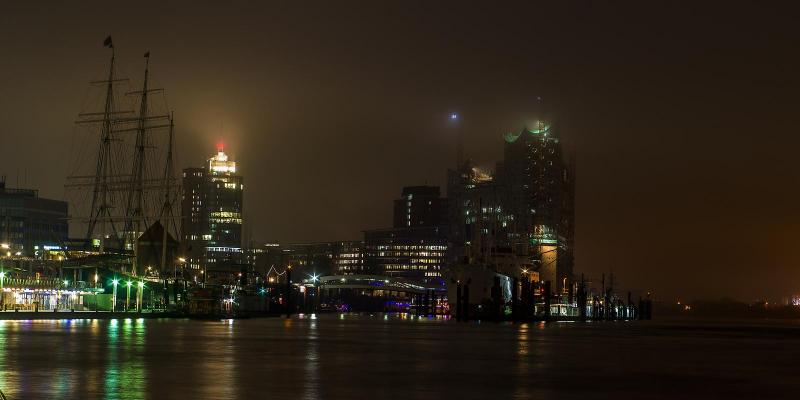
Basically as soon as I started considering working on a Vampire campaign, I decided that it would have to be set in Hamburg. The premise of the game requires that it’s set in a major city (unless your deliberately want to run a nonstandard campaign), and every time I start worldbuilding on something, I always take a few moment to think if there’s anything from the Baltic Sea region that I can use. We almost never get to see our regional history an heritage make an appearance anywhere. The only thing you ever get is Vikings, and even those seem to always be shown far away from home. Hamburg is the biggest city in Northern Europe between London and Saint Petersburg, and it also happens to be where I was born and lived as a kid for 10 years (and I still pass through there pretty regularly). So it really was the obvious choice with no other contestants. And it turns out to actually have a lot of recent history that is great material for a Vampire campaign.
Hamburg
As a major city with a metropolitan area of 5 million people, Hamburg obviously qualifies as a perfect setting for a Vampire campaign. But once I started looking up various barely remembered details from places I remember from my childhood, I rediscovered so many things that not only make it suitable but amazing for that task.
While not nearly as old as the Roman cities in southern Germany, Hamburg has a long history that stretches back over a thousand years. The city really came into its prime with the rise of the Hanseatic League in the 13th century. Merchants from many important port cities on the Baltic and North Seas formed an extensive network of relationships that eventually grew into something akin to one of the world’s earliest megacorporations. In many of these cities, the Hanse merchants formed their own aristocratic class that often came to govern the ports as independent or autonomous republics. The capital of the League was in nearby Lübeck, which with modern city growth and transportation infrastructure is now part of the Hamburg metro area. In the Holy Roman Empire, Hamburg and Lübeck were among a small number of cities that had no lords and owed allegiance only to the Emperor himself. This arrangement lasted until the 1920s, and even today the city of Hamburg is one of the 16 states of Germany, only one administrative level below the Federal Government. The merchant aristocracy of Hamburg was so proud that they would not accept any medals or join any orders of foreign powers, as they would recognize no authority other than their own. There really is no doubt: In the World of Darkness, the Hanseatic League was undisputed Ventrue territory.
Early on in the 30 Years War, Hamburg invested heavily in new massive fortifications to surround the entire city, and it was one of the few major cities in the Empire that were never besieged or pillaged, but still had the war come right to its doorsteps during Wallenstein’s campaign against the Danish king Christian, whose possessions included the northernmost parts of the Empire. Hamburg and Lübeck marked the greatest extend of Naploeon’s empire in the North at the start of the 19th century. After a great fire in 1842, the rebuilding of Hamburg led to a great industrial boom. Growing into the third largest port in Europe and becoming the gateway for emigrants to America and where exotic goods from around the world would come into Germany.
24 Then the Lord rained sulfur and fire out of the sky from the Lord on Sodom and Gomorrah, 25 overthrowing those cities, all of the plain, and everyone who lived in the cities. He also destroyed the plants that grew out of the ground.
– Genesis 19
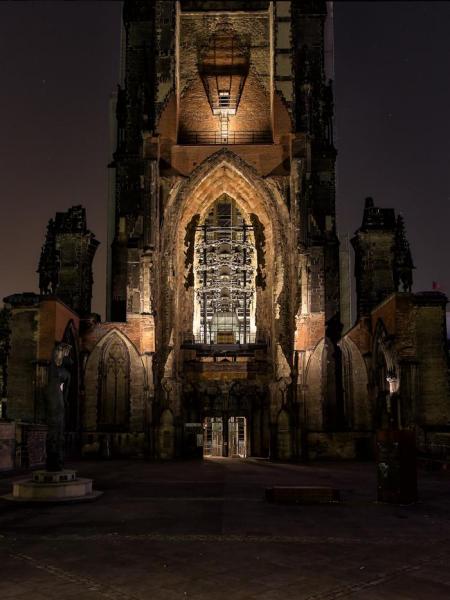
Ruin of St. Nicholas’ Church, destroyed in 1943.
In 1943, the British Royal Air Force launched Operation Gomorrah, and for a full week they attacked Hamburg with incendiary bombs. One night the relentless bombing exceeded their wildest expectation, with the inferno turning into a giant tornado of flames that incinerated much of the city. Later the amount of destruction and deaths from the atomic bomb in Nagasaki would be rated as “not nearly as bad as Hamburg”. Along with tens of thousands of humans, the fire destroyed a majority of the city’s vampires, including many elders of many centuries. There are few things that scare ancient empires, but this night haunts those who survived to this very day. Not even 20 years later, Hamburg suffered a great flood that devastated the poorest parts of the city in the South, there the old dykes had still not been properly repaired. Since then, things have been looking upward for the city.
Hamburg by Night
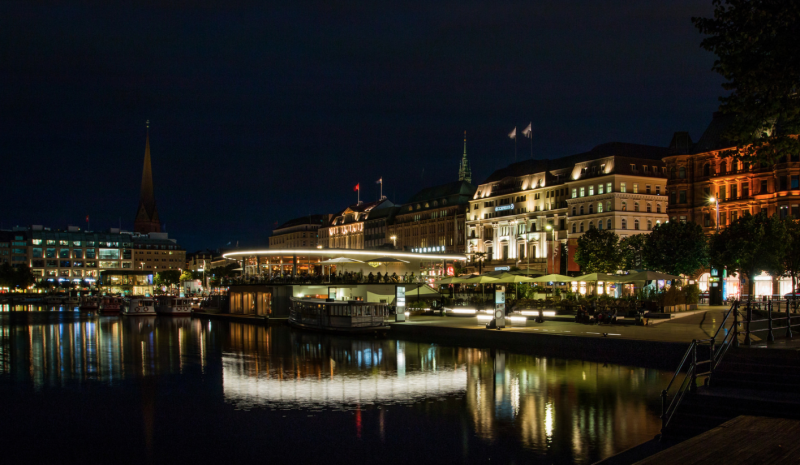
The classic style of Vampire: the Masquerade is one of urban decay and street gangs. While this was a very contemporary style in 90s America, it just really doesn’t make any sense for Hamburg in the 2020s. You could do such a version of Hamburg, but it just wouldn’t reflect the character of the city, even in a darker and more twisted way. With most of the historic buildings being completely destroyed by the two fires in 1842 and 1943, most of the current city only 70 years old. And with the hastily constructed concrete blocks from the 50s now showing their age and being considered eyesores, the city is giving itself a makeover of shiny glass and gleaming lights. It just looks very modern and crisp, with a booming economy. Industrial ruins and burning cars simply don’t fit into this place.
But even with such a shining exterior, there is absolutely room to fill it with evil and corruption. There are persistent stereotypes and jokes about German society and culture, which are so persistent because they are not exactly wrong. They don’t get it quite right and miss many of the finer nuances, but there is a lot of truth to that. And even with Germany as a whole, the “Northern Lights” have a reputation for being dour, joyless, and lacking in courtesy. In my experience, “Germany” is really just a language area. Culturally, people in Schleswig-Holstein, Hamburg, and Mecklenburg are Scandinavian. When we look South and see the Rhur Area with its Karneval, and Bavaria with its Oktoberfest, we just think they are all mad and an embarrassment to the whole county. It’s not that we mean to be rude or have no sense of humor or enjoying fun, but our regional culture puts a much greater emphasis of giving other people their space and being unobtrusive. We like not being bothered and extend that common courtesy to others.
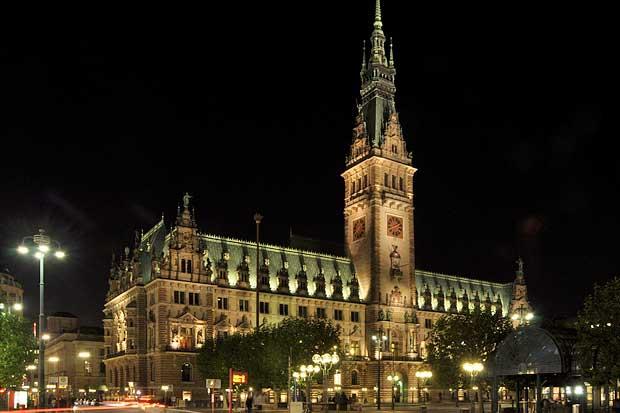
Hamburg City Hall
But even so, it does take very little to go from courtesy to callousness. There is only a small step between not being nosy and willful ignorance, and between not rocking the boat and complacency. It’s easy to find yourself kicked out into the freezing rain. And the 1930s were not our proudest moments. This version of Hamburg that I am going for is one of order and oppression, but not enforced by police with clubs, but by social pressure. The police is not the hand of the oppressor, but the foot of the people, put down on those trying to disrupt a good thing. Corruption is not a serious concern of the people, as you don’t see it unless you want to. It’s not the drugs that bother people, but the junkies passed out on the sidewalks. Fighting crime is not about dealing with the causes, but removing it from sight.
Hamburg is an old Ventrue city. Shaped just as much by the vampires who infest it, as they are shaped by it. It is orderly, efficient, and makes a whole lot of money. It’s running smoothly, and the masses just hovering ever so slightly above poverty is by design. People who can’t afford to lose their job don’t ask questions or make demands. With Ventrue pulling many of the leavers that control the city, “Human Resources” take on the full horrific meaning that the term implies. The city and its industry does not serve the people. The people are the fuel and the grease that make the city run.
A City of Steel and Sin
While Hamburg is generally not considered to be among the fancy global cities of Europe, like London, Paris, Berlin, or Moscow, it is still a quite impressive place of its own.
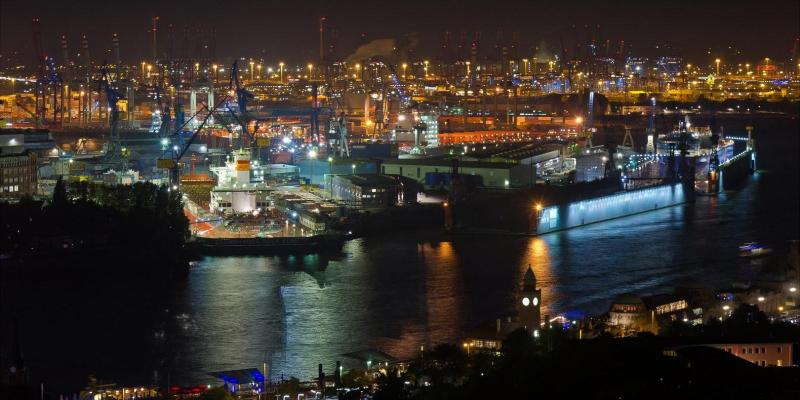
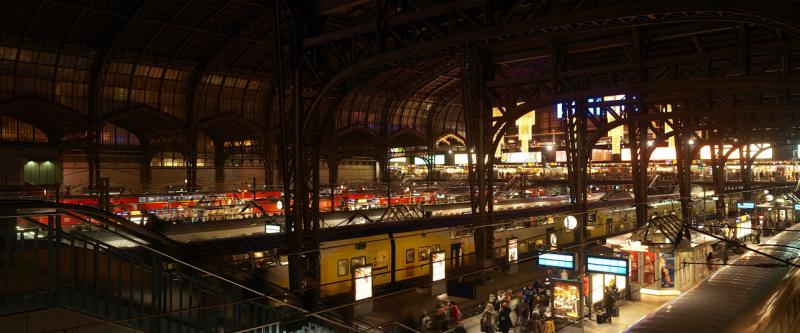
The port of Hamburg is the third largest in Europe, after Rotterdam and Antwerp. Aside from its massive container terminals, it also includes several shipyards and oil refineries on the south side of the Elbe. Hamburg is also the site of the largest copperworks in Europe, an Airbus production site, and countless machine factories. It also has a major airport and a main train station with 12 platforms inside a single 150m long and 75 meter wide hall of steel beams and glass.
Hamburg is also home to the second largest cemetery in the Old World. Most cemeteries have a but stop. Hamburg Ohlsdorf has its own two bus lines with 24 stops. Right nearby are the Fuhlsbüttel prison and the Ochsenzoll Asylum, making for a quite unique neighborhood.
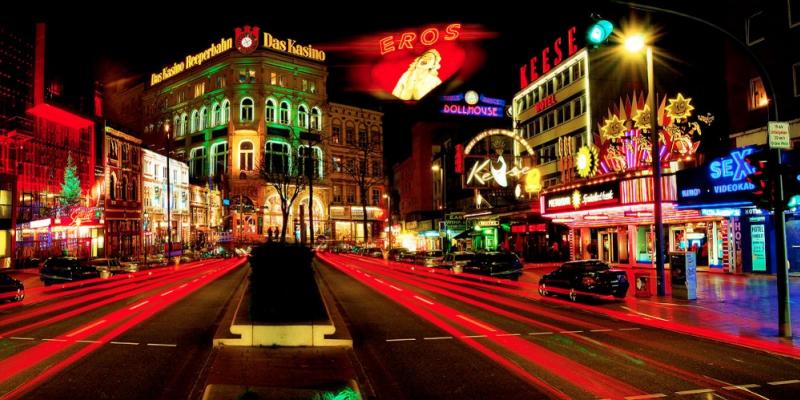
The Reeperbahn in the St. Pauli neighborhood is probably the second most famous Red Light District in Europe after Amsterdam. Originally the area started as a shanty town outside the walls of the cities Hamburg and Altona and became the home to all trades that were forbidden inside the cities. In the 1920s it fancied itself to be a glitzy and glamorous entertainment district the likes of Berlin, but after the war it was never properly redeveloped and turned into a crime-infested slum. In recent decades great efforts have been made to straighten it up and return it to its glory days. But it never lost its pride in its self proclaimed title as “The most sinful mile in the world.”
 Back when I finished the Inixon campaign half a year ago, I wrote that I am done with Dungeons & Dragons and that it just isn’t what I am looking for in a game. I neither like the baggage of assumptions about the world that players bring to a new campaign (to no fault of their own), nor the encounter and XP treadmill. But even back then, I did leave myself a door open that I wouldn’t rule out running a game using some variant or another of the Basic/Expert edition. The mechanical problems are mostly something specific to the d20 system that no tweaks and overhauls ever manged (or even tried) to solve, and the worldbuilding baggage comes from the AD&D tradition. When I actually read B/X for the first time six years ago, the thing that stuck out to me the most was how different it all felt from all the D&D I had known.