Row, row, row your boat, bravely up the stream

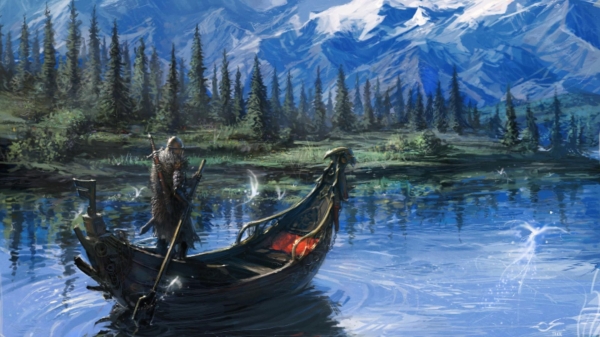
So, if you have a setting idea that is not centered around kingdoms and cities, what other reference frames can you use to give structure to the peoples and societies of a vast wilderness setting? How about rivers? All the earliest civilizations of the Bronze Age first appeared along the largest rivers in the old world because big rivers are really really useful. They provide a steady source of water, which in the sub-tropical zones where you find these civilizations can otherwise be quite a problem. But they are also extremely useful for transportation. Rivers allow you to transport large quantities of cargo just as easily as by rail. Load all the stuff on a boat, add a sail or go with the current, and wait until you’ve reached your destination. If you have goods to move, rivers are the way to go. Or to float. While water isn’t as much a problem in Central Europe, the region between Germany and France has been constantly contested for many centuries because it’s the origin of the Rhine, the Seine, and the Rhone, having easy access to the North Sea, Atlantic, and Mediterranean.

It’s been one of the design elements for Planet Kaendor very early on that all civilization has to be on rivers or the coast, with the deeper forests being more or less inaccessible for heavy cargos. When I was thinking of city states, I was mostly thinking about the coasts and large ports, but that’s not where the adventure is. Adventure is deep in the forests where the ancient ruins are hard to get to. I am now thinking about moving all the pieces on the map to correspond to three huge river systems and one archipelago of islands of the coast. I really like ocean beaches, but Planet Kaendor is meant to be a forest world foremost. While there won’t be any along the major rivers, there’s more than enough in the islands region. While I have plans for a sub-arctic and a tropical forest set in Kaendor, for practical reasons it makes the most sense to only go with the temperate-subtropical one for now. I think any single campaign is best served by being based entirely on a single river.
The Setting

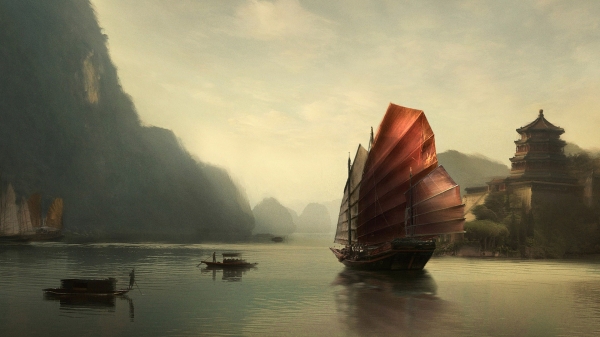
Since this first river is located in what I used to call the Dainiva forest, I’m going to call it the Dainiva river here for convenience. And since nothing is a permanent as a temporary fix, that’s probably now going to be its name forever. The great Dainiva river has been the home to many great civilizations over the ages. Cyclopean castles of the giant Rock Carvers overlook the river from cliffs towering over the meandering courses of the upper rivers, with the lower river being home to many old Naga cities. Ruins of the sorcerous Tower Builders rise above the dense trees flanking the river banks, as well as the magnificent living citadels of the Tree Weavers. All these civilizations have long ago faded from history, and it was many centuries after the Naga retreated to the jungles of the south that mortal peoples began settling on the lower banks, gradually but cautiously moving into the abandoned palaces of the serpentmen. Among the ruins they discovered the arts of casting bronze and mastering the secrets of alchemy, leading to the rise of the first mortal civilization. Over many centuries and generations, explorers ventured further up the waters, but even a thousand miles upstream, there were still no signs of the headwaters of the major branches. Only more water and trees, and the wrecks of explorers who had gone before them. And more ruins and monsters.
The Map

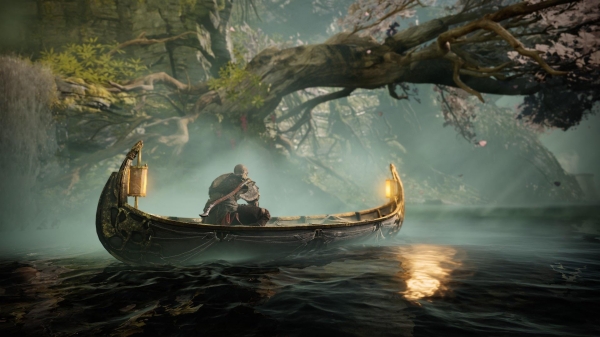
A setting of this type is perfectly suited for pointcrawls. Since travel is basically linear along the river branches or their banks, and ruins have to be visible from the river for characters to have any chance to find them, using a hexmap would not provide any actual benefits. Instead, a map showing the various main branches can show the distance between any fork, settlement, and ruin right next to them, and you can also use color to mark different types of water. For example, the common speed for rowing a canoe with no current is given in most places as 3 miles per hour. Currents of 1 or 2 miles per hour also don’t appear to be anything unusual, and while many rivers are much faster, the current generally is slower when you stick close to the shores where it’s more shallow. So you can mark the river conditions in three colors. Dark blue for the slowest water, in which rowers go 2 mph upstream and 4 mph downstream; medium blue for faster water, in which rowers go 1 mph upstream and 5 mph downstream; and light blue for waters too rapid to paddle against, that require continuing on foot. But you could still build a single-use raft from trees and go downstream at 6 mph. If you want to, you can also convert straight from miles per hour to miles per day, if hourly precision isn’t desired, but if you don’t have to deal with things like traveling 2.33 hexes in a day, I think tracking distances by the mile isn’t really any nuisance. On the major branches of a river of this size, there is easily more than enough room to navigate large cargo ships like a junk. With a slightly more sophisticated sail than just a plain square cloth, it is possible to sail up a river against the current, even with quite moderate wind coming from the sides. Merchant ships like these would replace the trade caravans seen in many land-based settings.

Settlements are all either directly on the river or at least have an accessible pier that connects to the actual village by a short path. Since they would want to be visited by traders, such piers would be clearly visible. But you could also have lairs of rivers pirates or secret cults hiding in barely visible side branches much too small for larger merchant ships. With civilization being based along the lower river near the coast, settlements become more scattered and smaller in size as one travels upstream. This can be used as a great indicator for players about the dangers they can expect to encounter. In civilized areas on the lower river, big monsters have long been driven out, but all the best ruins have been picked completely clean generations ago. But on the upper river, few mortals have ever set foot and there are both more dangerous monsters and much greater treasures to be found.
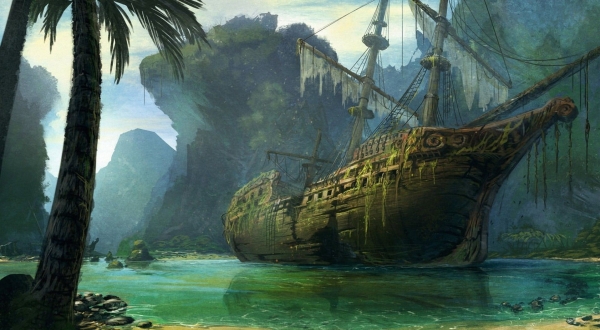
Since traveling on water is relatively simple and allows for the transport of great loads with little effort, I think a campaign of this type works best if you make it really big. Make it a river as big as the Volga, the Mekong, or the Columbia, where characters can go exploring for months between the end of the spring floods and the onset of winter. With the help of rafts, parties will be able to return with huge hauls of treasure, so the journey back to civilization should be a long one to compensate. Bigger hauls should translate to fewer hauls.

Basing a sandbox around a river system is also really convenient for a GM. By its nature, its close to a fractal, allowing you to just keep expanding it with more and more side branches as the party continues exploring upstream. A river map does not have to bother with mountains or elevation, and generally there’s no need to be exact about the width and depth of the water. And if you should end up with a branch that gotten too narrow and shallow to continue on, the party can always go back downstream a couple of miles and go up another branch. Now for the lower river, I think the players should have a map of the main branches and major side branches, as those are areas frequented by river merchants making their regular round. But once you leave civilization behind, there’s no limit for how far you can continue.

Similarly, it’s very easy to create villages and ruins in a vacuum and just plop them down on the map wherever the players decide to go. That goes a bit against the common ethos that players should have control over where they go by making informed choices, but I think in a setting like this, there really are not a lot of choices to make. Check it out or continue up the river? And given how many branches a river system of this size has, I don’t think working with fixed locations would actually be feasible. You’d end up with a lot of “this branch gets too narrow to continue and you’ve not seen any signs of a ruin”. That’s not player agency either. You could very well establish some facts about a ruin when the party stops at a village or trade post and gets a tip from the locals. But there wouldn’t be any need to establish any of this before the party arrives at this part of the river.

Encounters and Sites

I think for a campaign of this type, random encounters might actually the bread and butter of many adventures. Ruins are cool, but when slowly travel up a river for hundreds of miles, you’ll be doing a lot of encounter checks.

In a world with river merchants, you’d also get river pirates. Those pirates would know not to bother explorers going up the river in the spring, unless they are desperate for supplies, but be waiting to pounce at any explorers coming back down the river in the fall with their big hauls of loot. Merchants might invite the party to get a free ride with no paddling on their ships in exchange for protection against pirates while they have the same route. On the upper river, you can have encounters with aquatic and semi-aquatic humanoids, who could either be friendly or hostile to rare visitors from downriver with goods to trade. There can be the wrecks of failed expeditions, which might even be salvageable and be sold for a huge profit if floated down the river without sinking. Or repaired and used for further expeditions the next year. Or there could be ancient crumbling dams from the old civilization that threaten settlements downstream with disastrous floods, allowing for some variation between dungeon crawls.

And then there’s of course the river creatures. Obviously crocodiles and big snakes, but I’m really giddy at the idea of giving players a paralyzing phobia of hippos. Someone suggested to me adding dire beaver dams to block of some rivers and require hauling boats over land to continue. I also really like the idea of creatures in the trees following the players in their boats from shore, waiting for an opportunity to attack.

It really is a fairly simple concept for a sandbox setting, but one I think has huge potential, while looking very manageable at the same time.
Torch the Palaces, for fun and profit

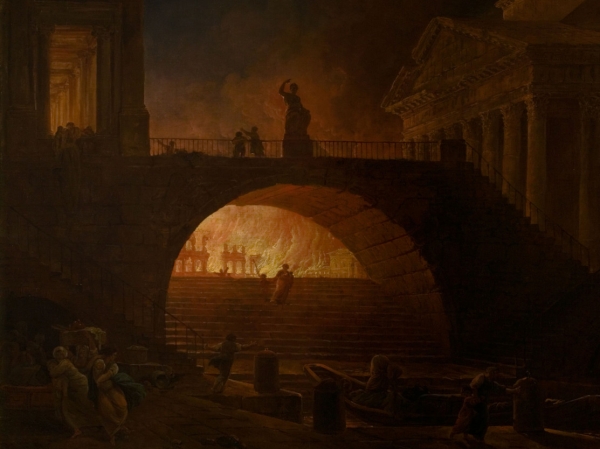
Rome wasn’t build in one day, but burned down in one night.

Two weeks ago I wrote about a problem I had with making Planet Kendor really feel like a wilderness setting instead of a cluster of city states that kept emerging from my pages of notes. While learning about the fantastically weird setting of Kenshi and the strange wasteland it is set in, I had a sudden insight that I had tried to create the map for Kaendor with completely the wrong reference frame in mind. One of my earliests concept ideas for the setting was “Dark Sun, but green”. The many strange desert creatures and equipment used by characters are cool of course, but I also was very much drawn in by the powerful sorcerer kings, who rule from their great palaces over their fortified cities with the help of their armies of templars. I still really love the idea of sorcerer kings and templars, but they might actually be something that doesn’t really work for the way I want the setting to be.

Dark Sun in green is a cool initial inspiration for an aesthetic, but the world of Athas is more than just a look. But it is not set in a desert world by accident, and the desert actually shapes the civilizations that inhabit it. Dark Sun is based around six city states because it is a world of extreme scarcity of resources. The people of Athas concentrate on these cities because they are the only places where various critical resources can be found, and the sorcerer kings are what they are because they have a monopoly over these resources. People live in these city states because there are no other places where they could survive. This is a completely different situation from a jungle world, and why you can’t simply take Dark Sun and make it green.

The idea for Planet Kaendor is a world where natural resources and particularly access to food and water are plenty. You can always go into the forests with a few dozen people and survive on what you find around you, with nobody coming to disturb you for most of the time. Lots of people actually do that. This completely flips the social pressures on society from a desert world with limited oases. Instead, the limited resource in Kaenedor is magical knowledge and magical artifacts, which are buried in the ruins of ancient non-human civilizations.

My problem has been for many months that this version of Kaendor keeps getting too focused on the city states, with the wilderness settlements disappearing in the shadows of the palaces of the sorcerer kings. So to get forward with the setting to the kind of world that I want to be, the solution seems clear. The palaces have to go. Not only are they not needed, they keep actively getting in the way.

I think I am going to keep only two of them in their current form, two neighboring cities that glare at each other accros the water. Ven Marhend, the cliffside city of the Sorcerer Lords, and Tanis, the great city of the god-king, son of the Moon Goddess and father to all mortals. All the other cities that I have made for Kaendor instead get scaled down significantly in size, remaining only as noteworthy towns that are the main trade centers for the nearby villages and barbarians. Hopefully this will get the whole thing out of the rut and back on the road.

The Burning Dead

The undead creatures of Planet Kaendor, with stats for Worlds Without Number.

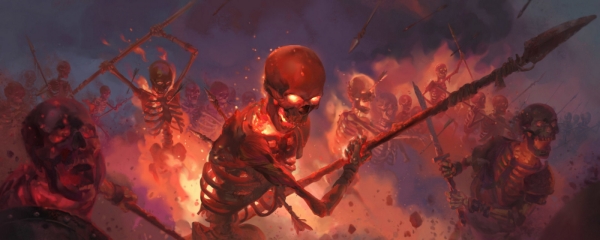
While fire has a part in the natural world, its true origin lies in the Underworld and is the animating energy of demons. Forests have adapted to survive fires and adjust their natural cycles to deal with it, and ancient mortals of ages past have learned to harness it as a powerful tool and weapon that makes civilization possible. The ability to contain the fire and to use it what sets them apart from the beasts of the Wilds. But even though fire is useful and potent, it remains a power fundamentally hostile to life. Usually fire simple kills and destroy any living things it touches, but under the influence of sorcery, the two can merge together, creating horrifying and unnatural abomination, neither living nor dead.

Charred Husk

Charred Husk: 2 HD, AC 11, Atk +2 (1d8), Move 20, ML 12, Skill +0, Save 14.

As undead, husks are immune to poison, disease, sleep, and unconsciousness.

Charred Husks are the most basic of undead creatures. They are corpses burned by the flames of sorcery and demons, which continue to smolder even after there’s nothing left to burn. Nothing of a living creature remains in a husk other than its charred bones and flesh. They commonly arise from creatures killed by sorcerous fire or demons, but can even be created when old corpses are consumed by the flames of sorcery. The animating energy within a husk is driven to spread itself to other living beings, and they typically attack all creatures they sense with blind ferocity.

Ghoul

Ghoul: 3 HD, AC 13, Atk +4 (1d8), Move 30, ML 10, Skill +1, Save 14.

As undead, ghouls are immune to poison, disease, sleep, and unconsciousness. Unlike husks, ghouls never actually died and resemble the living in many ways. The fire consuming them manifests itself not as flames, but as a slow smoldering corruption that eats away their bodies and minds. Many ghouls are the close servants of sorcerers who have been exposed to demonic magic for many years, but they are also found frequently haunting the ruins of cities destroyed by sorcery, from breathing in the ash of buildings, trees, animals, and people consumed by demonic flames.

Ghouls can often be mistaken for living people or beasts, but they soon develop a sickly appearance, with their skin and clothing smeared with ash and soot, and eventually developing burn-like scars all over their bodies. The mental state of ghouls can vary widely, regardless of the visible corruption of their bodies. Some act like slightly unhinged but otherwise sane people, while others are ravenous beasts. Like living creatures they still have to eat, and those surviving in the ashen wastelands rarely are particular about the kinds of meat they eat and hunt people just the same as animals, or will feed on old meat, unaffected by disease or poison. But not being truly alive, ghouls are unaffected by extreme heat or cold, but they still instinctively spend the nights huddled around fires if they can find something to burn. Eventually, most ghouls are consumed by the slow fire within them over the course of many decades and end up as charred husks. Though in some cases they also transform into wights.

Wight

Wight: 5 HD, AC 15, Atk +4/+4 (1d8; 2/15), Move 30, ML 10, Skill +1, Save 13.

As undead, wights are immune to poison, disease, sleep, and unconsciousness. They automatically stabilize at 0 hit points and require decapitation or similar destruction of their body to be permanently killed. Living creatures hit by a wight must make a Physical saving throw or be paralyzed for 1d4+1 rounds.

All wights began their transformation into undead as ghouls, though the exact conditions that turn only some ghouls into wights and not understood even by most sorcerers. There appears a strong connection to sorcery, as ghoul sorcerers rarely end up as husks, and they are often accompanied by the wights of their most loyal guards and servants. In other cases, wights have risen from killed ghouls who have been laid to rest in tombs and ruins highly corrupted by sorcery. Most wights appear to be sane, but also very hostile to living things with no interest in any kind of talk. They almost always attack any intruders into their lairs, but usually wait for an opportunity to ambush them instead of charging blindly into a fight.

Shade

Shade: 1 HD, AC 13, Atk +1 (1d6), Move 30, ML 12, Skill +0, Save 15.

As undead, shades are immune to poison, disease, sleep, and unconsciousness, and can only be harmed by obsidian or iron weapons. Living creatures hit by or walking through a shade take a -2 penalty to attack rolls and -1 penalty to damage rolls, shock damage, and skill checks for every hit, which remains until the end of the scene.

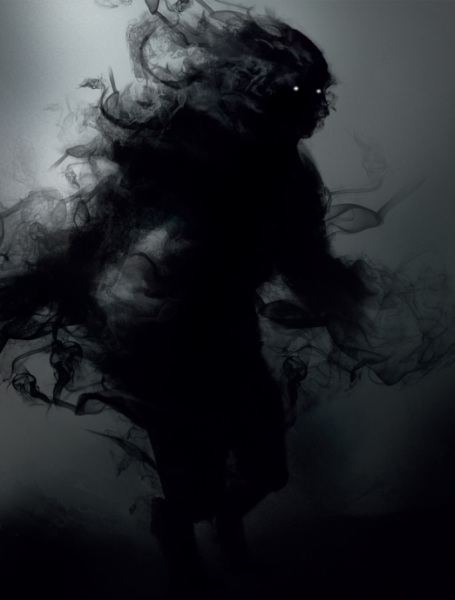
Shades appear as vague outlines of people made out of hazy smoke and shadows. They are not actually remnants of the dead, but rather the lingering remains of the demonic flames that consumed them. They appear somewhat related to charred husks, but the bodies that created them have been entirely reduced to ash, with nothing left for the flames to possess. Shades are just as mindless as husks, but show even less awareness of their surroundings. Shades often stand nearly motionlessly in the very spots they were created, not moving from their place for decades or centuries. Though they are created by fire, they have nothing left to burn, and instead draw in any warmth from their surroundings. Places haunted by shades are often unnaturally cold and touching them seems to drain the very life out of living creatures. Shades may attacking living creatures that are getting very close to them, though they might just as well completely ignore people walking straight through them.

Wraith

Wraith: 4 HD, AC 20, Atk +5 (1d6; 2/-), Move 30, ML 12, Skill +1, Save 13.

As undead, wraiths are immune to poison, disease, sleep, and unconsciousness, and can only be harmed by obsidian or iron weapons. Living creatures hit by a shade (but not when taking shock damage) take a -2 penalty to attack rolls and -1 penalty to damage rolls, shock damage, and skill checks for every hit, which remains until the end of the scene.

Wraiths appear somewhat similar to shades in that they look humanoid beings made of smoke and darkness, but their nature and demeanor is completely different. A wraith is the spirit of a highly corrupted being that has been so completely consumed by the fires of the Underworld that it burned its own bones and flesh into ash, leaving behind only a spirit of fire, smoke, and hatred. Like ghouls and wights, wraiths appear to retain much of the memories of their former lives and their intelligence, but all the trappings of a mortal life have long lost all meaning to them and the only thing driving them is a blind rage against all living things.

Rolling hit points for monsters

As I was delving into the ancient ruins to seek the wisdom of the sages of past ages, I came upon this nice little gem on Planet Algol: Non-randomized Monster Hit Points is the F’ing Devil. The unknown author (seriously, there’s no name anywhere on the site) makes a point that you really should roll the hit dice for monsters and NPCs the players might fight an not just assume the average, as it has a real impact on customizing individual opponents. Would players ever notice the difference between a 2d8 creature with 8 hp and an otherwise identical one with 11 hp? Probably not. But they very much would notice the difference between a 3 hp and a 15 hp one.

A note  is being made about perhaps rolling only one die and multiplying the result by the number of die, to make more extreme results more common than under the normal distribution you get from rolling and adding up multiple dice. But I was also curious about the results you would be getting from rolling hit points normally for every opponent and so I pulled up AnyDice to check.

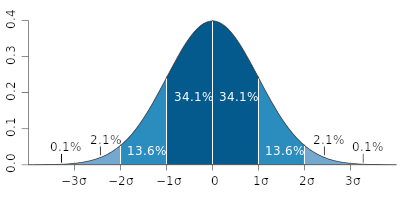
The added up results of multiple die rolls are a classical of a normal distribution. The classic bell curve. A typical way to compare and interpret the distributions of these curves is by using the Standard Deviations as reference points. I once learned how to calculate standard deviations and also understood the reason why they are typically used instead of any other arbitrary reference lines. I’ve forgotten all of that years ago, but I am going to use them anway. (And it turns out AnyDice can just tell you that number, spring me the need to manually crunch numbers for other reference values.) The only thing that’s really important to know is that 68% of all results will lie within 1 SD of the median value (the line between the lower 50% and the upper 50% of all cases), and 96% of all results within 2 SD.

Source

Since almost all creatures use d8 for hit points, I’m going to do the whole thing only for d8s. Obviously the spread will be somewhat smaller for smaller Hit Dice, and larger for larger ones, but the pattern remains the same.

HD -2 SD -1 SD +0 SD
+1 SD +2 SD
2d8 3 6 9 12 15
3d8 6 10 14 17 21
4d8 9 13 18 23 27
5d8 12 17 23 28 33
6d8 16 21 27 33 38
7d8 19 25 32 38 44
8d8 23 30 36 42 49
9d8 27 34 41 47 54

Now how to read this table for the not statistically trained? What this means is that 68% of all results you get will be between the -1 SD and the +1 SD columns. 96% of all results you get will be between the -2 SD and the +2 SD columns. Or in other words, only 2% of results will be smaller than the left column and only 2% larger than the right column.

Here’s the same data a bit more condensed, showing the range of hit points for 68% of the creatures if you roll their hp.

HD +/-1 SD +/-2 SD
2d8 6 to 12 3 to 15
3d8 10 to 17 6 to 21
4d8 13 to 23 9 to 27
5d8 17 to 28 12 to 33
6d8 21 to 33 16 to 38
7d8 25 to 38 19 to 44
8d8 30 to 42 23 to 49
9d8 34 to 47 27 to 54

Here the left column is the range you will see for 68% of your creatures, and the right column what you’ll see for 96% of your creatures. Results outside the range of the right column will occasionally happen, but will really be quite rare. As the number of dice goes up, the spread of the result will be come relatively narrower. The difference between 34 and 47 really is not that big and players might not notice. But the vast majority of enemies that will be fought in groups will have much lower number of Hit Dice, especially those in larger groups. Going from 6 to 12 means double the amount of hit points for 2d8 HD opponents, and when you deal 3 or 4 damage, that makes a real difference. And that’s only for the 68% group. A 2d8 creature with 2-3 or 15-16 hp will be rare, but still account for about 5% of individuals each. In a group of 10, you’d expect to see one of these outliers.

So yeah, I agree with the anonymous author. Rolling the hit points for every opponent individually seems very much worthwhile when you have a game with few fixed bonuses to the dice roll and PCs commonly dealing single digit damage.

“I strangled him on his throne the night I took the royal city”

“Did you deem yourself strong, because you were able to twist the heads off civilized folk, poor weaklings with muscles like rotten string? Hell! Break the neck of a wild Cimmerian bull before you call yourself strong. I did that, before I was a full-grown man —like this!”
– Shadows in Zamboula

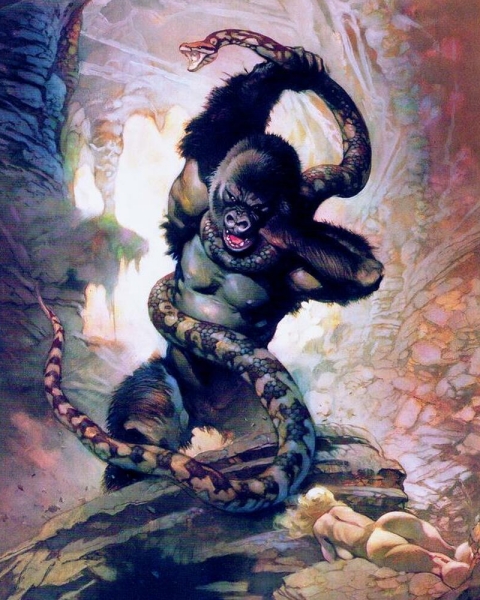
While thinking about a discussion about how you make adventures feel like Sword & Sorcery, it came to me that the Howard and Frazetta style in particularly is extremely physical and and greatly in love with the body and muscles. Fighting is not all about hacking and impaling, but often at its most intense and memorable when it comes down to a pure contest of Strength. I think that’s why large apes and giant snakes are so popular in Sword & Sorcery. They are the most spectacular incarnations of pure muscle.

Sword & Sorcery often has strong elements of swashbuckling and bravado, and when you think of pure all-out badassery, things that should come to mind are wrestling with snakes or breaking the neck of a lion with bare hands. So when it comes to picking a system for your Sword & Sorcery campaign, one thing it’s really going to need is a solid mechanic for wrestling and unarmed combat.

My current darling among the many B/X variants is Worlds Without Number, and that game has my favorite system for wrestling in any iteration of D&D and its retroclones. 3rd edition was particularly infamous for having a grappling mechanic that nobody could ever remember, but when you look at say 5th edition or the Rules Cylcopedia, I still find it difficult to truly get a full grasp of it just by reading, and remembering any of it once I turned to the next page. The WWN system is both simple and easy to remember and also has a neat little tweak to make it actually look attractive.

To start a grapple, the attacker has to first make a successful attack roll, and then both attacker and defender make opposing Strength checks. This means starting a grapple is more difficult than making a normal attack and dealing damage, since you have to make two successful rolls instead of one. But if you succeed to get a hold of the defender, the results are pretty nice.

The defender can use a Main Action on his turn to make another opposed Strength check, and if he succeeds, he gets free and may use his Move Action to get a few steps away. Otherwise, the only thing that both attacking and defending characters in a grapple can do is making unarmed attacks. If the attacks hit, they deal unarmed damage to their opponent. But now here comes the really cool tweak that I’ve never seen in any other grappling system. If the round ends with the defender still being grappled, the attacker automatically deals unarmed damage to the defender without an attack roll. Assuming the chance to land an unarmed attack is 50% for both fighters, the attacker will deal 1.5 times unarmed damage per round on average. However, the defender will deal only 0.5 times unarmed damage per round if he tries unarmed attacks, or 0 damage if he tries to break free of the grapple. The attacker is clearly at a major advantage if succeeds on the risky initial attack that requires two successful rolls to do anything.

Alternatively, the attacker can also choose to end the grapple and attempt another opposed Strength check to drag the defender 10 feet, or throw him for 5 feet.

You know what this is.

It may not be the best way to attempt fighting an ogre, but if you’re a big beefy barbarian with a few ranks in the Punch skill and the Unarmed Combatant focus, you probably can obliterate sorcerers very easily, unless you you’re dealing with another bronze god with muscles like steel. Even if making regular attacks with weapons might cause more damage, a grappled sorcerer can’t cast any spells or use magic items.

We’ll steal down through the top of the tower and strangle old Yara before he can cast any of his accursed spells on us.
– The Tower of the Elephant

An Expert starting with a Strength of 13 can learn the Developed Attribute and Unarmed Combatant foci, increase his Strength to 14, and gain a Punch skill of 2 by 3rd level, giving him an unarmed damage of 1d10+2. That’s an average of 7 damage, at a point where the average Expert has only 3d6 hit points, which is an average of 9. Unarmed combat has the potential to really fuck you up.

The Curse of discussing Sword & Sorcery on the Internet

Godwin famously discovered that as the length of a discussion on the internet increases, the probability that someone will compare another person to Hitler approaches 1.

Here’s Yora’s Law: “As the length of a discussion somehow related to Sword & Sorcery increases, the probability that it will turn into a debate on the proper definition Sword & Sorcery approaches 1.”

If for some inconceivable reason, it takes more than 10 posts to reach that point, that’s already amazingly impressive.