6th Century Armor

I realized one of the first mistakes I made with the Shattered Empire setting was to call it “The Shattered Empire”. The empire is supposed to be only a background thing to excuse the existence of all the dungeons and why they are full of treasures. It’s not what the setting is supposed to be about. I can always change that later, but for now it will do.

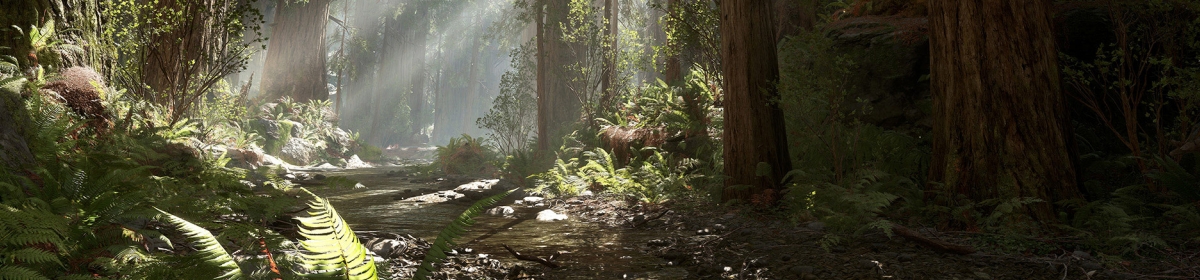
My original inspiration for the Shattered Empire was the Hellenistic Kingdoms that formed from the remnants of the Achaeminid Empire in the 3rd century BCE, but the better example really is the remains of the Western Roman Empire in the late Migration Period in the 6th to 8th century CE, between the fall of Rome and the Carolingian Empire, and long before the Vikings. It’s more reminiscent of the kind of landscape I want to go with, and it’s also a period you don’t really see at all made use of for fantasy.

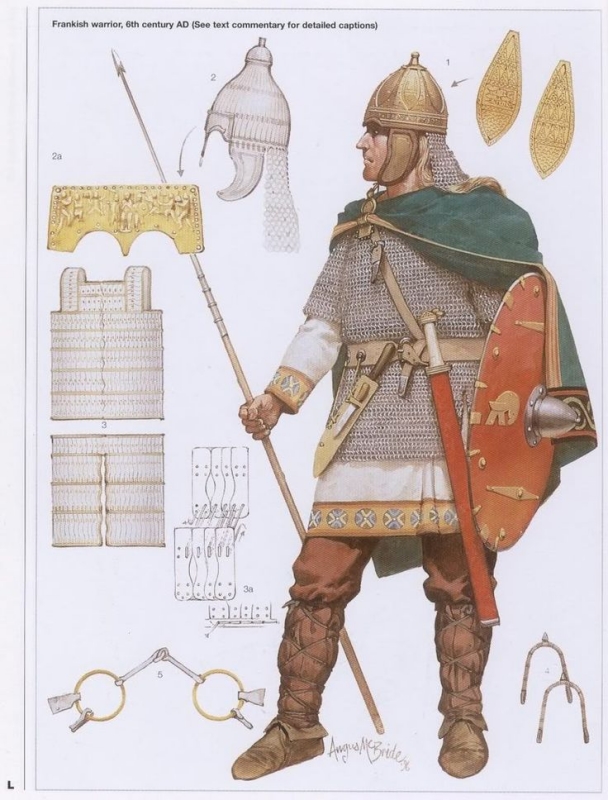
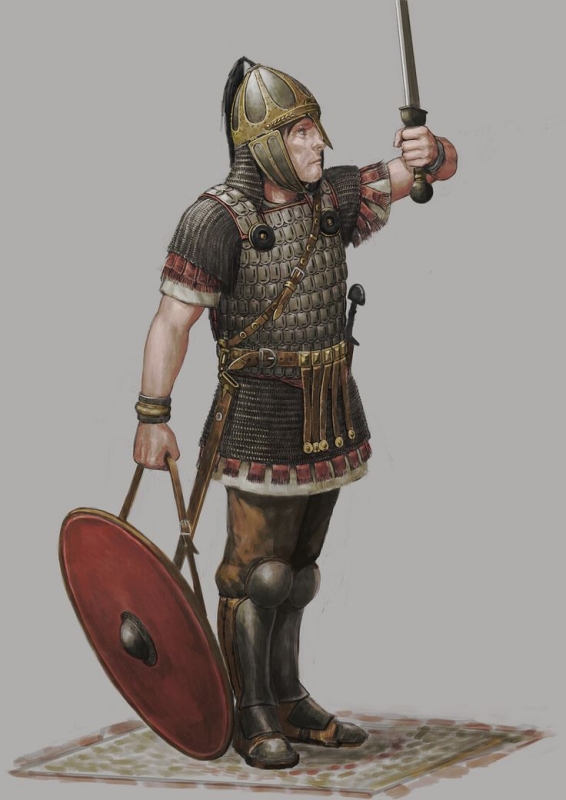
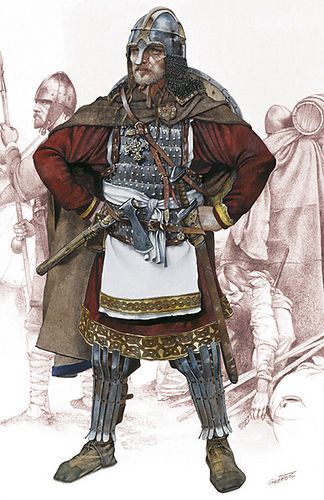
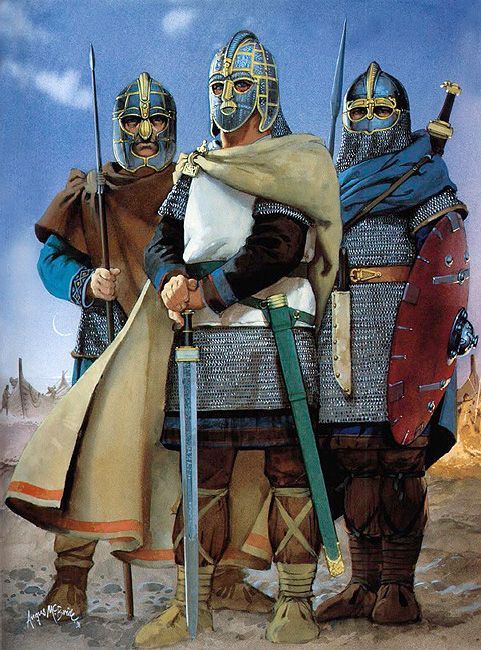
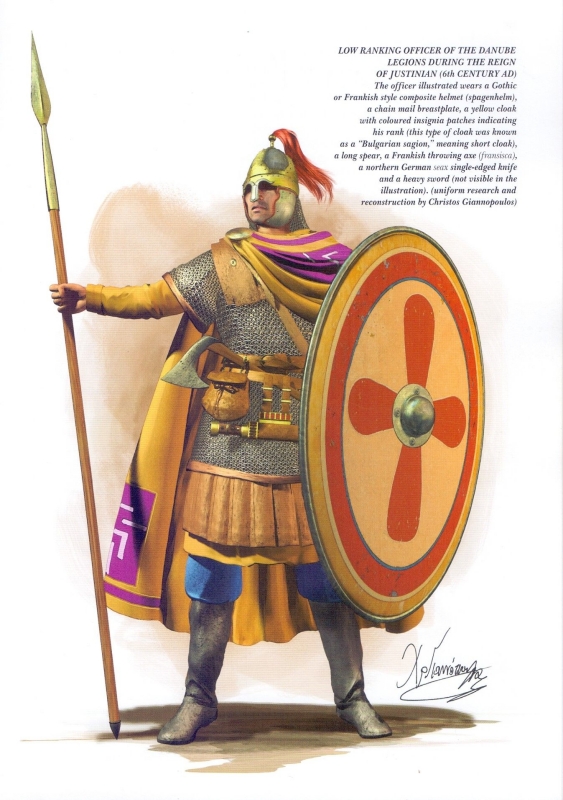
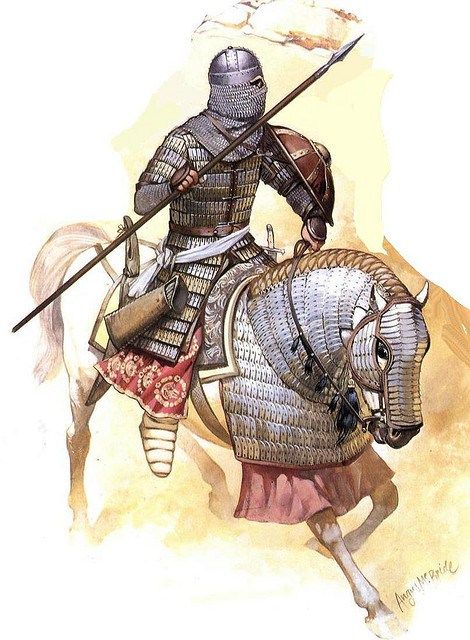
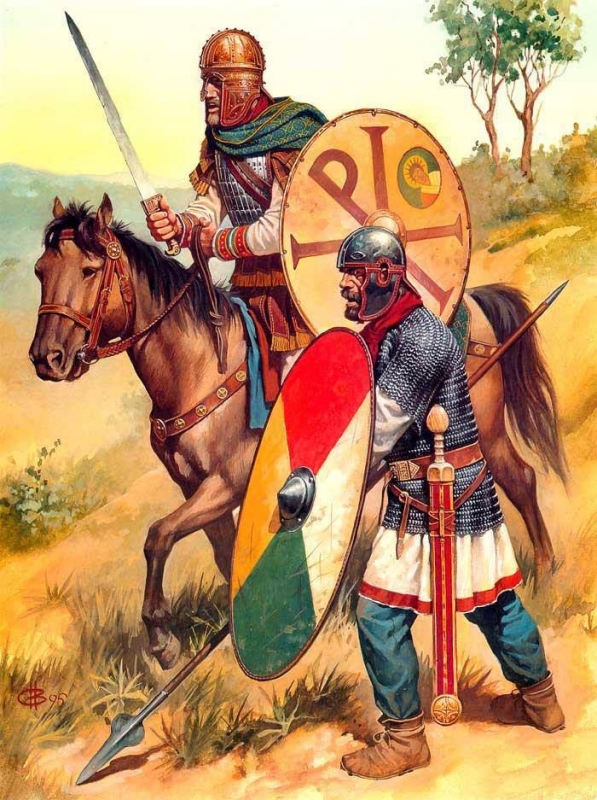
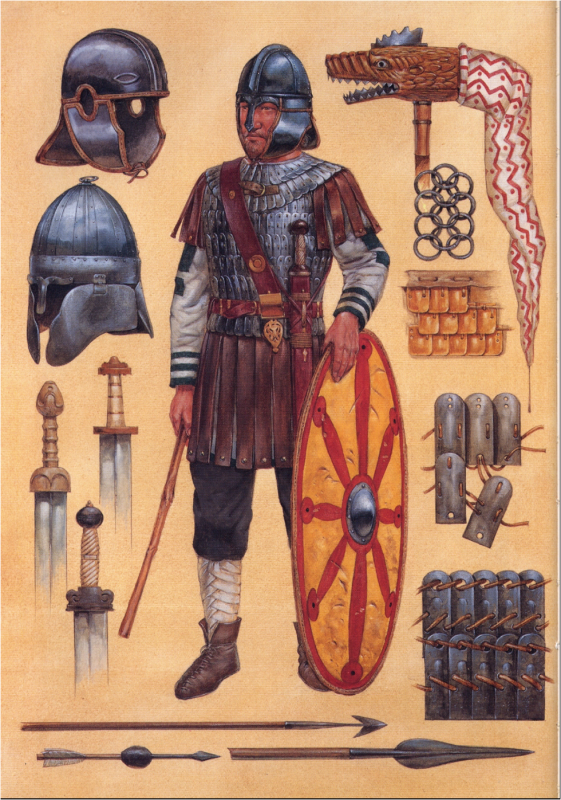
The main way in which using a historic period as visual reference is typically in the armor and the architecture. I might eventually get around to look into the later (probably not, as these things tend to go), but I did get a decent amount of reference images for armor from the period, which I think make for a good starting point to give the setting some specific character.

B/X and OSE have only three types of armor, which are called leather, chainmail, an plate mail, but effectively they are just light, medium, and heavy armor.

I think that Light Armor can be very well represented by central Asian leather scale lamellar armor. I didn’t see it at all in any of the images for the period I’ve come across, but it is well known from later centuries and the construction is basically the same as iron lamellar, which appears everywhere. I think it’s very likely that this kind of leather armor would have existed at the time, but being leather there’s simply no surviving examples that were ever discovered. And at the end of the day it’s fantasy, so I can do whatever I want, but I think it would fit with the other types of armor very well. And I think still much more realistic than typical fantasy leather armor.

For Medium Armor, we can just stick with the maille shirt and hauberk. This armor was popular back in antiquity and remained so late into the Middle Ages, and it does appear in images showing armor of this period everywhere.

With Heavy Armor, we see lamellar cuirasses over clothing, over maille, and even in almost full body versions. This really seems to be what everyone was using at that time to make cuirasses. It’s an armor type I never really see in fantasy illustrations, and I think that makes it a wonderful choice for a setting that feels like it could be a real place but doesn’t look like a typical fantasy world you’ve seen a dozen times before.

Ruins of the Shattered Empire

When my Inixon campaign ended a year ago, I had planned to do another great revision of my old Kaendor setting that I’ve used for a good number of short campaigns for many years now. But even though I put a good amount of work into the rivercrawl idea, it didn’t really get ignition. I feel that after all that time, the overall concept has lost much of its spark to me. I’ve been spending the last week digging really deep again into the original Forgotten Realms release and specifically The Savage Frontier, with which I have a very long standing fascination. While I discovered many new amd really interesting things that I had never noticed in my previous readings, when it came to laying out a new campaign using that material, I soon found myself thinking that I could do better with those ideas than using the map as it is. I really love many of the ideas and places, but they are arranged in ways that are inconvenient and really make me want to reach out fot my metaphorical hacksaw and welding torch.

I am still greatly amazed by the 1981 Basic/Expert Dungeons & Dragons rules, and now have fallen in love with the way they are repackaged in Old-School Essentials. I am similarly infatuated with Gus L’s take on Classic Dungeon Crawling on All Dead Generations. And any way I thought about it, Kaendor just didn’t seem a good fit with that. So I decided to once again take another shot at creating a new setting, this time one that is specifically tailored to be the backdrop for an OSE Classic Dungeon Crawl campaign. I want to approach this setting, as we say in German, ergebnisoffen. As an open-ended process without preconceived ideas what the prefered conclusion will look like. More an exploration of what could be done with certain innitial parameters, instead of having a specific world concept and making it work for various forms of actual play.

The Objective

The new setting is meant to be the setting for dungeon crawling adventures. This means that it has to be a world that has many dungeons, and the dungeons have to be full of treasures, and monsters that are in the way of getting them. The world should also be presented in a way that makes it plausible that there are still currently many dungeons that still have most of their treasures, and that going diging for these treasures is a worthwhile use for the time of adventurers who can use their skills and powers for all kinds of significant things.

Furhermore, I think the above stated parameters work best in a world that is fairly desolate and lacking in many strong institutions and authorities beyond the local level. Though this is probably more an aesthetic preference than a strict inherent neccessity.

Other aspects that turn into matters of purely personal tastes are that I don’t want to make just another genric D&D fantasyland world. I want to work with the mechanics and structures of OSE, but not just create a backstory for all the default monsters, classes, and people. I also decided that I don’t want to have any generic evil monster people who are just around to be killed in droves for being a naturally born offensive nuisance. I want all people to be treated like actual people with facets and individuality. If something is meant to serve the roll of a monster, then make it a full out monster. No need for some murky middle ground.

Finally, I am striving to capture the feel and aesthetic of fantasy from my youth, but without the cringy stupidity that usually keeps getting missed by nostalgia. For me, that’s 90s heroic fantasy games and a few other sources. Aspects of Baldur’s Gate and Icewind DaleAlbionMyst, and early Elder Scrolls. Also Record of Lodoss War. But without all the quaint renfaire nonsense. Many years ago I had a vague idea, or really more a vague inspiration, to do something with the successors of Alexander the Great and Greek coloialization in South Asia. Since fallen empires are always a prime spurce for dungeons filled with treasure and magic items, this seems like a good time to take that idea out again.

The Shattered Empire

800 years ago, a great warlord and sorcerer managed to conquer a significant majority of the known world. For 300 years he reigned, and under his rule the empire produced fabulous wealth and great magical wonders. But the wealth only went to the empire’s aristocracy while the subjugated peoples toiled in the fields and mines, and the empire’s great magical power served primarily to keep the masses in check and crush any attempts at rebellion. But while the empire seemed invulnerable to any threat from outside or below, betrayal came eventually from one of the emperor’s six generals. The emperor’s death was swiftly avenged by the other generals, but when the first among them claimed the throne for himself, he only united the other four against him. For 30 years the outer provinces assaulted the imperial heartland and the capital until the pretender was slain and the ancient city razed to the ground. But this did not end the fighting, and the four remaining warlords turned on each other to continue the war for nearly another century until there was nothing left of the great empire.

The Six Lands had been devasted by the emperor’s conquests and the wars that followed his death, and of the old cities, only a few still retain any semblence of their past splendor. For the past four centuries, civilization in the known world has consisted of confederations of self-governing towns and a few independent city states. While the Shattered Empire is slowly fading from memory to legend, the tales and songs of brutal tyrants and terrible warlords still live on, and continue to sour everyone’s taste for great empires and unified power. All lords that talk about expanding their realms and promising their people a future of greatness are highly suspect. For most common people, talk of powerful kingdoms sounds a lot like a tyrant’s plan to strengthen his own power, and neighboring realms see it as a threat that is greater than their own squabbles and rivalries. So far, few rulers have manged to change the balance of power and get away with it, and for the time being, warfare between realms mostly consists of border skirmishes and occasional raids. Things change only slowly in the Six Lands, and it rarely comes in big significant events.

In the later days of the Shattered Empire, warfare between the emperor’s generals who had ruled over the six provinces, and the constantly shifting allegiances of warlords and mercenary captains, meant a time of great chaos, and uncertainty about the future. Imperial aristocrats hid many of their own treasures away in family crypts or secret vaults beneath their villas, and the many warlords kept stashes of gold and silver to pay mercenaries and powerful magic items in great strongholds and hidden hideouts all throughout the Six Lands. Many of which became forgotten and lost when all who knew about their existence died in battle, or the keeps changed hands and the stashes became irrecoverable. When the fighting finally ended, large parts of the Shattered Empire had been depopulated and abandoned, and many strongholds were forgotten as the forests reclaimed them. While only some people consider the ruins of the empire to be cursed, it still takes a rare and special kind of people to descend into their dark cellars and poke around for whatever might have been left behind. And with any rulers sending people to recover the riches and magic that created and maintained the empires power becoming highly suspect, large numbers of these ruins have been left undisturbed for centuries.

Bringing back to the light of day what most people would prefer to remain forgotten in the darkness of the Earth gives adventurer’s an often quite ambiguous reputation. Their poking around in the hills and forests can make the lands around remote villages a lot safer, and their hauls of old imperial coins and other treasures can bring great riches a town. But it comes always with some degree of worry that they are returning an old source of evil and strife to the world that perhaps should better be left burried. This goes even more so for scholars of the arcane, as the tyranny of the emperor and his generals are highly associated with their powers of sorcery. While it is rare to cause outright hostility, travelling sages usually try to not advertise their arcane knowledge any more than needed be, and they generally blend in with other travelers and scoundrels.

How the map of Faerûn changed over time

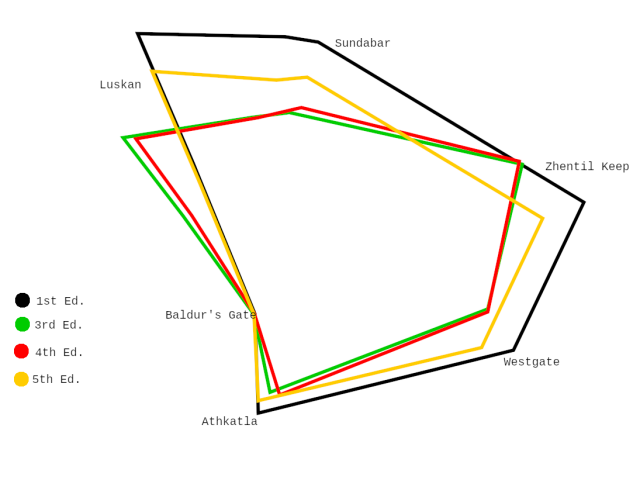
A discussion came up about how much the map of the Forgotten Realms was changed in size over the various editions, and I sat down to finally get a definitive answer to that.

As far as I can tell, the maps for 1st and 2nd edition are identical. The 2nd edition map perfectly overlaps all the outlines of the original, just prettied up to make it look more appealing. (An attempt was made.)

Working only with image files, getting the scale for the 1st edition map right took a bit of work. The Campaign Set and The Savage Frontier mention in the text the distances between various locations. Of these 11 given distances, two are completely off from all the others and as such I discarded them. The remaining nine were all in pretty close agreement and I went with the average of those to scale the image to the same scale as the other three.

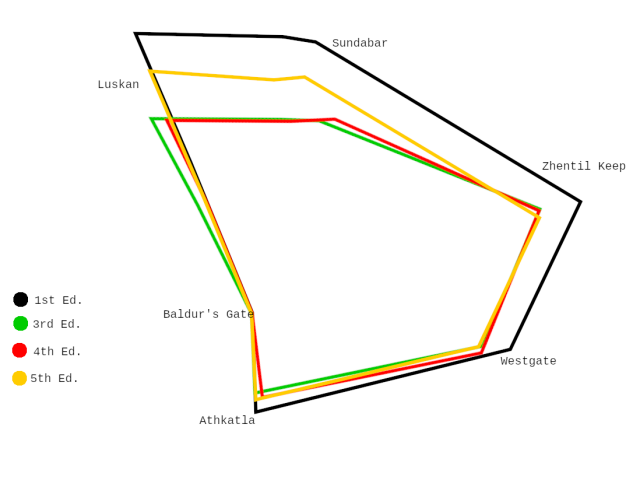
Making four overlayed layers into a comprehensible image would be an insane amount of work, so I have limited myself to a number of reference points and connected them with lines, which gives us this illustration.

As can be seen here, 3rd edition both scaled down and squished the map significantly. Even with all the major overhauls of the setting in 4th edition, the overall geography remained effectively untouched. In 5th edition, it appears they returned the overall shape of the landscape to its original form, but not its original size. Luskan and Sundabar have moved further North, but if you tilt it a bit, the distances between Baldur’s Gate, Atkatla, Westgate, and Zhentil Keep have not really changed at all.

Unfortunately, 5th edition only has a map for the Northwest quarter of Faerûn, but the changes that 3rd edition made to the rest of the map are also pretty  wild.

Visualizing populations

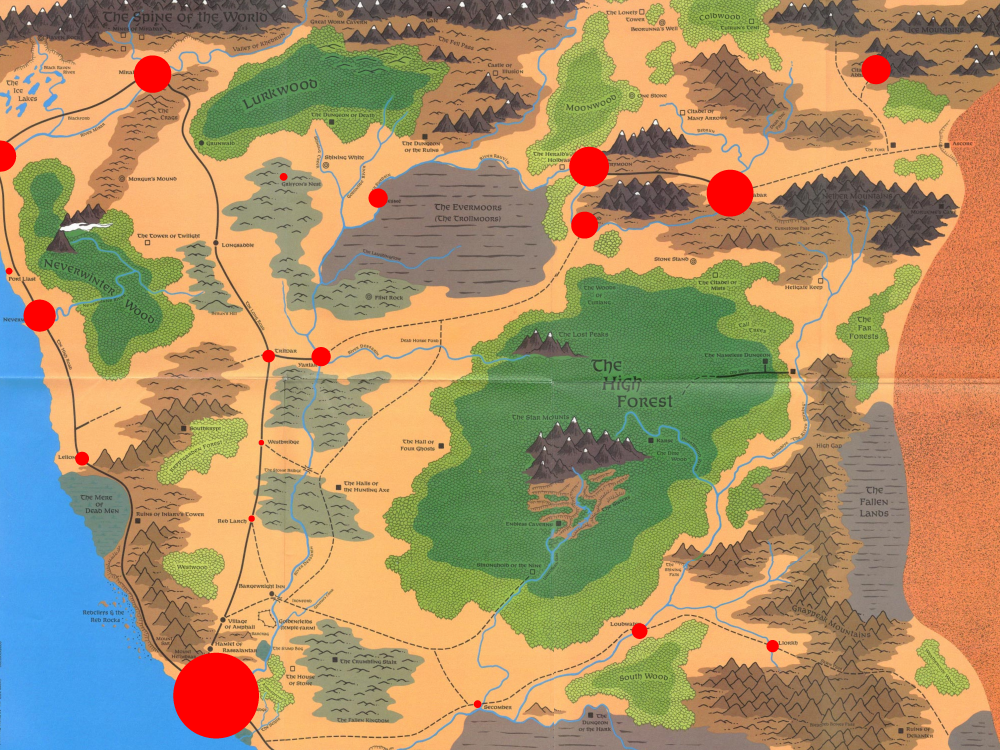
While considering what I would put on a map of the Savage Frontier that I would hand out to players to show the information available to their characters, I was using this original map of the North to mark which sites I wanted to include. I thought about using different sized circles for villages, towns, and major cities, and on a whim made the circles proportional to their population. (Square root of the population equals circle diameter.)

I had not expected it to come out like this. Of course, Waterdeep would be huge, but even with having seen the numbers for all the town many times over the last week, I did not anticipate this distribution of people. I had assumed that the inland road from Waterdeep to Mirabar would be the main area of population with all the black dots on the map, but aside from Yartar and Triboar, they are only tiny specks. In contrast to that, the three Rauvin cities Sundabar, Silverymoon, and Everlund really are one of the main concentrations of people in the region.

Looking at it like this, I think doing this little exercise could be really useful to get a first impression of a region when you read up on it. Actually, this area is the campaign setting I am most familiar with out off all that I know, and I still got surprised 20 years later.

Some other interesting things while I’m talking about this map. Back in 1st edition, the North Was way bigger than it has since 3rd edition. Distances have been shrunk to about 75% their original size, which reduces the total area of the region pretty much by half. Also at some point, the population numbers for Sundabar and Silverymoon got flipped around. Originally, Sundabar had a 30% larger population than Silverymoon. But with Silverymoon being more glamorous, they probably wanted to make it the shining capital of the far north. I think it being the smaller one, and the more industrial Sundabar being the larger one is actually more interesting. And did you know that  the people living on the Rauvin river are the last remnant of the Netherese? Somehow that detail never occurred to me all the many times I was reading 3rd edition material on the region.

The Forgotten Forgotten Realms

Playing Baldur’s Gate back in 1999 was really my first introduction to fantasy. My childhood had been full of medieval and fairy tale stuff, and I even had read The Lord of the Rings, but I merely thought it was neat and it was very much a one off thing for me. There were plenty of fantasy videogames around before that, but I never gave them a second look and was all into sci-fi stuff. Baldur’s Gate was what really opened  the gate to high fantasy as a genre and a major hobby. As such, Forgotten Realms dominated my early years of getting into RPGs. Back in the early 2000s, I had a very considerable collection of Forgotten Realms sourcebooks, both 3rd edition and 2nd edition. I was so much into The North, as was every other D&D fan around me at the time, that I even got the 1st edition The Savage Frontier to get every bit of existing material on the region, but found it very disappointing since at 64 pages it barely seemed to pass as a leaflet.

Looking back at more than 20 years now, my love for the setting didn’t actually last that long. By the time 3rd edition ended, I had already very much moved on and sneered at whatever passed as the 4th edition version of the setting just out of snobbery. All that dungeon punk stuff that spread through the revised 3rd edition also made it into later Forgotten Realms books, and that just didn’t feel right to me, whose first references had been Baldur’s Gate and the 2nd edition campaign setting box. And even that version of the Forgotten Realm had lost its spark, coming across as overly quaint and cozy.
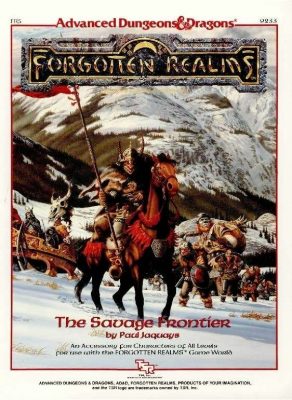
It was only much, much later, I think when I started getting interested in classic oldschool D&D, that I first got somewhat curious about the very first incarnation of the Forgotten Realms. At some point I directly compared the 2nd edition The North box with the 1st edition The Savage Frontier, and one thing that stood out to me that the new edition had killed off all the most interesting threats from the older version. Everyone slightly interested in the history of the setting knows that in 2nd edition they killed off all the cool evil edgelord gods. But it actually went much further than that. The demons in Hellgate Keep, the cursed adventurers in the Stronghold of the Nine, the Blue Bear barbarians who are manipulated by a disguised night hag, the orcs in the Citadel of Many Arrows, the mind flayer in the Ruins of Dekanter. The box even dedicates a paragraph with its own heading to The One, which informs us that he’s just not around anymore. Why even tell us about an interesting setting element that is not even part of the setting anymore?

I had been thinking occasionally about running a campaign in The Savage Frontier as it was originally presented, but I had hesitated for a very long until I got into 5th edition last year (and didn’t like it) and I never had any desire to actually try to run a campaign using the AD&D rules. I quite fell in love with B/X, but that game doesn’t have the bard, druid, and ranger classes, whose absence I think would really change the feel of the campaign. But recently I started taking a look at the Advanced rules for OSE and that stuff looks exactly like the perfect way to run an AD&D setting without all the AD&D mechanics. And being in a bit of a lull with my homebrew setting and not quite sure how I want to revamp it before I take it on another run, the idea to finally give that Savage Frontier campaign a shot came to my mind very quickly.
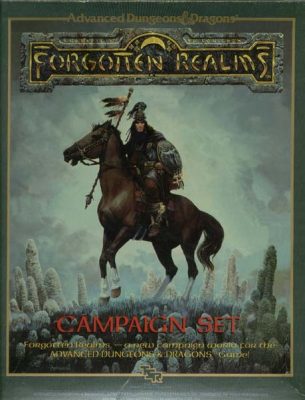
The idea I have is to run a campaign in the 1st edition version of the Forgotten Realms, ignoring all material that was released later, and simply taking the Forgotten Realms Campaign Set Grey Box and The Savage Frontier at their word. Of course, there would be a lot of blanks to fill in, since both sources are very sparse on specific details. The Grey Box only has about half a page on Waterdeep and Neverwinter, and The Savage Frontier has a total length of 64 pages. But as I can’t emphasize enough, the density of inspiring material is fantastic. It’s another Jaquays classic.

Having picked up the old setting again and going through it with an eye on how the original presentation of the setting differs from what was presented later on, I quickly noticed that it’s actually a really different place. The introduction of the Grey Box, we are informed, by I assume Ed Greenwood himself, that the Forgotten Realms are a world similar to Europe in the 13th and 14th century. I fully understand if this means nothing to anyone who isn’t a serious medieval history nerd, but right out of the door, this is a big one. 13th and 14th century is a completely different reference frame from what we’re actually seeing in the 2nd edition material. This is the time of seventh and eighth crusades, the Mongol conquests, the beginning of the Hundred Years War, the founding of the Hanseatic League and the Teutonic Order, and the conquest of the pagan Balts and Prussians. In contrast to that, the 2nd edition setting is much more in the style of Shakespeare and the English Civil War without guns, which places the reference time frame into the 17th or even 18th century. I don’t know how well the writers of the Grey Box were familiar with medieval Europe or how good available material in public libraries would have been in the mid 80s, so there really is no way to tell how much weight should be given to that claim and how much of a shift there really was in the minds of the people working on the 2nd edition boxes. But as I said, my idea is to take these sources as literal and attempt to use the material as it is presented, not as it has later become commonly interpreted. This already changes my perception of the world noticeably.

The same introduction also tells us that the contemporary civilizations are fairly new, and most of the land of the Forgotten Realms has until recently been uninhabited wilderness. From the perspective of a 21st century armchair historian that sounds rather implausible, given that a 13th century level society doesn’t spontaneously crawl out of caves and tree hollows, but I am still willing to make the effort to interpret the intended purpose of that statement. Maybe we can assume that some already existing advanced cultures in some core regions of the Realms have spread their knowledge to various barbaric societies beyond their borders over the last couple of centuries, similar to how the Romans interacted with the various Iron Age societies of central Europe. But to the writers’ credit, it is stated specifically that civilization primarily consists of independent city states. And true kingdoms like Cormyr are actually rather rare. At the end of the day, it’s fantasy, and there is no long detailed timeline of historic events to further scrutinize. What matters at the end of the day is that we have a tech-level and local social structures resembling the 13th century, and that people live in city states scattered across a vast wilderness. And it really is vast. The Savage Frontier itself is the size of the American Northwest, British Columbia, and southern Alaska, which I also think are the intended reference for the geography and environment of the region.

In The Savage Frontier, some more details are given on the demihuman and humanoid race that inhabit the North. Like the setup in Gygax’ game rules and Greyhawk setting, it’s made quite clear that is a setting not just predominantly, but nearly exclusively inhabited by humans. I’ve always envisioned the North as a region where elves and dwarves still have one of their strongest presences, but the actual presence described here is extremely slow. Dwarves really only have one major city, the Citadel Adbar, which is on the very edge of the map, in the most remote corner possible that you could find. And in this case, “city” refers to 14,000 dwarves, which puts it behind such famous metropolitan center as Luskan and Mirabar. The only other significant dwarves settlement is the mining town Ironmaster near Icewind Dale, which hardcore fans might remember having seen on the maps, but probably never heard anything about either. Citadel Felbar is still the Keep of Many Arrows, and at this point Bruenor Battlehammer is still only planning to reclaim the abandoned ruins of Mithril Hall. For the elves it looks even bleaker. For all intends and purposes, the elves of the North are gone. Their only significant presence is a clan of “elderly” elves in Ardeep Forest outside of Waterdeep. The description of Silverymoon mentions that it’s such a magical city that you can even meet elves there, a statement that is even deserving an exclamation mark! Gnomes are mentioned once by stating that there aren’t any in the North. Halflings are, but not much more is said about them other than that they are rare because they don’t like the bad weather. A personal guesstimate by me about relative populations in the North would be 93% humans, 3% half-elves, 2% dwarves, 1% elves, and 1% halflings.

Considering again that the Forgotten Realms as a whole are described as a fairly desolate place were most places have been settled only recently, it really makes to call the North “the Savage Frontier”. This place is really remote and even more sparsely settled than most other regions. To me, this is just shouting “wilderness campaigns”. One thing, that I am sure is very deliberate, is that it seems that the majority of ruins that are listed and described, are clearly stated as being former elven or dwarven strongholds. The history of the North is quite vague, but it appears to establish that the disappearance of the majority of elves from the region took place over 6,000 years ago. The prime of the dwarven kingdom was 2,000 years ago. That means those ruins are all incredibly ancient, and with no elven society remaining in the region, their true histories would be completely unknown. They are not simply known old ruins that have dangerous tunnels beneath them. Most ruins in the region would probably be ancient stones of which nobody has any shred of knowledge what they once were. That paints a very different picture than I always had about the “famous” ruins of the Forgotten Realms. With the current human civilizations being quite new, it is very likely that many of these ruins have not been seen by anyone for thousands of years.

Regarding humanoids, orcs get a good number of mentions and are described as having a significant presence in the northern mountains. Goblins are mentioned, but no real details given about them, and gnolls, kobolds, and kuo-toa aren’t mentioned at all. There is a single mention of a mind flayer, but actually several on beholders. Not quite sure what to make of that. That could indicate that humanoid monsters other than orcs don’t have a meaningful presence in the region, but it is also quite likely that they simply don’t get mentions because they are assumed to be generic dungeon critters.
Mage Hunter focus for Worlds Without Number

When I was thinking about treating magic as something inherently demonic in nature and commonly regarded as a violation of the divine order that governs the physical world, I originally had the idea to create a Mage tradition like the Healer or Vowed for priests who are trained in countering and negating the effects of magic. But a tradition means the character has to select 8 different arts by 10th level, and the total pool of arts to pick from should be considerably larger than that. But as it turned out, coming up with 12 different powers that counter magic and can be rationalized as not actually using magic themselves is really quite the challenge. To be a good mechanical representation of the concept, having a pretty small selection of very basic abilities feels a lot more fitting, and so I ended up making the Mage Hunter a single focus instead of a full tradition.

Nothing about this focus is really an original creation by me. All I’ve done is to take already existing mechanics from Worlds Without Number and arrange them in a way to become accessible to a broader range of characters. I think this is a good example to show how easy homebrewing new content to bring your setting to life can be.


Mage Hunter

Level 1: Gain Magic as a bonus skill, and Effort with a maximum of your Magic skill level plus your Wisdom modifier. You also gain the Sense Magic art.

Sense Magic: Commit Effort as an Instant action; while it remains committed, you can visually perceive magical energy and get a one-sentence description of the effect of any standing magics or magical items you inspect.

Level 2: You gain the Counter Magic and Suppress Magic arts.

Counter Magic: Commit Effort for the day as an Instant action when a visible enemy mage casts a spell. You make an opposed Wis/Magic check against the casters Int/Magic or Cha/Magic skill checks; if you win, their spell fizzles and is wasted. You can use this art no more than once per round.

Suppress Magic: Commit Effort for the day as an On Turn action and target a visible or known magical effect within one hundred feet. The effect is suppressed for 1d6 rounds plus your character level. Spells cast by more casters of a higher level than you may not be successfully suppressed. You can attempt to suppress an effect only once.