Speak no Evil, see no Evil, hear no Evil, do no Evil

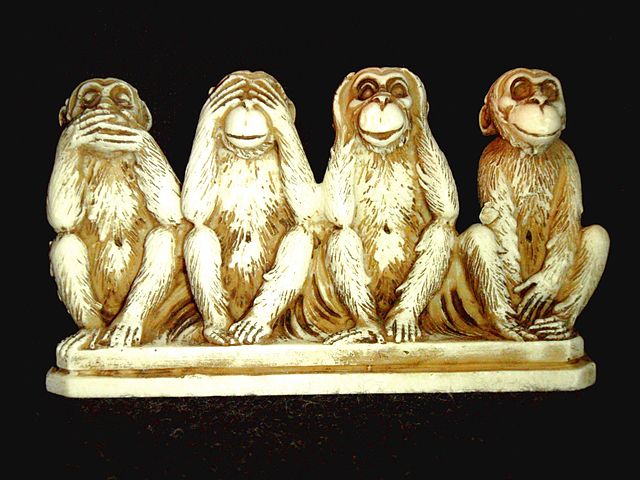
640px-Four_wise_monkeysReading a recent post from Bat in the Attic on the never ending topic of alignment in Dungeons & Dragons, one part did get me thinking:

What is good and evil? That is something each referee has to define. There is no right answer, my only firm recommendation is that there is answer and that it is consistent.

I had taken numerous classes on Asian philosophy and religion at university and one of the most interesting observations was that the concepts of Good, Evil, and Sin, as we are using them in European thinking and languages, don’t really apply in other parts of the world. They are frequently used in translations of Indian, Chinese, and Japanese texts, but such translations are both incorrect and misleading.

So why, instead of simply using mechanics as a rule in an RPG, not even taking the additional step and having a world in which not even the very concept of Evil exist at all? The concepts of Good and Evil assumes that there are universal rules, which can be followed or broken, and which have been put into place by some higher authority that is universally aknowledged to have the legitimacy to do so. This makes sense within Western and Islamic thought, where such a legitimized higher authority is assumed by default, even subconsciously by most people who rationally reject the notion. But in most fantasy worlds this is not the case and all you have is multipe higher powers that propose different views of morality and whose existance is universally accepted, even if most people chose to follow only the ideals of a specific deity. But without a single universal authority, you can’t have universal rules. Trying to enforce some kind of objective notion of Good and Evil seems arbitrary at best, and entirely inconsistent at worst.

Which is not to say that the majority of humans throughout human history did not have any notions of right and wrong. In Asian models of thinking you often find a related, but different concept of Beneficial and Harmful. In particular, beneficial and harmful for the pursuit of peace and harmony. Something that is harmful might not be considered evil, and some things that are good might not be beneficial. The concepts behind the monkes are of course not “see no Evil” and “hear no Evil”. The actual meaning is “do not watch harmfully, do nor listen harmfully, do not think harmfully, and do not act harmfully”. Yes, you can watch and listen harmfully. Being a spectator to bloodsports and public torture may not be Evil, as you’re not performing any evil deeds, but you still darken and corrupt your mind.

So why not have a fantasy setting in which Good and Evil do not exist. Not only not as forces, but also not even as concepts? In a roleplaying game, especially when you are running one in a homebrew setting, this is probably very hard to communicate to the players. But I think it might be a really interesting thing to attempt in my fiction writing. Most people would probably not notice it, especially in a Sword & Sorcery setting where things tend to get quite dark by default. But completely avoiding the use of the word “evil” really shouldn’t be difficult at all.
Fantasy Safari: The Theragraphica (Atlantis), Part 2

Chapter 3: Atlantis

The Apata Ori appear like the heads of giant stone statues but are in fact some kind of spirits. Usually they slumber in places near natural concentrations of magical energy but awaken when someone disturbes these magical fields. Then they fly into the air with the glow of lava coming from their angry eyes and screaming mouths. They shout in voices that sound like grating stones, but their speech is usually intelligible to almost anyone. When an Apata Ori attacks, it surrounds itself with a spinning cloud of sharp shards of bronze, which it can throw at targets up to 50 meters away and shred anything that gets too close to it. They also cast spells like a sorcerer.

A Diomekses is an atlantean horse of the finest breeding and stature, but has been corrupted by the evil god Ba’al. It often stands near roads for wanderers to come by and approach to capture it. Then ir reveals it’s maw full of sharp teeth and attempts to swallow the person in one pice. Which is obviously way too big for an ordinary horse to swallow so there has some massive jaw stretching to go on that defies ordinary physics.

The Loving Dead is one of the weirdest ideas for an undead I’ve come across. And not necessarily in a good way. It’s the corpse of a dead person that rises from its grave to seek company among the living. When it finds a target it hypnotizes it with its gaze, takes the person back to its resting place, and then suffocates it with its embrace over several hours.

The Ubuze is a tiny insect that is believed to feed on magic minerals used by the Atlanteans in their magic creations. They produce a soft blue light similar to fireflies and also small amounts of heat. Ubuze are attracked to shiny surfaces like polished metal or gems and have some means to attract more of their kind when they find any such object. Sometimes miners breed swarms of these tiny animals and release them in the night to be lead to any valuable metal deposites in the area. In the wilderness, a swarm of ubuze can be seen from miles away and is usually the sign of some valuables being exposed to the air, which of course does attract a lot of attentions from other people in the area. A swarm of ubuze might get quite annoying when adventurers try to secretly carry treasures through the wilds and make the job a lot more difficult. There once was a sorcerer who created a magc crystal that could attract any ubuze within a vast area. The swarm it attracted was so massive that their combined heat burned down an entire city before the gem got stolen and safely stored away.

Continue reading “Fantasy Safari: The Theragraphica (Atlantis), Part 2”

B/XoL: Hacking Barbarians of Lemuria for treasure hunting

Here’s an interesting idea I’ve been pondering all day. Using Barbarians of Lemuria to run an oldschool campaign in the spirit of the old Basic and Expert rules of Dungeons & Dragons. I really quite love the style of adventures that is presented by this version of D&D, but I am just really not a fan of the game at the most basic level. The entire combat system and magic system just isn’t to my liking. BoL on the other hand is pretty close to ideal to what I want out of a rules system.

However, it could be argued that even Basic D&D and BoL are build on fundamentally different assumptions that make them highly incompatible with each other. The main difference is that D&D is build entirely around the assumption that the players want to get Experience Points and treasure, which make them more powerful and better equipped. On the other hand, BoL does not have any XP or treasure, and equipment is extremely limited.

But I think I’ve found a neat and very effective solution to this problem. By default, characters in BoL advance by finding some treasure of indeterminate value during the adventure, and at the end the players describe how they drink and gamble it all away in true Sword & Sorcery fashion. Depending on how creative and “heroic” the players describe it, their characters get between 1 to 3 Advancement Points, which they can use to improve their characters abilities. Instead of doing this, it’s trivially simple to not give the players AP based on the story they tell, but at the rate of 1 AP for every 10 treasures they spend. A treasure could be anything; a sack of coins, a golden idol, a big gem, some fine silverware, or whatever you want to think of. In practice it doesn’t matter. When the heroes search a vault or a fallen enemy, the GM can either describe what they find or simply say that they stuff 2 treasures into their pockets. They still don’t get Advancement Points for beating an enemy like in D&D, but I think it’s really the XP for treasures that makes the old editions of D&D so fascinating.

Another important element of the Basic and Expert rules is that players need to ration their supplies and have to judge how much food and treasure they can carry at the same time and how much it will slow them down between destinations in the wild. (Don’t want to find out in the middle of the dessert that you should have better taken one more skin of water instead of another bag of gold.) That will take some more thought, but I might get back to this somewhere the next days.

Fantasy Safari: The Theragraphica (Atlantis), Part 1

As the third book of the Fantasy Safari, my choice has been the Theragraphica for Atlantis: The Second Age. Having been released as pdf only last November, the printed book has just been shipped to backers of the kickstarter campaign. It’s simply an astonishing book and in my opinion even beats the Fiend Folio. It was actually the main reason I did pick up the Fantasy Safari series after such a long break, simply because I want more people to know how amazing this book is. (And the game it’s for is really great, too.)

Since this is a very new book by a small publisher, and they haven’t put the art for it online, I am not going to copy all the pictures here. But I think for this book this also won’t hurt much, as these creatures are really much more about their strange behaviors and weird abilities, and simply going by physical appearance might even create the false impression that they are rather mundane. But believe me, they are not. Or don’t believe and see for yourself what I am going to tell you about them. There are over 170 creatures in this book and I am only going to talk about my personal favorites in detail. Otherwise I’d never get through all of them.

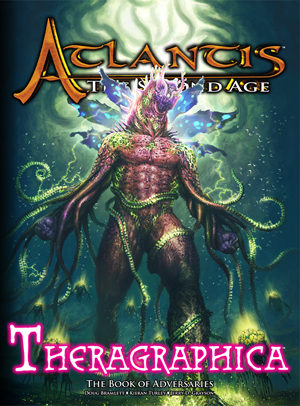
Atlantis: The Second Age - Theragraphica
Atlantis: The Second Age – Theragraphica

Theragraphica for Atlantis: The Second Age by Khepera Publishing, 2014; 131 pages of monsters.

Atlantis is a relatively simple system, compared to D&D and d20 games, so the stat block for each creature is quite short. They have 14 stats plus two lines for damage and armor, and a short list of any special abilities and weaknesses. As a rules-medium game, the explanations for all special abilities are explained once in the back of the book and not elaborated on in each individual creature entry. Which at first was a bit confusing, because the creature descriptions often don’t really say what these abilities do either. But in truth, this works all really well and effectively. Aura of Fear always works the same for all creatures (with the specific strength depending on attribute scores) and is really pretty self-explanatory. The creature is scary. Those who see it close up get scared. Poison also always works the same way and a creature that attacks with its teeth obviously has poisonous bite, and one that attacks with a stinger obviously with a poisonous sting. This is information that does not need to be spelled out again every time and every GM can figure out how to describe it with a little bit of imagination. Because of that, the descriptions for each creature are really very short. Often just three or four sentences. But the free space that is left on each page is used well with a big picture of the creature, which are mostly very well done. All this combined, I feel like I am getting a lot more flavor from these monsters than from most other monsters books. My descriptions of each creature I’ll present will most likely be longer than the actual descriptions that are in the book, putting into words and talking about all the thoughts that come to my mind from these very dense entries.

I actually have not read the entire thing myself yet, but just having read a quarter of it in detail and seeing all the pictures has gotten my really exited about this. So, here we go:

Continue reading “Fantasy Safari: The Theragraphica (Atlantis), Part 1”

Ancient Lands: Magic

In the world of the Ancient Lands, there is only a single supernatural force at work. Life force, magic, spirits, souls; it’s all the same basic energy that is found inside and between everything. This energy is what gives living creatures their strength and make them grow and heal injuries and disease. It is also what creates the souls of mortal creatures and in places where the energies of the landscape are strong, they manifest in sentient spirits of great power.

The arts of magic are the mastery of the ability to not just call on the life energy within oneself, but to extend ones mental control to the energies around one and even inside other objects and beings. When casting a spell, a mage is sending a ripple through the energies surrounding him to manipulate the energies within creatures and objects to his desire, just as normal people control the energies within their arms and legs. Magic spells can make plants grow or move, split or shove away rocks, create lightning and set things on fire, and even take some control over other creatures thoughts. To be able to manipulate the life force and magical energies at a distance, mages needs to build up a reserve of energy separate from their own life force, which they accomplish by many years of training and meditation. Once this reserve is spend, they can no longer cast any spells until the energies are restored. People who have mastered magic, and creatures that are naturally magical, require almost no effort to regain their spend magical energy. Their energy reserve has become a natural part of their own being and during rest energies from the surrounding environment automatically move in to fill the void and restore the natural balance of energies. Compared to the amounts of energy in the natural world, even the most powerful spellcasters can store only such a small amount that there is no noticable drain of life force in the creatures and plants arround them.

Blood Magic

In the earliest days of the mortal races, the magical abilities of spirits and other magical creatures was not yet entirely understood and the earliest mages did not yet have the ability to create reserves of magical energies to power their spells. But they realized that magical energy and life force is essentially the same and in no other part of a mortal creature is its life force as strong and concentrated as in the blood. Not only could these early mages use the energy in their own blood to cast their spells, they could also use the life force of other living creatures.

When the more common forms of magic were discovered, this blood magic was soon abandoned. The storing of magical energies from the environment is not only much more effective, but also much less painful and gruesome. However, unlike many shamans and witches would like to believe, the traditions of blood mages never entirely disappeared and continued to exist in some small remote places for all the thousands of years. Pure, traditional blood mages are almost unheard of in the present age. The advantages of using the magical energies of the surrounding natural world are just too great for any mage to ignore. But there are still some advantages to blood magic, which allowed the ancient traditions to survive. By drawing the life force from their own blood, blood mages can significally extend their reserves of magical energy and even make their spells stronger and more powerful than they would usually be able to. And by using the life force of other living creatures, blood mages can have access to vast amounts of magical energy for prolonged rituals and large scale magical effects, that would take ordinary mages days or week. Because of the violent and gruesome nature of blood magic, most people regard it as savage and horrific, but contrary to common believes, blood magic itself does not have a corrupting effect on those who use it or are affected by it.

Demonic Energy and Corruption

Outside the natural world that consists of the material world and the Spiritworld exists a realm of infinite time and space that is simply called the Void. Just as there are spirits in the natural energies of the spiritworld there are also beings born from concentrations of the energies of the Void, called demons. When mages learn a way to create a connection to the Void, it allows them to draw some of its energies to their own world and use it as an additional source of magical power in addition to their own. With these energies they can create spells that can not be cast with magical energies of the natural world and it also greatly increases the number of spells they can cast before their reserves are exhausted.
However, the natural world and the Void are realms of completely different laws that are conflicting with each other and bringing energies from the Void into the natural world causes it to become warped and twisted, an effect known as corruption. The demonic energies are toxic to any living things that are affected by it. Mages who have mastered their use can learn to resist its effects and may show only very little signs of the massive exposure they recieve from many years of casting demonic spells. However the land around their homes and lairs becomes significantly affected, making these places hostile to all living things, turning them weak and sick and eventually killing them.

But corruption is not simply a drain of life force, but a warping and twisting of it, and corrupted life force is still able to support life, at least in a manner of speaking. When creatures becomes entirely corrupted but do not simply fall dead, they turn into the undead. Zombies and skeletons are corpses that have become powered by corrupted energy after their death, while those who have never really died become ghouls or wights. In rare cases, a person dies but the corrupted energies that have been part of him continues to exist as a faint afterimage of a creature known as a shadow. When the corruption has been so complete that the soul itself has become corrupted, it continues to exist even after the body has died as a wraith.

Why the right name and cover for a game is vital

I believe I’ve found what is possibly the worst name and book cover for an RPG I’ve ever come across.

mog1301
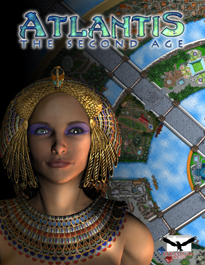
Atlantis: The Second Age (First Edition)

Doesn’t look so terrible? You probably think you’ve seen far uglier things before. But this isn’t about beauty, but appropriateness. The game is called Atlantis: The Second Age. What does that make think you off? A utopian society from the Golden Age of Greek mythology where people were enlightened and lived in pleasure and luxury? And look at the cover art. This women decked out in jewelry and in the background a map of a precisely geometrically constructed city with parks and palaces.

But why is this so terrible? Think about the assumptions you make what this game is like and how it plays? It certainly does not say action-packed Sword & Sorcery based entirely around mechanics that encourage and reward the players for outragous stunts and hot-blodded carnage, where your characters grow in power based on the awesomeness of their heroic deeds. A world where you can play as a hyper-intelligent gorilla with guns? But that’s what you actually get once you make it behind this cover and take a look at what’s inside.

atl3
Atlantis: The Second Age (Second Edition)

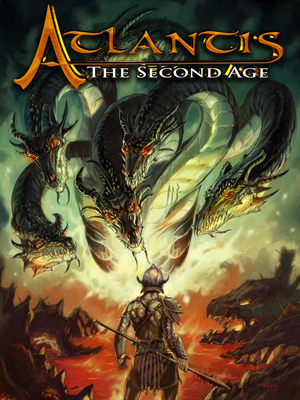
The recently released second edition still carries over the legacy of this unfortunately boring name, but look at the cover! This is awesome! So much more better than the first edition that was the incarnation of boring. This one captures perfectly what this game is all about. Being a total badass slaying legendary monsters and adding their feared reputation to your own glory.

I quite like Barbarians of Lemuria as a lightweight Sword & Sorcery game. And while Atlantis is significantly rules heavier (though still quite moderate), there is so much more flavor and incentive to actually play an over the top Sword & Sorcery hero.

And let my say it again: Hyper-intelligent gorillas. With guns!