Supernatural Adventures

Worldbuilding is all about finding a specific theme and atmosphere that pervades everything within the setting. Places, people, magic, and technologies are all means to bring that specific mood to life and make the audience feel it. But at the same time I don’t believe it’s possible to really know the right mood for the world right at the start of the worldbuilding process. You have to start with ideas that might be cool and then experiment with them to discover which work well together in a way you enjoy and then let a more specific concept take shape through these efforts. With the Ancient Lands I originally had an idea for a pretty standard fantasy world but simply with more wilderness and elves and dwarves as the primary races and humans one of several minor ones. It’s still a good idea but over the time I discovered that there are other related concepts that I would enjoy even more pursuing.

But in practice I often tend to lose track of some of the design decisions I made over the years and find myself further developing ideas that I had previously decided to drop. This requires to constantly finding the focus again, about which I wrote in my Project Forest Moon post two weeks ago. But a bit before that I wrote a few posts about antagonists and adventure templates. Which I think are pretty good, but they are for a setting about tribal warfare. Which really isn’t what I want the Ancient Lands to be. My favorite branch of Fantasy is Sword & Sorcery, which ultimately is about encounters with supernatural forces. Which my templates for antagonists really just aren’t and most of the templates for adventures aren’t either. They work, but they are generic. They don’t really do much to evoke the atmosphere that I want the Ancient Lands to have and which is meant to make it stand out from among other settings.

Another thing is that my enthusiasm for sandbox campaigning isn’t really holding up. I’ve been working on an outline for my next campaign for the last days and a sandbox where the players are meant to freely chose which of the ongoing background conflicts and events to get involved with just doesn’t get me excited as a GM. I see the potential of the concept, but I am just not feeling it. I feel much more drawn to keep running open ended adventures that encourage players to make use of support from people they had previous dealing with. A little bit like a sandbox, but one in which I chose the quest and give it to the players and then let them do with it whatever they want. Not plotting out the adventures for the players but “just giving them a little shove out the door”, as one bearded guy with a hat once said.

Now to the good part. What kinds of adventures do I think make good templates for a setting that is about encounters with the supernatural and exploring wondrous places? Here are a few ones on my new list of quests:

  • Hunters report finding a ruin that was previously unknown. But being just hunters they didn’t explore it and leave that up to actual heroes. Alternatively, people have been seeing strange things from a great distance, indicating that an already known place no longer is as empty as it was believed.
  • Water becomes unusable or wild animals are disappearing. This means someone has to go and find the source of this problem and deal with it, or the villages might have to be abandoned. It could be the work of a rare creature or a spirit or sorcerer who wishes the village harm.
  • Supernatural forces prevent access to a valuable resources. It might be a mine or a well, a hunting ground full with animals, or an old pilgrimage site. But something unnatural has taken hold of the place and makes it impossible for people to use it. It could be something new that is disrupting the life of the local people, or something very old that has made the place inaccessible for a long time and recent events make the use of the site vital to the people.
  • A returning hunter brings a curse to the village. It could be something that he did while on the hunt, a place he stumbled on, or an object he picked up. Now some kind of magical malady spreads through the village and heroes have to deal with the source and remove the effects it caused. Both can require visiting magical places or strange spirits to find a solution.
  • Enemies of the clan have gained supernatural help that lets them attack the village. This supernatural influence has to be broken to save the clan from being defeated. It could be a sorcerers, a dangerous spirit, or a powerful ancient relic.
  • Something is threatening the guardian spirit of the village. It has to be found and stop or the village will be unable to survive without its guardian. Often its a sorcerer who wants to steal something from the spirit or an attempt to weaken the villages under the spirit’s protection.
  • Villages or traveling merchants have been disappearing. They have fallen victim to a spirit or wandered too close to a newly appeared or unearthed supernatural danger. The victims have to be saved and the danger stopped. They may have been made to serve the spirit or have otherwise been changed to be hostile against the heroes who come to investigate.
  • The village’s guardian spirit demands a task has to be fulfiled. Often it will be some form of regular tribute that has been pledged by the founders of the clan in exchange for the protection of the spirit. Or one of the sacred laws has been broken and the spirit demands that the people do something to restore the supernatural order. It’s also possible that an enemy deliberately tried to disrupt the peace between the spirit and the villagers and might perhaps have stolen or destroyed an important object that needs to be recovered or replaced.
Not everything is trying to kill you

I think the greatest thing that oldschool roleplaying brought to the attention of younger GMs like me is the whole system of wandering monsters, reaction rolls, and morale checks. When I first got into RPGs I occasionally saw mention of them, but they seemed silly and annoying for what I assumed a good adventure to be like and a good riddance in general. But after having played and run games for over 10 years, all the adventures never turned out to be anything like what I had been hoping they would. And I think it really comes down to D&D of that time having abandoned the aforementioned mechanics. Which didn’t start with 3rd edition but actually preceded even AD&D 2nd edition for a good number of years.

My first contact with RPGs was Baldur’s Gate and that set a precedent of what I expected adventures to be like and I found it confirmed by AD&D modules I’ve looked at. When you encounter a creature, one side makes a surprise attack and then the fight continues until one side has been wiped out. The characters get XP and the treasure lies where the enemy fell. Having creatures appear randomly and someimes trying to run away would be a nuisance and interrupt the plot. But videogames NPCs are still absolutely primitive compared to one controlled by a GM and I much later learned that most of the modules were not meant to be normal AD&D adventures but tournament modules for conventions where many groups would play the same dungeon simultaneously as a single session one-shot and then compare which party got the most points. Which is why The Tomb of Horrors is so awful. It’s not meant to be part of an ongoing campaign, but unfortunately fails to explain that to GMs who read it.

Wandering monsters in a dungeon have the main function of keeping the party moving and the clock ticking. They make resting in a dungeon almost impossible and that means your spells and hit points have to last you through the whole expedition. Since wandering monsters have negligible treasure and roughly 75% of XP are expected to come from collecting gold, fighting them is just a waste of resources and a risk of death with barely any reward. And as wandering monsters are encountered based on time spend in the dungeon, there’s a real incentive to be quick. Giving the majority of XP for treasure also has the effect that it is often more efficient to just steal treasure without a fight and minimize the loss of spells and hit points (and party members). Getting 75% of XP for stealing treasures without defeating the owners will get you more than getting 100% from just one creature. XP for gold seemed silly, but is actually great design.

It also makes morale checks much more interesting. An opponent who runs away may abandon its treasure. Every round you don’t have to fight saves you more hit points and spells and allows you to continue the current expedition a bit longer. Yes, they run away with their pocket change, but you still get all the XP for having defeated them.

But let’s now look at reaction rolls, which are perhaps the most intriguing element of oldschool roleplaying. A reaction roll tell you how a group of creatures or NPCs will react to encountering the PCs when their reaction is not predetermined by the adventure or obvious. I took notice of this and mentally filed it away to be used with animals encountered in dungeons or NPC parties encountered during overland travel. But what does “obvious” actually mean? A group of zombies? Yeah, obvious. A golem guarding a door? Predetermined by the adventure. But what about a group of orcs sitting around a campfire? Obvious?

Well, I always assumed it is, based on fantasy books, movies, videogames, and all the adventures published by WotC and Paizo. But this is a preconception that is not actually supported by the 1981 Moldvay Basic rules. Yes, orcs are chaotic and it says that Chaos generally means evil. But player characters can be chaotic as well and they are members of the party. Chaotic indicates breaking rules and promises when it benefits you and you can get away with it. And what benefit is there in randomly attacking groups of well armed people?

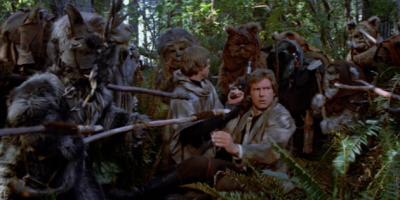
I always found it somewhat difficult to interprete the rection table. What does it mean if the result is “Hostile, possible attack” or “Uncertain, monster confused”? But with a bit of searching you can easily find a few examples from fiction. When Bilbo encounters Golum under the mountains, Golum plans to kill him and eat him. But he doesn’t have surprise and knows that frontal attack is risky so he keeps Bilbo talking in the hope of getting an opportunity where he has advantage. That fits very well with “Hostile, possible attack”. Another good example is in Return of the Jedi when Leia encounters the ewok Wicket whose reaction is just spot on “Uncertain, monster confused”. He holds up his spear but only to keep her at a safe distance, not with an intention to attack her. Because she handles the situation well she’s able to get the ewoks as allies. A bit later the others get in a similar situation but Han handles it less well ad the ewoks decide to cook them.

return-of-the-jedi-ewoksOnly on a roll of 2 on a 2d6 does a reaction roll actually indicate an immediate attack and a 3 to 5 indicates hostility with a chance that the creatures might attack. This results in only a 28% chance that a fight breaks out without the players initiating it. If you start making reaction rolls for any encounter where the reaction isn’t automatically fixed, it will change the game quite a lot. Orcs and ogres are no longer monsters but people just like bndits, mercenaries, or barbarians. Their culture might be different and unappealing to many of the PCs, but if the players handle it right they can be interacted with just like people.

This affects both worldbuilding and the way that adventures play out. A dungeon in which only a third of encountered denizens are hostile and the rest could provide information, cooperate with the PCs, or even offer free help is a very different place from the common deathtrap presented in most modules in which everything including the kitchen sink tries to kill you on sight. And again, this is supported by XP being gained mostly through finding treasure. How much XP you get out of a dungeon does not depend on the number of fights. XP for gold may not be perfect, but it certainly beats XP for combat only. If you get a reward for fighting and no reward for not fighting, the message for players is clear. Kill everything. (Don’t let them run away, they take all their treasure with them which you need to buy magic items from stores.)

This encourages and supports a play style that is really about exploration and discovery of fantastic environments the PCs will find themselves in. Treasures are an incentive to poke around and find hidden rooms, but seem much less like the main purpose why you go on an adventure. The options to discover things about the environment and the greater world are very much limited when all your interactions are with statues and wall paintings. There is so much more that can be leared by interacting with other people and the knowledge you gain becomes much more useful and meaningful if it can help you with dealing with other people you’ll encounter later. Or possibly people you encountered before and who might reward you for sharing your discoveries.

Another fascinating part of the rules that had almost entirely disappeared are retainers. In 3rd edition you have to be at least 6th level and spend one of your precious few feats to get only one retainer. In Basic everyone can have around 4 at first level for free. (You have to pay wage, but that’s no limited resource.) My assumption was that you’re meant to post job offet notes at the market place and then pick one of the people who come to apply. But that’s not what the rules demand. A much more fun and interesting option is to recruit people you meet on adventures. It says retainers can be of any level or any class but not have a higher level than the PC they follow. But the Hit Dice of a monster are effectively the same as class levels in every way. Once you make it practice to befriend monsters, why not let players take them along as retainers? The GM would have to rely on making good judgement calls on what kinds of monsters might possibly be hired. A black pudding or a purple worm would be silly. But if it’s reasonably intelligent, able to integrate into society, and the player mange to get it friendly, why not?

While working on my setting and preparing for my next campaign I wanted to do something different than the average treasure hunt or assaulting the lair of a villain over and over. Instead I want to do something much more fantastic that focuses and supernatural things and discovery. I mostly failed at this with my last two campaigns and even in the last months much of my preparation once again ended up focusing on humanoid antagonists. Realizing that the 35 year old Basic rules suggest a world that is much less hostile and encouraging cooperation with dungeons denizens between the line has been a major eye opener for me. And once more makes me feel amazed that an RPG so close to what I consider perfect has been around almost from the very beginning. (There’s still negative armor class and spell preparation, but those are easily fixed and exist for the purpose of edition compatibility.)

Setting Modules

In a discussion about The Maze of the Blue Medusa, one person mentioned that despite many highly positive reviews for OSR “settings”, there seem to be barely any people who say that they actually ran a game in Red Tide, the Red and Pleasant Land, Qelong, or Yoon-Suin. Despite the praise and the money people pay for it, they seem to be barely getting used by anyone.

Which wouldn’t really be that surprising as the people who enjoy this kind of content tend to be people who also create a lot of their own custom content for the campaigns they run. The main draw seems to me, and probably many others, to salvage these books for ideas. I regularly buy books for games I don’t have or know the rules for, or ever have any intention to play. It’s always all idea mining for me with everything I get for RPGs. I don’t think I ever used anything out of the box since my earliest hears with D&D 3rd edition.

And I believe many of the people who make OSR settings are very much aware of that. Vornheim and Yoon-Suin can’t really be considered settings in the traditional sense and are really all about being toolboxes for creating your own content. My impression of Red Tide is that the setting of the islands and the backstory of the setting is really mostly a practical example for how a world using the tools in the book could look like.

My previous Ancient Lands setting was very traditionally designed like the many settings of the late 80s and the 90s, but when I started all over with a blank canvas to do the Old World I abandoned that approach pretty much entirely. It’s not practical for running my own games and I doubt there would be more than two or three GMs in the world who would actually run a campaign if I would get it into a releasable form.

I recently looked into One Page Dungeon after talking somewhere about my frustration with typical D&D settings being so vague on adventure locations to be practically useless. As all dungeons are made independently by completely different people and the only format restriction is that it has to fit on a single page, people have been trying out a lot of different things with that idea. And I think this could be a really good approach for small scale campaign setting writers in the coming years. Completely abandoning the idea that a setting is a single world and instead providing collections of thematically matching but mostly stand alone pieces of content.

Retainers as local guides

Today I was watching Matt Coleville’s latest video (even as a GM of 15 years I still find them really helpful) and he mentioned that he prefers to answer any questions the players have about the world through NPCs. In fact, he finds it annoying when the players end up in situations where they have a lot of questions but he didn’t arrange for any cooperative NPCs to be around to ask. As a GM running a game, you really are the only channel through which the players can perceive and experience the world around their characters. Trying to trick the players into making mistakes based on false assumption is both trivial and cheap. There is nothing clever about it since the players can only know anything based on what you tell them and how to tell them.

Even when you have no intention to trick the players that can still be a problem. Unless the group is particularly screwed up, most players will always take their GMs by their word. Otherwise you can’t really effectively play. But very often you want the players to doubt what seems true and speculate about what’s really going on. That’s a major part of giving the players agency, which I consider the primary goal of anything a GM does. But it’s often not easy to clearly distinguish between what the characters actually see, what the characters know about their world, what the players have heard about the world, and what the GM declares to be factually true about the world. And having the questions of the players answered by an NPC is indeed a really wonderful method to clearly distinguish between what the characters have heard and what the GM is explaining to the players. Even when it’s something that is common knowledge in the setting and should be known to the PCs, having an NPC deliver an answer might often be preferable to telling the players what their characters already know. It establishes that whatever answer you give them comes from an in-universe source whose reliability the players have to judge for themselves. Very neat little trick, I think.

But always having a GM controlled sage around to interrupt the players when you think they are making errors would be a terrible idea. There are no such things as DMPCs. It’s a terrible practice that greatly interferes with the players’ agency. Because as I said, the GM is implicitly trusted unconditionally and when you have a guy following their characters everywhere and mention helpful things to them or provide assistance, it sends the clear message that you think the players are playing the adventure wrong.

But the last two weeks or so I have been rethinking my position about retainers. Named NPCs with some kind of personality who are servants of a specific player character and accompany the party on adventures and gain experience (As opposed to faceless mercenaries and laborers.) Who actually controls these NPCs has always been left largely open to interpretation. I personally think that they should be controlled in combat by the player who brought them in the first place, since the GM is already controlling enough combatants who are working against the PCs. They are also great in situations where it becomes narratively practical to split the party and one or two PCs would be gone for a good while. The players could either play a retainer for the while or perhaps a retainer could take care of the errand off screen.

But at other times it might be more practical when the GM plays a retainer so they don’t simply become a second PC for the player. And any time the players have a question about the world would be a perfect situation for this. What do the inscriptions in the Cave of Caerbannog say? Brother Maynard might know. Is there a way to disable the tractor beam? Ask R2-D2. Not only are retainers great to explain things the characters should already know, they can also provide helpful information on things the PCs would be very unlikely to know. I find that a much more elegant solution than making an Intelligence check or putting points into a Knowledge skill. It also provides a good reason why players would want to take an NPC they meet as a retainer and why the party should attempt to get a diverse team with various different backgrounds that don’t directly translate to additional firepower. The five Skullcrusher Brothers and Reverend Healbot don’t really add anything to the game that some magic items couldn’t do as well.

The Specialist class in the Old World

Probably the biggest oddity of the Lamentations of the Flame Princess system that makes it stand apart from any other versions of the Basic/Expert rules of D&D is the specialist class. It takes the position of the traditional thief class but attempts to be a lot more than this narrow character archetype. LotFP really only uses the rules of D&D but does not attempt to retain its style. In fact, it very much gets away from that to be a more generic system. (Which is part of what attracts me to it.)

The specialist is an attempt at greater versatility. You can easily make your specialist a thief, but you don’t have to. By focusing on other abilities you can also use the class to represent a range of characters who would not outright be considered combatants. Which I find very interesting as a possible character concept in a 16th or 17th century campaign that is more about being smart than fighting battles.

But in a setting like the Old World? This setting is very much Sword & Sorcery with a more hopeful outlook. And Sword & Sorcery is all about… well, swords and sorcery. What’s a noncombatant character to do in such a campaign?

One of the nice things about LotFP is that every character can pick up any weapon and put on any armor and use them. A specialist who is dressed in armor and has a spear or bow in hand fights just as well as any nonheroic warrior. Better actually, with a +1 bonus to attack rolls. And as the character gains more levels, hit points and saving throws keep improving, so even without the bonus to attack that fighters (and scouts) get, you’re still not completely useless in a fight. Quite far from that, actually. As a specialist you won’t be the big ass dragon slayer your fighter friends are, but you’re not limited to stand in a corner and wait until the fight is over. In the LotFP system, clerics, dwarves, nd halflings (which are not classes in the Old World) all fight only just that good as well.

But when does a specialist actually do shine in this setting? When is a specialist better than any other characters in the party? I spend a good amount of time thinking about characters from fiction with dynamics similar to what I have in mind who would make good examples for the specialist class. There weren’t a lot but the two main examples I found are Leia from Star Wars and Naomi Hunter from Metal Gear Solid. And no, it’s not a coincidence: Almost all specialist type characters from pulp-style fiction I could think of are women. That’s how competent female characters in the 30s worked and how it was retained by works that aimed to capture the style. Which is not really a bad thing for a single character. It’s only unfortunate when you end up with all the men as warriors and all the women as clever manipulators. Some sharing between the two is all I want to see. But I think it’s actually a very interesting and fun character archetype.

One thing that almost all these characters have in common is that they are smart and good at talking, which is generally their primary special power. OSR type games usually don’t address that. And I am mostly very much in agreement with that. When you have a group of people together verbally discussing and describing the actions of their characters, then it becomes necessary to rely on abstract game mechanics to represent combat actions, but it makes little sense to do the same thing when their characters are talking. You’re already talking so just say what your character is saying. However, the side effect of this approach is that it really comes down entirely to the players how a conversation with an NPC turns out with the players’ characters making no difference. Having some kind of Persuasion skill for the specialist class would be nice, but it should also be in a way that does not negate the need and purpose of talking with NPCs.

A potential solution to this mismatch of goals is the Angry GM’s advice to not let the players roll any dice when the result won’t make a difference. Say the players talk to a chief and make an offer of alliance which the chief likes. Why roll dice if the players can convince him, he already wants to agree! Or the players make an offer that goes completely against the goals of an NPC. Again,it would be nonsensical to have a player mae a dice roll with a chance of only 2% to succeed. Instead a die roll should be made in situations when the GM just doesn’t know what should happen. Say the players make an offer or demand that the NPC doesn’t really care for but also isn’t fundamentally opposed to. That’s a good situation to call for a roll. For regular characters, the odds to make such a roll is only 1 on a d6, which will mean mostly failures. 1 in 6 is really quite bad so it really makes sense to only have the players roll on these things when you think it probably won’t work but they might get lucky. But specialists have the unique feature of being able to improve the odds of any such skill by one every level and become really good at it.

One benefit of such an approach to specialist skills is that players don’t get to say “I make a Persuasion roll”. In any situation the players first have to talk with the NPCs and at the end the GM decides, based on how the conversation went, whether the NPC has been won over or refuses, or if he wants a player to make a roll for Persuasion.

This is also the same way I approach the Stealth skill. Any character can attempt to be sneaky and for as long as they don’t get close to any guards or stay out of sight this will usually work, no roll required. Sneaking up on a guard in a lit empty corridor while he’s looking in the character’s direction is impossible. But occasionally you might have a player who wants to sneak right up to a guard while there is no loud noises nearby and it would be a minor miracle to pull off. That’s when a role is made. For a fighter with only a 1 in 6 chance this is grasping at straws, but there are many situations where this has to be good enough. But a specialist with a chance of 5 in 6 this might actually be a decent chance to take even without great pressure.

However, I think for my own campaign I am going to remove the option to bring a skill to a chance of 6 in 6, which means that on a 6 a second d6 is rolled and only a second 6 means failure. That’s a chance of failure of only about 3%, which really is too close to being negligible for me. Getting people who are on the fence to come around 80% of the time is already really damn good. You don’t need to be able to impove it to 97%.

Old World Adventures

With my last two post having been about antagonists in the Old World and creating campaign settings to be ideally suited to run adventures in them, I’ve spend the last days thinking about what adventures specifically could take place in the Old World.

Here are a few basic adventure plots for which I want to create a good selection of sample locations and backgrounds. I believe that adventures should be very much tailored to the setting in which they take place to make the campaign feel truly distinctive and the worldbuilding feel more than just cosmetic. Not every adventure can work in every setting and in a world with little civilization and without most of the institutions of ancient and medieval society a setting like the Old World is particularly restricted. But even when the campaign might be just about barbarian hunters in the wilderness, there’s still quite a lot you can do other than fighting other clans and searching for food. The following adventure types should all be working in any Old World campaign, whether it’s set in the vast frozen emptiness of Venlad or in the sorcerous city states of Senkand.

  • Defending against Raiders: The old classic. The Seven Samurai. The Thirteenth Warrior. A community is under regular attacks by an enemy they can not defeat through their own strength so they turn to the heroes to protect them in their hour of need. The antagonists can be either clanless outcasts or a rival local clan, or even reavers coming across the sea while the heroes happen to be around. Usually a pretty straightforward affair, but it can all be made more interesting by having the attackers kidnap prisoners, giving them complex motivations for their raids, or splitting them into multiple groups with slightly different motivations.
  • Hunting a Beast: Also incredibly oldschool. A dangerous beast or a group of them has come to the area and poses a serious danger to the locals. The heroes have to find its lair or lure it into a trap and somehow get rid of it for good. Which can turn out rather more complicated than that in a wide range of ways. Understanding the nature of the creature and anticipating its moves is key to overcoming it.
  • Hunting an Enemy: The person in question might be an assassin who must be caught before murdering someone or a criminal who is on the run. Alternatively the heroes might be tasked with kidnapping or killing an enemy leader to help their allies win a larger conflict.
  • Scouting New Locations: The leaders of the settlement have learned about the existance of a previously unknown ruin or cave, or a hidden path to an unexplored valley and they want to know more about what’s inside them. Whether they could be dangerous or may hold anything of value to their people that should be claimed before someone else does. A task best suited for experienced explorers who are capable of dealing with whatever they might find. As settlements in the Old Worldare few and far between, new places can still be found everywhere, even just a few hours outside of a major port city. Since it’s meant to be an adventure for the players there should be something worth telling tales about. People like exploration, but it’s not the act of exploring that is fun, but the joy of discovery. Even when you don’t know yet what it is you will find. A well done exploration should include a regular series of discoveries that each hint that there is more to find if the heroes press on instead of turning back, even when that would be the reasonable course of action. The discovery near the ens of the exploration can be almost any of the other items on this list, with the difference that the players don’t know what it is until they find it.
  • Calming Angry Spirits: The spirits of nature are a major feature of the Old World, and one that should regularly appear in most adventures in some capacity. In adventures of this type they take the center stage. Somehow the actions of people have upset the peace with the local spirits, putting the survivial of any nearby villages at risk. The heroes have to find out what angered the spirits in the first place and put an end to the offence, and then find a way to appease the spirits’ anger. There’s a lot of things that someone might have done to offend the spirits, which can be unique for any agreement between a spirit and a settlement. The offense might have been an accident, a crime that was hidden from other people but did not went unnoticed by the spirits, or a deliberate attack by a hostile group. Village shamans might be able to learn the general nature of the spirits’ anger, but to truly understand what upset them and to fix the conflict someone has to visit and investigate the sites of the offenses in person. Which can often be a highly dangerous task in itself and too big for a simple shaman to handle.
  • Uncovering malicious Sorcerers: Sorcery has a corrupting influence on the minds and the hearts of those who practice it and who are falling under its spell. Raiders, wild beasts, and angry spirits are a constant threat to any village or town, but sorcery is a threat that can strike from the inside and be just as devastating. Except for the city states of Senkand and distant Kemesh, sorcerers always practice their craft in secret as few people are willing to tolerate them in their midst. Witches are already highly suspect and rarely fully trusted, but signs of the much darker magic of sorcery are usually treated as major threats to be dealt with before it can do greater damage and doom everyone. To most people it makes no difference whether a sorcerer is actively trying to corrupt and control the leaders of their community. Once their existance is discovered there will be no rest until the hidden threat is dealt with for good.
  • Breaking a Curse: In many ways this is quite similar to dealing with both angry spirits and nefarious sorcerers. The heroes become aware of a curse that lies on a place or group and people and are tasks with putting an end to it. Usually this means there has to be an investigation of how the curse started in the first place, what exactly it is doing, and how it can be reversed. Often the curse is some kind of haunting by a raving spirit, but sometimes it is the work of a witch or sorcerers who deliberately drove the spirits to such hostile behavior. The spirits might be able to tell, but often it is very difficult to get them to reveal their reasons unless the original source of the curse is discovered and a method found to force the spirits to show themselves and state the conditions to stop their haunting.
  • Recovering a Relic: Most often these adventures take the form of learning about a magic item that is located in some kind of dungeon and has not yet been claimed. The most plausible source for such information in the Old World are spirits who know about the item but have no interest in it themselves. Though conversations with spirits, shamans and witches might have learned of the existance and stories of such objects of power, which might have been known among experts of the occult for centuries even though no mortal has ever seen them. When a witch comes into possession of enough clues to identify the likely location of a relic it will still have to be retrieved from a potentially distant and likely dangerous place. Which is a great job for heroes looking for adventures. Alternatively they could try to follow the trail of people who were known to be in possession of such relics but disappeared in the wilderness and were never seen again. Or the item might have been stolen with the thief being still on the run.
  • Rescuing People: Same idea as recovering a relic but the object of the quest is to return people to safety. They could be prisoners or people who have been lost in the wilderness or a ruin. Finding them is only half of the adventure as taking them back to the village might be even more difficult.
  • Destroying hostile Cults: All throughout the Old World are cults of Wilders who worship the Ancients who live deep beneath the earth and the oceans. Not all such cults are hostile or dangerous, but their association with sorcerous powers makes them widely feared in lands that consider themselves civilized. And often enough their suspicions are true, as some are thralls to malicious spirits craving for sacrifices and rewarding their followers with dark powers. Larger cults can often appear as raiders coming from the wilds but being more interested in captives than in plunder. But sometimes small cults arise in secret within villages and towns that worship the spirit of the land. These are a threat very much like sorcerers, but instead of just one or two apprentices the leader of such groups might have dozens of followers among the local people.
  • Escaping from Dangerous Places: This is a variant of most of the above. Instead of the heroes having to find the main object of the adventure they have to get away from it. They could unknowingly enter the territory of a dangerous beast or angry spirit, become trapped in a ruin or cave and have to explore to find an exit or break the curse that keeps them from leaving, or become captives of raiders, sorcerers, or cultists.