Mapping a River for pointcrawling

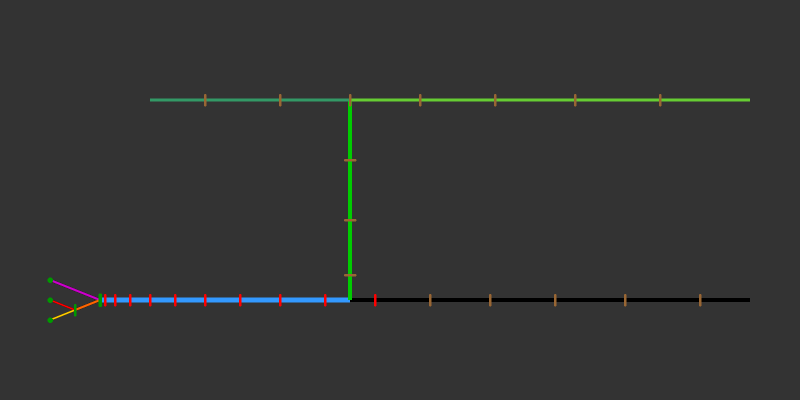
While tinkering further on my Rivercrawl idea, I cam up with this notation to map a huge river network.

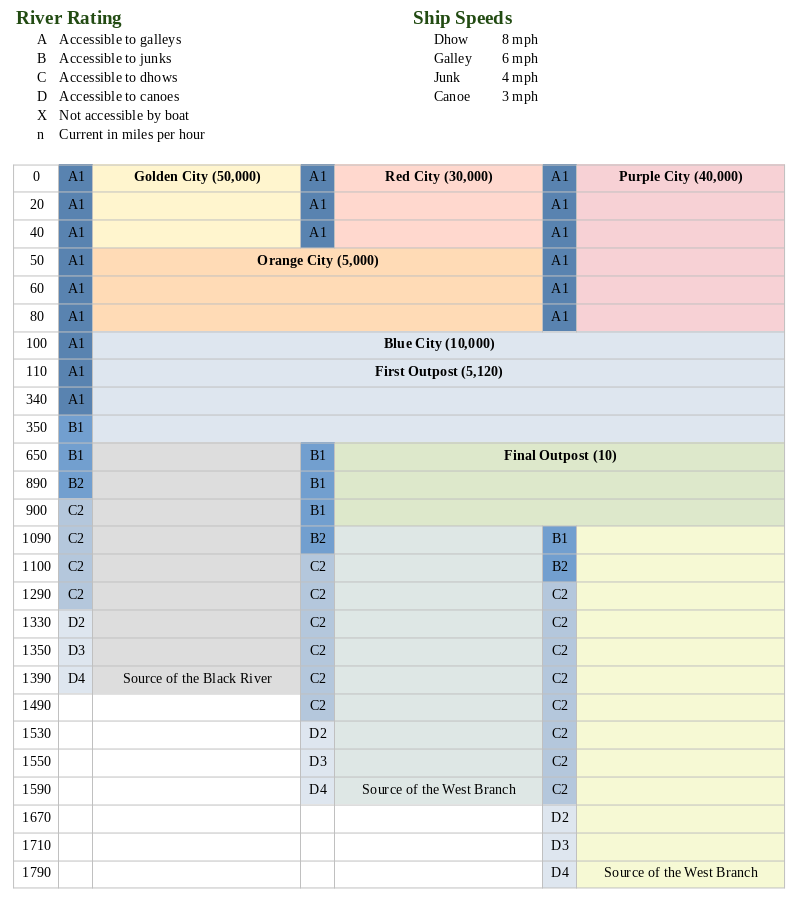
First I made a Melan diagram of the main river branches for my river and marked the branches in different colors, which then looks like this.

I then turned the same information into a big table. Below you have a heavily cropped down version to show the principle of how it works. The real thing I made actually has 180 rows over five pages, but most are still completely empty at this point. The principle is basically the same as in Ultraviolet Grasslands, but without the illustrations. I find this easier for river that curves and fans out, compared to the more or less straight trade routes in UVG, and it also allows to make more notes without making a huge unreadable mess. As a tool for GMs to use at the table, I think this plain look isn’t a bad thing.
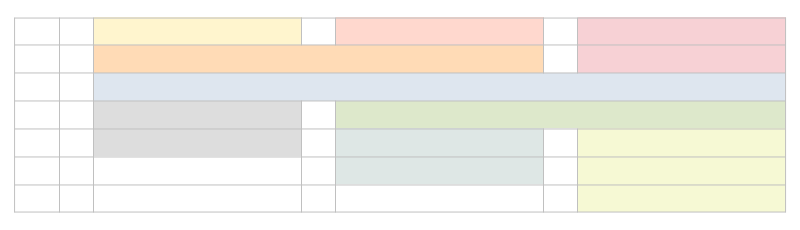
Getting the whole thing set up was a bit tricky, so here’s how I did it: Since I have only three main branches at any given point of the river, I made a table with seven columns. I think you could also do it with four branches and fit nine columns on one page, but more than that probably makes the thing more a nuisance to read than a help. I found that my river has seven different combinations of parallel running branches, so I made the table with seven rows as well. At this point you first set the column widths that you want, because this will be a total bitch if you try adjusting those later. After that you merge cells together as the river branches fork and meet, which in my case looked like this.
At this point, you can simple select and row and use “add rows below” or whatever your program calls it, and you should get an identical row to the one that you had selected. Then add mile markers to the leftmost row, and you’re done.
Now to the new neat feature that I actually came up with myself. The River Ratings. Each river section row has a little field on the left side that quickly shows the GM the water conditions the players are moving into. It’s fairly self-explaining when you look at the legend above. The letter says what size categories of ships can enter that section of the river. In case of my emerging setting, it’s galley size, junk size, dhow size, and canoe size. Ships larger than that will get stuck on the bottom of the river. (The width of the river or any obstacles in the water are not considered as a separate factor for the sake of convenience. Either your ship can continue on, or it gets stuck on something.) The number indicates the speed of the current. This number is added to your ship’s speed when you travel downriver, and subtracted when you travel upriver. If the speed of the current reduces your speed below 1 mile per hour, you can’t continue by water. I had been thinking to mark the type of terrain on the riverbanks as well to calculate overland speed, but that would mess the readability of this format with too much clutter. For the setting I want to make, it’s going to be “dense forest” pretty much everywhere anyway. I did a bit of looking around for average speeds of the boat types I listed, and the numbers I went with seem to be quite realistic. They are actually leaning to the lower end, as I suspect the original numbers were based on strong ocean breezes, so it would be slower further inland.

My plan for the campaign is that there is an adventuring season of 8 month, which is then interrupted by a flood season of 4 month, where the water speed is simply too much along the whole river to get upstream. I think it would be cool to make a roll at the start of each new adventuring season to see if water levels are exceptionally high or low this year. A high river increases the size rating for the whole river by one, while a year of low water levels reduces it by one. The players might find that the expedition they had planned either needs to be canceled or attempted with a much smaller boat as the river conditions make reaching the destination in a junk or dhow impossible. You could also have a randomly determined special event that changes the water level or speed halfway through the season, which can lead to very inconvenient complications hundreds of miles away from civilization.

Recovering arrows after a fight

Thanks, Dewwy, for this suggestion.

Someone pointed out to me that when parties go on very long adventures far away from civilization, it’s not just food and light sources they can run out of, but arrows are also a limiting factor for how long they can go before having to return to resupply. But there’s always plenty of arrows around after a fight, many of which are still perfectly usable.

In D&D 3rd edition, there was a rule that all arrows are destroyed if they hit, and have a 50% chance to be recoverable on a miss. To that you’d have to add all the arrows still in the quivers of fallen enemies. I’ve never heard of anyone actually doing that because  it’s just too fiddly to count the number of misses arrows that were fired, on the minor chance that a player actually cares to go looking for them. There’s a lot of such rules that are too fiddly for actual use that D&D has collected over the years. But here’s a very simple and easy alternative solution.

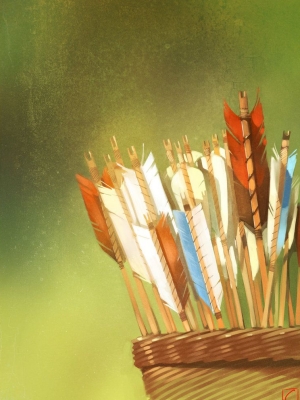
If PCs go collecting arrows after a fight, they recover 1d10 arrows for every archer involved in the fight.

It’s a complete abstraction, of course. But for something this minor, abstracting it is exactly the way to go. Those arrows might still be in the quiver of dead or captured archers. Some might stick in corpses or somewhere in the ground or trees. And a lot got broken on impact or disappeared into the undergrowth. 5.5. arrows on average per archer might be a bit low, but for the purpose of adventurers deep in the  wilderness, we actually want arrows to seem like a limited resource. If there’s more around than the players would ever need, then there’d be no point in tracking them in the first place.

I also found out that someone who’s skilled at it can make a stone arrowhead in 15 minutes. It takes a bit more to make a complete arrow, so let’s say 2 arrow per hour. In a whole day of working, a character with the required skill could make 20 arrows, which just happens to be the default quiver size in most games I’ve seen. For my campaign, I’m thinking of treating stone arrows just like regular arrows, except that they use a die one size smaller to roll for damage.

Rolling hit points for monsters

As I was delving into the ancient ruins to seek the wisdom of the sages of past ages, I came upon this nice little gem on Planet Algol: Non-randomized Monster Hit Points is the F’ing Devil. The unknown author (seriously, there’s no name anywhere on the site) makes a point that you really should roll the hit dice for monsters and NPCs the players might fight an not just assume the average, as it has a real impact on customizing individual opponents. Would players ever notice the difference between a 2d8 creature with 8 hp and an otherwise identical one with 11 hp? Probably not. But they very much would notice the difference between a 3 hp and a 15 hp one.

A note  is being made about perhaps rolling only one die and multiplying the result by the number of die, to make more extreme results more common than under the normal distribution you get from rolling and adding up multiple dice. But I was also curious about the results you would be getting from rolling hit points normally for every opponent and so I pulled up AnyDice to check.

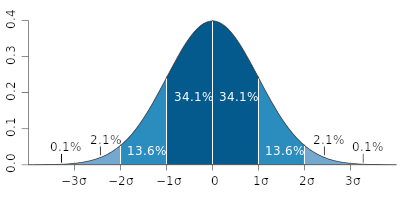
The added up results of multiple die rolls are a classical of a normal distribution. The classic bell curve. A typical way to compare and interpret the distributions of these curves is by using the Standard Deviations as reference points. I once learned how to calculate standard deviations and also understood the reason why they are typically used instead of any other arbitrary reference lines. I’ve forgotten all of that years ago, but I am going to use them anway. (And it turns out AnyDice can just tell you that number, spring me the need to manually crunch numbers for other reference values.) The only thing that’s really important to know is that 68% of all results will lie within 1 SD of the median value (the line between the lower 50% and the upper 50% of all cases), and 96% of all results within 2 SD.

Source

Since almost all creatures use d8 for hit points, I’m going to do the whole thing only for d8s. Obviously the spread will be somewhat smaller for smaller Hit Dice, and larger for larger ones, but the pattern remains the same.

HD -2 SD -1 SD +0 SD
+1 SD +2 SD
2d8 3 6 9 12 15
3d8 6 10 14 17 21
4d8 9 13 18 23 27
5d8 12 17 23 28 33
6d8 16 21 27 33 38
7d8 19 25 32 38 44
8d8 23 30 36 42 49
9d8 27 34 41 47 54

Now how to read this table for the not statistically trained? What this means is that 68% of all results you get will be between the -1 SD and the +1 SD columns. 96% of all results you get will be between the -2 SD and the +2 SD columns. Or in other words, only 2% of results will be smaller than the left column and only 2% larger than the right column.

Here’s the same data a bit more condensed, showing the range of hit points for 68% of the creatures if you roll their hp.

HD +/-1 SD +/-2 SD
2d8 6 to 12 3 to 15
3d8 10 to 17 6 to 21
4d8 13 to 23 9 to 27
5d8 17 to 28 12 to 33
6d8 21 to 33 16 to 38
7d8 25 to 38 19 to 44
8d8 30 to 42 23 to 49
9d8 34 to 47 27 to 54

Here the left column is the range you will see for 68% of your creatures, and the right column what you’ll see for 96% of your creatures. Results outside the range of the right column will occasionally happen, but will really be quite rare. As the number of dice goes up, the spread of the result will be come relatively narrower. The difference between 34 and 47 really is not that big and players might not notice. But the vast majority of enemies that will be fought in groups will have much lower number of Hit Dice, especially those in larger groups. Going from 6 to 12 means double the amount of hit points for 2d8 HD opponents, and when you deal 3 or 4 damage, that makes a real difference. And that’s only for the 68% group. A 2d8 creature with 2-3 or 15-16 hp will be rare, but still account for about 5% of individuals each. In a group of 10, you’d expect to see one of these outliers.

So yeah, I agree with the anonymous author. Rolling the hit points for every opponent individually seems very much worthwhile when you have a game with few fixed bonuses to the dice roll and PCs commonly dealing single digit damage.

“I strangled him on his throne the night I took the royal city”

“Did you deem yourself strong, because you were able to twist the heads off civilized folk, poor weaklings with muscles like rotten string? Hell! Break the neck of a wild Cimmerian bull before you call yourself strong. I did that, before I was a full-grown man —like this!”
– Shadows in Zamboula

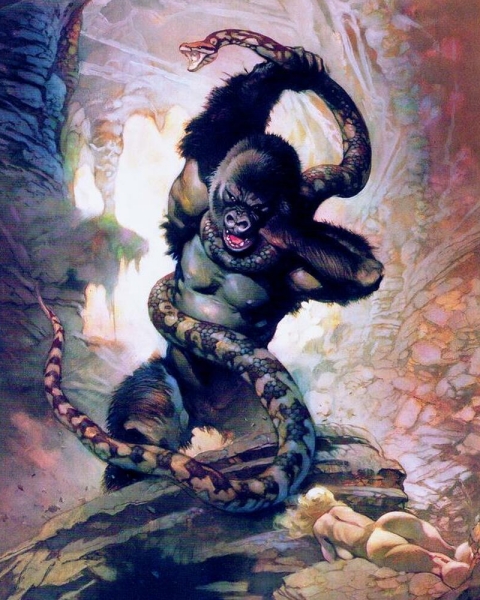
While thinking about a discussion about how you make adventures feel like Sword & Sorcery, it came to me that the Howard and Frazetta style in particularly is extremely physical and and greatly in love with the body and muscles. Fighting is not all about hacking and impaling, but often at its most intense and memorable when it comes down to a pure contest of Strength. I think that’s why large apes and giant snakes are so popular in Sword & Sorcery. They are the most spectacular incarnations of pure muscle.

Sword & Sorcery often has strong elements of swashbuckling and bravado, and when you think of pure all-out badassery, things that should come to mind are wrestling with snakes or breaking the neck of a lion with bare hands. So when it comes to picking a system for your Sword & Sorcery campaign, one thing it’s really going to need is a solid mechanic for wrestling and unarmed combat.

My current darling among the many B/X variants is Worlds Without Number, and that game has my favorite system for wrestling in any iteration of D&D and its retroclones. 3rd edition was particularly infamous for having a grappling mechanic that nobody could ever remember, but when you look at say 5th edition or the Rules Cylcopedia, I still find it difficult to truly get a full grasp of it just by reading, and remembering any of it once I turned to the next page. The WWN system is both simple and easy to remember and also has a neat little tweak to make it actually look attractive.

To start a grapple, the attacker has to first make a successful attack roll, and then both attacker and defender make opposing Strength checks. This means starting a grapple is more difficult than making a normal attack and dealing damage, since you have to make two successful rolls instead of one. But if you succeed to get a hold of the defender, the results are pretty nice.

The defender can use a Main Action on his turn to make another opposed Strength check, and if he succeeds, he gets free and may use his Move Action to get a few steps away. Otherwise, the only thing that both attacking and defending characters in a grapple can do is making unarmed attacks. If the attacks hit, they deal unarmed damage to their opponent. But now here comes the really cool tweak that I’ve never seen in any other grappling system. If the round ends with the defender still being grappled, the attacker automatically deals unarmed damage to the defender without an attack roll. Assuming the chance to land an unarmed attack is 50% for both fighters, the attacker will deal 1.5 times unarmed damage per round on average. However, the defender will deal only 0.5 times unarmed damage per round if he tries unarmed attacks, or 0 damage if he tries to break free of the grapple. The attacker is clearly at a major advantage if succeeds on the risky initial attack that requires two successful rolls to do anything.

Alternatively, the attacker can also choose to end the grapple and attempt another opposed Strength check to drag the defender 10 feet, or throw him for 5 feet.

You know what this is.

It may not be the best way to attempt fighting an ogre, but if you’re a big beefy barbarian with a few ranks in the Punch skill and the Unarmed Combatant focus, you probably can obliterate sorcerers very easily, unless you you’re dealing with another bronze god with muscles like steel. Even if making regular attacks with weapons might cause more damage, a grappled sorcerer can’t cast any spells or use magic items.

We’ll steal down through the top of the tower and strangle old Yara before he can cast any of his accursed spells on us.
– The Tower of the Elephant

An Expert starting with a Strength of 13 can learn the Developed Attribute and Unarmed Combatant foci, increase his Strength to 14, and gain a Punch skill of 2 by 3rd level, giving him an unarmed damage of 1d10+2. That’s an average of 7 damage, at a point where the average Expert has only 3d6 hit points, which is an average of 9. Unarmed combat has the potential to really fuck you up.

Adventurers, Heroes, and the Endgame for high level PCs

“Excuse me, but why are we doing all of this again?”

One thing that has troubled me with fantasy adventure games for a very long time is the nebulous concept of adventurers, and how they could actually stand up to scrutiny in a fantasy setting that aims to be internally plausible and self-consistent. Something I’ve been writing about many times over the years. There have been precedents of fantasy protagonists who just wander around and happen to run into adventures long before the inception of D&D player characters. But books are a different medium than RPGs and concepts don’t generally copy over neatly between the two, especially when narrative structures are concerned.

The original RPG adventurers where people who risked live and limb to gain huge piles of treasure, because the campaigns where relatively simple and straightforward games of facing monsters and collecting treasures. The game was about the gameplay, not about creating a story that exists in a wider world outside of the current dungeon the PCs are in today. Of course, it expanded to be just that, and very quickly, but there was never a real serious overhaul of what kind of people adventurers actually are how they fit into the societies of their world. We go to fight monsters and loot dungeons because there are monsters and dungeons over there. And monsters exist to the fought, and dungeons to be raided. For the sake of gameplay, this isn’t generally questioned any further. Just do it and have fun.

But the idea of playing campaigns that are more about stories than gameplay has always had a huge appeal, and there are two main justifications, and I wouldn’t shy away from calling them excuses, for why adventurers go on these adventures they go on. The first is the plain old treasure hunter, tomb robber, or murderhobo. These characters just don’t bother with any logical explanation. Fighting is fun, getting stupidly rich is fun. But the risk that adventurers typically face in RPGs is ridiculously high, and adventuring just seems like a fast track to a horrible death. These characters make only questionable sense to begin with, but just don’t hold up at all for the wide variety of personalities players like to give their PCs. At the very end of this path lies the insanity of Shonen anime where 12 year kids end up with a happy childhood of friendship and the daily slaughter of dozens. The other common alternative are the knights in shining armor or superheroes. They do all the same things as the murderhobos, but they don’t do it for the riches. They do it out of compassion for the innocents. They are heroes; that’s what heroes do. It works as a justification for gameplay, but it also doesn’t work for stories with even a little bit of depth that aim for some amount of plausible believability.

What is needed to make the existence of adventurers plausible, is to create a concept of what adventurers actually are alongside with creating a setting in which they serve a believable function and role in society. The typical D&D solution, or you might call it the Forgotten Realms solution, is to treat adventurers as private security contractors and exterminators that deal with various trouble when the official authorities can’t be bothered right now. It’s considered a valid career choice, but don’t question how it’s so easy to get established in the business as complete newcomers when the typical contracts are stuff that the army can’t handle. It also stretches plausibility how in a world with absent official authority, roaming vagabonds get invited into communities to protect them. Yes, it worked in The Seven Samurai, but much of the three hour movie is about how unusual this is and the struggles of everyone involved to make it work. Great for a stand-alone story, but not something you want to deal with in every new village the party comes through. But there are other games where the role of PCs is tailored to a specific campaign concept and setting, like in Blades in the Dark or Band of Blades for example.

Now to finally get to some kind of point, I think I finally found some kind of concept for what kind of people player characters are and their place in society that integrates well into the kind of world that I want to create with Kaendor.

The primary vision behind Kaendor is a world dominated by wilderness and primordial powers, with small and isolated civilizations being scattered far and wide, in an environment that is constantly changing that swallows up city states just as fast as it creates them. It’s a world in a kind of perpetual apocalypse; a frontier without a heartland. One constant in this world is that there are always people looking for a new home to settle as the cities of their ancestors are swallowed by the forests and fall into the seas. As for any valley or island that becomes uninhabitable, another place opens up for farming somewhere else. But every time people leave their failing city states to begin a new life somewhere else, they are making a huge gamble. If the settlement of a new aspiring lord fails, there are often no second chances to try somewhere else. That’s where Heroes come in.

Heroes in the classical sense are not just people who did something brave, but special individuals who possess an inherent greatness. Always highly extraordinary individuals and even superhuman, and often actual demigods. Our own culture rejects such notions that some people are inherently elevated over others and destined for greatness, but in a fantastical setting drawing on elements from Antiquity and the Bronze Age, it’s a very important aspect of how those societies tick. In a fantasy adventure game, player characters are inherently special because the game is fundamentally leaning in their favor and their victory over almost all opposition they encounter pretty much a given. Working this gameplay element into the culture of the setting seems like a really fun idea. Dark Souls is a prime example of this, and it works out beautifully there, allowing you to get invested and believe in a world that exceptionally absurd as fantasy worlds go. In fantasy, you can get away with almost anything, as long as the the world as a hole makes sense in its own internal logic.

As I was saying, the special socio-environmental conditions of Kaendor create a constant demand for special people capable of extraordinary greatness to perpetuate the cycle of migrating populations and rising and falling city states. That is the social niche I see for the institution of adventurers. Adventuring is an occupation that serves to create individuals capable of being the leaders of the following generations by giving them experience about the many natural and supernatural dangers of the wilderness and testing their resilience and capacity to lead. It is to these heroes who have proven themselves and earned a reputation that has carried their names far and wide that people will look up to when they are forced from the crumbling cities that have been their homes for generations.

Not every player character has to have this lofty goal of one day raising a stronghold that will grow into a great and wondrous city. But even if only a tenth of them are pursuing this dream, it creates a society that values the kind of people who venture into the wild to face the monsters that threaten civilization, scout out potential areas for new strongholds, and recover abandoned resources and lost magic from fallen cities of the past. And it often takes more than just a single Hero to establish and defend a new strongholds. Hero kings depend on an entourage of other exceptional people to serve as their champions, providing other opportunities for those who fought besides them.

Now this is all sounding an awful lot like the classic D&D endgame of establishing a stronghold and running a domain. Which has been covered to some extend throughout various editions, but by all accounts only very rarely became part of actual play. Instead, it was much more common that ascending the throne meant effectively retiring the character from play. And in campaigns where players could have several characters of different levels (because sometimes you want to do stuff that requires a PC to be locked up in a lab for months), having one character retire while the others continue their adventures wouldn’t really be that strange. And I think making this an explicit assumption for a campaign concept might actually be a really nice idea. Domain management is a weird thing that just doesn’t really fit with the rest of fantasy adventure games. These games are group games, while running a domain is a solitary occupation, and the stuff you’d be doing would be completely different from the stuff you’d be doing up to that point. And if you really wanted to play a game like this, it should be about this stuff from the start, not at the end after you spend months doing something completely different.

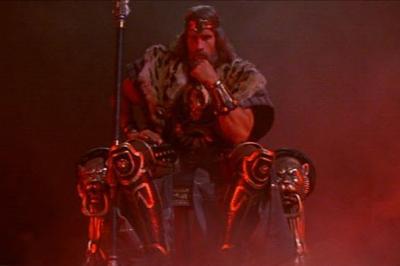
Instead, introducing a campaign as being about adventurers who struggle to earn themselves a place among the hero-kings of the setting, with the possible establishing of a stronghold and settlement constituting and ultimate conclusion seems like a very interesting and compelling way to approach a game. And like the cool chap in the picture above, the actual ruling and administrating of the domain would constitute the epilogue. Yes, in three of the original stories Conan is a king. But he doesn’t do any ruling in any of them, and leads an army into battle only once. At the end of the campaign, you could have a final adventure of having to defend the new throne of one of the PCs against a rival as the final test, but after that, the campaign would be concluded.

Now one oddity about old D&D is that that the establishing of a domain was generally limited  to characters of at last 9th level. Which seems rather arbitrary, as anyone who clears out a castle and has the money to hire guard could do so regardless of character level. But if you assume it’s meant to be the conclusion of a character’s career, then the whole thing makes a lot more sense. I decided a long time ago that in Kaendor, all mortals are limited to 10th level, so that magic spells cap out at 5th level and everything beyond that being the powers of the gods. The thing with maximum levels in games where much of the motivation comes from advancing to a higher level is what do you do when you actually reach the last level? By the point you reach it, there’s nothing really left to do with it. I quite like the idea that at the point characters reach 10th level, their goal changes from advancing in power claiming their domain. To have a whole final adventure in which the 10th level characters fight for their stronghold and no longer gain XP.

My thoughts on this might be changing in the future, as they always do. But as of now, this is so far the concept for the role and identity of adventurers that I liked the most.

A take on Reaction Rolls and the Charisma modifier anomaly

The Basic/Expert rules are the system that keeps on giving. At only 121 pages (of which 43 are monster and treasure descriptions), they would make a pretty thin rulebook and still I keep coming back to them to reread various sections over and over. I’ve seen people considering the ambiguities and unfinished nature of some rules to be a virtue many times, but I don’t consider it good design or even intentional. I’m quite certain that Moldvay and Cook mostly had specific rulings in mind but were not aware that they didn’t sufficiently communicate them in a clear way, and possibly in some cases simply copied things that Gygax had written before without really understanding how it’s supposed to work either. I’m usually not too hard on this, giving them some leeway considering that they had no real reference for what they were doing and making things up as they went. And with rules that into only 78 pages, filling in the gaps is not that much amount of work.

One section I was going over again recently are the mechanics for Reaction Rolls. The reaction roll is used to determine how randomly encountered creatures react to the party, if their behavior isn’t already obvious given their nature and circumstances of their encounter. Creatures like zombies always attack everything they encounter. Goblins always attack when they encounter dwarves. And if you have the party trying to sneak into a guarded enemy stronghold and they run into a guard patrol, the attitude of the guards is also obvious. The Reaction Roll is for situations in which the reaction of the creatures could be anything. But there’s still a lot of ambiguity left. What are you supposed to do with “Uncertain, monster confused”, which is the most likely of all reactions? How is it different from “No attack, monster leaves or considers offers”? The reaction roll is also modified by a character’s Charisma score. But whose charisma score? And if the Charisma score is 13 or higher, the result of “Immediate attack” is impossible to happen. So after pondering the issues over several days, I came up with the following procedure. I believe it mostly just fills in some blanks without really changing anything that is printed on the pages.

Beginning an Encounter

An encounter can start in two ways: The party enters an area in which monsters are already present, or the GM made a roll for Wandering Monsters for that turn. In the order of events for every turn (10 minutes of dungeon exploration) the first step is rolling for wandering monsters. The second step is “moving, entering rooms, listening at doors, and searching the environment”. Dealing with monsters comes as the third step. I think this order is significant because it can mean that wandering monsters can stumble into a room while the party is in the process of searching it. The random encounter is something that happens within the turn, not between turns.

Surprise

If the party and monsters encounter each other, the next steps are determining the distance at which they can become aware of each other, and rolling for surprise. These two steps happen basically at the same time and it doesn’t appear to matter which of the two rolls you make first. But I think it’s actually more convenient to roll surprise first and determine the distance after.

To roll for surprise, both the party and the monsters roll a d6. By default, a 1 or 2 means that they are surprised, while a 3 to 6 means that they are not. Two d6s allow for 36 possible results that cover four different outcomes.

Odds Outcome
4 in 36 Both sides are surprised.
8 in 36 Party is surprised, monsters are not.
8 in 36 Monsters are surprised, party is not.
16 in 36 Neither side is surprised.

Some monsters have a special ability that makes the party getting surprised by them on a roll of 1 to 3 or even 1 to 4, which significantly changes the odds to get the jump on the party in their favor. (A monster ability that modifies the party’s roll instead of their own roll isn’t very elegant, but it’s probably the least complicated way to get the desired result.)

The results of both sides being surprised and neither side being surprised are basically identical. However, I’ve seen a rule somewhere, and to my actual surprised it’s not in B/X, that in the case of both sides being surprised, the encounter distance should be half of what it would be in the other three outcomes. I really like it and so I’m mentioning it here anyway. This is also why I would make the roll for the encounter distance after the roll for surprise. Inside a dungeon, the distance is 2d6 x 10 feet, outdoors it’s 4d6 x 10 yards (or 4d6 x 30 feet, because we really don’t need two different units of measurement).

Something that surprised me coming from later editions is that the rules for surprise don’t really seem to take into account that one side or the other could by lying in ambush, or have time to quickly set one up. However, the Expert rules state that a group of three or more gains surprise outdoors they could be set up to have surrounded the other side. Maybe the idea is that even when you see a light at the next corner or hear footsteps approaching, there just isn’t enough time to set a proper ambush indoors. But I am a big fan of sneakiness myself, and I think it should absolutely be possible for players to avoid getting noticed by the wandering monsters, or quietly retreat from an area that has unaware monsters inside.

The rules as they are written only state that “those not surprised my move and attack the first round, and the surprised enemy may not”. I think the whole game becomes much more interesting if the side that has surprise can use its turn during that first round to back away without the surprised side becoming aware of them. Not only can it be a great opportunity for fun shenangians on the players’ side, it can also be interesting to have monsters stalking them in secret and wait for a good opportunity to strike.

Reaction

After surprise and distance have been determined, the sixth step is the Reaction Roll. As I mentioned earlier, the reaction roll is modified by Charisma. But whose Charisma actually? I long assumed that it would be the character who is walking at the head of the column or perhaps the party member with the highest Charisma, but that never really felt right since there is no indication either way.

The new idea I got recently, and which is the reason for this entire post, is that the reaction modifier for high or low Charisma only applies if a PC has the opportunity to talk to the monsters before a fight breaks out. If the monsters are surprised but the party is not, one of the PCs can hail the monsters and they make a reaction roll modified by the PC’s Charisma. If both or neither side are surprised and the party wins initiative for the first round of the encounter, the players also have an opportunity to hail the other group.

There is also the possibility that the monsters surprise the party or they win initiative, and their reaction is “Uncertain, monster confused”, which is the most likely result for an unmodified 2d6 roll. I’ve seen some retroclones rephrase this result as the monsters waiting to see what happens, which I think is a great interpretation. What you get is the monsters simply doing nothing for now. Then when it’s the party’s turn and the party is aware of the monsters, the players have another opportunity to hail them. At which point you could make a second reaction roll, but this time modified by the respective character’s Charisma.

And there’s actually something in the order of events for each exploration turn that supports that. Step six is making a reaction roll, but step seven, the resolution of the reaction, says “If both sides are willing to talk , the DM rolls for monster reactions and initiative, as necessary.” Making two reaction rolls is already written into the rules as they were printed. And I think it makes perfect sense to have a character’s Charisma modify a reaction roll only in those cases where that character is talking to the other groups. In situations where the monsters spot the party but the party is not aware of them, I think the reaction roll should be done without any modifiers at all. It’s of course also possible that the players might think of something so convincing that no reaction roll is necessary at all. If for example they encounter a group of guards and know the password to identify themselves as people who have permission to be in the place, then making a reaction roll can become moot. In the same way, if the party has surprised and decides to attack immediately and ask questions later, no reaction roll is necessary either. (Though a morale check might be.)

The Charisma Modifier Anomaly

Unlike in AD&D, the modifiers to various things based on the various ability scores are quite consistent in Basic. An 18 in Strength gives you a +3 bonus to melee attack rolls and melee damage, an 18 in Dexterity gives you a +3 bonus to ranged attack rolls and Armor Class, and an 18 in Constitution gives you a +3 bonus when rolling your hit points for each level. But Charisma stands out. An 18 in Charisma gives you only a +2 bonus to Reaction rolls instead of +3, and a 16 or 17 only a +1 bonus instead of +2. Some retroclones fix this by applying the same modifiers to all six ability scores, and I actually did this myself in the past. But I now think that this inconsistency is not an oversight but actually a deliberate choice.

The modifier in question is not a generic modifier to Charisma rolls, but specifically an “Adjustment to Reactions”. Reaction rolls are its only intended application (though this includes retainer hiring reactions for which the following calculations apply equally). The Reaction roll is 2d6, and the Reaction table lists results from 2 to 12. The “Immediate attack” result can only happen on a 2 (or lower, one presumes), and the “Enthusiastic friendship” result happens on a 12 (or higher). If you get a +1 bonus to the roll, a result of 2 becomes already impossible. You can’t go lower than 3 and get “Hostile, possible attack”. Which is one more argument why some Reaction rolls should be done without applying Charisma modifiers. But not only that, the 2d6 also give us a bell curve and shifting a bell curve sideways results in often very significant changes in the odds for any given value. When you get a +3 bonus to the Reaction roll, even the hostile result only has a probability  of 3%. Pretty much anything would be somewhat friendly if you’d happen to have someone with 18 Charisma doing the talking for the group.

But I think the +3 bonus from an 18 is not even the main reason for why the modifiers are different for Charisma. The chance for any given Character to get a randomly rolled 18 on 3d6 is under 0.5%. In a group of four characters, that’s still below a 2% chance for any of the characters to have an 18, and that player might not even want to do all the talking with everything they run into. It’s an unlikely scenario. But the chance for any character to randomly roll a Charisma score of 16, 17, or 18 is almost 5%, and getting someone in a party of four with a 16 or better is 17%. And a bonus of +2 to Reaction rolls is still really big. At +2, you have a 17% chance for a friendly reaction and only an 8% for a hostile one. With a 42% chance for monsters to negotiate. That frankly doesn’t sound particularly fun to me. Having the odds for this scenario being only 2% for any given party of four instead of 17% seems a very sensible change to me, even if it breaks the beautiful symmetry of ability score modifiers.