Expanded Wilderness Travel Rules

Expanding on my table for wilderness travel rates from a few days ago. For maximum efficiency, I am simply listing travel rates in 6-mile hexes. I think in the same way that a 10-minute Turn is not exactly 60 rounds or 600 seconds, we don’t need to treat a 6-mile hex as exactly ….31680 feet. (I had to look that up, and so would you. Those units are stupid!) In actual play, both duration and distance are abstract fiction that don’t relate to anything physical. And characters in the game world would not have actually have any means to measure either distance or time with any accuracy anyway. In a game, if players ask an NPC for a distance to a place or how long it would take to get there, that NPC would give them a rough guess like “some 10 miles” or “three days, if you keep a good pace”. That’s good enough on the players side. When I run wilderness adventures, I am fully in the camp of “the players never get to see any hex maps”. The hex map is a tool for the GM, just like random encounter tables. And for the purpose of telling the players when they arrive at a point, you really only need hexes. Miles are meaningless from a mechanical point. Or at least they are if you have a system for travel speeds in place that doesn’t have any granularity smaller than a hex. Which is what the following tables are all about.

Land Travel

Encumbrance Easy Terrain
Difficult Terrain
Unencumbered 6 hexes 3 hexes
Encumbered 4 hexes 2 hexes
Heavily Encumbered 2 hexes 1 hex

As I mentioned in my previous post, this is based on the assumption that a healthy adventurer with no significant load can cover 36 miles on a road or easy ground in a day. That would actually be quite impressive for a real human, but still plausible. However, in practice characters traveling through the wilderness to explore dangerous ruins and caves will be carrying quite a lot of stuff, and mostly deal with difficult terrain once they get off the roads, so that travel rate will rarely come up in actual play. So for the sake of easy use by the GM, I have no issue with that table maybe getting a bit high.

River Travel

River Speed
Upriver
Downriver
Base Speed 4 hexes 4 hexes
Slow Flow 3 hexes 5 hexes
Fast Flow 2 hexes 6 hexes
Rapid Flow 1 hex 7 hexes

From all I could find, going at 3 miles per hour ± the speed of the water is a pretty common speed when paddling on a river. Take that by 8 hours and you get 24 miles per day, or 4 hexes. If you go with the water flow, you’re going to get a bit more, if you’re going against it, you’ll get a bit less. If you wanted to, you could probably quite easily calculate what the flow speeds in the table above would be in miles per hour. But since player character’s won’t be measuring that during play, “slow”, “fast” an “rapid” are good enough for me.

Switching Pace

Something that I think would be neat to have is a system in which you can seamlessly have the party switch from one pace to another, like going a certain distance by boat, then continuing by foot on a road for a while, and covering the rest of the day’s travel on a mountain path. It could be done, but for that you really would need 1-mile hexes, and that’s just way too small for my own needs. At this point, I am diverting from my usual approach to get the mechanics all neat and consistent, and instead just guestimate things. If the party wants to move into a hex with terrain and encumbrance that would allow for 2 hexes per day, just check if they still have half of the day left. If yes, their camping spot for the night will be in the next hex. If not, it’s going to be in the last hey that they reached. It’s imprecise, but good enough for me.

Random Encounters

I know many people like to check for random encounters in the wilderness once per hex that party moves through, but I found that to actually not make much sense to me. Yes, you are moving through more area when traveling at a faster speed, so there are more spots you pass through where you could encounter something. But you’re also going to spend less time in each spot, which reduces the chances that you are in any one given place just as other creatures are passing through it. I think that just cancels each other out and travel speed does not actually affect the chance of encountering something on a given day. Only the total time spend in the wilderness does.

So I simply roll for random encounters four times per day. Once in the morning, once around noon, once in the afternoon, and then one more check during the night. Regarding which hex a random encounter takes place in, I am again going with “make something up”. If a party is traveling four hexes in a day and a random encounter happens during noon, is it locate in the second hex or the third hex? I don’t know, pick one. It really doesn’t matter.

To check for an encounter, roll a dice that reflects the likelihood of encountering anything in the area the party is traveling through. Going with my paradigm of something always happens on a 1, smaller dice result in more encounters, and larger dice in fewer encounters.

Encounter Density Encounter Check Dice
Desolate d10
Sparse d8
Average d6
Populated d4

I can totally understand if this system is a bit too abstracted and not granular enough for some people. But I like its neatness in how easy it is for actual use during play, while still overall being somewhat plausible in the distances a party can cover in a day and not diverging too significantly from the distances and durations you’d get with using the exact numbers from the Expert Rules.
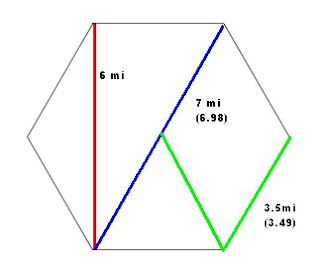

Overland Travel Speed

The 6-mile hex has long ago established itself as the default size for overland travel on hex grids for a number of reasons. And I rally quite like it myself. I like consistency.

From Hydra’s Grotto (click for more detail)

Hexes are a nice aid for GMs in that you can break down all distances in easy to track chunks, and more importantly can note down where the party of PCs is currently at by simply marking the hex they are in.

One thing that D&D has always gotten annoyingly wrong however, is that the various systems for overland travel speeds all don’t work with 6-mile steps. This whole thing is getting really rambly, but I don’t know how to get it more concise right now, and I really want to get some new stuff on the site.

In B/X, movement speed outdoors is either 24, 18, 12, or 6 miles, depending on a character’s encumbrance. Great. But if you are traveling through forests, deserts, hills, and broken lands, this speed is reduced to 2/3 the normal progress. So 16, 12, 9, or 4 miles. Only one of these is a multiple of 6. Same issue even now in 5th edition. Movement speeds of 30, 24, and 18 miles work great. But not if you cut them to half in any kind of difficult terrain and you get rates of 15, 12, and 9 miles per day.

You don’t actually get the most convenient feature that using a hex grid can provide. You still have to track how many half hexes or even third hexes the party has moved in a given day.

The most convenient for GMs would be a system in which all possible distances are increments of 6 miles. And the only way in which this really works is using base speeds of 36, 24, and 12 miles per day, with all forms of difficult terrain reducing that by half to 18, 12, and 6 miles per day.

Encumbrance Easy Terrain
Difficult Terrain
Unencumbered 36 miles 18 miles
Encumbered 24 miles 12 miles
Heavily Encumbered 12 miles 6 miles

However, 36 miles is really quite a lot.

But how unrealistic is it really? There are plenty of sources for military references for marching armies that put good progress somewhere in the 24 to 30 miles per day range, though often much less than that. And if you look around for advice on how far people can expect to hike for a day, those 24 to 30 miles numbers show up as well as recommendations for beginners who might be unsure how far they can actually make it in a day. 36 miles in a day is significantly more than that.

But a party of PCs in a wilderness exploration game is usually not an army on the march. Nor are they inexperienced hikers. Also, all those numbers assume 8 hours of moving per day. That leaves 8 hours of resting in camp and 8 more hours of… what exactly? If you’re on vacation and hiking for fun, there’s plenty for you to do during that last third of the day. But moving through dangerous territory to get to an even deadlier dungeon is very much not a vacation. I think adventurers crossing the wilderness would do a bit more walking each day than tourists. And another very important factor is that in most systems, being “unencumbered” usually translates to very light gear with very little weapons, tools, and supplies. When a party is crossing through the wilderness for several days, they won’t be unencumbered. If using the numbers I’ve proposed above, 36 miles in a day would be something that only really happens for messengers in a hurry. No loitering around, carrying only the barest necessities, sticking to roads and easy ground. And in that context, 36 miles in a day does not seem that implausible. Much more common, at least for the campaigns that I run, would be traveling with a medium load, mostly going through forests and swamps, which would reduce the usual distance per day down to 12 miles. A much smaller number.

And at the end of the day, we’re talking about a game that has hit points as one of its basic mechanics. We’re not running an actual simulation of anything here. Also, any amount of miles really is just a made up number in an almost undefined virtual space, not any actual physical distances. Might some people think that 36 miles in a day is a bit of a stretch? Sure, why not. And I am not going to argue with anyone on whether that can actually be sustained for more than a day or two. But having to bother with only full hexes and not dealing with any fractions or partial hexes is a big convenience for running fantastical adventures in a made up space, and that’s the part that really matters.

Random thoughts on alchemy and sandbox campaigns

With the top level worlduilding for the Shattered Empire having reached a pretty concrete and solid stage, I’ve started turning back to thinking about specific details for an actual sandbox campaign set somewhere in this world. And while discussing some ideas, we happened to talk about players spending the money they get from all the dungeon crawling, travelling merchants as random wilderness encounters, and how generic magic weapons are boring compared to setting up your gear to fight a specific monster. It got me thinking about how the Witcher games don’t let you drink potions or put poison on your weapon while a monster is trying to claw your eyes out. You got to do your alchemical preparations before you step into the monster’s lair, perhaps even brewing up some special brews you didn’t normally keep stocked in your inventory.

And that discussion gave me an idea: Let’s have alchemical ingredients that can be used to create potions to help fight specific monsters, but these ingredients are hard to get and can each be used for a number of different potions.

Usually in videogames with crafting systems, you have basic ingredients that you can pick up from defeated enemies or growing in the environment in practically infinite amounts, and special ingredients that are only dropped from a single monster in the whole game to make one specific item, or make you choose one of two possible items that can be made with it. For the record, I hate crafting in videogames. It’s mostly a pointless waste of time that clogs up inventory space to drown you in junk that is worse than stuff you find. And I think one of the main flaws with these mechanics is the way they treat the ingredients.

But let’s approach this differently to make it something that is narratively meaningful and doesn’t turn into a convoluted minigame. The really badic ingredient, which are dirt cheap and just grow everywhere in the environment, are not even worth tracking. They have negligible costs and require no effort to acquire. And to make the special ingredients much more interesting and meaningful, make them both limited and expensive and make them useful for multiple different things. Letting the players fight a monster and take ingredient A from it, which they can turn into item X is really just a different way for giving them item X from the monster’s treasure. But say instead that there are maybe a dozen of the monster in the whole sandbox and the players might end up with anywhere from 0 to 12 of ingredient A, depending on how they explore the world and interact with the creatures, and that each of the ingredients can be used to make item X, Y, or Z. If these items they can make have limited uses that mostly shine in quite specific situations, the players will have to make a choicd if they want to use the three ingredients they have to make one of each item, three of the same item, or two of one and one of another. Since they don’t know what situations they will be dealing in the future, the correct answer is to keep them stored and make whatever item is needed, once they know it is needed. This adds a few additional scenes to adventures in which the PCs are making specific preparations for the adventure ahead, based on the information they have of what they arw getting into. That’s always great to make a world become more alive and present.

But also, you can make these ingredients available in small quantities for high prices at merchants. If it’s travelling merchants, it’s going to be a one-time offer as well. If the objects that can be made are sufficiently strong and have appropriately limited uses before they are used up, then these ingredients might be worth quite a lot to the players. And asking to take a look at the alchemy chest of each merchant they encounter can be a highlight of each shoping trip.

Buying the ingredient isn’t the same as buying the final item. There’s still alchemical work to be done. If it’s something that takes longer, it can be useful to employ an alchemist, especially when this kind of work comes up regularly. Which also costs money. And that alchemist is going to need a lab. Don’t let him do that stuff over a campfire with a little box of alchemy supplies. A proper lab best fits into a permanent base, which can be a much bigger source of expense for the party.

I’ve not done any work yet on either ingredients that could be found on adventures or be one-time offers by travelling merchants, or the kinds of items that could be made with them. But I think it’s a really interesting direction to follow that could potentially add a lot to sandbox campaigns.

Why do I never see links to All Dead Generations?

Looking back, the prime days of OSR lie now a decade behind us, and while a number of people are still around, occasionally sharing some new thought or insight every couple of months, very little of any meaningful significance is added to the discourse of B/X and AD&D that hasn’t been thoroughly examined years ago.

But one thing still does stand out that really brings something new (back) to the table that has significant value to help understanding how those old games tick and how you can make them really work without existing experience going back to the 80s. Which is Gus L’s “new” site All Dead Generations. This is an excellent resource I never really see mentioned anywhere.

When I finished my D&D 5th edition campaign a year ago, one of the realizations that I gained from it was that I just didn’t get the concept of dungeons. What a dungeon is is obvious, but I never understood how going from room to room filled with monsters and random crack-wizard puzzle-devices was supposed to be fun for anyone involved. As someone who got into D&D in the last days of 2nd edition, when the 90s Metaplot craze was still in full swing, fighting monsters in rooms never seemed like something that contributes to the plot of an adventure or a campaign. And it doesn’t. That’s one of the key things to take away from the many long pages of All Dead Generations. Thinking about a plot when going into a dungeon to explore is already the completely wrong approach. I never figured out how to make it work in 20 years, because that’s never how it was supposed to work. Dungeons & Dragons under WotC has been a cargo cult game, that emulates mechanics from the 70s and early 80s because they’ve seen these things being a major part of D&D, but with no apparent understanding of what they are for and how they work.

All Dead Generations has been a massive eye opener for me and got me super excited about an all dungeon crawl campaign just after I had given up on using dungeons in my games entirely. It’s a fantastic read for anyone who wants to understand how B/X is actually supposed to be played. And yet, nobody seems to be talking about it. I guess partly because there are few people still around who could talk about it, but to do so they’d also need to hear about it in the first place.

So here’s a big shout out to Gus. Which is a bit weird from a marginal nobody like me to one of the well known big guys of oldschool RPGs, but it is what it is. Go check out All Dead Generations.

Something always happens on a 1!

I mentioned this idea in another post last summer in regards to wandering monster checks, but I think it’s actually a rally nice principle that can be applied to all dice rolls without a defined die size and target number.

I’ve talked about accessibility of RPG rules in the past, both here and in several other places, and my personal experience as a GM with ADD has always been that my brain very easily becomes overloaded when juggling numbers at the same time as I am trying to follow a conversation. The trivial task of putting the initiative counts of six to eight participants in an encounter into a descending list has always been the single most challenging thing and greatest struggle to me about running games. (Now I always use group initiative to skip the whole issue.) But another thing that isn’t always easy for me in the heat of the action is probabilities like “2 in 6”. I rolled a 4, is that a success or not? Do we count the lowest two numbers or the highest two? This can be really easy stuff, but for my brain that’s something that takes up completely disproportional amounts of processing power. Not a good situation.

My solution is to make any such rolls a probability of “1 in 4”, “1 in 6”, “1 in 8”, and so on. If I’m using material that uses other odds, I translate them into whichever “1 in N” probability gets closest and write that in my notes. The result of this is that even when my mind is getting overloaded with input from the players and I am trying to establish what happens next, I only have to look at the die in front of me and remember “Something always happens on a 1!”

If it’s not a 1, then nothing happens. Proceed as normal. If it’s a 1, that always means the answer to “does X happen?” is always a yes. I’ve adopted this method as a solution to my specific personal problem, but I think it’s a really neat way to handle a wide range of rolls in general. It’s also helpful for new players who are still trying to figure out what’s actually going on all the time. On top of that, there’s a dozen different ways of how you can roll a die to determine the outcome of an action. Sometimes they have to roll higher than a number on their character sheet. Sometimes they have to roll lower. Sometimes they roll a die and add a number from their character sheet and the GM tells them if it’s a success or not. Sometimes they roll d6 and a 1 is a success, other times they roll a d8 and 7 is a success. Any time you can simply tell a player “just roll that die, when it’s a 1 something happens” is a moment where that player has a lot less new information to process.

I also think it helps with speeding along play and creating additional excitement by simply having a player roll a dice in the middle of the table, and since they’ve seen the same thing a dozen times before now, they already know “something always happens on a 1!”, without you having to explain to them how the odds for this specific roll are working. And by having established that something always happens on a 1, there is no ambiguity on whether that roll really mattered or you arbitrarily decided the outcome in disregard of the die. When the players see a 1, they can jeer in excitement or despair without even having to look at you. In my perception, this is a very useful tool to make players realize that the fates of their characters are entirely in the hands of themselves and random luck, and that trying to figure out what the GM wants or expects doesn’t make any difference.

You could of course switch it around and say “something always happens on the highest number of the die”. But that requires one additional mental step to get to the actual result, which is identifying what type of die has just been rolled. I think everyone who’s played with new players know that it takes them a good amount of time to look for the die in front of them that has the same amount of numbers that you just told them to roll. It may not be immediately obvious if a die sitting in the middle of the table and showing a 10 is a d10 or a d12. And in my personal situation, when I am trying to run an encounter with lots of players chattering in excitement, staring at a die in front of me and trying to remember what meaning there was behind the die I just roll can take me two or three seconds. Figuring out if that 10 on the die before me means something or nothing is an additional step I just don’t need if it doesn’t add any additional value to the game. And ADD is not an uncommon condition, anecdotally even less so among RPG players. I would hazard to guess that more groups have one than not, and wouldn’t be surprised if a good number of them is affected by similar forms of mental overload as me. Even if this seems to trivial to be pointless to you, there might very well be a player in your group who’d really benefit from it. So “something always happens on a 1!”.

Mage Hunter focus for Worlds Without Number

When I was thinking about treating magic as something inherently demonic in nature and commonly regarded as a violation of the divine order that governs the physical world, I originally had the idea to create a Mage tradition like the Healer or Vowed for priests who are trained in countering and negating the effects of magic. But a tradition means the character has to select 8 different arts by 10th level, and the total pool of arts to pick from should be considerably larger than that. But as it turned out, coming up with 12 different powers that counter magic and can be rationalized as not actually using magic themselves is really quite the challenge. To be a good mechanical representation of the concept, having a pretty small selection of very basic abilities feels a lot more fitting, and so I ended up making the Mage Hunter a single focus instead of a full tradition.

Nothing about this focus is really an original creation by me. All I’ve done is to take already existing mechanics from Worlds Without Number and arrange them in a way to become accessible to a broader range of characters. I think this is a good example to show how easy homebrewing new content to bring your setting to life can be.


Mage Hunter

Level 1: Gain Magic as a bonus skill, and Effort with a maximum of your Magic skill level plus your Wisdom modifier. You also gain the Sense Magic art.

Sense Magic: Commit Effort as an Instant action; while it remains committed, you can visually perceive magical energy and get a one-sentence description of the effect of any standing magics or magical items you inspect.

Level 2: You gain the Counter Magic and Suppress Magic arts.

Counter Magic: Commit Effort for the day as an Instant action when a visible enemy mage casts a spell. You make an opposed Wis/Magic check against the casters Int/Magic or Cha/Magic skill checks; if you win, their spell fizzles and is wasted. You can use this art no more than once per round.

Suppress Magic: Commit Effort for the day as an On Turn action and target a visible or known magical effect within one hundred feet. The effect is suppressed for 1d6 rounds plus your character level. Spells cast by more casters of a higher level than you may not be successfully suppressed. You can attempt to suppress an effect only once.