XP in campaigns of Hope & Heroism

When it comes to RPGs that are meant to result in campaigns that follow a certain style or genre, one of the strongest incentives to get players to play along with the concept is the way the game awards experience points. Since the 2nd edition of Advanced Dungeons & Dragons in the early 90s, giving the players XP for defeating enemies has become well established as the most common and perhaps default method of character advancement. Often it is never questioned at all but it’s far from being the only option.

Giving XP for winning fights sends a very strong signal to the players: Go and find any enemy you can and defeat all of them, or you will be at a disadvantage later. It’s a mechanic that tells players not just that it’s okay to fight everything but that they are supposed to fight and defeat everything. Not doing so effectively results in a penalty.

An interesting alternative used by earlier editions of D&D is to give only a small amount of XP for defeating an enemy in combat but a much bigger XP reward for leaving the dungeon with treasure. With a combat system that makes fights pretty dangerous and death a constant risk, taking enemies on head on isn’t such an attractive choice. Instead the option to steal a treasure without a fight looks much more promising. 70 to 80% of the reward for only a fraction of the risk? That sounds like a really good bargain. In some cases avoiding any kind of confrontation becomes the best choice. What are you going to gain from fighting wolves who don’t have any money? The potions and spells to heal the wounds from such a fight could have been much better spend on letting the party steal more treasure. It seems somewhat strange that stealing gold makes a fighter fight better and become more durable, but then it’s just as nonsensical that a wizard would learn new spells from hurling sling stones at enemies. XP are always an abstraction of heroism, they can’t really represent skill training.

When I was looking for interesting Sword & Sorcery games a few years back, one very interesting one was Atlantis The Second Age. In this game players get XP for attempting cool and amazing stunts. And they get full XP regardless of success or failure. It’s so simple but also brilliant. As a GM in a Sword & Sorcery campaign you want the players to play larger than life heroes who do crazy awesome things. Players don’t want to risk their characters getting hurt with nothing to show for the effort. So if you give XP only for successful stunts they will only attempt it when they are reasonably certain they will make it. Playing it safe is not the Sword & Sorcery way. Doing cool stuff that is excessive and out of proportion is the way things are done. Giving full XP even for failed attempts to be awesome encourages players to go looking for opportunities that could serve as a pretext to do something cool. If they fail they get hurt, but you also get hurt when fighting an enemy for XP, so it’s fine.

I really like this approach of both old D&D and Atlantis. Reward the players for acting in ways that match the genre of the campaign. You don’t have to ask the players to do it and you don’t have to explain to them what you want them to do. Players also want to play their characters in the way they see fit, it’s not the GM’s place to tell them what their characters should be doing. But when you reward certain behaviors this does change. Players will adjust their perception of the campaign and image of their character so they can gain more benefit from the way the game handles character advancement. Most players are pretty happy to play a wide range of different characters. But they will make their choice based on what they expect the campaign to be like. Once that choice is made, the GM telling the players what they should be doing is just not done. But seeing the XP reward system in action can make players adjust what they want to play. If you explain it from the start before character creation that’s even better.

When I had abandoned XP for defeating enemies, the new approach I used was to tie character advancement to completing goals. If the players accomplish the objective without getting into any fights they still get the same XP as if they slaughtered everything that moves. But if they failed and could not complete the goal their characters did not advance. This seemed like a good idea and worked quite well for a long time, also because it rarely happened that the players failed completely. It was somewhat based on the ideas of Lamentations of the Flame Princess where getting into fights with nightmare creatures is a certain way towards a quick and horrible death.

But now that I am working on methods to run a more heroic campaign of bold warriors confronting evil, this approach doesn’t seem right anymore. Caution, careful planning, and cutting your losses isn’t the kind of behavior I want to promote with Hope & Heroism. I want something more like Sword & Sorcery with heroic bravery. And I think the way Atlantis approaches XP is the way to go.

What things are expected of heroes in a campaign of Hope & Heroism? I think they should race to the rescue of people in danger, intervene when witnessing injustice, and be an example to others. It’s a style in which it seems very appropriate to treat it as more important to try than to succeed. I want the players to give it their all even when the odds are dismal. “Nah, sorry. This looks too tough for us” isn’t something that players should be saying. So the mildly radical idea is this: Player’s get full XP for an encounter any time they take a risk to save someone or confront villains. Doesn’t matter if they fail or if they have to flee or surrender. It’s the effort that counts. But they only get XP for encounters if it’s to advance an attempt to restore peace and order and save people from danger. Getting into any other fights or dangerous situations without need doesn’t get them any XP.

But of course, any encounter has other consequences beside XP or no XP. Trying to save someone and failing might mean they get no reward and no recognition. Confronting villains will likely gain them new enemies regardless of which side loses the fight. Trying to talk opponents into changing their behavior but leaving with no success will affect how others think of them. In some situations it might be best to not get involved and accept that the odds are stacked against the PCs. But if they risk it anyway, the players always get at least the XP for it. There is always the temptation to interfere even when it’s against the players’ best interest. And for a band of courageous heroes this seems very appropriate to me.

(And now I realized I have to determine XP values for all my monsters. Damn.)
Blood Magic

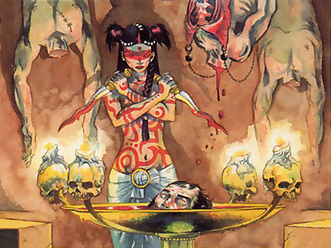
Blood Magic has very much fascinated me since I encountered it in Dragon Age six years or so ago. I wanted to have something like that in my own setting since all the way back when I started planning it. Since then I learned a lot more about how magic works in the Thedas setting and it actually is mostly demonic mind control. Not really much blood involved. But I most liked the idea of blood magic not being fundamentally evil and one of the first blood mages you encounter in the series is actually a pretty nice and also average guy. That had always had me want to have blood magic in my setting and the idea of using blood as a power source instead of some ethereal mana or mental energy is also really cool. It’s much more savage and primitive than arcanists in their libraries playing with astrology. Perfect for a Bronze Age barbarian setting.

But the whole time I never developed the idea further than that, always keeping it off for later. Because I just didn’t have any good idea how blood magic could be different from regular magic and my magic system kept changing all the time anyway. Now I do have a magic system that I really like (but still got not around to write out in full) and with the rest of the setting being already very far along it’s really getting time to finally tackle it.

How it works

latestMagic in the Old World is based aroud the idea that the being of any creature is a single entity of spirit and body, but that it extends beyond the boundaries of the physical form that is seen with eyes or felt through touch. The physical forms of creatures and things have clear boundaries, but the immaterial aspects do not. They just weaken with distance and eventually blur together with the essence of everything else. (Similar to gravity or magnetic fields.) Most beings only have mental control over their own bodies and minds, but since everything is connected and the spirit has no clear boundaries, it’s possible to take control over things outside the physical body and even over other beings’ bodies and thoughts through a contest of wills. This control over other creatures or things is magic, as it is used by all witches, shamans, and spirits. One important limitation of magic is that it only works when the caster is actively taking control. When the control ceases, the magic ends. It’s also not possible to use magic against creatures who are not nearby, unless a spirit is send to visit people and use it’s magic on them. It is also the reason why magic objects can not be created; they can only come into existance naturally.

Blood magic is one way to get around this limitation. Instead of maintaining control over an enspelled target, a blood mage weaves the spell into the target’s blood, whose life force will then power the magic instead of the mages mental energy. Blood magic keeps working regardless of how far the target moves from the blood mage and the spell can continue potentially for as long as the target lives. Masters of blood magic can even weave spells into the blood of their target that will remain dormant until certain conditions are met and they perform their true enchantment. Having some of its life force consumed by a blood magic spell causes the target to be slightly weakened, depending on the power of the spell. But usually the effect is too small to be a clear sign of blood magic, with the target only being slightly more tired or faster out of breath during strenuous activities.

A more well known use of blood in the casting of magic is as an alternative power source to the mental energies of a blood mage. Wrestling control over another person’s body or thoughts is one thing, but actually draining life force from living creatures is much more difficult. Usually this is done by complex rituals and the use of various potions that allow apprentices and acolytes to give their masters access to their mental energies. A simple shortcut to this is to simply tear the blood out of a living creature’s body and use the life force it still carries. This gives a blood mage a great boost to his power when casting a spell. It’s still a difficult thing to do, especially in the middle of a battle, so often blood mages draw on the life energy within their own blood.

Since the corrupted energies that animate undead are very different from the life force of living beings, they are neither affected by it, nor can they use it.

What it does

Aside from giving a blood mage a boost in power from draining life force from a living creature, blood magic can be used to put long lasting enchantments on living creatures. One common use is to make the target creature a permanent slave that has to obey the blood mage’s orders. It’s similar to a powerful charm spell but the ideas planted into the targets mind do not fade away as it remembers its own thoughts and memories.

Alternatively a blood mage can give a creature specific orders to be performed under specific circumstances without it even knowing that such an enchantment is in place. Unlike a spirit following around a victim, such enchantments are very difficult to detect by other witches or shamans. Blood magic can also be used to permanently alter memories. Such enchantments are very difficult to break and require a shaman who knows exactly what he’s looking for. Blood mages familiar with the process can break it just like any other spell.

Instead of manipulating a creature’s mind, blood magic can also make changes to the body. Blood mages can give their servants and henchmen great strength and resilience which they retain even without the spell being actively maintained. Since the magic power to maintain these spells is entirely drawn from the creature’s own life force and not the mental energy of the caster, such enchantments tend to take a significant toll on its health. Giving greater strength to heroes for an important battle can often be more than a worthy trade, but guardians who are kept permanently enchanted often live for only a few years. The enchantments keep them strong until the very end but eventually they just fall over dead as desiccated corpses.

How it is treated

Blood magic is not an inherently corrupting or more harmful form of magic but usually seen as one of the darkest forms, similar to sorcery. Tearing the blood of a creature from open wounds is an incredibly violent process compared to the casting of other spells and it’s easy to see why it is especially feared. The effect it has on the bodies and minds of creatures that have been heavily enchanted with blood magic also gives people plenty of reason to regard blood mages as nothing more than savage sorcerers. Blood magic is more common among the more wilder and isolated clans of the Old World and often associated with the witches of the Witchfens, which gives it a reputation of being primitive and brutish though it’s actually a very advanced magical art.

Blood magic also has a much greater potential for manipulating people’s thoughts and controlling their minds than ordinary witchcraft, wich makes known blood mages even much more mistrusted. Even those powerful ancient witches and high shamans who know the secrets of the red art rarely trust their students with such powers and the lack of teachers makes it a very rare skill outside of clans who practice it openly.

RPG implementation

Except for the blood draining ability there are no specific rules for implementing blood magic as a game mechanic. It simply allows blood mages to make their enchantments permanent without any special costs or mechanics.

Races of the Old World for B/X

One of the oddities of B/X D&D is that nonhuman races are treated as classes. It’s actually a nice streamlining of the fact that nonhuman characters in OD&D were all limited to just one class. All that B/X does is providing separate tables for human fighters, dwarf fighters, and halfling fighters and a table for elven fighter/magic-users.

When adapting the system to settings that are not limited to human PCs something needs to be done to make the other humanoids playable. In the Old World elves are the only race that has stats in B/X and humans don’t exist at all. In addition to that all races can be thieves and witches in addition to fighters. So my solution is very simple: Don’t use special stats for races at all.

All races can be of all classes (no clerics) with no level limits. It’s pointless to make twelve custom classes when I can just use the three classes out of the book. And what difference does race really have for characters? In most editions of D&D it’s almost none and what little there is evaporates to nothing after a few levels.

Though one thing I am currently considering is to create maximum limits for ability scores. Elves are limited to 15 Con, kaas to 15 Dex, skeyn to 15 Str, and yao to 15 Int. But I might even ditch that.

Why have I not been informed: New LotFP edition in work

I just now spotted an article on the playtest document for the new edition of Lamentations of the Flame Princess that has been send out to some GMs back in february. I also noticed just a few days back that the new Referee Guide is still in work, which will include new unique monsters for the game. I assume it will be released alongside the new rulebook.

I don’t have the playtest rules myself, but looking at this summary from Dragons Gonna Drag (another new OSR website, like what you did so far Justin) I already spotted some things that I found interesting.

Intelligence determines skill points at first level. After that only specialists keep getting more points. I’ve been thinking about ways to give fighters and witches limited access to skill in my campaign these last couple of days. This is certainly one way to make it work.

There’s also a Medicine skill, which is nice, as it indicates support to play without magic healing. Very Sword & Sorcery.

Strength affects how many items characters can carry. This is one shortcoming I’ve seen with the Encumbrance system of the current edition and something which I think the system by LS from Pencils and Papers did better.

What I find really interesting is that classes are reduced to fighter, specialist, and magic-user (the other classes are said to be put in an appendix). I did the very same thing for my campaign. There’s been some talk not long ago about clerics and how they are pretty much a unique thing of D&D and not really fitting for other settings that don’t want to be worlds defined by the D&D conventions. (B/X is a great system on its own, even divorced from its D&D legacy.)

All characters advance with the same amounts of XP, a topic that I’ve been discussing on a forum just today. And I am very much in favor of it. Making miniscule adjustments to XP required for the next level is pointless when level loss, replacement characters, and characters of newly joined players all have a much bigger impact on the different levels of characters.

Justin mentioned having the impression that group initiative is being ditched, which is something I wouldn’t approve of. But it’s trivially simple to do anyway, and it isn’t like Dexterity would become a useless stat if it no longer affects Initiative.

There’s a new saving throw mechanic that basically uses a d6 dice pool and counting successes. That’s something I really don’t see myself using if it makes it into the new edition. I think a d20 roll against a target number indicated by your class level is just fine and much less of a hassle. There’s also partial saves, which is more granularity than I want to bother with. This new system also doesn’t improve odds as the characters level up, which I think is a pretty important feature of B/X. I can see why Raggi wouldn’t want that in his home games, but it’s something that I would really not want to miss in mine.

There’s also big changes to how spells are prepared, but since I’m using a completely different magic system that doesn’t have anything to do with D&D magic anyway, this doesn’t affect me personally.

Overall, I think this all sounds very good. I almost certainly won’t use the rules straight out of the book, but I don’t think there are many OSR GMs who do that with any game that is around. I am very much looking forward to the new rulebook and referee guide.

Water and Rations in a Wilderness Campaign

As I mentioned in my previous post about Encumbrance, supplies of food and water are the main factor of deciding how much weight you can afford to carry, other than treasure. Wilderness adventures have always been the most interesting thing about RPGs for me, and while I think dungeons can be pretty nice when done well, town adventures never were of any real interest to me. Compared to dungeons, the density of threats is much lower in a wilderness even in the most hostile regions. And those dangers you encounter might not be as outright hostile. Compared to towns, a wilderness has very few people you can meet, and its even more rare that those are directly in conflict or allied with each other. When trying to prepare wilderness adventures as a GM, one of the biggest question is what the players might actually do?

Dungeon adventures are players against monsters and town adventures are players against people. Wilderness adventures are players against environment, but since the environment doesn’t have any goals or motives and doesn’t care about what the players do, making adventures in the wilderness needs a somewhat different approach than usual. One way in which the environment can become a big part of the adventures is by including supplies in the campaign.

What can water and rations add to the game?

Food, water, and other supplies all only become important when they have run out. Or when there is a threat they might run out. When this happens, things can get very interesting.

Say, for example, that the players have run out of water. They need to find some and relatively quickly. When they encounter someone who has water, they need to consider their options: Are they trying to just ask for it and hope that those people will share? Are they willing to trade some of their possessions for it? What if those people are hostile? Will the players try to steal water or will they be willing to let themselves be captured to escape looming death? If a fight breaks out they might already be in really bad shape and it would be a fight they absolutely can not afford to lose. Alternatively, the players can steal or destroy the food and water supplies of their enemies and then wait to starve them out to give them an advantage in an upcoming confrontation.

Or instead, the players will have to decide to risk entering a highly dangerous place that might have water. Usually caves and ruins are explored searching for treasure, or the players might consider them too dangerous to be worth the risk. You can always get gold from another place later, but when you’re looking for water there might very well not be a later. There might also be a chance that they could find a safer source of water soon, but they might not be able to reach it if they are getting seriously injured now.

Or you could have another situation in which the players have to get to the other side of an area with very food and water quickly. Should they risk taking the short route straight across, or perhaps take the long route around where they will be able to forage for more supplies. Taking a lot of water on the trip would mean a lot of stuff to carry which might even slow them down enough so that the short route actually takes longer.

There are a lot of interesting things that can happen when supplies are running low.

Making the tracking of supplies practical

But as much as running low on supplies might lead to interesting situations, for as long as as the supplies are lasting nothing is actually happening. Not having supplies is fun. Having them is boring. An in practice, how often will running out of supplies actually happen? Unless you are playing in a desert setting, it’s very unlikely that the players will find themselves in a situation where they begin to starve. My Old World is almost entirely forests, rivers, and coasts, where it probably is going to be particularly rare. Under those circumstances, is it really worth the efford to track the consuming and restocking of supplies every day? To have a nontrivial amount of bookkeeping that then probaly will never actually lead to anything? That really seems like way too much trouble for being worth it.

And I had actually already considered to not track supplies at all and with that also ditch Encumbrance as well. But then I got an idea that I think is really clever: One situation in which supplies matter is when travelling light and travelling fast. When you run out of water and food, you will have to make a break in your journey to forrage for it, which could make you lose time that could have been saved if you had packed more from the start. So my idea is this: Normal travel distances per day are based on the assumption that the party is constantly foraging to gather as many new supplies as they consume. But if they have extra rations they don’t need to take time for foraging and can cover additional distance for the day. (Say six additional miles per day, as my Encumbrance system uses 6 miles steps for each category of encumbrance.) This makes ration effectively a consumable item that boost travel speed for a day. If the players don’t use it, it simply is assumed that they always gather some new food while eating the food items that are getting old. So the “ration” items in their inventory remain constantly fresh. As long as the players don’t tell the GM that they are using their rations to increase their travel speed, those rations just quietly sit in the inventory without anyone ever having to think about them. If throughout the whole campaign supplies never become an issue, the rations will just have taken up some inventory space but not caused any amount of bookkeeping work for anyone.

But if it ever happens that the players get in a situation where resupplying might not be possible, this changes. The GM then tells the players that from now on they have to consume rations whether they want to or not. One ration is substracted each day and when they are out, they get whatever effects there are for lack of food and water. (Still have not decided what effects I will use, but I probably make a post when I have picked an option.) If the players decide to go on a journey where this will probably be the case, the GM will tell them as soon as the characters would become aware of it. Which might well be several days before they will actually have to start consuming their rations.

This can also be applied to arrows. In most situations the players will be able to collect a good amount of their arrows and even those that got damage could still be fixed in the field by replacing a shaft with a piece of wood from the forest. Or they might pick up some that have been shot by their opponents. It’s only when the GM thinks that collecting arrows might not be possible that he tells the players to start tracking their arrows now. If the players are fleeing from an enemy and keep shoting arrows behind them, it would be one such situation. If it happens occasionally that players retreat after some arrows have been shot but nobody tracked how many, it’s not going to be a big deal. Just start counting when it becomes clear that running out might become a problem.

This system really is the best of both worlds. It lets me eat my cake and have it too. As long as everything goes fine, supplies completely stay out of everyone’s hair and are fully invisible. But once there is an opportunity to have an adventure with supplies running low, they are instantly there, ready to do their job.

War Cry of the Flame Princess: Encumbrance

I retroactively added this post to the WCotFP series and made some small channges accordingly.

Encumbrance is possibly the most hated and most ignored rule in games like Dungeons & Dragons, simply because it’s way too much bookkeeping for usually no noticable gain. An Encumbrance system that people are actually going to use has to be so simple that it’s practically invisible when not doing anything, but immediately available when it becomes relevant. As a GM you never want to tell the players “please look up the weights for all the items in your inventory and calculate your modified travel speed because of Encumbrance”. You just wouldn’t do that.

Why have Encumbrance in the first place?

Because Encumbrance shows up so rarely in adventures and campaigns and the games work just fine without it, there’s the obvious question why to bother with it at all? The answer I have to that is that the effects of Encumbrance are actually a lot of fun and can lead to great encounters and even whole adventures. It all comes down to the players having to make decisions what things they want to carry with them and what things to leave behind. The more stuff you carry, the slower you move. In the older editions of Dungeons & Dragons this is hugely important. Characters get some experience points for defeating monsters and other enemies, but the majority of XP will be gained from bringing treasures back from their adventures. The most efficient way to become more powerful and not dying in the process is to steal treasure without fighting the onwer. And if you do get caught, it’s often the smartest way to run. The amount of experience you get depends on how much treasure you collect. The speed at which you run depends on how much tools and treasure you are carrying. This is a kind of conflict, and both in fiction and RPGs, conflicts are always great. That’s where things get interesting.

There are also the wandering monsters and random encounters. The longer you stay in a dungeon, the greater the chance of accidentally running into someone. Since wandering monsters generally don’t carry their treasure with them, they are a lot of danger for very little potential reward. The best way to get treasure out of a dungeon is to do it quick, and to be quick you need to be able to move fast. Do you really need that big bag of copper coins that are worth barely any XP? Would it perhaps be better to just ditch it? How much are you willing to risk for a few XP more?

When dealing with wilderness adventures where the characters are away from civilization for days and weeks, another element comes into play. Without places to simply buy food, you have to bring your own or be able to find some along the way. If you run out, you have a problem. This is especially important when traveling through deserts, where you might have to carry a great amount of supplies, which will slow you down a lot and make the whole trip significantly longer. And staying longer in the desert means greater risk of running into someone hostile. And, as players of post-apocalyptic campaigns might probably know, it makes supplies a potentially valuable type of treasure to be found. Unfortunately, most RPGs don’t bother with any rules for going without food and water and so this is something that almost never comes up. Tankfully, Lamentations of the Flame Princess does have some pretty decent rules to cover thirst and hunger in easy to handle ways and also with a simple system to find new supplies in the wilderness. I recommend using those.

Tracking Encumbrance the easy way

When it comes to a system for determine a character’s Encumbrance level, I simply recommend using the system from Pencil and Paper. This is by far the best way to track Encumbrance I have ever seen and even though it was designed with Pathfinder in mind it works with every game that has a Strength score and movement speeds. LotFP uses something that is based on the same idea, but I think this execution is even much more elegant than that.

The rules I am using for the Ancient Lands are these:

  • All items smaller and lighter than a dagger do not count towards encumbrance. Containers holding multiple such insignificant items (like a bag of coins, a quiver of arrows, and so on) count as a single item.
  • Items that require both hands to carry or are unusually large (such as a polearm) count as two items.
  • Light armor counts as two item, medium armor counts as four items, and heavy armor counts as six items.
  • Characters carrying a number of items no greater than their Strength score are unencumbered and have a speed of 120′ per round/24 miles per day.
  • Characters carrying a number of items no higher than two times their Strength score are lightly encumbered and have a speed of 90′ per round/18 miles per day. If attempting to swim, they have a 1 in 6 chance of drowning.
  • Characters carrying a number of items no higher than three times their Strength score are heavily encumbered and have a speed of 60′ per round/12 miles per day. If attempting to swim, they have a 3 in 6 chance of drowning.

As by the standard rules of LotFP, being encumbered has some limitations on the use of skills. Characters other than specialists can not make dificult climbs requiring Climb checks if they are encumbered. Specialists (and scouts) have their Climb and Stealth skills reduced by 1 in 6 when lightly encumbered and by 2 in 6 if heavily encumbered.

Tracking Encumbrance

But don’t you still have to constantly count the numbers of items in your inventory and then check the Encumbrance table? With the right type of inventory sheet, you don’t. Most character sheets have a space for the inventory that just consists of a number of rows. Simply number each row at the left and then make sure you won’t have any empty spaces when you fill in your items that you are carrying. The number of the last row that holds and item is the number of items you carry. Since the amount of items you can carry never changes as the character advances, you can then simply use some kind of marker to make a clear line below row 10, row 20, and row 30 if your character has a Strength of 10.

To the left of the list you can then simply make a small note for the movement speed your character has when the inventory is filled up to those marked lines. You will always be able to tell immediately what your current movement speed is whenever the GM wants to know it, and it doesn’t mean any extra work for the players. All they have to do is write all their items down on the inventory sheet.

Encumbrance for mounts and pack animals

One thing that RPGs (and fantasy in general) almost always gets wrong is how traveling with a horse works. On a short sprint, a horse will always beat a human easily. But when it comes to endurance running, the only creature on Earth that can keep up with humans are dogs. This is the big superpower of our two species and was the beginning of a wonderful fiendship (consisting mostly of killing other animals and eating them). All other animals need a lot of rest during the day and can’t keep marching all day. For humans and horses, the differences between speed and endurance are about canceling each other out and so you are not going to be any faster on a horse than on foot. That is, if you are not carrying any big loads.

If you have to not just get yourself from one point to another, but also a lot of other stuff, a horse can make a big difference, especially when you’re not riding it. Having a horse allows you to walk without having to carry anything, while your horse is slowed down only very little by what would be a really heavy load for yourself. And if you have two horses you can ride one while the other carries your stuff, and so you don’t have to walk.

So the effects of encumbrance for mounts are like this:

  • Small characters count as 10 items, human sized characters count as 30 items, and large characters count as 50 items for calculating encumbrance. All the items carried by characters have to be added to be mount’s encumbrance as well.
  • Mounts carrying a number of items no greater than their Strength score are unencumbered and have a speed of 240′ per round/24 miles per day.
  • Mounts carrying a number of items no higher than two times their Strength score are lightly encumbered and have a speed of 180′ per round/18 miles per day.
  • Mounts carrying a number of items no higher than three times their Strength score are heavily encumbered and have a speed of 120′ per round/12 miles per day.

I originally had another post covering water and Rations, but I since realized that this system doesn’t really work, so better ignore it