Trade Goods as Treasure

This is one of these “I made this, so I might as well share it” things.
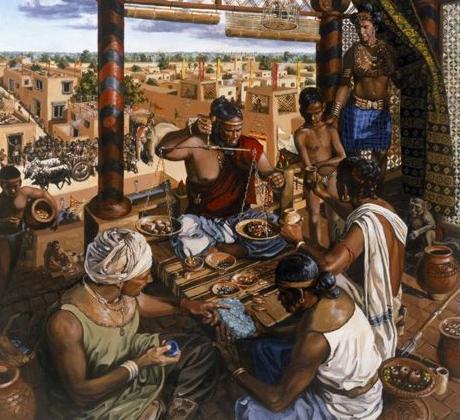
In my setting, travelling merchants are supposed to be a really big deal. And I also enjoy the players having to deal with encumbrance. Making exotic goods into a type of treasure that can be found is the sensible thing to do.

In my encumbrance system, weights are rounded up to the next multiple of 10 and then divided by 10. So the average weight for an item with an Encumbrance load of 1 is around 5 pounds. (Equally, the encumbrance limits for characters are divided by 5 to get the number of items that can be carried instead of the weight in pounds.) The quantities listed in this table have been chosen accordingly and the resulting prices and container capacities are based on the numbers from the 5th Ed. Player’s Handbook. If players come across these goods and want to take them as treasure, the only relevant number at that moment is how much they can carry while staying under the Encumbrance limits. Players won’t be trading in silk by meter but by encumbrance unit.

For the sake of simplicity, the numbers for kegs and barrels of ale and wine are rounded to easy number. The actual values for any of these goods are completely made up anyway.

Item Quantity Price Encumbrance
Sack of grain 30 lb. 3 sp 3
Sack of flour 30 lb. 6 sp 3
Pouch of salt 5 lb. 2 sp 1
Pouch of ginger 5 lb. 50 sp 1
Pouch of cinnamon or pepper 5 lb. 100 sp 1
Pouch of cloves 5 lb. 150 sp 1
Pouch of saffron 5 lb. 750 sp 1
Keg of ale 20 l 10 sp 4
Barrel of ale 200 l 100 sp 40
Keg of wine 20 l 20 sp 4
Barrel of wine 200 l 200 sp 40
Bottle of expensive wine 1 l 100 sp 1
Keg of expensive wine 20 l 2,000 sp 4
Canvas 6 sq. yd. 6 sp 1
Cotton cloth 20 sq. yd. 100 sp 1
Linen 12 sq. yd. 600 sp 1
Silk 24 sq. yd. 2,400 sp 1
Iron 5 lb. 5 sp 1
Copper 5 lb. 25 sp 1
Tin 5 lb. 100 sp 1
Silver 5 lb. 250 sp 1
Gold 5 lb. 2,500 sp 1


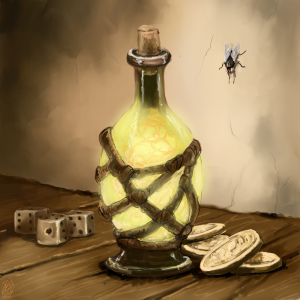
Potions

Hemra

This potion is made from the boiled leaves of the hemra plant and some simple additional ingredients. The potion is a slightly bluish green and heals 2d4+2 hit points. Partiqularly high quality potions have a deep blue color and heal 4d4+4 hit points.

Rusan

This potion is an oil made from the leaves of the rusan shrub. A full dose causes unconsciousness for 1d4 hours, while drinking a third of that amount put a person into a hazy state that gives an advantage on saving throws against being frightened and disadvantage on all Dexterity and other Wisdom checks, which lasts for 1 hour.

Valkar

Eating one of these seeds gives advantage on saving throws against exhaustion for 6 hours. Eating another within 24 hours requires a DC 15 Constitution saving throw or it causes the poisoned condition instead.

Satak

This vile potion is made from a mushroom found in Venlad. For 6 hours it gives advantage on Strength and Constitution ability checks and saving throws, and disadvatage on Wisdom and Charisma ability checks and saving throws. When the effect ends, the drinker takes 1d4 points of poison damage and is poisoned for 6 hours.

Tamgut

This potion is made from specially prepared berries from the Tamgut shrub of the Wyvern Mountains, mixed with rusan oil. It causes incapacitation for 6 hours, at the end of which a DC 15 Wisdom check must be made. If successful, the drinker gets the effect of a divination spell.

The most useless RPG advice ever

“If you want that, you really should be running a different game.”

That’s not advice. That’s just stupid. You might notice that it’s always “a different game”, never any actual specific game.

This is not helping. Never suggest this to anybody if you can’t recommend a specific system and explain why this might potentially be an interesting game to take into consideration for the campaign in question.

Failure is always an option

Yesterday there was a post on Mythic Fantasy about the idea that “combat is a fail state” is nonsense. Sadly it’s not possible to comment there directly without a Google Account, but now Necropraxis also picked it up so let’s make this a proper discussion.

“Combat means that the players have failed” is wrong, I agree with that. But I think this is just an oversimplification resulting from years of careless repetition, about an actually significant observation.

As I see it, it’s not that “combat means the party failed their task of stealing treasure undetected”. For ease of use by people who assumed everyone already knew what they were talking about, critical details were no longer mentioned in the ongoing discussion of the subject. But what I think it really means is that “unprepared combat in an environment not of their chosing means the party failed their task of maximizing their odds of survivial”. Combat is always an option. It’s a tool in the toolbox and one of the original classes was specifically made for this job. But swords are only one tool and not meant to be used alone. You don’t just walk through doors, put your hands into holes, make a lot of noise, and see what happens. Because then the opponents prepare for a fight and pick a battlefield of their choice. When this happens and the players chose to stand their ground and fight under the conditions their enemies want them to, then they have failed.

If they die in a fight that isn’t stacked in their favor, then they have nobody to blame but themselves. They have plenty of options to scout the environment and the numbers and positions of potential threats, to plan for retreats and set ambushes, to protect themselves with spells and potions, and to prepare a battlefield by setting or clearing onstacles. If they don’t make use of these tools, they failed in playing the game right. Which they might not know, so it is one of the GM’s duties to show the players that these options do exist and to set up dungeons in which they can be applied. You don’t need to tell them what to do in a fight, but to players who are not familiar with such games, it is not obvious that your allowed options are not restricted to their character sheets.

And also: Just because something is stupid doesn’t mean it isn’t fun. There are lots of reasons why players might want to create situations they know could have been avoided. I think most of us don’t play for a score, but for excitement. RPGs are not meant to be an optimization exercise but an adventure.

Wilderness Adventures for characters of level 4+?

Common wisdom appears to have it that parties in B/X transition from pure dungeon adventures at 1st to 3rd level to the wider world of wilderness adventures after reaching 4th level. The Expert Set adds rules for characters of 4th to 14th level and rules for wilderness adventures. And of course B1 In Search of the Unknown and B2 The Keep on the Borderlands are the most classic dungeon adventures and X1 The Isle of Dread was the first D&D hexcrawl. So obviously it must be true. Basic characters stay in the dungeon, Expert characters expand outdoors.

But I’ve come to wonder whether this really is the intention behind the way rules are split between the Basic and Expert Set. My suspicion is actually that the choice to split the rules into multiple sets was done with the intent to introduce both players and GMs to the rules gradually and not overwhelm them with everything at once. Which I think might have been a pretty good choice. The original Basic Set was a total of 60 pages. The Rules Cyclopedia comes to 300. That’s a lot of stuff to digest in one go before you feel confident that you know what you need to start playing. If you want to teach the basics of the game, you do need the dungeon, but outdoor adventures are indeed something that can, and perhaps should, wait for a bit later. Once everyone who is completely new to the game has got the hang out of the basics. By putting level 4 to 14 into the next set, the amount of spells that players (and GMs) are exposed to is much easier to overlook and you also get a collection of monsters that for the most part wouldn’t be absurd to face for a new beginning party. (Looking at you here, Dragon.)

I suspect that the separation of content was done as a teaching aid, primarily for GMs. It’s not so much that adventures change at higher levels, but that GMs can expand once they have become familiar with the basics. When you look at the Expert Set it says that “now” new paths of adventure are open, but does not do so in the context of character level. It is “now” that the GM has access to these expanded rules of the game. The Rules Cyclopedia does not touch upon this whole subject at all, from what I was able to tell.

Another strong piece of evidence, as I see it, are the modules B10 Night’s Dark Terror and X1 The Isle of Dread. Terror is a Basic module for characters of 2nd to 4th level while Isle is an Expert module for characters of 3rd to 7th level. Both begin at Basic levels and continue up into Expert levels and they are both wilderness adventures. The creators of these modules clearly did not write under the assumption that “you have to be this high” to go on adventures in the wilderness.