You used to be an Adventurer like me?

This post somewhat continues on my thoughts from two months ago.

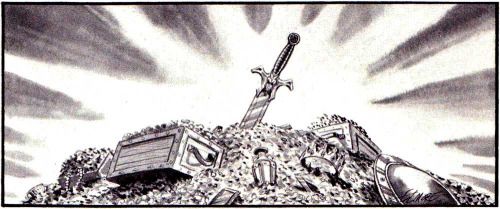
When Dungeons & Dragons appeared and became the last common ancestor of basically all RPGs today (I know, it didn’t appear ex nihilo in a complete vaccum), it wasn’t even called a Roleplaying Game. It was labeled on the box as a “Rules for Fantastic Medieval Wargames” and later “Fantasy Adventure Game”. The PCs went to the dungeon because it was there. They looted all the treasures in the dungeon because the treasure exists to be looted. The adventurer’s life of dungeon crawling started as a game mechanic. Some kind of plausible fictional reasoning for why people would engage in an activity with such an outrageous fatality rate for the sake of collecting piles of gold they didn’t actually have any use for was tacked on later. It also followed the footsteps of Greek heros and Arthurian knight. The adventurer makes sense within the world of the dungeon, but its existence becomes much more far fetched and implausible when it is migrated into a semi-ordinary world of towns and farms, inhabited by lords and peasants who are going by their everyday lives.

Seas of ink have been spilled on how the world of the Forgotten Realms makes no sense, in which low-level adventurers have to risk their lives to save villages from deadly monsters if the local tavern owner or herbalist could wipe them all out in a matter of minutes with their legendary magic swords and awesome arcane powers. And when Fantasyland with its D&D conventions reached Japan and found its way into shonen anime aimed at 10 to 16 year old boys, we eventually ended up with stories that specifically acknowledge that the internal logic of the world runs on game mechanics. That American D&D cartoon, that I’ve never seen, probably played a big part as well. (Portal Fantasy is cancer!)

What we ended up with are fantasy world where adventurer is a common profession, with many larger settlements having a local branch of the adventurer’s guild where people come to list contracts for adventuring work like killing the rats in their basement. These worlds make no sense. And no, I’m not talking just about some juvenile anime or bad fan fiction. It’s all the way up in the most prestigious, big budget, and mass audience works of contemporary fantasy.
No, you are absolutely nothing like me.

I feel that to have a world in which people go into ancient ruins to face terrifying beasts and deadly traps, adventuring does not make sense as a career choice for regular people. To be in any way plausible, a setting for adventures of dungeon crawling, monster killing, and treasure looting needs two main elements (and a third lesser one):

First, ordinary people must not be able to fight back against “Real Monsters”. And this also includes professional soldiers. A king can not just send 30 of his best trained and armed men to deal with monsters threatening the realm. If that were the case, there would be no need for adventurers other than cutting costs by outsourcing the work to contractors. That hardly sounds heroic. When I am talking about real monsters, I mean stuff like a basilisk or a manticore. To my knowledge there are no famous tales of Sir Lancelot and the Wolves, or how young Perseus fought eight goblins. Those stories would not be worth telling either. Sure, a fantasy world can have fictional critters. I’ve made plenty of them myself. But those are mostly background flavor, not the stuff of heroic tales.

The second thing is that PCs can’t just be adventurers who thought fighting monsters would be an interesting career choice. This goes completely against the first point that I just established. PCs need to be Heroes, with a capital H. Extraordinary people who have been gifted with exceptional powers and abilities. The heroes of ancient myths are very often descendants of gods. And even in Athurian tales, you could argue that noble knights are a unique kind of people, different by birth from the ordinary folk and granted special status by god. This is something I’ve never seen mentioned in D&D outside of Birthright. Which I guess might very well be an American thing. But then, Superheroes are also one of the most American things ever, and they all have unique superhuman powers from birth, or incredible funds from a highly privileged upbringing. Now I am a very outspoken critic of Tolkien and seeing The Lord of Rings as a big apologetic manifesto for the racial superiority of the English aristocracy, so I can fully understand if people don’t like the idea of PCs being destined to be Heroes instead of earning their merit through hard work and dedication. But a special trait that makes rare individuals capable of becoming Heroes in ways that are completely out of reach of most people does not have to be tied to specific ancestral bloodlines. You can also have something like Star Wars, where being strong in the Force is a rare inborn trait that apparently can appear in everyone completely at random. But I think it’s important that player characters are not random people, and not everyone can become a Hero. If that were the case, nothing would stop the king’s 30 best trained men from becoming 8th level fighters and deal with all the monster problems in the realm themselves.

I believe that for a good background setting designed for campaigns that center around dungeon crawling and monster slaying, having a distinction between Heroes and normal people is important. And it can even be valuable to have that distinction be consciously understood by the people who inhabit the world, and make it part of their culture. I feel that the whole life of adventurers makes so much more sense and feels so much more believable in such a cultural context. It provides a reason for why the PCs gain access to the highest ranks of society that are usually barred to common folk, and why people put all their hopes into them. It’s a relatively easy way to make the setting shape itself to the game, rather than awkwardly trying to make the game fit a setting.

Earlier I mentioned a third worldbuilding element that helps making a world of treasure filled ruins much more plausible, which is one possible most people here would already have heard about long ago. It is the idea that the implied environments of early D&D were all post-apocalyptic settings. And it certainly helps. Why are there so many dungeons everywhere, often within a relatively short walk from the nearest settlements? Why are they loaded with huge hoards of treasures and magical items? And most importantly, if they are that easy to access, why haven’t they been plundered centuries ago? It all makes a lot of sense when you assume that there was a civilization much wealthier and with much more magic than there is today. And it also used to be that way until relatively recently.

There are so many magic items in abandoned ruins and old tombs because at the time, these were not nearly as rare as they are now. The minor king who was buried with his legendary sword and ring of incredible power did not take the greatest treasure of the realm into his grave. Those were only baubles with sentimental value to him, but sacrifices his successors could afford to make to honor his memory. And why do adventurers keep breaking into these tombs to loot all these magic treasures today? Because these tombs and forgotten stashes are the only places where you can find such items now. It’s less treasure hunting than salvaging. Not to say that all the magic items used to be minor junk in the days of Atlantis, but their presence in tombs and old castles makes a lot more sense if you assume that these items were not nearly as valuable as they are today. One reason for it being people being able to make more of them. The creation of new magic items being nearly impossible is a big factor in making the looting of old ruins worthwhile and the pillaging of grave goods more justified. If your average town alchemist or blacksmith can make minor magic items, this aspect starts coming apart at the seams. Wizards being required to be 9th level to start creating magic items might seem excessively high and seem a bit implausible. But when the goal is to make the creation of new magic items exceptionally rare and difficult, it does make a lot of sense.

It all also becomes more plausible the more recent you place the fall of the previous civilization, or at least the rise of the new one. Even low-level PCs can still find great treasure in relatively easily accessible dungeons because they are among the first people who have come to raid them since treasure hunting became the primary way to gain access to such riches and items. The people in the village may know about the old ruin up on the hill, but since the founding of the village the PCs are some of the first people who have shown up and might have a shot of surviving crossing the first threshold.

So yeah, my points. Insert witty conclusion here.
Prime Requisites are pointless

The original D&D edition, AD&D, and Basic all had the Prime Requisite mechanic, in which all classes have one main ability score that affects the amount of XP they get. It’s a modifier that gets applied to all XP a character gets before they are added to the character’s XP total. In B/X (where I will be taking all further numbers from) the modifier ranges from -20% for a score of 5 or lower, to +10% for a 16 or higher. Which sounds quite significant when you put it like that, but actually makes a much smaller difference than you might expect, because of the way XP requirements to reaching the next level increase.

The way it’s supposed to be done is that the GM announces the amount of XP every player gets, and the players have to remember to apply their relevant modifier to that number before adding it to their total. (I don’t exactly have high trust in this.) Since the players might encounter various magical effects that increase or decrease their ability scores, and potentially change their XP modifier, I can see why this approach was chosen, instead of having five different columns for XP needed by each class based on the prime requisite score. But to make the comparison easier, I did just that with the XP requirements for fighters. Because adding and subtracting percentages changes the outcome based on the order of operations, a -20% to all XP gained translates to the character requiring 125% the amount of XP to reach any given level. And a +10% bonus to all gained XP means a requirement of 91% the XP to reach the same level.

How does this translate to characters advancing through levels faster or slower? Of course, a character with a very high prime requisite score will reach Nth level before a character with a very low score. But how big is that advantage in the long run?

  • At 10,000 XP, a Fighter with a -20% penalty will have reached 4th level, and a Fighter with a +10% bonus will still be 4th level.
  • At 50,000 XP, a Fighter with a -20% penalty will have reached 5th level, and a Fighter with a +10% bonus will still be 5th level.
  • At 100,000 XP, a Fighter with a -20% penalty will have reached 7th level, and a Fighter with a +10% bonus will still be 7th level.
  • At 500,000 XP, a Fighter with a -20% penalty will have reached 10th level, and a Fighter with a +10% bonus will be ahead at 11th level.

It is only at the point where the GM has awarded all characters 72,000 XP and a Fighter with no modifier has reached 13th level that there’s an actual gap to Fighters with a -20% penalty, who are still at 11th level. And that’s for the extreme cases where a player with a Strength of 5 or lower decides to play a Fighter anyway for shits and giggles. Such characters being played up to 11th level probably isn’t going to happen in a terribly high number of campaigns. If we narrow the scope to only penalties of -10% and bonuses of +10%, the effect becomes even significantly smaller.

It’s even more marginal in AD&D, where characters can’t have any penalties and it’s only the default XP or +10%.

This does not seem like something that is worth accounting for. Having players with high or low prime requisites remember to apply the modifier every time they get XP does not seem worth the near undetectable difference in results to me. If you have two characters with the same class start at the same point, then yes, sometimes one player might announce that he reached a new level before the other player. But if either of those two characters misses out on a single session, or gets disabled and gains no XP in one session,, that pattern will already be completely out of whack anyway.

In my opinion, prime requisites make too little impact to be worth bothering with. I’ve come around on my earlier opinion that all classes should just use the Fighter XP requirements because the level difference between a Thief and a Wizard with the same XP really is quite substantial. (A wizard needs +100% the amount of XP that a Thief needs!) But prime requisites is something I threw out right when I started running B/X games, and that  under closer statistical observation, I still see no reason to bring back.

A simple system for supplies and hunting

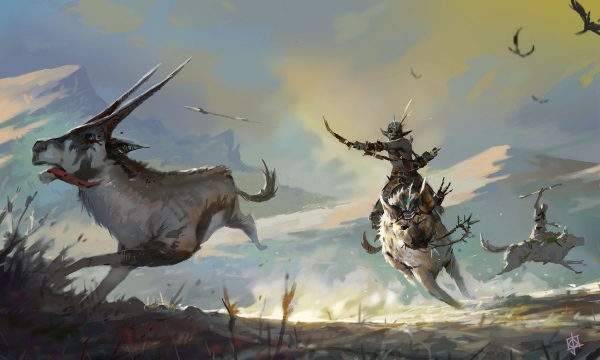
Way too dramatic fantasy hunting scene, but this is what I got.

Kaendor is a continent that is very large and very sparsely populated, with almost all land covered in trees or steep mountains. For campaigns in a setting like this, especially when it ‘s intended for parties with numerous followers and animals, tracking food and water supplies and dealing with the consequences of hunger and thirst is something that really should be part of the game and the everyday travel procedures. While B/X provides a neat simple system for hunger and thirst, the rules for hunting are very vague and appear implausibly inefficient.

So here’s my take on it. The foraging system is taken straight from the Expert set, and expanded with the hunting mechanic. With how often players will likely go hunting throughout a full campaign, I really don’t want to bother with having combat encounters with rabbits and deer that might just run away. The mechanic for hunger and thirds is straight from Basic Fantasy, though I added the time limit to die from dehydration regardless of remaining hit points.

Hunger and Thirst

Humanoid characters need one ration worth of food and one waterskin of drink every day. Characters who do not get sufficient amounts of food lose 1 hit point per day. If they don’t get sufficient amounts of water, they lose 1d4 hit points per day. In either case, the characters are unable to naturally heal any damage without magic until they receive enough food and water again. In addition, characters who go without water die after 3 days. Characters with a Constitution score of 13 or higher can survive for an additional number of days equal to their Constitution bonus to hit points.

Foraging and Hunting

In most circumstances, parties come across enough sources of drinkable water in the wilderness to refill all their waterskins to full. So unless the GM specifically states that no water source was encountered during the day, water consumption does not need to be tracked. If the party stays in areas without natural water sources for an entire day or more, one waterskin has to be subtracted every day, but finding any source of drinkable water is usually enough to refill all waterskins to full.

Rations of food have to be tracked every day the party spends outside of settlements. While traveling through the wilderness, characters can gather edible plants they find along the way, and the party has a 1 in 6 chance to collect 1d6 rations worth of food on any given day. In practice, this number is simply subtracted from the number of rations that are consumed on that day. (Assume the characters eat food that is close to perishing first and keep any food that keeps well for later, so there’s no mechanical difference between preserve rations and fresh plants or meat.)

Alternatively, the party can decide to not travel on a given day and instead spread out around the campsite to hunt for food. Each group of hunters has a 1 in 6 chance to collect 1d6 rations worth of food, but also makes separate checks for random encounters at noon. (Random encounters in the morning and evening are assumed to happen at the camp.)

The Essentials Version

Hunger: Characters who do not eat one ration worth of food in a day, suffer 1 hit point of damage and can not heal damage naturally without magic.

Thirst: Characters who do not have one waterskin worth of drink in a day, suffer 1d4 hit point of damage and can not heal damage naturally without magic. After 3 days + 1 day per CON bonus, the characters die.

Foraging: A traveling party has a 1 in 6 chance to find 1d6 rations worth of food per day.

Hunting: A party resting at camp for a day can send out hunting parties that each have a 1 in 6 chance to find 1d6 rations worth of food per day.

Yora’s Law of getting 1s in a dice pool

While I was checking the odds on an old system for rolling for random encounters in the wilderness, that I’ve come up with some years back, I discovered an amazingly simple equation (with help from gunnervi and A1vin) to calculate the expected amounts of 1s that come up in a roll of multiple dice of the same type.

If you roll N number of P-sided dice (NdP), then the expected amounts of 1s to be rolled is N/P.

When you roll 4d6, the the expected amount of 1s to be rolled is 4/6 (or 0.67).

When you roll 3d8, the the expected amount of 1s to be rolled is 3/8 (or 0.375).

My random encounter system rolls a single die four times per day, with a result of 1 indicating an encounter. To get different odds for areas with high or low population densities, you switch to different types of dice, with d4s being used for very busy areas and d10s for very desolate wastelands. I wanted to know how many encounters you would get per day on average, and the numbers I got for the four dice types are 0.4, 0.4998, 0.666, and 1. With the d8 looking like a rounding error of 0.5, I realized that these are all fractions. Specifically 2/5, 1/2, 2/3, and 1/1. That doesn’t look much like a pattern, but I felt like poking at it just a bit more, and you can write the same numbers of 4/10, 4/8, 4/6, and 4/4. Which matches the sizes of the dice, and as I figured out a bit later, the number of rolls!

I only checked this for rolls of one to four dice and only for the d4, d6, d8, and d10, but the results are so exact that I am very confident that it works for any number of dice of any type.

I had decided to go with random encounters happening on a 1 instead of the max number of each type of dice because it just seemed neater to say “encounter always on a 1!” But the math works out the same either way. If you have a player roll Xd6 and want to know how many 6s you can expect to come up on average, it’s the same as counting the average amounts of 1s. Or any number actually. As long as it’s just a single number you are looking for, and not a range of numbers (like “3 or higher”), this equation works.

You can even use this to get the expected average result for mixed dice pools. To get the expected amounts of 1s that you get from 3d8+4d6, you just add them together as 3/8+4/6. Not as neat, but still really simple.

This might be of some use for people tinkering around with dice pool mechanics.

Sometimes I think nobody at TSR knew what they were doing

When you pay a little bit of attention to discussions about rules interpretations in old D&D systems from the 70s and 80s, you run into people all the time who say things like “this is the way to do it, because that’s how Gary did it”. And Gygax created the game, he must know what’s best.

When you look at OD&D and the AD&D rulebooks, I find that very hard to believe. And if you pay a bit more attention, you also very often come across people saying “Oh, you should just ignore those pages from the DMG. Gary never used those rules himself.” I believe Gygax didn’t really have any clue what he was doing. Which isn’t to say that anyone else did either. For one thing, this new Fantasy Adventure Game was a new concept with pretty much no pre-existing foundations to build on and compare to. There was very little data to work with, and also no real established procedures for designing such games. And those early designers literally worked out of their living rooms.

But sometimes I see things that just make me grasp my head in disbelieve. Why did anyone think that was a good idea? The completely backwards math to roll against Armor Class is the obvious black sheep. But sometimes there is also stuff that makes me feel absolutely certain that nobody ever playtested it before it went into print. And possibly the writer didn’t even check how the math works out.

What I am looking at in particular right now are the wilderness movement speeds in the 1981 Expert rules. I am generally a huge fan of Cook’s work, he’s probably my favorite of the TSR designers. But this overland travel system? What the hell was he thinking?

To determine the speed of a character, you first need to look out the base movement speed based on Encumbrance in the Basic rules on page 20. Then you go to the Expert rules on page 20, which has a list that tells you the miles traveled per day based on the base movement speed. Then you have to go to another table that tells you the speed is 2/3 the normal rate in forests, 1/2 the normal speed in mountains, and 3/2 the normal rate on roads.

Why not simply give us a table like this?

It’s so easy. With this table we could easily travel along our 6-mile hex map (as implied on page 56).

But what do I spot there? 27 miles per day? 9 miles per day? 16 miles? 4 miles? Those aren’t divisible by 6! Did nobody notice this when the Expert rules were written? Did they notice it and not thought about maybe changing the system so it works with 6-mile hexes?

At least the movement rates for ships are all in 6-mile increments. But I think for sea travel, I’d rather use 30 mile hexes instead.

Balancing of Treasures in B/X

Since I first discovered the actual Basic/Expert game almost exactly six years ago, I’ve taken out the Basic rules a couple of times for relatively short games, but never really got into any of the Expert material. I also did not make much use of the wandering monsters and morale mechanics and mostly ran it pretty “modern conventional”. And I certainly did not use the random treasure tables. When I started work on my next campaign, I made the choice to try to really understand all the rules as they are written and follow the procedures as they are presented by Moldvay and Cook, to see how that plays out before I start making significant changes. It’s a game that is meant to be highly flexible and customizable, but it’s generally a bad idea to start making modifications to something before you understand what the default setup does.

A line of thinking that I encountered in the wild over the years of listening to the words of the elders, is that the tables for wandering monsters and generating randomized treasures are the main reference for how you set up dungeons with appropriate challenges and corresponding amounts of rewards. I’ve seen discussions about how some magic items are more valuable in Basic or AD&D because of the greatly different chances of them appearing in treasure hoards, and how this is indicative of the original assumptions how the games would be played and why some classes have different advantages with the rarity of those items in mind. I’ve long had my doubts about that and suspecting that that very little actual thought went into the creation of these tables and the resulting chances for certain encounters and rewards. And when you look at how the tables are constructed, this really seems very likely. On the wandering monsters tables, there are 20 entries, each with the same 1 in 20 chance. On the same table, you have 1 HD creatures appearing in numbers of 1-8, and 2 HD creatures in numbers of 2-12. This is not adjusted to be roughly equal in challenge on average. The magic item tables in Basic are just alphabetical lists numbered from 1 up, all with the same chances. The Expert tables are a bit more elaborate using a d100, but in the end all potions have either a 3% or 4% chance. I think these were all just eyeballed without any thought to intended play or adjustments for balance.

But I still was quite surprised when I scoured the texts again, and discovered what exactly Moldvay wrote on these topics.

Treasures are determined randomly or chosen by the DM. The DM should always determine the contents of a large treasure hoard before play in order to determine how best to hide and protect the treasure from theft, and if magic items are present.


The DM may choose treasures instead of rolling for them randomly, or may choose a result if rolls give too much or too little treasure. The choices should be made carefully, since most of the experience the characters will get will be from treasure (usually 3/4 or more). It will often be easier for the DM to decide how much experience to give out (considering the size and levels of experience in the party) and place the treasures to give this result.

The method advocated here is to start with the total amount of XP that characters will be able to make in the dungeon or dungeon level as a choice by the GM and work backwards from there. One quarter of that amount should be in the form of enemy encounters, and the remaining three quarters in the form of treasures. Or to get the same effect, just populate the dungeon with whatever monsters you want to use, then calculate the XP for defeating all of them, and multiply that result by 3 to get the appropriate value of the treasures you should distribute among the creature lairs. The treasure tables seem more to be intended to be used when you don’t really have an idea for what treasure you might want to put in the dungeon and to give you some suggestions. But since the tables don’t know how many of the creature lairs will be of creatures that have treasure hoards or not, this can’t get you that rough 3 to 1 ratio for XP except by pure accident.

For my setting, I have a lot of custom creatures (though most of them are plain reskins), and I had been thinking about how I would assign treasure types to all of them. But I don’t think I really should bother with that. I don’t believe the treasure tables and treasure types have much logic behind them I could figure out and apply to my own creatures. It’s always only been eyeballed to look good enough.

Another small detail that I noticed is that something that I considered a new house rule of mine is actually tucked away in the text already.

Treasure is normally found in the lairs of monsters, but may be paid to a character by a high level NPC for performing a mission or job.

The basic formula of “you’re treasure hunters, so go hunt treasure for the sake of hunting treasure” never really worked for me as a basis for compelling adventures. I thought that carrying a rescued prisoner back to town for a 500 gp reward is mechanically the same as carrying a big gem from the dungeon that is worth 500 gp, so players could get the same amount of XP for this. Turns out this was already suggested 40 years ago.