Star Wars Gamemaster Handbook – A book that teaches gamemastering

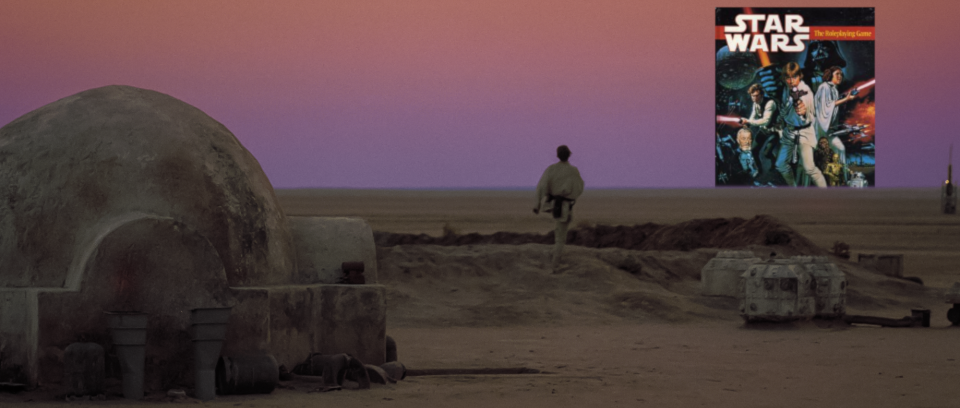
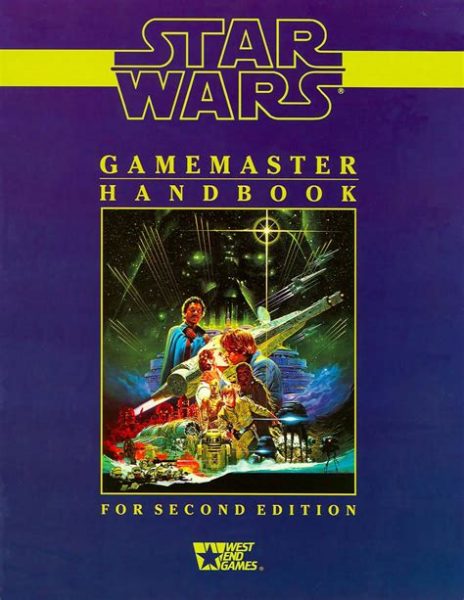
Star Wars Gamemaster Handbook, West End Games, 1993.

The Star Wars Roleplaying Game by West End Games was first released in 1987, four years after Return of the Jedi had been in theaters. It got a second edition in 1992, which this time also included a Gamemaster Handbook that was released in 1993. This was 14 years after the first Dungeon Master’s Guide for AD&D 1st edition, and 2 years after the 2nd edition DMG. At the same time, Shadowrun had  been around for four years, Warhammer Fantasy Roleplay for seven, and Call of Cthulhu for twelve, so it really wasn’t entering into any completely unknown territory.

While I can’t really say anything about the later games, I am quite familiar with all the Dungeon Master’s Guides other than 4th edition, as well as the GM sections for a dozen or so retroclones based on B/X and AD&D 1st ed. But when I managed to get my hands on the Star Wars Gamemaster Handbook and read it, I discovered something that seemed amazing:

The Star Wars Gamemaster Handbook tells you how to be a Gamemaster!

“Well, duh!” you say? “That’s obviously what a gamemaster book is for.” Well, it should be obvious, but when you look at what passes as Dungeon Master’s Guides in D&D, it really isn’t. In the many editions I had both on the internet and with the players of my D&D 5th edition campaign (most of who have much more experience with it than I do), people regularly bring up how 5th edition is really unclear on how you’re supposed to actually run the game because it seems to assume that you run narrative-driven campaigns but all it’s rules are for dungeon crawling. Particularly older GMs express that the 5th edition DMG fails to even mention such basic things like how you make a map for a dungeon and fill it with content.

But this isn’t really a new thing. Since the very beginning, D&D has always assumed that GMs already know anything there is to preparing adventures and running the game, and all the GM content in the books consists of optional mechanics, lists to roll for randomly generated content, and magic items. What are you supposed to do with those to run an enjoyable game for new players? “Well, it’s obvious. Isn’t it.” But no, it isn’t.

The Star Wars Gamemaster Handbook is the complete opposite. It’s 126 pages and except for the example adventure that makes up the last 21 pages, there is a grand total of two stat blocks! Both as examples for the section that guides you through the process of creating named NPCs and translating them into game terms. Which don’t even take up one page in the twelve page chapter dedicated to this topic.

  • Chapter 1: Beginning Adventures, 10 pages, gives an overview of the process of coming up with adventure ideas and turning them into playable content that has some narrative structure to it.
  • Chapter 2: The Star Wars Adventure, 11 pages, expands on the previous chapter and goes into more detail about making full use of the unique setting and capturing the tone, pacing, and dynamics of Star Wars in a game.
  • Chapter 3: Setting, 11 pages, has great advice on using places and characters from the movies or creating your own material, with a focus on explaining what kind of elements you actually need to prepare, what is irrelevant, and the reason for it.
  • Chapter 4: Gamemaster Character, 12 pages, is all about thinking of NPCs as people first, and imagining them in ways that are memorable and makes them relevant to the events of the adventures and campaigns as individuals, and how to use them during actual play. Creating stat blocks for them is only a minor subject at the end of the chapter.
  • Chapter 5: Encounters, 13 pages, deals with encounters primarily as social interactions and what purpose individual encounters could serve to further the development of the narrative. There are a few sections on selecting the right amounts of hostiles for encounters that could turn violent, but it manages to do so without using any tables or stats.
  • Chapter 6: Equipment and Artifacts, 11 pages, is all about gear and related stuff, but doesn’t include any stats for specific items. It’s a chapter about resources that can be made available to PCs and NPCs and how they can drive the developing narrative of adventures as they unfold.
  • Chapter 7: Props, 7 pages, is about handouts and maps and the like.
  • Chapter 8: Improvisation, 8 pages, explains in simple and easy to understandable terms the concepts of prepared improvisation, or the art of equipping yourself with the tools you’re likely going to need to quickly address completely unplanned situations on the fly.
  • Chapter 9: Campaigns, 9 pages, lays out some basic ideas of running games for a long time through multiple adventures, in many ways approaching it from a perspective of sandboxing.
  • Chapter 10: Adventure “Tales of the Smoking Blaster”, 17 pages, is a simple adventure consisting of four episodes that shows how all the principles from the rest of the book could look like in practice.

To be fair, none of the things I’ve read in this book are seemed in any way new to me. I knew all of this before, and it doesn’t go very deeply into detail. But it took me 20 years to learn these things on my own and soaking up the wisdom of several dozens old-hand D&D GMs. And here it is, black and white on paper, spelled out in simple terms that are very much accessible to people completely new to RPGs, in a 27 year old book!

Now I am not a dungeon crawling GM. I am not a tactical fantasy wargame GM either. And there are different goals and requirements for different types of campaigns. But I feel that this is hands down the best GM book I’ve ever come across. It even beats Kevin Crawford’s Red Tide and Spears of the Dawn. They are very impressive books in their own right and do a great job at explaining the practices of sandbox settings in a D&D context. But they also fail to mention most of the information that is in the Gamemaster Handbook, like how you run NPCs as people and set up encounters to be interesting and memorable, apparently assuming that these things are obvious and already known. Like all other D&D books on gamemastering.

I think for most people reading this, there won’t be much new or particularly enlightening in this book either. But I think when any of us are asked by people who are new to RPGs (or maybe not) and first want to try their hand at being GMs but have no idea where to start, I think this book is still very much worth a huge recommendation. Not just for Star Wars, but for all RPGs in general. All the things that are laid out in this book would be really useful to know even when you want to run an OD&D dungeon crawl.

This book is fantastic, because it’s the only GM book I know that really teaches you how to be a GM instead of telling you about additional mechanics not included in the main rulebook. If my favorite RPG posters all got together to put together a guidebook on how to actually run games in basic and easy to understand terms, I don’t think I’d expect anything to be in it that isn’t already in the Gamemaster Handbook for the Star Wars Roleplaying Game 2nd edition from 1993.
I’m done with Dungeons & Dragons (again)

This week I finished my D&D 5th edition campaign that I’ve been running almost weekly over nearly five months for a total of 19 games. This has not only been the longest campaign I’ve been involved with, but also the first one that actually reached its conclusion. I think it’s also the best one I’ve ever run by a considerable margin. My experiences from running campaigns on and of over the many years since the 3rd edition was first released, but also the many theories about gamemastering that I’ve learned about in the seven years since I started this site finally came together in a way that made me feel like I actually knew what I was doing, and that things turned out more or less as I had intended. And in the process, I think I learned even more from this campaign than any other I’ve ran in the past.

So all taken together, this really was a huge success.

But one important thing I realized in the final third or so of the campaign is that D&D really is not the game for me. I feel like I am done with Dungeons & Dragons, but also with dungeons, as well as dragons.

One of the reasons is the particular style of fantasy that D&D is both build upon and it perpetuates through the mechanics of its rules. D&D fantasy is fantasy that does its primary worldbuilding through establishing mechanics and standards for how things work and how beings behave. It’s a form of fantasy that is structural and rational, with clear rules that everyone can understand, leading to expectations that players automatically bring to the game. It is the opposite of being magical, wondrous, and elusive, which to me defeats the overall purpose of fantsy. Everything becomes systemised, quantified, stiff, and bland. I do have some fond memories of The North of the Forgotten Realms, and think there’s some really cool sounding ideas about the less popular lands in the distant east. Dark Sun looks really cool with really great concepts, and there’s something unique and compelling about Planescape. But when you play campaigns in these settings, you’ll always be playing D&D, and players looking at everything through the D&D lense, trying to analyze their situation and formulate their plans by D&D logic.

While I think that the D&D mindset is not my cup of tea and that other styles of fantasy are much better, this is something that I could live with and accept as something that comes with entertaining the players. As a GM, my job is not to get the players to play the ideal fantasy campaign that I would want to play, but to give them the opportunity to play the way they want to play. (There is only darkness and despair down the path of telling the players how to play the campaign right.)

The bigger problem, and I think ultimately the dealbreaker, is that D&D is build around certain structures that I simply don’t find compatible with where my strength in the preparation and running of adventures lie. I just don’t get dungeons.

And it’s not like D&D needs dungeons because they are in the title of the game and players would be disappointed if they don’t get them. The whole game is based around dungeons on the most fundamental level. The game needs dungeons, not just as locations within the story but as a structure in gameplay. D&D is a game of attrition. If the party is facing just one villain, even one surrounded by guards and minions, the fight will either be very short, or very lethal for the PC. Single fights are not meant to be difficuly, they are meant to gnaw away on the endurance of the party. To play the game as it is designed to work, you need environments where the players will be facing six, eight, or ten fights in a row. And that is just not something that works in the kind of stories that I can create. For situations that make sense to me and that I feel will be rewarding for players, it almost never makes sense to have more than two or perhaps three encounters before leaving the place to regroup for the next outing on another day. When I make larger dungeons, they always end up as huge piles of guard creatures that serve little narrative function. Classical dungeons also regularly have puzzles, but I almost never find situations in which the presence of a puzzle would make sense and wouldn’t be nonsensical. You also can have nonhostile NPCs and creatures, and I often include those, but they don’t contribute to the attrition that games like D&D need. I often feel like I do rationally understand how dungeons are supposed to work, how they are structured, filled with content, and the purpose they have in a game. I just find them somewhat dull and completely out of place in the kind of adventures that I know how to make compelling and fun.

So what then about simply forgetting about all that attrition stuff and embracing the unlimited freedom to make the way whatever I want it to be. Yes, that certainly is an option. But what would really be the point of that? The main thing that broke the camel’s back for me with 3rd edition was the abundance of new class features and special abilities that characters get at almost all levels. And that’s something that is still present in 5th editon. Not quite as heavily as in 3rd, but still very much. Way too much, I think.

D&D is ultimately a game about pursuing experience to get access to new abilities. At least in the editions of the last 20 years, but it’s been like that for spellcasters since the very beginning. D&D is a game about getting new special abilities. It’s a main element of what drives players forward, and the prospect of new abilities is what makes players pick their character concepts. The group I had for my last campaign was amazing. They all went all in, head first, with all the narrative freeform nonsense I presented to them. But even these players were constantly talking about the new abilities they were looking forward to after and between games, and they were always proud to tell each other what cool new tricks they just got when they reached a new level. This is something that is baked into the game. This is what the game is about. And I feel that when you run adventures for the group in which most situations don’t result in fighting, then what is the point of running D&D? I am feeling very confident that I am certainly able to run cool and fun adventures. But when I run D&D, I have to provide plenty of opportunities for the players to use their wide and always increasing range of cool special abilities, and I simply don’t see how to do that in adventures that are cool and fun.

Dungeons & Dragons is not for me. If a group of players I like to play with invites me to a game of D&D, I probably wouldn’t say no. As long as I don’t have to come up with adventures that provide something to be entertaining for the players, I have no problem with it, even when I think other games would be even more fun. But running D&D sets requirements and limitations for the GM that don’t work with my abilities as a GM and what I consider enjoyable about gamemastering. Perhaps if the planets happen to align and some unexpected circumstances arise, I might possibly run a B/X campaign or something of a similar type. They are nowhere near as burdened by special abilities, but in the end they are still games about large dungeons filled with monsters and puzzles. I much more see my future with heroic fantasy games looking like Barbarians of Lemuria. Or perhaps some Apocalypse World. But for now it’s Star Wars all the way. And not the Star Wars with the D&D class features, or the Star Wars with the funky dice. The original Star Wars d6 game, where all the dice you need are d6s, and all your character’s abilities are the basic skill rolls. Rules light rules at their best.

Star Destroyers are big!

Yes, of course they are big. Everyone knows they are big. That’s their thing.

But in the movies we only ever see one of them next to a Corellian Corvette, which is one of the very smallest ships that is still considered in the capital ship category. A number of additional capital ships have become well established in the Expanded Universe over the decades, each with their own listed lengths. But seeing the numbers on paper usually does not really give a true sense of the relative sizes. A ship that is twice as long as another ship of the same shape is not twice as big in total mass and volume, but eight times as big.

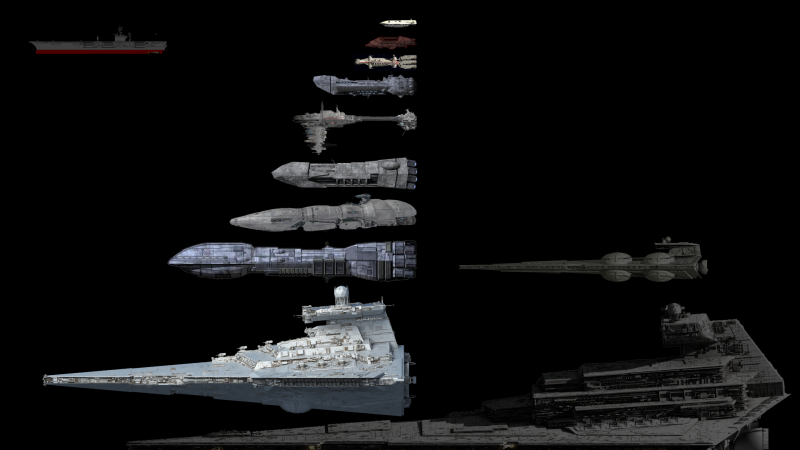
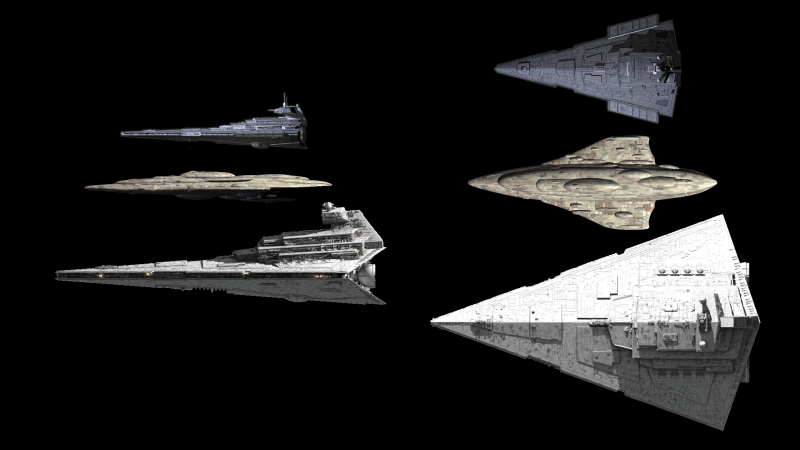
To better visualize this I took images of the various ships that make the most frequent appearances and put them together side by side at the same scale. And it turns out, Star Destroyers are really big.

Top to bottom: GR-75 Medium Transport (90m), Action VI Bulk Freighter (125m), CR90 Corellian Corvette (150m), Lancer Frigate (250m), Nebulon-B Frigate (300m), Carrack Light Cruiser (350m), Strike-class Medium Cruiser (450m), Dreadnought-class Heavy Cruiser (600m), Victory Star Destroyer (900m); in background: USS Nimitz (333m), Interdictor cruiser (600m), Imperial Star Destroyer (1,600m)
Top to bottom: Victory Star Destroyer (900m), MC80 Star Cruiser (1,200m), Imperial Star Destroyer (1,600m)

In the movies, the Imperial Star Destroyers are simply very big, with no real reference to how they compare to other large warships. But against the most common ship types of the Expanded Universe, they are still absolutely massive. There really isn’t anything in their weight class except for the occasional obscure one-off appearances.

Because the Mon Calamari MC80 cruisers are over a thousand meters long, I always had assumed that they are comparable to Imperial Star Destroyers. But seeing them side by side that really is not the case. The MC80 is actually most comparable to the Victory Star Destroyer, which is usually seen as the miniature version of the Imperial Star Destroyer.

And again, the Victory Star Destroyer is not a small ship itself. It is still absolutely enormous. When Dreadnoughts were introduced in the Expanded Universe, they were usually portrayed in a way that made them seem like extremely large and powerful ships, or at the very least would have been during the Clone Wars. Apparently the biggest ships the Old Republic had in its fleet. But at 600 meters in length and with a relatively narrow shape, they are already dwarfed by a Victory Star Destroyer and appear almost tiny next to an Imperial Star Destroyer.

When I create stuff for Star Wars, I always try to take the three movies at face value, taking them as my reference frame for what the Star Wars universe is by default. But in light of this comparison, sending four Imperial Star Destroyers into an asteroid field to chase the Millennium Falcon was absolute overkill. And as much as it pains me as someone who regards The Empire Strikes Back as the best movie ever made, the Super Star Destroyer was just stupid.

When it comes to having Imperial ships make appearances in Star Wars adventures, I think Star Destroyers should be reserved for scenes of particular significance. Using them as the go to Imperial warship for most common space encounters lessens the impact their incredible size and power can have. The appearance of Star Destroyers near a planet where the heroes are on a mission, even a Victory Destroyer, can be used as a very effective signal that the stakes have been raised well above normal. Because when there’s a Star Destroyer, there’s always a huge number of TIE Fighters, and even larger numbers of Stormtroopers that could be on the ground. A Star Destroyer is a threat you can not really fight. Your only options are to try to hide or to run. But unless you have a huge fleet on your side, you’re not going to defeat it in battle. And if you manage to get on board of one to sabotage it, your only hope is to evade the thousands of Stormtroopers. You’re not going to defeat them and capture the ship.

It’s just too damn big!

Dusts of Minethys

The petitioners of Minethys are miserable; they’re greedy sods, and they won’t share anything with anyone unless they’re paid for it. Since there’s not much use for jink here, they barter for services and rags for protection against the wind. The strong are those who manage to gain the services of many: their sand-built huts offer the best shelter from the wind, though this means nothing in the path of the tornados. They’re a hard lot, and they’ll bob a body for all he’s worth, if he lets ’em.