Beasts of Kaendor, Part 1

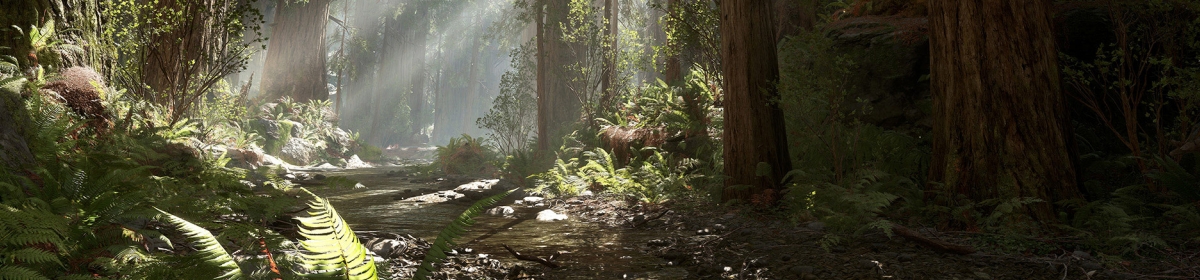
One of the things that really impressed me about Dark Sun and Morrowind, and which are a great part of the inspiration they have on Planet Kaendor, are the very unique wildlifes that inhabit these settings. They are creatures that look very different from the animals that are common in Europe or even outright alien to anything that can be found on Earth. It’s one of the things that makes these settings feel like alien worlds instead of alternative versions of Earth, and something that’s found in others of my favorite settings like John Carter’s Barsoom, or the old videogame Albion.

The wildlife on Planet Kaendor is dominated by giant reptiles and many kinds of huge arthropods. Some well known ones like crocodiles and snakes don’t seem to stand out too much, I think, but most of them are loosely based on obscure extinct animals that your average four-year-old won’t be able to name in under a second. I want to avoid animals that feel immediately like being specific to Europe and North America, so there are no wolves, bears, or boars, and also no horses, cows, or ducks. I’m also avoiding spiders and scorpions, but I am making some concessions to deer and antelopes, as well as various kinds of weasels. (Because weasels are cool.)

I am writing under the assumptions that my next campaign will be using the Forged in the Dark rules from Blades in the Dark, which don’t really assign specific stats to NPCs and creatures. But in some cases it’s useful to have some number to judge the relative strength of beings the PCs are facing, to determine the specific effects and consequences of a confrontation with them. I use quality as primarily a measure  of skill in a fight, which can be relevant to judge the severity of injuries if PCs get hit by them. It’s also an important number for rolls when a PC tries to lead them into battle against an enemy. Scale is simply an estimate of a creatures total mass. It’s usually used to estimate the size of groups of people, but also seems useful for particularly big creatures. It can serve as a guideline for how much effect common attacks by PCs have on a creature. A relatively small insect could easily be killed with a single kick, while much more massive creatures would barely notice getting hit by arrows. Ratings go from from 0 to 6, but these are purely ordinal numbers. They indicate which creatures are more or less dangerous, or larger or smaller than others, without stating specifically how much.

Arag
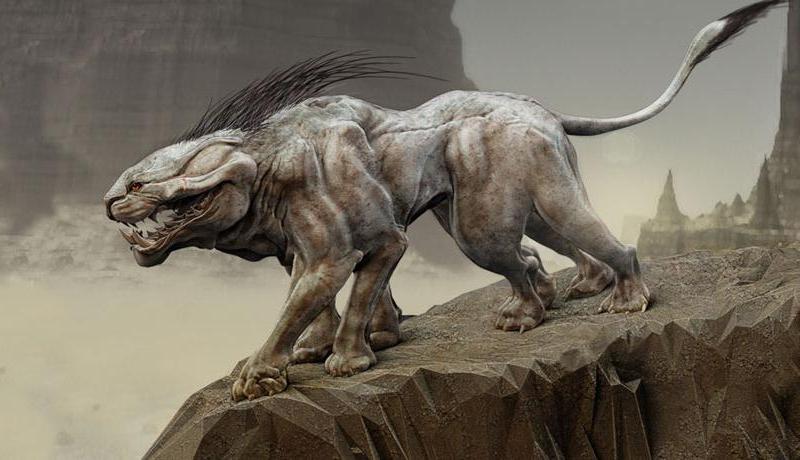
Arag

(quality 1, scale 2)

This common predator is found throughout the known forests and mountains. It’s about the size of a very large dog, with a big head that resembles both a lion and a fish. The hide of an arag resembles a snake with a gray-brown coloration that sometimes has greenish streaks that help it blend in with the environment. Arags hunt in small packs that generally stay away from settlements, but can be very dangerous when they attack small groups of travelers in the wilderness.

Burak
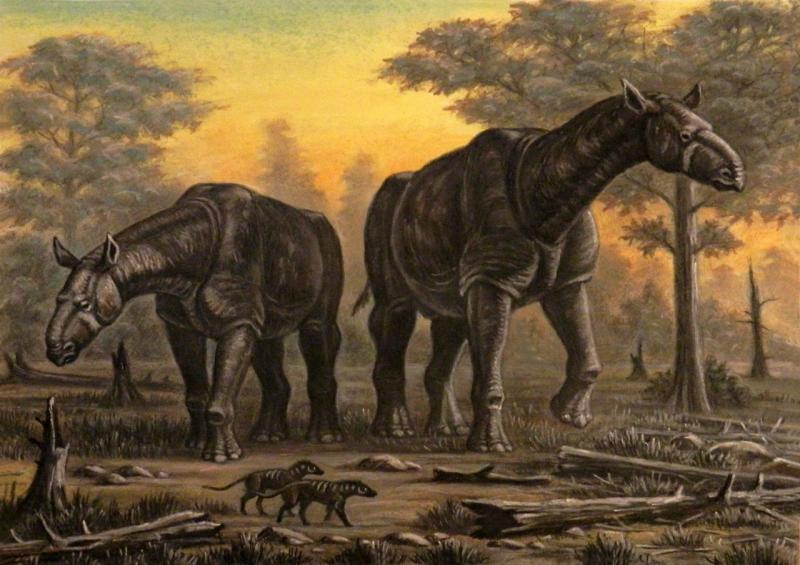
Burak

(quality 3, size 6)

The burak is a giant behemoth that has some resemblance to a rhinoceros, a horse, and a giraffe that towers about anything else moving through the forests. Because of their massive size buraks have very few predators and generally ignore other creatures unless they are guarding a nest or recently hatched young.  While nesting, pairs of buraks while share the guarding of the nest while the other goes off to forage for food. Once the young are hatched, families rejoin small groups of up to a dozen adults. While some buraks have been captured alive and tamed to some degree, nobody has ever had any success with training one.

Droha

Droha

(quality 2, size 3)

Drohas are large four legged reptiles that somewhat resemble very big and heavily build camels. They are primarily found in the south, where they can often roam in large herds across the open swamps and heaths, but can also be found in smaller numbers all the way up to the shores of the Misty Sea. Drohas are relatively easy to capture and train, and are one of the most common pack animals both among the city states and wilder tribes. They are not particularly fast compared to other mounts, but can carry huge loads over long distances.

Gira

Gira

(quality 2, scale 4)

This huge animal resembles antelopes, giraffes, and horses and is the largest mammal to be found anywhere in the forests of Kaendor. While larger and stronger than drohas, giras are more difficult to train and not very popular as either mounts or pack animals.

Gren
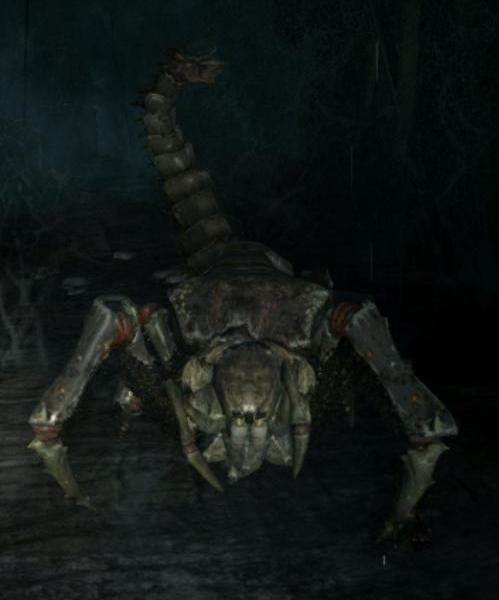
Gren

(quality 1, size 1)

Gren are large, four legged arthropods that resemble crabs and spiders. They primarily live in large burrows under the forest floor, but sometimes also make their nests in caves higher up in the mountains. Grena can grow as high as a man’s waist and often hunt in groups to take on prey significantly larger than themselves. A gren’s bite can kill either by blood loss or poison.

Heor
Heor

(quality 1, size 2)

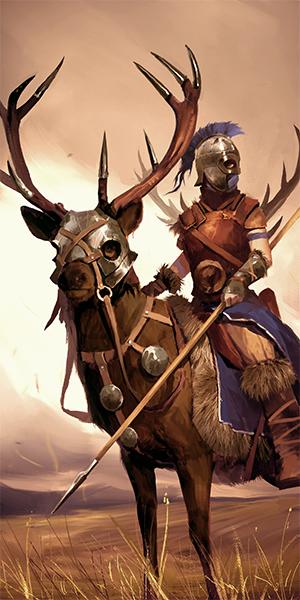
The heor is a powerfully build deer found throughout the northern forest and roaming the heaths of Venlat. Like all deer, a heor can be quite skittish, but it’s large enough to carry a rider even across difficult frozen ground. Domesticated heors are calmer than those found in the wild, and have been bred with shorter antlers to decrease the risk for riders, but they are still not easy animals to train and control. This makes them somewhat rare as mount, but they are highly prized for messengers and scouts.

Huliar
Huliar

(quality 3, size 2)

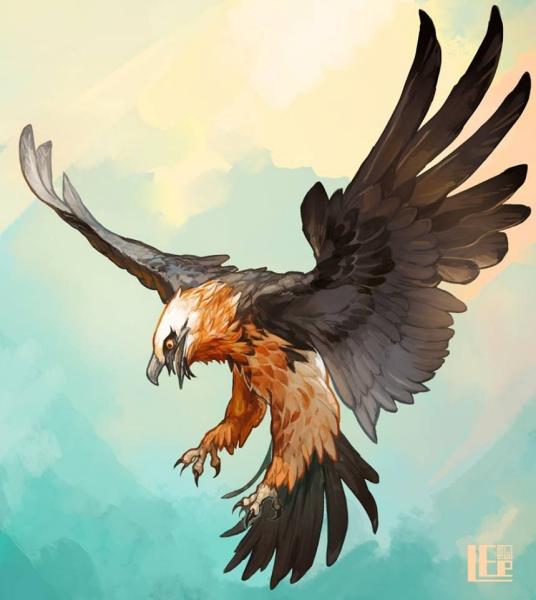
This large feathered reptile is found in many parts of the Mountains of the Moon and the Mountains of the Sun. The huliar is a dangerous predator that makes its home far from civilization, but its size and intelligence makes it an exceptionally valuable mount, as well as an exceedingly rare one. Huliar’s can have a wide range of coloration, which come in various patterns of orange, yellow, red, black, and gray feathers.

Kerik
Kerik

(quality 1, size 2)

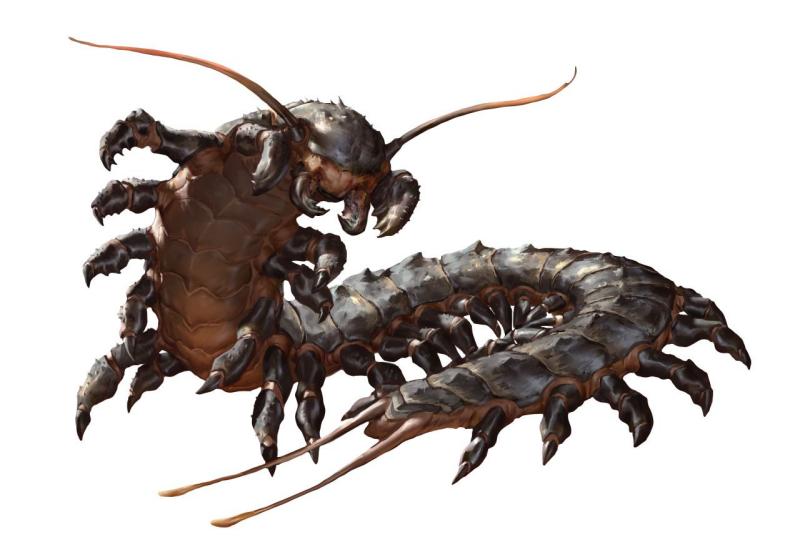
Keriks are giant centipedes that grow up to three yards in length and are found throughout all forest, as well as many mountain ranges and islands. They are ambush predators that mostly feed on small animals, and their large size is mostly for defense. But they can be very aggressive when threatened by other creatures that are getting too close for them and have a very painful poisonous bite. Fortunately, keriks are not particularly fast runners and rarely pursue fleeing enemies for more than a few paces.

Back whence you came

I was browsing through some of the oldest post I’ve written way back when I started this site, and discovered that I first wrote about pre-medieval wilderness worldbuilding almost exactly seven years ago. (I’m also well over 500 posts currently. Yay, me!) I often feel frustrated that despite my years of work, I seem to be making barely any progress. The amount of material I have doesn’t really appear to grow and it often feels like I am only moving pieces around a bit instead of actually creating anything new.

Reading again through What are the Ancient Lands? and Laying the Foundations for the Ancient Lands turned out to be quite interesting reads, though.

Of course, my motivations and inspirations to work on a setting of this style have not really changed since then. A dissatisfaction and boredom with Fantasyland, and a great appreciation for Conan and The Witcher. And some of my favorite elements of Planet Kaendor can be found all the way back in those early posts about the Ancient Lands. Even back then, I was already writing about populating the world with giant reptiles and insects and forests of giant mushrooms. I wrote about wanting a lower amount of magic and a stronger presence of spirits. But quickly I started to run into surprises.

Looking at them side by side, Planet Kaendor really isn’t Ancient Lands v4.0. A blend of cultural elements from Northern Europe and East Asia? When did I ever had that idea? Well, in 2013, according to the date. I do remember having had such an idea, but I had totally forgotten about it for years. Planet Kaendor is very much inspired by the Mycenaeans, Hittites, Egyptian New Kingdom, Achaeminids, and Mauryans. Those aren’t even remotely similar.

The Ancient Lands were meant to be a setting about the age of the great empires of elves and dwarves who shared the wild world with tribes of human barbarians. A contrast of city states and barbarians still exists in Planet Kaendor, but there aren’t any empires. Or even elves and humans.

The Ancient Lands also had major populations of gnomes and beastmen. And a great underground city that was ruled by demons bound into giant crystals, south of which live dark elves and lizardmen. None of these have anything comparable in Planet Kaendor.

The new setting is certainly drawing from the same well of ideas. Or perhaps better, it is being build from the same big box of Lego pieces that I used seven years ago. There are a few elements that I spotted that have endured through my various setting to this day with seemingly very little change. The Sorcerer Lords of Ven Marhend, who rule an an oligarchy over a great port city build into the side of a huge cliff are still there. As is the fey witch Queen Meiv of Halva, a city build of white stone at the feet of a great northern mountain range. But at the same time, there seem to be more things that are completely different.

The truth remains that I don’t really have more material now than I had five or six years ago. But it doesn’t mean that I didn’t make any progress in all that time. For every step forward, I seem to have made a step back. But I now realize that at the same time I have made a huge number of steps sideways, finding myself in a very different place from where I started.

Describing Consequences and Resistance Rolls

One thing that I always felt somewhat ambivalent about with PtbA games is how much they stress that the GM isn’t preparing the story for adventures and campaigns, but that everything is collaboratively decided by all the players. Apocalypse World  takes it to the extend that the setting is not defined at the start of the game but procedurally generated as the players get to come up with theit own answers about the world that they ask the GM.

Now I absoutely understand where this approach comes from and the motivation behind it. It is all too easy as a GM to get fixed on a specific idea how things should play out in the campaign, how everything looks and works in the setting, and how characters in the setting talk and behave. Players can’t read the minds of their GMs to understand the setting in the same way they envision it (unless the camapign is set in Fantasyland), and so their characters will never act quite like their culture is supposed to be, and they create backstories for their characters and declare that the do things which include technologies, institutions, and customs that don’t match the GM’s vision. Not getting too attached to the specific details of your setting and adjusting your plans to what the players do is good practice for all GMs. Creating the entire setting collaboratively during play certainly is one way to deal with this, but I consider it overkill. I think even when running a PtbA game, you don’t strictly have to do everything collaboratively and can have a perfectly good game by simply being accomodating  and working with the players’ initiatives instead of shutting them down.

It’s not how these games are supposed to be run, but it’s something where I am putting my foot down and assert that I know better than the writers. Giving the players considerable agency over their characters is important, but letting the players not only see how the sausage is being made, but participate in its production, is detrimental to the experience of discovery and mystery. In the case of Blades in the Dark, I am really not sure when the author intends for a question about a ruling to be considered internally by the GM, or openly discussed among all the players. But many sections make it appear like you’re supposed to discuss with the players the entire consequences that will happen if an action roll comes out as a failure or partial success. That’s collaborative storytelling to me, but seems antithetical to roleplaying. As a player in a roleplaying game, I want to experience the world and events from the perspective of my character, not as a member of the writing team.

I am fully on board with discussing with the players how they imagine things to play out of they succeed on the roll for their action. That’s perhaps my number one favorite piece of advice I like to give new GMs asking for help: “Always make sure you understand what a player is trying to accomplish.” The mental picture of a situation in a player’s head is always somewhat different from the picture in the GM’s head. Almost every stupid, random, and suicidal action that a player announces makes complete sense in the situation that the player envisons. When a player randomly start to fight a gazebo to the death, it’s almost always because the GM did not successfully communicate the situation for the current scene. As GM it’s your job to first solve this confusion before having the players make hopeless rolls that make them upset about being randomly punished by the consequences. That part of the BitD action resolution system I get fully behind.

But the way the game explains the handling of negative consequences seems actually utterly bizarre to me. To quote the game itself:

The purpose of threatening harm is not always to inflict it, it’s to describe it. The threats become manifest in the minds of everyone playing, even if they’re avoided.

The bad outcomes are spoken aloud. They hang there in the room as horrible potential. They’re scary. Then the player gets to roll their resistance, look you in the eye and say, “No. It’s not that bad. I take the stress instead.” It’s empowering.

If you do it like this, then you are already describing the entire scene and stating it as fact. And then you ask the players if they want to use their option to rewind the scene, make a Resistance Roll, and have the scene play out less severely in exchange for taking stress.

That just feels completely wrong. Again, this is collaborative storytelling. This is not putting yourself in the role of a character who is actually experiencing these events. This approach creates distance between players and characters, the opposite of what we want in a roleplaying game.

And it’s completely unnecessary to implement the existing mechanic in actual play. Instead, you can simply phrase it like this:

You slip off the roof and fall down to the street below, crashing onto the stones which causes a terrible pain going through your leg. Is it broken?

Now the player can decide to say “Yes, it’s broken” and take a level 2 injury “broken leg”. Or declare “I roll on my side and check my leg, and realize that fortunately it’s only a twisted ankle” and make a resistance roll to see how much stress he takes and a level 1 injury “twisted ankle”.

Or take this:

He deflects your blade with his shield and you see his sword hitting you right in the hip. Did the blade impale you?

Again, the player can say “Crap, that got me, I am done for” and take a level 3 injury “impaled”. Or he can say “There is a lot of blood and terrible pain, but my armor just deflected it enough to save my life” and take a level 2 injury “slashed side”. (No stress because armor allows you to resist one hit for free.)

You can do this with any consequence that a player can chose to resist. Describe the consequence to just before the “point of impact” and ask the player if it’s really as bad as it looks. You still describe it, you still speak it out loud. You still get the effect of all the players knowing “this is what would have happened if he had not resisted”. But by phrasing it as a question first you don’t need to retcon something that was already described as having happened. Yes, you could have described in gruesome detail how a PC has his head sliced off and fountains of blood cover all the other PCs nearby before asking the player if he wants to resist. But you don’t need that to make the players feel the gravity of what was just avoided. Movie directors and comic artists figured out a century ago that you don’t need to show all the gory details. It is often much more effective to merely imply it and let the audience fill in the blanks. Telling the players “you swing wide and suddenly see the heavy axe blade falling right on your neck” is completely sufficient.

Instead of calling Cut! and winding back the action, you have the player right at that moment where you felt the impact but are not yet sure how bad it is. It’s the moment between your hand getting caught and feeling terrible pain,  but not yet having it pulled back to see the state and remaining number of your fingers. These are the moments where the adrenaline kicks you righr in the chest. It’s the exact moment in a story when the tension is highest. Why would you cheapen this with a tension deflating retcon?

I think it might actually be more memorable to let the players hanging with “what could have been”. It’s up to their own fears and anxieties to fill in that gap with an undefined feeling of dread, which is much more unsettling than telling the players the details of what did not happen.

When it comes to players having the option to use a mechanic to alter the outcome of an event on their characters, simply phrase it as a question. No need to make it a statement and then having to undo it.

Kaendorian Magic in Forged in the Dark

Some years ago I had already be thinking about how the supernatural abilities of Apocalypse World could be translated into a fantasy magic system. It had informed how I had been thinking about magic in Kaendor, but when the Inixon campaign ended up running in D&D 5th edition I didn’t want to bother the players with significantly altered spell lists. Offering none of the regular D&D character races had already been a significant change and I didn’t want to cause too much chaos for players who thought they were going to play D&D. But it turns out that my interpretations of AW powers maps very well to the Forged in the Dark rules.

The Wyrd

The concept of Wyrd describes the infinite and eternal web of connections between all beings and all living things. It surrounds us and penetrates us. It binds the world together. (Yes, not original, but if you steal, steal from the best.) Everything is connected to everything, and affects everything else. The Wyrd is a weave of fate, but it is not immutable nor inevitable. The Wyrd merely shows how being have been affected by other beings in the past, and will affect other beings in the future. The Wyrd shows where everyone’s steps are leading if they stay on their current paths. It can show what decisions people will make and what actions they will take in encounters that lie ahead of them if they don’t change their way of thinking. The Wyrd does not dictate what mortals and spirits will do. It only shows the paths they are on, both in body and in thought.

All beings sense the Wyrd, even if they are not aware of it. To most people, it is simply intuition, but wise ones know to trust the feelings in their guts. Spirits perceive the Wyrd just as they see, hear, and smell the world around them, which gives them the ability to sense both the future and the past. But it is an infinite number of futures that could lie ahead, and pasts that could have led to this present. Though most spirits pretend otherwise, the pasts and futures they see within the weave are not infallible.

(Wyrd is a Germanic term, while I am going for a more Indo-Iranian style with the setting, so the exact term might still change.)

Changing Fate and Fated to Change

Characters can use their connection to the weird to get a subconscious impression of the causes that led to a situation and the likely effects of an action about to be taken. This ability is open to all characters, regardless of whether they have any education or experience in magic. This covers the options to push yourself, assist another character, or lead a group action. It can also be used to resist and suffer only less severe consequences than would normally have followed from a failure or partial success.

When using any of these options, characters are listening to their intuition to give themselves an advantage in a tense situation, or advise others about things that feel like they would be important to overcome an obstacle. When using such actions to add additional dice to an action roll, characters are opening themselves up to the effects of the supernatural world that is usually kept out of their minds.

On Planet Kaendor, this replaces stress from FitD in the form of strangeness. Strangeness is mechanically identical to stress, but translated into terms that are more in line with the fiction of the setting. Any time characters reach 10 points of strangeness, they are affected  by a permanent change, which works the same way as trauma caused by stress. A change adds a new aspect to the personality of a characters. Players are free to choose how much and how often they want the changes to impact their characters’ behavior and actions, but any time they do, their character gains XP towards learning new special abilities.

Characters can have up to three changes. When characters get their fourth change, they either join the folk of the forests or turn into a ghoul, depending on how much they have been exposed to sorcerous corruption. (Player’s call.)

Characters can always try to reduce their current strangeness as a downtime activity. Many practitioners of magic use meditation rituals or prayer to calm their minds and ground themselves in their mortal nature. Though characters can choose to do whatever helps them keeping their minds from gradually unraveling. Characters who don’t take such actions after an adventure and have already gained a first change continue to accumulate strangeness even back in the comforts of their homes. (This works just like vice, except that there is no risk to overindulge.)

I am currently very much considering that changes will give characters additional options for special abilities to learn during character advancement. Changes don’t have to be negative things, and thinking more like spirits could be regarded as a beneficial transformation by many sorcerers. Having changes can also be used as a factor for determining the effect level for actions like Consort and Sway, reducing the effect when talking to ordinary mortals, but providing increased effect when talking with normally inscrutable spirits.

Rituals

When characters use the Attune action, they are attuning their minds to the Wyrd. Through the Wyrd they can sense the connections between all living things, and connect their thoughts to those of the spirits to see what they have seen, hear what they have heard, and rely on their ancient wisdom to make sense of the sensations. Divinations like these are the most common form of rituals.

Rituals can also connect to the minds of other people, altering their memories or giving them ideas that are not their own.

Alternatively, characters can attempt to make a bargain with a spirit or compel it to perform a service. Almost all magic that doesn’t fall into divinations or charms is of this kind. What services spirits can perform depends on their powers, but most commonly it relates to controlling the natural forces of the environment. Sending a demon to attack or abduct an enemy is also a possibility, though.

Performing rituals exposes characters to strangeness, the amount of which depends on the scope and strength of the desired effects.

Alchemy

While alchemical substances are inherently magical, working with them is a regular trade using the Tinker action and not relying on the Attune action. As alchemical creations are important components in many rituals, most sorcerers and shamans have at least some basic knowledge in the alchemical arts, and the nature 9f their work leads many alchemist to have a rating of one or two dice in the Attune action.

One of the most important alchemical substances is iron. When using implements made of iron, they have the standard potency against spirits. Items made from bronze, like most weapons and tools, only have limited potency when used against spirits.

Performing alchemy does not expose a character to strangeness.

Forged in the Dark Probabilities

The Forged in the Dark system from Blades in the Dark uses an action resolution system that is very similar to Apocalypse World but also slightly different. Just like in AW, all rolls are made with d6s and the possible outcomes are failure on a 1-3, partial success on 4/5, and full success on a 6. But instead of always rolling 2d6 and adding the appropriate attribute modifier to the result, FitD has you roll a number of d6s equal to the attribute rating and taking only the number from the highest dice as the result for the roll.

Usually I really don’t like dice pool mechanics (though I make an exception for Star Wars). I think my main objection is all the counting of dice, but in this system you don’t even have to do that. All you have to do is to look if you see any 6s, and if not if you see any 5s or 4s. There’s also a critical success if you have multiple sixes, but that still only requires you to tell the difference between “one six” and “multiple sixes”. This is stupidly simple. And still you get all the benefits from a dice pool system. Did any other games do this before? Did it take four decades of RPGs for someone to think of this?

The attribute rating a character can have for anything can range from 0 to 4 dice, but there are fairly simple ways to get another 2d on top of that. You could even get higher than that through situational modifiers, but here I’ve only taken it up to 6 dice. Starting characters probably have some points in about half of the 13 ratings, and it’s always up to the players which of their abilities they want to use. When you get attacked by enemies, nothing says that you have to cross swords with them to end the fight with a Skirmish roll. You can also end the fight by talking them down with a Skirmish roll, or make a daring escape with a Prowl or Finesse roll. It will lead to widely different results coming from a success or failure, but if you have the same ratings in the different abilities, the mechanics make no difference between them. And you can always chose to get a bonus die to any roll by adding to your character’s stress level. So if you don’t want to, you barely ever have to make a roll with less than 2 dice. Though if for some reason you want to make a roll with 0 dice, you roll 2 dice and take the lower number as your result.

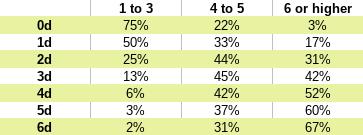
Reading about the probabilities for 2d6 on Jeff’s Gameblog had me wondering how the actual odds are really looking for Forged in the Dark rolls, and I came up with this. (I don’t know how to easily calculate for two or more 6s for critical successes, but they are really just a slightly stronger versions of full successes on a single 6.)

A result of 4 or 5 is a partial success, which means that you do the thing you wanted to do (an effect), but you also suffer a negative complication (a consequence). This can mean that you effectively get both a success and a failure at the same time, but the consequence can also simply be that you get a weaker version of what you intended to accomplish.

When rolling a single die, there is only a 50% chance of a full failure, which means a 50% that you get at least some success at what you tried to do. When you go to 2d, you’re already at 75% to get some kind of success. Above that, the probability that you just straight fail at your attempted action quickly becomes negligible. However, the chance to just get a full success with no negative consequences does not improve nearly as much.

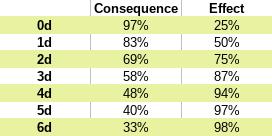
In this table, I added the chance for a partial success both to the odds for a failure and a full or critical success. This is the table that matters when you’re asking yourself “How much do I need to do what I want to do?” or “How much do I fear the possible consequences?” And I find the result very interesting. If you have invested some of your advancement points into an ability and take the stress penalties for an extra dice or two, the chances that your character succeeds at doing what you wanted to do are very high. But the odds that you will have to deal with a consequence starts at an extremely high level and always stays significant.

Overall, the odds for the possible results are hugely different between 0d and 6d, or even just between the more commonly encountered range of 1d to 5d. But regardless of what you roll, the partial success result in the middle means that you always have a good shot of getting what you want with your actions, but never rest assured that it will go smoothly. I think that’s actually brilliant for making a game always exciting.

Forged in the Dark

Looking over my older posts, I’ve started talking about Barbarians of Lemuria some five years back, and been thinking about how to combine elements of it with aspects of Apocalypse World basically since I first learned about that game two years ago. Both are pretty rules light, and while they are both presented with quite distinctive settings, the mechanics have always struck me as having great potential for a very wide range of campaigns. They are both rules systems that have mechanics to figure out the outcome of uncertain situations when the PCs try to do something in the face of opposition from other people or the environment, which they do quick and painlessly and then are out of your hair to let you go on with the developing story. I really like this approach to what an RPG should be and do.

Some kind of hybrid of the two games has long been a vision of an ideal game for me, but since I have little personal experience with both BoL and AW, cobbling something entirely new together never seemed like a real option. And the way my groups form, getting a number of players together to play the weird homebrew system of a GM they never played with never really had any promise of success.

When I was looking into fantasy games based on the mechanics of Apocalypse World, there were really only two that have any popular presence. The first of course being Dungeon World, which I found to be very disappointing as it is an attempt to recreate the experience of D&D adventures with different dice rolling mechanics instead of doing anything with the very different approach to what a campaign can be that is promised by the Apocalypse World rules. And the other one is Blades in the Dark.

This game had been recommended to me by some people in the past and I had taken a look at it some time back. I don’t recall what I had been looking for back then when I took a peek, but I remember that I mostly looked at the setting, which is very post-apocalyptic Victorian steampunk. It’s basically Thief and Dishonored the Roleplaying Game, which really is cool, but at the time made me write it off as not being useful to whatever I was trying to do. I also remember seeing it has only three attributes, which made me go eww… Which turns out was a real shame.

Because looking at the system again from a mechanics focused perspective, it really strikes me as the closest thing I have yet encountered to that idealized blend of Barbarians of Lemuria and Apocalypse World, I had been dreaming of. It’s of course not exactly the game that I want to run for my next Kaendor campaign. There are all kinds of peripheral rules in this game about the gang of the PC’s increasing their reputation in the underworld, fighting for turf, and dealing with the police putting pressure on their activities, which really wouldn’t have any place in my campaign. But the core mechanics for making characters, character advancement, task resolution, and character durability is really solid.

While it’s not necessarily being more compact than Apocalypse World, it is much more straightforward and easy to grasp, even though at first there seem to be a lot of new mechanical concepts and principles you have to dig through. And Blades in the Dark really is quite a big book that doesn’t scream rules light. But I tried to write down the basics of character creation and action resolution as a simple introductory handout for new players, and I managed to get it all on only two and a half pages. (Excluding the rules for running a criminal empire.) That’s really quite impressive.

The Basics of the System

Characters in Blades in the Dark are really very simple. They mostly come down to 12 action ratings and 3 derived attributes. But these are not like attributes and skills like you see them in most other skill based systems, where you add your attribute scores to your skill rank to determine what dice you roll. Instead you have twelve basic actions, which in other games would be skills, or moves in Apocalypse World. Anything that PCs might do that has a chance of failure and negative consequences falls under one of these twelve actions.

  • Attune (do magic stuff)
  • Command (order people around)
  • Consort (chat with people)
  • Finesse (climbing, jumping, picking pockets, …)
  • Hunt (tracking, trapping, …)
  • Prowl (sneaking)
  • Skirmish (fighting)
  • Study (inspect or research a thing or person)
  • Survey (observe people or places)
  • Sway (convince people of things)
  • Tinker (work with machines)
  • Wreck (break stuff)

These actions are not methods or techniques, but arranged by outcomes. Skirmish is the action for the vast majority of ways that you can fight, regardless of weapons, armor, fighting style, and so on. Sway can be debating, deceiving, seducing, pleading, or whatever else you can think of to make people change their mind with your words. I can’t really think of anything to do with Prowl other than sneaking past people without being detected, and Study and Survey do overlap quite a bit, but I can’t really think of anything that might come up in a game where you need any other category of action as a player. Characters have a rating for all these actions that goes from 0 to 4.

What I really like is that there are twelve equal actions and only one of them is combat. Hunt and Wreck can also be used for violence in some situation, but that’s not their primary purpose. Treating fighting as equal to all other actions is something that really appeals to me and makes it a very inviting system for games where fighting is not the main event of adventures.

Unlike Apocalypse World, where you always roll 2d6 and add your attribute score to the result, Blades in the Dark has you roll a number of d6 that is equal to your rating, plus and minus additional dice for various circumstances. (If you end up with less than 1 die, you roll 2 dice and take the lower one.) The die with the highest number is your result for the roll, with a 6 being a success, a 4 or 5 giving you a success but also negative consequences, and 1 to 3 being only the bad consequences with no success. I’m not generally a fan of dice pools, but picking the highest number out of only up to 6 or 7 dice at the most with no additions is really quick and painless.

While there are attributes, they are not very similar to attributes in other games. Instead the 12 action ratings are grouped into three groups of four, resulting in four Insight actions, four Prowess actions, and four Resolve actions. The attribute score is simply the number of actions for which you have a rating of 1 or higher, resulting in a score of 0 to 4, which increases over time as you put a first point into the skills of that group. Attributes are mostly used when you roll to reduce the severity of negative consequences from a failed or partially successful action roll, and for tracking which action ratings you can improve when you get XP.

Characters also start with 1 special ability selected from a long list of options, and probably gain a new one that can also be freely selected every 1 to 3 game sessions.

And that is mostly it. There are of course a lot more bells and whistles regarding items, wealth, the injury and stress mechanic, but attributes and special abilities are more or less all the character creation and character advancement for this game.

Action Resolution

Taking an action in Blades in the Dark work the following way.

  1. The player describes what his character is trying to do.
  2. The player declares which of his character’s action ratings he will use for the roll.
  3. The GM judges the positioning for the action, which is the potential severity of the consequences should the action roll fail or only be a partial success.
  4. The GM judges the effect if the roll will be a success. Based on the approach the player described, the GM decides if it should result in the ordinary outcome for such an action, or the result will be of limited or greater magnitude.
  5. The player can decide to push himself to get an extra die for the roll, and another player can decide to assist and also add an additional die.

Basically this come down to what happens in most games with a GM who isn’t a jerk. The player ask “Could it work if I…” and the GM replies “Yes, but the chance is…”. Then the player might take it and make the roll, but could also decide that he really wants a greater effect than the GM declared and change the action to something more daring that also results in a worse positioning by increasing the danger resulting from a failure. Or the other way around, the player might decide that the danger is too high and instead change the action to something with a better positioning and accepting a reduced effect.

To keep things simple, there are only three categories of position: Controlled, Risky, and Desperate. And only three categories of effect: Limited, standard, and greater. This is easy to follow without any math involved. Do you want risk high or low danger and do you want to go for high or low reward? It’s not always a simple trade-off. Sometimes things are so much in your favor that you only have the low risk of controlled positioning and the expectation of a greater effect as the outcome. Or things look extremely bleak and you can only expect a lesser effect even though the positioning is desperate.

But these things don’t come down to only luck. Players have quite a lot of room to control the damage a failed action roll leads to. At any time, a player can declare that the severity of an injury or complication resulting from a roll is reduced by one category. The GM can say “You fall from the roof and badly hurt your leg. Is it broken?” And the player can decide to reduce the damage and say “No, fortunately it just seems sprained.” You can always do this, but it comes at the expanse of added stress. And when a character reaches 10 stress during an adventure, the character has some kind of mental breakdown that takes him out of the adventure and leaves a permanent mark on his mind. You also gain stress when pushing yourself or assisting another character to add additional dice to an action roll. Stress can also result from exposure to the supernatural, just like it does in Darkest Dungeon. Injuries will heal, but damage to the mind sticks around. So you might not always want to reduce the severity of your injuries or complications.

Forged in the Dark

The really neat thing that I found out today is that there is an SRD for the system that contains most of the rules that are not specific to the Duskwall setting of Blades in the Dark. It does not include the seven playbooks (character templates in PtBA games), but simply has all the special abilities put into a big single list from which GMs can put together their own lists for different character archetypes in their campaign. The SRD even has a template to make your own playbooks, and I think it has everything you need to fully recreate the ones from BitD. (Not sure what difference it makes, but there surely must be some copyright considerations behind this.) The only other thing from outside the setting chapter I’ve found to be not included are the four types of undead in Duskwall, but again the mechanics for making your own are there.

There also is of course a license to make your own stuff with the material from the SRD and using the Forged in the Dark label for it. The License is extremely generous and only requires you to include an attribution to John Harper and One Seven Design and not claim any official connection or endorsement by them. The Duskwall setting remains copyrighted, but everything in the SRD is fair game. And that’s all there is. Which I think is really cool.

Nothing set in stone yet, but right now I really want to give this a try for my next campaign. Aside from the criminal empire rules, this seems like a really well rounded system not just for fantasy but in general, and I think you could run a campaign even with just the basics. I can absolutely see myself making up some new rules for paranormal investigation, but I don’t think that’s even necessary to start a campaign. Really looking forward to trying this out.