Project Forest Moon

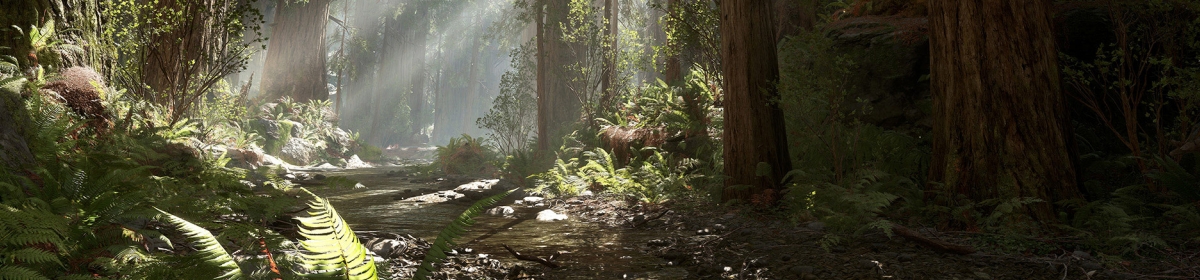
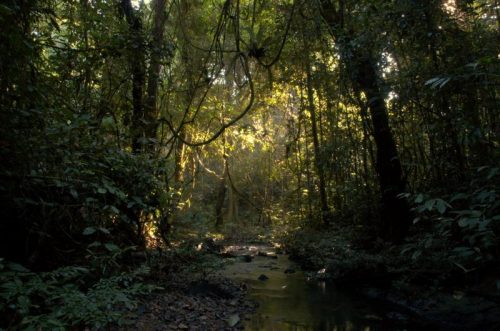
While visiting my parents I recently watched all three Star Wars movies again with my mother who seemed to have forgotten most parts of The Empire Strikes Back since last seeing it. Which really is something that needs to be rectified and now we had a good opportunity. And with no kids in the house my parents have a nice movie room with a projector and 5.1 sound. I don’t think I’ve seen the movies in this big since their re-release back in 1997. And while watching Return of the Jedi I was reminded how very much of an impact Endor had on my perception of a fantasy wilderness.

When I started toying around with worldbuilding for RPGs, my first attempt was to make the High Forest from Forgotten Realms but 4,000 years in the past, which I imagined very much like Endor, and it soon turned into a setting “inspired by” the ancient High Forest. My Ancient Lands, Old World, and the preceding Wildlands are all evolutions of that initial concept. Since the Wildlands each iteration became a successively smaller world. As some French guy said, “perfection is achieved not when there is nothing left to add, but nothing left to take away”. And seeing Endor again in all its crisp green glory made me realize that there’s still some stuff I’ve been hanging on to even though it doesn’t really add to the main parts of the setting and rather distracts from and dilutes the core concept.

This led to me starting Project Forest Moon. Another directed effort of stronger increasing the focus of the setting and giving it a more unique character.
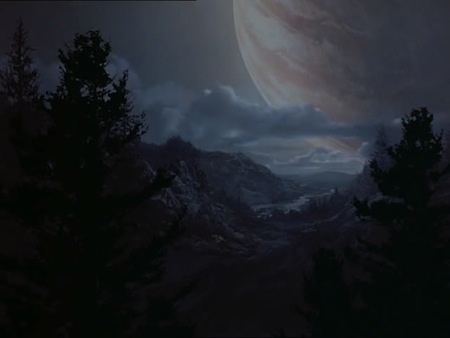
Endor

  • Only Forests, Mountains, and the Sea: It all started with the idea of a single huge forest and now I am returning to that paradigm twelve years later. I am linking up all the forests of the Old World and eliminating the patches of plains and deserts that were still around in some places. Open land is limited to some floodplains on the sides of major rivers and barren mountain valleys.
  • Scrapping Venlad: During the last focusing of the setting I had already removed humans as one of thr humanoid peoples and merged the human Suri with the elven Eylahen, which took over as the people of Venland. But while Icewind Dale, Northrend, and Forochel are all somewhat intriguing places, I don’t really have any need or purpose for an arctic tundra in a forest setting. So Venlad has to go. The northernmost part of the map is clipped off and the Rayalka Mountains become the effective edge of the known world. Yakun is already a region with heavy winters and the Rayalka Mountains on its northern border are a decent environment for anything snow and ice based.
  • It’s pure Fantasy: When I began worldbuilding my main reference for a very long time was Forgotten Realms, which is a very Renaissance style setting full with farming villages, market towns, and big merchant cities. And combine “German” with “RPG fan” and you get a particularly potent brew of “pedantic about realism”. It also happens that my home city was the biggest trade giant in late medieval Northen Europe and this history is still a big part of our cultural identity. (Even though with the exception of Hamburg, Northern Germany is now a total rural backwater.) The resulting attention to sound economic resource flows and historically accurate productions of food and trade goods turned out to be a weight on a chain that slowed down work on the important parts of the setting and often worked directly against the idea of a world of supernatural wonder. It’s certainly always a big asset to know about how things historically worked to avoid big blunders and major stumbling blocks in making a world believable, but it’s not helpful to get caught up in minutiae when you really want to be fantastical. I’ve not written much about these things before but put a lot of work into them. And I think a lot of it can just be ditched. What you really need to know for running a game is how a settlement could be cut off from their food and fuel sources and where they got their weapons. That’s almost always going to be the only aspect of economy that might become relevant.
  • Big Bad Beasts: On Earth, the human ability to use tools and coordinate tactics very quickly made them the top predator on the entire planet. With some planning, spears and arrows are sufficient to kill everything that moves and doing it repeatedly to exterminate whole local populations. Humans can kill bears, mammoths, and even whales with the clever use of pointy sticks. Wherever humans go they quickly dominate the landscape. But in a fantasy world you can have creatures much bigger and meaner than bears, mammoths, or whales. Things that won’t die if you stick them with a spear. This serves as a natural barrier to the expansion of settlements. Many regions are home to wildlife that makes them impossible to settle. You can move through with lots of armed guards but it’s just way too dangerous for farmers in the fields or let children roam around outside. Humanoids only thrive in areas where they can be at the top of the food chain, with only the occasional wandering monster showing up to cause terror.
  • Fortified Settlements: With a world that is all forest and forests that are full of lethal predators, the average feudal European farming village wouldn’t work. All permanent settlements need to be defensible, and it’s a good idea to chose camping grounds with the same approach. There’s a wide variety of options. Wooden palisades always work with a limitless abundance of trees. But cliffs are also very effective, as is putting settlements on islands. Fields and orchards usually have to be kept outside of the defenses, but sleeping places and stores of stores and wealth should always be in a safe and protected location. Whenever the players enter a settlement they should be aware that they are crossing a clear border by going through a gate, across a bridge, or crossing water by boat.
  • Tree Villages: I made the decision early on that I don’t want my elves to be cliche elves that so many people hate, since they are the most numerous group of humanoids in the setting. And so I wanted to avoid tree villages. But this is now no longer a big kitchen sink setting. This is now Project Forest Moon. Giant trees are the dominant landscape. Can’t really justify not having tree villages as one of the regular types of defensible settlement.
  • Pack Animals: In a world that is all forest, mountains, and water, carts and wagons aren’t really that useful. First you need to clear a wide path and then get it level, and the distances between places will often be huge. The only practical way to transport goods over land is by having them carried. By something like a droha or an oget. I actually would even go a step further and make the Old World a world without wheels. The Americans had to deal with a lot of forest and had no suitable draft animals and did very well without wheels. The loss of handcarts and wheelbarrows is not going to make a big impact on fantasy villages and I think it might give the setting some unique character. If anyone would actually notice their absence.
  • I’m on a Boat: I had mentally filed away a note that most settlements should be on rivers or coast to make it possible to trade goods with ships and avoid reliance on caravans slowly crawling along small forest paths. It’s clearly the ideal solution to moving large bulks, but there’s also the classic adventure tale of exploring a river with a boat and getting deeper and deeper into a strange wilderness. And if Star Wars can teach us one thing, it’s the great effectiveness of relying on classic and recognizable motives from fiction to get the audience immersed into a new and fantastic world. You could go on adventure by foot or riding heors and ogets, but I think whenever an excuse can be found to make part of the journey on water the opportunity should be taken. The oared river boat should become as ordinary a part of adventures as a horse.
  • Elementals with personality: I’ve always been a big fan of elementals. Or at least the idea of elementals. But their execution in Dungeons & Dragons leaves much to be desired. They have low intelligence and only speak very obscure languages and generally go straight for attack. That’s the most boring kind of encounter you can have once you get past the first joy of fighting something that is made of fire. They are just big heaps of hit points that attack with their fists. I think mechanically they are okay. Big brutes are okay. But they are also nature spirits so there should be much more interaction with them than just combat. What they need are some kind of motivations and patterns of behavior. Not sure what exactly I will do with them, but that’s one of the next things I want to work at. The older and more poweful they are, the more I’d like them to be like nymphs, treants, or elemental weirds from D&D as local guardian spirits of the land.
  • No satellite view map: I think I’ve wrote about my preference for point maps some months back and that I don’t like the sense of cartographic precision implied by hex maps. But for a forest world I think any kind of crisp and clean map would be a disservice. Except for mountains that rise above the forests or out on sea, there are almost no places from which you could observe the area for more than maybe a few hundred meters. And even up on a mountain you would not be able to see any landmarks that are hidden below the trees. People in such a world would not be able to make any kind of map that even roughly approximates the actual shape of the land. This would require very sophisticated surveying tools and methods and the amount of work would be incredible and unbelievably slow. Characters in the setting don’t have landscape maps, they only have landmark maps. Like in a pointcrawl map. And so the players should be limited in the same way. I believe this helps establish the notion that the wilderness is huge and people are small, and when you go beyond the familar surroundings of your home you are stumbling blindly through the forest, hoping that following a trail or a river might lead you to civilization. This probably also requires creating a system for getting lost and finding back on a point map. Not looking particularly forward to that, but it seems necessary and might hopefully add a lot to the campaign.
  • Nature Shrines: Instead of having religion being covered by priests and temples, I really like the idea from the D&D Companion Set of giving priest abilities to villages through relics. The idea was created as a workaround for elves, dwarves, and halflings not being able to take the cleric class, but I think this solution is even better. The elven relic is a Tree of Life and its keeper can draw on its power to cast healing spells without being a cleric. It also repells all undead in an area around it. The main change I make to this is that a relic is not a magical object, but instead a fixed location in which the local spirit of the land manifests itself to communicate with shamans. Mechanically it’s the same thing, but the god can also give advice and instructions to the shamans or withhold its magic power whenever it pleases. This natural shrine does not have to be a tree, but could also be a cave, a hill, a monolith, or a lake very close to the settlement.

Looking really good so far, I would say. Collecting these things over the last days made me once more very excited about seeing this world continuing to take shape.
Setting Modules

In a discussion about The Maze of the Blue Medusa, one person mentioned that despite many highly positive reviews for OSR “settings”, there seem to be barely any people who say that they actually ran a game in Red Tide, the Red and Pleasant Land, Qelong, or Yoon-Suin. Despite the praise and the money people pay for it, they seem to be barely getting used by anyone.

Which wouldn’t really be that surprising as the people who enjoy this kind of content tend to be people who also create a lot of their own custom content for the campaigns they run. The main draw seems to me, and probably many others, to salvage these books for ideas. I regularly buy books for games I don’t have or know the rules for, or ever have any intention to play. It’s always all idea mining for me with everything I get for RPGs. I don’t think I ever used anything out of the box since my earliest hears with D&D 3rd edition.

And I believe many of the people who make OSR settings are very much aware of that. Vornheim and Yoon-Suin can’t really be considered settings in the traditional sense and are really all about being toolboxes for creating your own content. My impression of Red Tide is that the setting of the islands and the backstory of the setting is really mostly a practical example for how a world using the tools in the book could look like.

My previous Ancient Lands setting was very traditionally designed like the many settings of the late 80s and the 90s, but when I started all over with a blank canvas to do the Old World I abandoned that approach pretty much entirely. It’s not practical for running my own games and I doubt there would be more than two or three GMs in the world who would actually run a campaign if I would get it into a releasable form.

I recently looked into One Page Dungeon after talking somewhere about my frustration with typical D&D settings being so vague on adventure locations to be practically useless. As all dungeons are made independently by completely different people and the only format restriction is that it has to fit on a single page, people have been trying out a lot of different things with that idea. And I think this could be a really good approach for small scale campaign setting writers in the coming years. Completely abandoning the idea that a setting is a single world and instead providing collections of thematically matching but mostly stand alone pieces of content.

The Green Hell and the Circle of Life and Death

Today someone mentioned the idea to me that most decent pulp settings appear to have some cool major distinctive feature that also works as a kind of source for all manners of conflicts within the world. For example in Dark Sun, the magical technique of defiling was what killed most life on the planet, is what gives the sorcerer kings their power, and allows them to keep the few surviving cities from being burried by the desert as well for the time being. In Star Wars the Dark Side of the Force created the Empire, drove the Jedi to extinction, and also is the main reason why the Jedi exist as an order of knights in the first place. In Morrowind the Tribunal and their belief to be living gods led to the creation of the Dunmer, their extreme conservatism and hostility towards outsiders, and the existance of the Ashlanders. And in the vast majority of stories of Conan the whole trouble comes from sorcerers desiring power. I think to make my Old World setting more pulpy than my old Ancient Lands setting, some kind of similar universal driver of tension could possibly be a great help.

A few weeks ago I read a post by someone writing about having seen a somewhat unusual nature documentary that showed life in the wilderness just how it is without overly dramaticising it. And it seemed to him to show that nature is not at all nice and pleasant, but really full of violent death. The vast majority of it being the deaths of children. Around the same time I’ve read a post by Zak S. about Lovecraft’s fear of the unknown being mostly a revulsion against life, which I found to be very convincing. Life means feeding and reproducing which in many cases, or perhaps even most, is neither pleasant not pretty.

In my years at university dealing with cultural studies I made the discovery that almost all major religions disapprove about the physical aspects of living and promote a detachment from bodily things and a focus on the purely mental. And it really made me wonder why all religions that praise and approve of living seem to promote having sex with the cult leader? I’ve been wanting to do something with a very body-positive approach in a non-creepy way in my worldbuilding for a long time but never really got around to it.

jungle3

And I think here might be the perfect opportunity to adress all these things. I had often thought of the Old World as being “a lot like Dark Sun, but with forests instead of desert”. In Dark Sun the driving force behind all conflicts is magic that drains nature of life. How about a setting in which the source of conflict is an overaboundance of life?

Life is not just life. It is also death. The Circle of Life is also a Circle of Death. To actively live all living things have to consume. In the end everything dies, and then it gets eaten. The only way a species can survive is to reproduce faster than its members are getting killed. It’s an endless breeding and feeding. Breeding is feeding. And in the center of all this killing and reproducing are people. And nature doesn’t care for them a bit. Like it does for anything else. The cycle just continues and there is nothing that one could do to stop it. People simply have to arrange themselves with this simple truth. And this process of arranging is where ultimately all conflict comes from. The desire to feed yourself and your relatives and to avoid being fed upon for as long as you can is what all conflict ultimately comes down to.

jungle2

I’m still not 100% sure if I really want to go with this. Things like these always take two or three days with me before I know how I really feel about them. But I think there’s certainly a lot of potential to give the setting it’s own distinctive character and quirks, which really is a major thing in Sword & Sorcery and pulp in general. Here are some applications I have already in mind:

Civilization is fragile: This is something I’ve had in my mind for a long time now. I don’t want to do the standard fantasy thing where the world was once great and then everything declined into some kind of post-apocalyptic world or another. Instead the Old World is a world in a constant cycle of growth and decay. Settlements are founded, grow, decline, and are eventually abandoned or destroyed to be reclaimed by the wilderness. This has happened countless times before and will happen countless times again. Abandoned and ruined settlements are found everywhere in regions that are settled by people. There are many great stone ruins as well, which had been build by the various fey folks. They are still found in many places and many of them hold magical wonders beyond the powers of mortals. But their builders were not killed by some kind of catastrophe. In truth their reign over the land came to an end when they realized that even with their great magical powers the attempts to build lasting kingdoms and empires was futile in the face of the power of nature itself. Shie, naga, raksha, and giants are still around, but they all live in the Spiritworld once more, as they did for countless eons before.

jungle1

The Green Folk: I’ve long been a fan of both treant and spriggans (duh…) and also like the idea of shambling mounds and other big beasts made from vines, branches, thorns, and moss. All these walking plant spirits are collectively known as the green folk. There are many types of them and they are literally found everywhere not covered by water or ice. In a way they might be the true masters of the world but they normally care little for either mortals or fey.

The Swarm: It’s not only plants that dominate the Old World, but also animals as well. In particular insects which though small outnumber all the larger beasts combined. Though not all insects are simple tiny bugs. Every now and then huge swarms of big insect creatures appear from seemingly nowhere and by the time they start stripping the surrounding region of all available food they have already been building their nest to raise even larger numbers of young. The swarm is a natural disaster that can happen anywhere where there is food to be found, which is almost everywhere. The immediate surroundings of a nest are soon reduced to barren wastelands but drones swarm out for many more miles to hunt for any kind of meat they can find. The only protection is to bar oneself up in a cellar and wait for the swarm to move on, which can often take several days. Once the hunting stops, the nest is soon abandoned with the creatures seemingly vanishing into thin air again. Many believe that they are not ordinary animals but instead creatures from the Spiritworld, perhaps to forrage for food for their young before they return back to their home.

Old World Adventures

With my last two post having been about antagonists in the Old World and creating campaign settings to be ideally suited to run adventures in them, I’ve spend the last days thinking about what adventures specifically could take place in the Old World.

Here are a few basic adventure plots for which I want to create a good selection of sample locations and backgrounds. I believe that adventures should be very much tailored to the setting in which they take place to make the campaign feel truly distinctive and the worldbuilding feel more than just cosmetic. Not every adventure can work in every setting and in a world with little civilization and without most of the institutions of ancient and medieval society a setting like the Old World is particularly restricted. But even when the campaign might be just about barbarian hunters in the wilderness, there’s still quite a lot you can do other than fighting other clans and searching for food. The following adventure types should all be working in any Old World campaign, whether it’s set in the vast frozen emptiness of Venlad or in the sorcerous city states of Senkand.

  • Defending against Raiders: The old classic. The Seven Samurai. The Thirteenth Warrior. A community is under regular attacks by an enemy they can not defeat through their own strength so they turn to the heroes to protect them in their hour of need. The antagonists can be either clanless outcasts or a rival local clan, or even reavers coming across the sea while the heroes happen to be around. Usually a pretty straightforward affair, but it can all be made more interesting by having the attackers kidnap prisoners, giving them complex motivations for their raids, or splitting them into multiple groups with slightly different motivations.
  • Hunting a Beast: Also incredibly oldschool. A dangerous beast or a group of them has come to the area and poses a serious danger to the locals. The heroes have to find its lair or lure it into a trap and somehow get rid of it for good. Which can turn out rather more complicated than that in a wide range of ways. Understanding the nature of the creature and anticipating its moves is key to overcoming it.
  • Hunting an Enemy: The person in question might be an assassin who must be caught before murdering someone or a criminal who is on the run. Alternatively the heroes might be tasked with kidnapping or killing an enemy leader to help their allies win a larger conflict.
  • Scouting New Locations: The leaders of the settlement have learned about the existance of a previously unknown ruin or cave, or a hidden path to an unexplored valley and they want to know more about what’s inside them. Whether they could be dangerous or may hold anything of value to their people that should be claimed before someone else does. A task best suited for experienced explorers who are capable of dealing with whatever they might find. As settlements in the Old Worldare few and far between, new places can still be found everywhere, even just a few hours outside of a major port city. Since it’s meant to be an adventure for the players there should be something worth telling tales about. People like exploration, but it’s not the act of exploring that is fun, but the joy of discovery. Even when you don’t know yet what it is you will find. A well done exploration should include a regular series of discoveries that each hint that there is more to find if the heroes press on instead of turning back, even when that would be the reasonable course of action. The discovery near the ens of the exploration can be almost any of the other items on this list, with the difference that the players don’t know what it is until they find it.
  • Calming Angry Spirits: The spirits of nature are a major feature of the Old World, and one that should regularly appear in most adventures in some capacity. In adventures of this type they take the center stage. Somehow the actions of people have upset the peace with the local spirits, putting the survivial of any nearby villages at risk. The heroes have to find out what angered the spirits in the first place and put an end to the offence, and then find a way to appease the spirits’ anger. There’s a lot of things that someone might have done to offend the spirits, which can be unique for any agreement between a spirit and a settlement. The offense might have been an accident, a crime that was hidden from other people but did not went unnoticed by the spirits, or a deliberate attack by a hostile group. Village shamans might be able to learn the general nature of the spirits’ anger, but to truly understand what upset them and to fix the conflict someone has to visit and investigate the sites of the offenses in person. Which can often be a highly dangerous task in itself and too big for a simple shaman to handle.
  • Uncovering malicious Sorcerers: Sorcery has a corrupting influence on the minds and the hearts of those who practice it and who are falling under its spell. Raiders, wild beasts, and angry spirits are a constant threat to any village or town, but sorcery is a threat that can strike from the inside and be just as devastating. Except for the city states of Senkand and distant Kemesh, sorcerers always practice their craft in secret as few people are willing to tolerate them in their midst. Witches are already highly suspect and rarely fully trusted, but signs of the much darker magic of sorcery are usually treated as major threats to be dealt with before it can do greater damage and doom everyone. To most people it makes no difference whether a sorcerer is actively trying to corrupt and control the leaders of their community. Once their existance is discovered there will be no rest until the hidden threat is dealt with for good.
  • Breaking a Curse: In many ways this is quite similar to dealing with both angry spirits and nefarious sorcerers. The heroes become aware of a curse that lies on a place or group and people and are tasks with putting an end to it. Usually this means there has to be an investigation of how the curse started in the first place, what exactly it is doing, and how it can be reversed. Often the curse is some kind of haunting by a raving spirit, but sometimes it is the work of a witch or sorcerers who deliberately drove the spirits to such hostile behavior. The spirits might be able to tell, but often it is very difficult to get them to reveal their reasons unless the original source of the curse is discovered and a method found to force the spirits to show themselves and state the conditions to stop their haunting.
  • Recovering a Relic: Most often these adventures take the form of learning about a magic item that is located in some kind of dungeon and has not yet been claimed. The most plausible source for such information in the Old World are spirits who know about the item but have no interest in it themselves. Though conversations with spirits, shamans and witches might have learned of the existance and stories of such objects of power, which might have been known among experts of the occult for centuries even though no mortal has ever seen them. When a witch comes into possession of enough clues to identify the likely location of a relic it will still have to be retrieved from a potentially distant and likely dangerous place. Which is a great job for heroes looking for adventures. Alternatively they could try to follow the trail of people who were known to be in possession of such relics but disappeared in the wilderness and were never seen again. Or the item might have been stolen with the thief being still on the run.
  • Rescuing People: Same idea as recovering a relic but the object of the quest is to return people to safety. They could be prisoners or people who have been lost in the wilderness or a ruin. Finding them is only half of the adventure as taking them back to the village might be even more difficult.
  • Destroying hostile Cults: All throughout the Old World are cults of Wilders who worship the Ancients who live deep beneath the earth and the oceans. Not all such cults are hostile or dangerous, but their association with sorcerous powers makes them widely feared in lands that consider themselves civilized. And often enough their suspicions are true, as some are thralls to malicious spirits craving for sacrifices and rewarding their followers with dark powers. Larger cults can often appear as raiders coming from the wilds but being more interested in captives than in plunder. But sometimes small cults arise in secret within villages and towns that worship the spirit of the land. These are a threat very much like sorcerers, but instead of just one or two apprentices the leader of such groups might have dozens of followers among the local people.
  • Escaping from Dangerous Places: This is a variant of most of the above. Instead of the heroes having to find the main object of the adventure they have to get away from it. They could unknowingly enter the territory of a dangerous beast or angry spirit, become trapped in a ruin or cave and have to explore to find an exit or break the curse that keeps them from leaving, or become captives of raiders, sorcerers, or cultists.

Campaign settings as coloring books

I am still settling in after my recent move across the country back to the grim North of the Baltic Sea, looking to pick up my great grandfather’s trade as a carpenter, or another great grandfather’s trade as a saddler, or take the old family passion of gardening as a job in a plant nursery. (And yes, we are almost as rural as you can get in central Europe.) So this idea is still somewhat half baked, but something I consider interesting to ponder.

Many campaign settings published for RPGs tend to written in a way that makes them interesting ro read, but not necessarily good to actually play in. When a 300 page setting book tells me that there is a burried ruin at the end of an old elven road in the forest, which is constantly guarded by a dozen or so elves from local clans, and which turn away everyone until they have a special permit from their leaders, it does get you interested and makes you want to explore the place. If you are a player. But if you are a GM, what are you going to do with it? A few words on why the elves make the effort to post a permanent heavy guards and what reasons would get the players permission to enter would be more than just useful. Such information is necessary.

And it’s something that I rarely seem to find. Published campaign settings never seem to be able to decide if they are an overview for players with knowledge that player characters could easily know, or GM guidebooks that provide hidden behind the scenes information to run adventures. I’ve been long of the opinion that these kinds of books should simply be split. A main volume with the standard public informtion, and a smaller booklet with secret knowledge for GMs. But how would such a GM book look like?

I think a good length would probably be about half a page for each location, including a basic overview of what the place looks like, what special features it has, what it is inhabited by, and what kind of big secret it hides. Even with small font side you get half a page very quickly. But I think as content goes this might be enough. Enough for GMs to use it as a starting point to create their own location based adventures. Some ominous words about a room with six portals to other worlds being hidden somewhere in the deepest halls, or frog-like creatures seen dancing around a large fire during stormy nights is insufficient for GMs. It makes players curious and interested to check out these places, but doesn’t give any help to GMs who still have to make up some cool background and story for it from basically nothing. What GMs need is not a finished adventure for every place in the setting, but a solid concept of what each place is meant to be and what it’s special feature is that the players are meant to discover.

In many ways, this would be making a campaign setting like a coloring book. You provide the outlines that already let you see what you’re dealing with, but it’s up to the GM to bring it to life by creating maps, chosing the types and numbers of creatures to be found there, the current situation the players will encounter, and so on. Every GM’s dungeon will be different, so it doesn’t matter much if some of the players have read the description in the past. They will always encounter something completely new behind each door and corner. And even knowing that somewhere in the dungeon is an undead warrior guarding the tomb of a mummified sorcerer who is gathering his strength to return and conquer the country wouldn’t give away how exactly an encounter with these two would play out.

As someone wrote a while back, people don’t like exploration. People like discovery. A campaign setting that only gives you things to explore but no things to discover isn’t really well suited for use in an RPG. And even as a GM, creating places to explore is easy. Filling them with things to discover is much harder, especially for a world you’re only passingly familiar with. I think a lot more could be done in this regard than it has been in the past 30 years.

Villains for the Old World

As I was writing on the idea of Hope & Heroism, someone pointed out to me the importance of motivations for the antagonists. Coming up with a list of heroes who represent all the ideals I am looking for in protagonists was very easy. But examples for good antagonists turned out to be a much more difficult task. I had a few ideas for villains who I think are cool and who I would love to put into the Old World, but thinking of any reason why the heroes would be fighting them was a lot harder.

The more I was thinking about it, the more I came to the conclusion that good motivations for an antagonist are much more dependent on the specific attributes of the setting than it is the case for heroes. Heroes are generally easy to create as they really just need to be good people with the determination to take action against villainy. You can quite easily move these from one setting to another and their motivation to do good always works just fine. But antagonists don’t have to work just with the heroes, but also with the many unique aspects and elements of the setting. They need much more than just a hero to oppose them. They need to have a goal that benefits them and a plan that is actually feasible. And these things really depend a very great deal on what and who else is all in the setting.

So I’ve decided that a post on Villains of Hope & Heroism wouldn’t be making any sense and not be useful. The same narrative principles can be applied to a huge range of very different settings. Instead I am focusing on the nature of antagonists in my own Old World setting.

After going through all the examples of books, ,movies, TV shows, and games for ideas what kind of antagonists could work in such a setting, I narrowed it down to four main types of antagonists.

  • Warlords: Perhaps the most classic type of antagonists. These people are military leaders whose long term goal is to hold their territory against their many enemies, and often to destroy them before they attack on their own terms.
  • Sorcerers: If there are antagonists for Sword & Sorcery type tales more iconic than warlords then it’s the sorcerers. Masters of dangerous arcane powers who are always looking for more knowledge and power and often try to take direct control over the domain of the master they serve.
  • Bandits: Simple but reliable. Some antagonists don’t have any big elaborate plans or higher goals. Some are simply content with taking what they want and killing those who resist them.
  • Avengers: In a world where might makes right and the law is in the hands of whoever carries the biggest stick, vengeance is the way to put the offenders in their place. In many tales the protagonists set out to avenge their fathers and masters, but in a tale of Hope & Heroism nothing good can come from that. But a lot of bad for a lot of people who are only tangentially involved. Whether the tool of vengence is poison, an army, or a horde of demons, it’s always a great source of trouble for the heroes to take action against.

Regardless of who the antagonists and their minons are, every heroic tale needs some type of villainous plot that the heroes are trying to stop. (I wonder how far back this convention goes. It doesn’t seem to be common in ancient hero tales.) For a setting of city states and barbarian tribes I found these following ones to be a good set of templates to work with.

  • Conquest: Sometimes an antagonist of the warlord type simply wants to expand his territory for greater wealth and fame. It is simply ambition that drives him and a need to show his prowess. Not a particularly interesting motive but a simple and uncomplicated one. Probably works best as an additional complicating factor in situations where tbe heroes are already busy with going after someone else. The conquest might be just an opportunistic small warlord seeing a chance to make his move or be the backdrop for the tale of the heroes. In either case, the conqueror is probably not being to be the focus of the adventure since he’s not very interesting in himself.
  • Resources: In this situation a warlord is in the whole conquering business just for the sake of it, but it really is just the means to get access to very important resources. Something that the antagonists needs, and needs so badly to kill for it and take it from others who need it as well. This is much more interesting as it’s probably easy to see that the antagonist had to do something to keep his people fed and save. But it’s going to be the method with which the heroes will take objection. Simply beating back the antagonists forces won’t end the conflict, only delay it for a while at best. This doesn’t have to be a military invasion of a neighbor. It might very well be the antagonist’s own subjects who have to carry the burden.
  • Defense: Things get even more ambiguous when the antagonist is taking drastic actions as a measure to defend his domain against another foe. The measures taken to improve defenses might lead to hardship for the farmers and workers, but can also mean attacks on and annexation of vital territory. Many of the locals might even support a change in leadership which will only make the antagonist to resolve to even more draconian measures.
  • Magic Power: True magic power is in a wholly different league than ruling over land or people. This alone might lead sorcerers to see the hardships of others as a very accepable price and warlords might very interested in getting their hands on a magic weapon that can secure and expand their power. The plans to attain a new source of magic power can be very complex, but as a motive for an antagonist it’s actually very simple. Many of the lunatic sorcerers who want to destroy the world can be made much more plausible if they are simply searching for magic power and are willing to pay a very high price for it. Or rather, have someone else pay that price.
  • Vengeance: A relatively simple and straightforward motivation, but one with endless possible applications. Pretty much any character imaginable can be motivated by vengeance and the possible plans to gain it are endless. The main use of vengeance in tribal society is to scare away enemies and prevent further attacks in the future. Retaliation as a show of strength. In societies with no police this can put the heroes in quite difficult positions. For a short adventure a group of warriors seeking vengeance against someone in the protection of the heroes makes for a great conflict. But revenge for past crimes that have already been mostly forgotten can be a much bigger source for a lot of trouble that is still to come and the heroes are probably going to much less sympathetic to such a cause. Especially when the revenge comes in a form that affects many other people mostly unconnected to the original offense.
  • Plunder: And sometimes all that bad people want is some wealth and comfort. Other people’s wealth to be specific. Greed is as basic a motivation as it gets and there is little about it that would justify negotiating some kind of compromise between parties. But used for minor antagonists or as an easy break between more complex adventures it’s still something that does the job. Antagonists out to burn and pilage (and that other stuff) might either be in addition to the primary opponents of the adventure, or they might constitute a particularly unpleasant segment of the main antagonist’s minions.

These lists are both not very long, but I think each of them comes with so many variables that they can be reused many many times without becoming overdone. Especially when you switch between them regularly to avoid falling into a regular pattern. Even when not looking specifically for something to use in an adventure of Hope & Heroism or something set in a Bronze Age setting, all of these motives should easily work in most types of tales.