Books I have not read yet

But plan to do so in the near future:

  • The Witcher Saga by Andrzej Sapkowski. I am actually already two chapters into Blood of Elves, but for some reason haven’t really been any books these last couple of weeks.
  • Bloodstone by Karl Wagner.
  • The Tombs of Atuan by Ursula Le Guin.
  • The Saga of King Kull by Robert Howard.
  • The Gods of Mars by Edgar Burroughs.
  • Metro 2033 by Dmitry Glukhovsky.
  • Elric of Melniboné by Michael Moorcock.
  • The Dinosaur Lords by Victor Milan (when it’s out in July), because it has a knight on a dinosaur on the cover!
  • Imaro by Charles Saunders.

The Difference between Conan d20 and Barbarians of Lemuria

Yesterday someone had been asking me why I consider the descision to base the Conan d20 roleplaying game on the d20 system to be the biggest mistake the developers had made. I think the d20 system is not suited for any game based on fantasy literature, movies, or videogames and only gets in the way of everything that defines the Sword & Sorcery genre in particular. It’s all about fast action and outrageous stunts and is deeply set in a mindset that is all about emotion and not rational consideration. It’s not the smart and calculating guys who win, but the ones who are courageous and daring. It takes place in worlds that work by the Rule of Cool. And the d20 system is the total opposite of that. You can play in a world that looks just like a Sword & Sorcery world, but it does not play like a Sword & Sorcery world.

This is something that requires explanation if you are not familiar with rules light Sword & Sorcery games like Barbarians of Lemuria and especially when all you ever played is d20 games. I couldn’t see how the choice of system makes a difference either until I really started to learn some other games as well.

Conan d20

GM: While you are sitting at your table in the tavern, an officer of the guard and two guardsmen approach you. The officer steps next to your chair and orders you to come with him to the palace.

Player: Is the officer within 5 feet of me so I can strike him?

GM: Yes, he is right next to your chair, looking down at you.

Player: Is he wearing a helm?

GM: Yes.

Player: What kind of helm?

GM: It’s a type of steel cap.

Player: How close are the two guardsmen? Am I in the area they threaten to make Attacks of Opportunity?

GM: They are too far away to attack you from where they stand.

Player: Okay, I want to take my mug and bash the officer in the head with it to knock him out.

GM: Make a Sleight of Hand skill check to see if you can grab your mug without drawing suspicion.

Player: 12.

GM: The officer has a 15 on his Spot check and notices you reaching for the mug. Roll Initiative.

Player: I got a 15.

GM: The officer has a 9, the two guardsmen have a 17 and a 6. The first guard is too far away to see what is going on so you go first.

Player: I try to hit his head with my mug.

GM: Are you still sitting or do you stand up first?

Player: Can I still draw my sword in the same round when I stand up and make an attack?

GM: No, standing up and drawing a weapon are both Move Actions. But since your Base Attack Bonus is +1 or higher you could draw the weapon while you are standing up as a single Move Action.

Player: Okay, so I try to hit the officer with my mug while still sitting, then stand up and draw my sword at the same time.

GM: Since the officer has not had a turn in this fight yet he can not make an Attack of Opportunity because you use an improvised weapon. Do you have a special ability that allows you to make attacks with improvised weapons without a penalty for not being proficient with it?

Player: No.

GM: Okay, then make an attack roll with a -4 penalty for using an improvised weapon and a -2 penalty for sitting.

Other Player: Is there even enough light in this smoky tavern to make a normal attack roll or should the attack have a 20% miss chance from Concealment?

GM: They are standing right next to each other, I think that’s good enough to not have a miss chance.

Player: My attack roll is 12.

GM: Since the officer has no weapon in his hand he can not parry. But as he is still flat-footed he also loses his Dexterity bonus and Dodge bonus to his Dodge Defense, reducing it to 10. You hit him. The mug deals 1d3 points of nonlethal damage plus your Strength modifier.

Player: Since he is flat-footed I also get my extra 1d6 Sneak Attack damage, right?

GM: Yes.

Player: Okay, that’s 1d3+3+1d6… 9!

GM: Since you said you specifically want to bash him in the head, I only apply the Damage Reduction for the helm, but not the armor he is wearing. So that’s 8 points of nonlethal damage.

Player: Does that knock him out?

GM: No. As it is his turn now he draws his sword and makes an attack against you.

Player: Oh well, was a fun idea though.
Barbarians of Lemuria

GM: While you are sitting at your table in the tavern, an officer of the guard and two guardsmen approach you. The officer steps next to your chair and orders you to come with him to the palace.

Player: I bash him in the head with my mug!

GM: Roll attack.

Player: 11!

GM: Your mug shatters on his face and he drop down cold. The other two guardsmen raise their spears in panic.

Player: Come and get it!

We are not using the Z-Word!

A few weeks ago I wrote a post about the concept of Evil in my Ancient Lands setting. It got me thinking about how a story or series of stories can be given its own distinctive character by deciding what words and concepts don’t exist in their worlds. Even longer back, I also remember reading an article about a writer saying he doesn’t use the word “damn” in his story because in that world there is no damnation that could await people. And it does not make sense in a Legend of Zelda game when a character says “Gee, it sure is boring around here”, because “Gee” is Jesus. Selectively not using word is probably something that readers are very unlikely to actively notice unless they are specifically looking out for it. But I think a great number of readers will at least sense it unconscously. So I’ve been thinking some more on other words I don’t want to use in my writing.

"Why not?" "Because it's ridiculous!"
“Why not?”
“Because it’s ridiculous!”

Zombie: The original Z-word. In the world I am using there are the corpses of the dead which get animated by magic and wander around attacking the living. But these are not created by some kind of plague or being altered by a wizard, but are possessed by evil hostile spirits. They can be mostly intact or nothing more than skeletons or anything in between. While not terribly smart or displaying any real motivations, they still think. They are still very much like zombies, but they are also quite different from the common movie-zombie. Also, a zombie is something the readers know and are familiar with, and within the world of the story the walking dead are so rare that almost no character will ever have encountered them. If I call them zombies, the readers will think the protagonist thinks of them as zombies and therefore assume these are not really anything to worry about for an experienced hero. If the protagonist is surprised and does not quite know what he’s dealing with, then the reader should feel the same and that just won’t happen if they are described as zombies.

Hell, hellish: Something can not look hellish, like Hell, or like from hell if there is no place called Hell and the people in the stories have no concept of such a place.

Ghost: Still not entirely certain about this, but I think I want to avoid using the word ghost. Those are those white glowing souls of the dead with unfinished business they have to complete before they can depart. In a world that is highly animistic, the default world for an incorporeal being would be “spirit”. In case the spirit is actually a dead person, I prefer the words Shade or Wraith. Like the zombies, it keeps readers a bit uncertain what exactly it is.

Soul: Like Evil, the word soul comes with a lot of preconcieved bagage. If the life energy of a person is not immortal and going to remain what it is in some form of afterlife, the term soul seems misleading to me.

Sin: Another word that really works only in a christian context. The best analogue in an animistic world would be taboo.

Wizard: I never use the term wizard. It always reminds me too much of scholars with libraries of arcane tomes and magic wands. Since that’s not in any way similar to what these people are in my stories, I always call them sorcerers or witches or something like that.

Fire!: This is admitedly pendantery. But arrows and catapults are not fired.

(And yes, I know. I need to find some other names for Ghost Paint and Soul Stones.)

Magic items in fantasy fiction

Long before I even started to consider serious fiction writing, I’ve been running roleplaying games for years. And in many games, things like magic swords, magic boots, and flying carpets are a pretty big deal. And when you look at many classic “proto-fantasy” stories and the Lord of the Rings, magic items are everywhere. Every halfway decent god or hero had two or three magic items he acquired over his many adventures by stealing them from villains he defeated.

I am not terribly well read in contemporary fantasy books, but it seems to me that magic items are almost absent these days. And in the Sword & Sorcery of Howard and Leiber they appear to be almost nonexistent. (Moorcock being an exception here, with a prominent magic sword being almost a character in its own right.)

Like monsters, I like magic items, as unfashionable they may be right now. But unlike monsters, I don’t really see how I would include magic items in my stories. It’s not that I can’t get magic items to fit into the world, but that with all my characters and villains, I just don’t see any actual use for them. A normal sword, a normal armor is good enough; as is a normal rope with a grappling hook and you can sneak around just fine without boots of sneakiness or an obscuring cloak.

The one point where I really do like “magic items” is when it comes to alchemy. Potions, poisons, smoke bombs and the like are wonderful stuff. These are quite different from regular magic items in two ways: They can be made by craftsmen and may only be borderline magical, and they are also used up once you use them. After that, you need to get new ones if you want to use them again. Which, again, isn’t that particularly difficult as they are relatively easy to make.

But I think it’s not primarily the “mundanity” of potions and bombs that makes them so much more interesting to me, but rather that they actively do something in a noticable way that makes a lot of difference. Take our default example for half of all fantasy discussions: Frodo Baggins. Frodo has a lot of magic items. A magic sword, magic armor, a magic cloak, a magic light, and of course a magic ring. The armors special ability comes into play only once in the entire story, when Frodo gets hit by a troll. But everything Frodo did was “not die”. His sword is a magic sword, but its most interesting ability is not that it’s super durable, super sharp, and super harmful to monsters or anything like that, but that it glows when orcs are nearby. That this magic item of orc detection is shaped like a sword is really just coincidence that doesn’t actually affect its usefulness. The one time Frodo uses his magic stuff actively is his light. And this is not the item that makes him fight harder, survive longer, and hide better, but the one item that he turns on and aims at an enemy. It’s a much more interesting weapon than his sword really.

And that’s what I like about alchemical items. Any time a character uses one, you really see something dramatic happen. In a story, you probably wouldn’t mention a character taking a sip from a magic potion to heal some bruises and small cuts. Healing potions are for when the character would die without it. Smoke bombs, flash powder, liguid fire, and metal eating acid are things that really change the situation a lot. A potion that protects against fire or cold allows a character to survive in otherwise deadly conditions. They don’t just improve the odds, they enable the character to do completely new things he couldn’t normally do.

Those few ideas I have for genuinely enchanted items go into a similar direction. A magic lantern that shows the way to a magically hidden place for example, or a magic gem that glows in the dark. These are also items that you turn on when you need them to do their thing, but don’t keep running the whole time. I think making a magic item being active makes it a lot more interesting than the item just being sligtly better manufactured than mundane gear.

The Ultimate Retro-Pulp Fantasy Setting

A couple of weeks ago me and a few others threw around some random ideas for the Ultimate Retro-Pulp Fantasy Setting. It didn’t get very far, but even with the little we got it’s already a really cool setting I really would like to use for a couple one-shot stories or adventures.

To begin with, we have planet with a giant moon, which is the home to amazons and dark elves, who occasionally come to raid the planet riding on giant space whales.

On the planet there are the evil serpent men and the island empire of Talantis. The Talantians also build air ships, which can fly to the moon as well. There is also the great dragon sorcerer Tyrannosaurus Hex. Hawk Men are one of the minor races that inhabit the planet. There are also giant apes and dinosaurs.

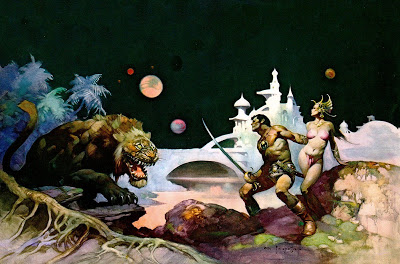
frank_frazetta_thuviamaidofmarsThe moon would be even more hardcore and dangerous and only for experienced heroes. Below the surface live the dangerous Generic Brand™ Mind Flayers.

Regarding religion, the true gods are totally weird and alien beings from a different plane of reality and beyond human comprehension. There are lots of temples in all the cities, but only the high priests really know what kind of thing they are worshipping. Gods don’t intervene and don’t reveal themselves to normal people.

Colossal stone bodies cover the landscape and are the remains of titans, who were very powerful, but not true gods. There also is no real difference between a sorcerer and a priest, their magic is all the same thing.

Based on all these things, the tech level for weapons and armor would best be Antiquity. No knights in plate armor or samurai, or anything like that. That means chainmail, dragonhide, breast plate, and boob plate.

Magic of the Ancient Lands: Ghost Paint and Soulstones

Ghost Paint

The dark elves of the tropical jungles in the south make a special paint from chalk and various plants and minerals with alchemical properties that is used to draw runes on the bodies of their warriors. These runes draw energy from the spirits of the clan and the jungles they inhabit to give the warriors strength and protection. The runes can be created at different degrees of complexity, with the fully completed patterns being the most powerful ones.

Least runes are very simple and only a couple of lines and can be done in a minute. Shamans apply a few of these to themselves every morning and when going to war all the warriors are given some to protect them in battle. Even apprentice shamans can do these and scouts patroling the borders of the clans territory are often given one or two by an apprentice before leaving the village.

Lesser runes are used much more limited and are only given to special people, like senior shamans, leaders of warbands, or scouts send into enemy territory. They take 10 minutes to create and can give the person significantly increased strength, reflexes, and perception.

Greater runes take one hour to make and are therefore only used for very special situations like shamans summoning a very dangerous spirit, chiefs leading their warriors into battle, or clan champions fighting an important duel. They can give a person inhuman strength and endurance and require a great deal of magic power from the shaman that creates them.

True runes are the most powerful patterns that can be made. They take several hours to make and a very experienced shaman, but when completed they allow a spirit to take full possession of the person as its avatar. The possessed person becomes incredibly powerful, but it is widely believed that any person who has once been possessed this way could become possessed again without summoning the spirit god and then it would not be bound by any contract made with a shaman. Therefore anyone who had been given a true rune must be slain after the possession ends.

Soulstone

A soulstone is a gem or piece of bone that has been carved with many symbols that serve as clues how one could find the place where they were originally made and to which clan it belongs. A soulstone is given to any members of a Vandren clan who leave the clans ancestral homeland and serves as an anchor for the owners soul in case he should die on his journey. If a Vandren dies while in possession of his soulstone, his soul will retain its form for far longer before completely fading into the spiritworld. If the soulstone is returned to his clan, the spirit will follow it and can be laid to rest by the clan shaman in the village shrine. It is believed that the shrines in the center of Vandren villages is a source of spirit power that allows any newborn children in the village to gain some of the strength and courage of their ancestors. If a Vandren would die far away from the clan, his power would be lost to them, but with a soulstone at least some of it can be recovered even long after the person has died and his spirit almost entirely faded away.

Clans will always give very great rewards for anyone who returns a soulstone to the shrine regardless of the circumstances of its recovery. Getting the strength and courage back which has been with their ancestors for generations is more important than any indignity of paying a scoundrel or greedy treasure hunter. Sometimes soulstones pass through several hands before they reach their final destination, as it is well known that they can be turned into gold and silver eventually. The easier the clan indicated by the engravings is to identify and the closer its current location, the more valuable they are. Some highly dispicable warriors collect the soulstones of the enemies they have slain and keep them as amulets to claim their power for themselves. To almost any other halfway decent folks this is one of the most horrible things that could be done to an enemy and absolutely without any honor. Anyone with at least some shred of honor will see that the soulstones of fallen enemies are returned to their clan.