The Green Hell and the Circle of Life and Death

Today someone mentioned the idea to me that most decent pulp settings appear to have some cool major distinctive feature that also works as a kind of source for all manners of conflicts within the world. For example in Dark Sun, the magical technique of defiling was what killed most life on the planet, is what gives the sorcerer kings their power, and allows them to keep the few surviving cities from being burried by the desert as well for the time being. In Star Wars the Dark Side of the Force created the Empire, drove the Jedi to extinction, and also is the main reason why the Jedi exist as an order of knights in the first place. In Morrowind the Tribunal and their belief to be living gods led to the creation of the Dunmer, their extreme conservatism and hostility towards outsiders, and the existance of the Ashlanders. And in the vast majority of stories of Conan the whole trouble comes from sorcerers desiring power. I think to make my Old World setting more pulpy than my old Ancient Lands setting, some kind of similar universal driver of tension could possibly be a great help.

A few weeks ago I read a post by someone writing about having seen a somewhat unusual nature documentary that showed life in the wilderness just how it is without overly dramaticising it. And it seemed to him to show that nature is not at all nice and pleasant, but really full of violent death. The vast majority of it being the deaths of children. Around the same time I’ve read a post by Zak S. about Lovecraft’s fear of the unknown being mostly a revulsion against life, which I found to be very convincing. Life means feeding and reproducing which in many cases, or perhaps even most, is neither pleasant not pretty.

In my years at university dealing with cultural studies I made the discovery that almost all major religions disapprove about the physical aspects of living and promote a detachment from bodily things and a focus on the purely mental. And it really made me wonder why all religions that praise and approve of living seem to promote having sex with the cult leader? I’ve been wanting to do something with a very body-positive approach in a non-creepy way in my worldbuilding for a long time but never really got around to it.

jungle3

And I think here might be the perfect opportunity to adress all these things. I had often thought of the Old World as being “a lot like Dark Sun, but with forests instead of desert”. In Dark Sun the driving force behind all conflicts is magic that drains nature of life. How about a setting in which the source of conflict is an overaboundance of life?

Life is not just life. It is also death. The Circle of Life is also a Circle of Death. To actively live all living things have to consume. In the end everything dies, and then it gets eaten. The only way a species can survive is to reproduce faster than its members are getting killed. It’s an endless breeding and feeding. Breeding is feeding. And in the center of all this killing and reproducing are people. And nature doesn’t care for them a bit. Like it does for anything else. The cycle just continues and there is nothing that one could do to stop it. People simply have to arrange themselves with this simple truth. And this process of arranging is where ultimately all conflict comes from. The desire to feed yourself and your relatives and to avoid being fed upon for as long as you can is what all conflict ultimately comes down to.
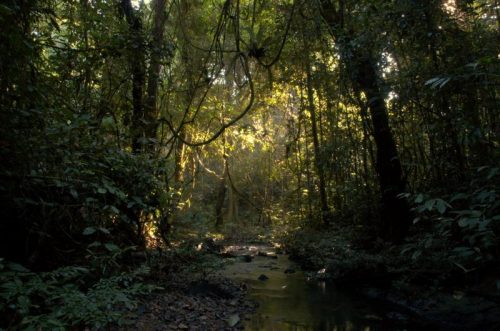
jungle2

I’m still not 100% sure if I really want to go with this. Things like these always take two or three days with me before I know how I really feel about them. But I think there’s certainly a lot of potential to give the setting it’s own distinctive character and quirks, which really is a major thing in Sword & Sorcery and pulp in general. Here are some applications I have already in mind:

Civilization is fragile: This is something I’ve had in my mind for a long time now. I don’t want to do the standard fantasy thing where the world was once great and then everything declined into some kind of post-apocalyptic world or another. Instead the Old World is a world in a constant cycle of growth and decay. Settlements are founded, grow, decline, and are eventually abandoned or destroyed to be reclaimed by the wilderness. This has happened countless times before and will happen countless times again. Abandoned and ruined settlements are found everywhere in regions that are settled by people. There are many great stone ruins as well, which had been build by the various fey folks. They are still found in many places and many of them hold magical wonders beyond the powers of mortals. But their builders were not killed by some kind of catastrophe. In truth their reign over the land came to an end when they realized that even with their great magical powers the attempts to build lasting kingdoms and empires was futile in the face of the power of nature itself. Shie, naga, raksha, and giants are still around, but they all live in the Spiritworld once more, as they did for countless eons before.
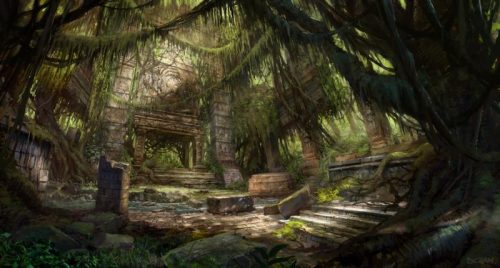
jungle1

The Green Folk: I’ve long been a fan of both treant and spriggans (duh…) and also like the idea of shambling mounds and other big beasts made from vines, branches, thorns, and moss. All these walking plant spirits are collectively known as the green folk. There are many types of them and they are literally found everywhere not covered by water or ice. In a way they might be the true masters of the world but they normally care little for either mortals or fey.

The Swarm: It’s not only plants that dominate the Old World, but also animals as well. In particular insects which though small outnumber all the larger beasts combined. Though not all insects are simple tiny bugs. Every now and then huge swarms of big insect creatures appear from seemingly nowhere and by the time they start stripping the surrounding region of all available food they have already been building their nest to raise even larger numbers of young. The swarm is a natural disaster that can happen anywhere where there is food to be found, which is almost everywhere. The immediate surroundings of a nest are soon reduced to barren wastelands but drones swarm out for many more miles to hunt for any kind of meat they can find. The only protection is to bar oneself up in a cellar and wait for the swarm to move on, which can often take several days. Once the hunting stops, the nest is soon abandoned with the creatures seemingly vanishing into thin air again. Many believe that they are not ordinary animals but instead creatures from the Spiritworld, perhaps to forrage for food for their young before they return back to their home.
War Cry of the Flame Princess: The Scout

I retroactively added this post to the WCotFP series.

Earlier this year many people have been writing about the cleric class being an oddity unique to Dungeons & Dragons that doesn’t really fit in most other fantasy settings and seems rather inappropriate. Priests in other fictional worlds never really look and behave like that, and especially in the early edition a great amount of spells are taken from biblical miracles. There seems to be some move to not use the cleric class and instead represent priests and shamans through alternate spell lists for the magic-user class. I am fully behind that.

That leaves you with the now very well established scheme of warrior, mage, and rogue, which you’ll find almost everywhere in fantasy gaming. And I have to say, I also don’t like rogues.

han-lando
Scoundrels on the other hand are a completely different story.

The thief class for D&D was a later addition that didn’t exist yet in the first release of the game but was added very soon after. And in hindsight this move made many people angry and was seen as a move in the wrong direction. But the effect that the introduction of the thief meant that fighters and mages no longer had any reason to try to deal with traps or scout ahead because now there was someone who was always much better at it then them is not my main problem with the archetype. The original thief class had a clear identity but soon people wanted the thief to be good at fighting as well which lead us to the current form of the rogue. And rogues don’t really know what they want to be. The thief aspect has largely vanished and instead we have a fast fighter with light armor, who does huge damage with special attacks, or could be an archer. That takes away almost everything the fighter had left except for heavy armor. In a campaign with knights that’s not necesaarily a problem, but when you play in a setting that doesn’t have heavy armor or huge weapons, what is left? This was one of the reasons that made me pick Lamentations of the Flame Princess as my current system of choice, as its specialist class is meant to be neither great at fighting, nor required to be a thief.

But still, I am not fully happy with that. For my Old World that is full of barbarian warriors and made for adventures mostly set in the wilderness, the specialist seems a bit too flimsy to represent a hardened adventurer and the fighter too simple to represent the more skilled and sneaky hunters. On Dragons Gonna Drag, Justin presented the idea of merging the fighter and specialist classes together. But I really like classes and am already down to only three of them, so my idea is to do something similar but opposite.

drow_xendrik

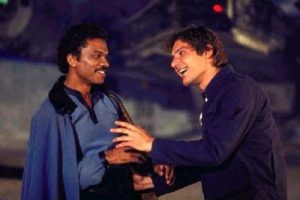
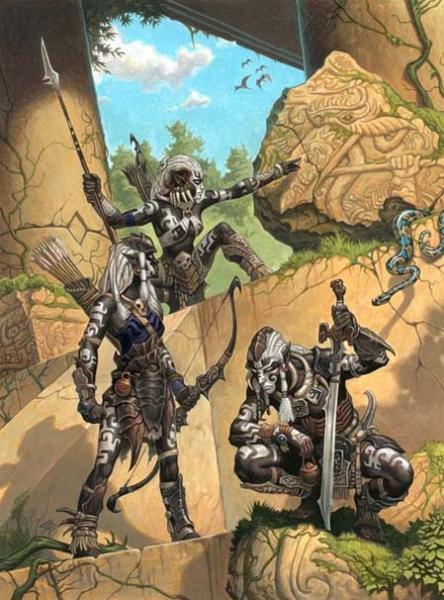
One of the greatest idea I’ve seen for the warrior, mage, rogue archetypes is in Star Wars Saga Edition which has the soldier, scout, scoundrel, and noble classes as a spectrum of different approaches to fighting character and skilled characters. Neither the scoundrel nor the noble are exactly thieves, and the scout is something different than just a fighter/thief. And so I decided to come up with some kind of scout class that represents a more sneaky kind of warrior than the fighter.

One idea I’e seen a while back is that the halfling class would make a pretty good base for a Basic ranger. And while looking around for some more ideas I discovered that this is pretty much exactly what Adventurer Conqueror King did with the explorer class. It’s pretty much the B/X halfling with a different name. That’s also what I ended up doing.

Level Hit Points Attack Bushcraft Stealth
1st 6 +1 3 in 6 2 in 6
2nd +1d6 +1 3 in 6 2 in 6
3rd +1d6 +2 3 in 6 2 in 6
4th +1d6 +2 4 in 6 3 in 6
5th +1d6 +3 4 in 6 3 in 6
6th +1d6 +3 4 in 6 3 in 6
7th +1d6 +4 5 in 6 4 in 6
8th +1d6 +4 5 in 6 4 in 6
9th +1d6 +5 5 in 6 4 in 6
10th+ +2/level +5 6 in 6 5 in 6

Creating a scout class for LotFP turned out to be pretty quick and painless. The basic frame is once again the halfling class with the addition of an attack bonus half that of the fighter (other classes im LotFP always remain at +1) and the saving throws taken from the dwarf class (which covers a wider range of levels) and reduced by 2. Since it’s a scout class, the Bushcraft skill of the halfling is retained, but it also gains the Stealth skill with a chance of 1 lower than Bushcraft and not the flat 5 in 6 chance in wilderness environments that halflings have. A scout also can make a sneak attack for double damage with no option to increase like a specialist does.

And there you pretty much have it. I am considering giving also a 2 in 6 chance for Search and Climb, as it would fit the theme, but right now I am somewhat uncertain whether that might be a bit too much. Compared to the fighter the higher saves should even out with the lower hit points, which leaves all the skills compensated only by the reduced bonus to attack. But overall I am very happy with the class and it really took only about an hour to make, including research.

Villains for the Old World

As I was writing on the idea of Hope & Heroism, someone pointed out to me the importance of motivations for the antagonists. Coming up with a list of heroes who represent all the ideals I am looking for in protagonists was very easy. But examples for good antagonists turned out to be a much more difficult task. I had a few ideas for villains who I think are cool and who I would love to put into the Old World, but thinking of any reason why the heroes would be fighting them was a lot harder.

The more I was thinking about it, the more I came to the conclusion that good motivations for an antagonist are much more dependent on the specific attributes of the setting than it is the case for heroes. Heroes are generally easy to create as they really just need to be good people with the determination to take action against villainy. You can quite easily move these from one setting to another and their motivation to do good always works just fine. But antagonists don’t have to work just with the heroes, but also with the many unique aspects and elements of the setting. They need much more than just a hero to oppose them. They need to have a goal that benefits them and a plan that is actually feasible. And these things really depend a very great deal on what and who else is all in the setting.

So I’ve decided that a post on Villains of Hope & Heroism wouldn’t be making any sense and not be useful. The same narrative principles can be applied to a huge range of very different settings. Instead I am focusing on the nature of antagonists in my own Old World setting.

After going through all the examples of books, ,movies, TV shows, and games for ideas what kind of antagonists could work in such a setting, I narrowed it down to four main types of antagonists.

  • Warlords: Perhaps the most classic type of antagonists. These people are military leaders whose long term goal is to hold their territory against their many enemies, and often to destroy them before they attack on their own terms.
  • Sorcerers: If there are antagonists for Sword & Sorcery type tales more iconic than warlords then it’s the sorcerers. Masters of dangerous arcane powers who are always looking for more knowledge and power and often try to take direct control over the domain of the master they serve.
  • Bandits: Simple but reliable. Some antagonists don’t have any big elaborate plans or higher goals. Some are simply content with taking what they want and killing those who resist them.
  • Avengers: In a world where might makes right and the law is in the hands of whoever carries the biggest stick, vengeance is the way to put the offenders in their place. In many tales the protagonists set out to avenge their fathers and masters, but in a tale of Hope & Heroism nothing good can come from that. But a lot of bad for a lot of people who are only tangentially involved. Whether the tool of vengence is poison, an army, or a horde of demons, it’s always a great source of trouble for the heroes to take action against.

Regardless of who the antagonists and their minons are, every heroic tale needs some type of villainous plot that the heroes are trying to stop. (I wonder how far back this convention goes. It doesn’t seem to be common in ancient hero tales.) For a setting of city states and barbarian tribes I found these following ones to be a good set of templates to work with.

  • Conquest: Sometimes an antagonist of the warlord type simply wants to expand his territory for greater wealth and fame. It is simply ambition that drives him and a need to show his prowess. Not a particularly interesting motive but a simple and uncomplicated one. Probably works best as an additional complicating factor in situations where tbe heroes are already busy with going after someone else. The conquest might be just an opportunistic small warlord seeing a chance to make his move or be the backdrop for the tale of the heroes. In either case, the conqueror is probably not being to be the focus of the adventure since he’s not very interesting in himself.
  • Resources: In this situation a warlord is in the whole conquering business just for the sake of it, but it really is just the means to get access to very important resources. Something that the antagonists needs, and needs so badly to kill for it and take it from others who need it as well. This is much more interesting as it’s probably easy to see that the antagonist had to do something to keep his people fed and save. But it’s going to be the method with which the heroes will take objection. Simply beating back the antagonists forces won’t end the conflict, only delay it for a while at best. This doesn’t have to be a military invasion of a neighbor. It might very well be the antagonist’s own subjects who have to carry the burden.
  • Defense: Things get even more ambiguous when the antagonist is taking drastic actions as a measure to defend his domain against another foe. The measures taken to improve defenses might lead to hardship for the farmers and workers, but can also mean attacks on and annexation of vital territory. Many of the locals might even support a change in leadership which will only make the antagonist to resolve to even more draconian measures.
  • Magic Power: True magic power is in a wholly different league than ruling over land or people. This alone might lead sorcerers to see the hardships of others as a very accepable price and warlords might very interested in getting their hands on a magic weapon that can secure and expand their power. The plans to attain a new source of magic power can be very complex, but as a motive for an antagonist it’s actually very simple. Many of the lunatic sorcerers who want to destroy the world can be made much more plausible if they are simply searching for magic power and are willing to pay a very high price for it. Or rather, have someone else pay that price.
  • Vengeance: A relatively simple and straightforward motivation, but one with endless possible applications. Pretty much any character imaginable can be motivated by vengeance and the possible plans to gain it are endless. The main use of vengeance in tribal society is to scare away enemies and prevent further attacks in the future. Retaliation as a show of strength. In societies with no police this can put the heroes in quite difficult positions. For a short adventure a group of warriors seeking vengeance against someone in the protection of the heroes makes for a great conflict. But revenge for past crimes that have already been mostly forgotten can be a much bigger source for a lot of trouble that is still to come and the heroes are probably going to much less sympathetic to such a cause. Especially when the revenge comes in a form that affects many other people mostly unconnected to the original offense.
  • Plunder: And sometimes all that bad people want is some wealth and comfort. Other people’s wealth to be specific. Greed is as basic a motivation as it gets and there is little about it that would justify negotiating some kind of compromise between parties. But used for minor antagonists or as an easy break between more complex adventures it’s still something that does the job. Antagonists out to burn and pilage (and that other stuff) might either be in addition to the primary opponents of the adventure, or they might constitute a particularly unpleasant segment of the main antagonist’s minions.

These lists are both not very long, but I think each of them comes with so many variables that they can be reused many many times without becoming overdone. Especially when you switch between them regularly to avoid falling into a regular pattern. Even when not looking specifically for something to use in an adventure of Hope & Heroism or something set in a Bronze Age setting, all of these motives should easily work in most types of tales.

Blood Magic

Blood Magic has very much fascinated me since I encountered it in Dragon Age six years or so ago. I wanted to have something like that in my own setting since all the way back when I started planning it. Since then I learned a lot more about how magic works in the Thedas setting and it actually is mostly demonic mind control. Not really much blood involved. But I most liked the idea of blood magic not being fundamentally evil and one of the first blood mages you encounter in the series is actually a pretty nice and also average guy. That had always had me want to have blood magic in my setting and the idea of using blood as a power source instead of some ethereal mana or mental energy is also really cool. It’s much more savage and primitive than arcanists in their libraries playing with astrology. Perfect for a Bronze Age barbarian setting.

But the whole time I never developed the idea further than that, always keeping it off for later. Because I just didn’t have any good idea how blood magic could be different from regular magic and my magic system kept changing all the time anyway. Now I do have a magic system that I really like (but still got not around to write out in full) and with the rest of the setting being already very far along it’s really getting time to finally tackle it.

How it works

latestMagic in the Old World is based aroud the idea that the being of any creature is a single entity of spirit and body, but that it extends beyond the boundaries of the physical form that is seen with eyes or felt through touch. The physical forms of creatures and things have clear boundaries, but the immaterial aspects do not. They just weaken with distance and eventually blur together with the essence of everything else. (Similar to gravity or magnetic fields.) Most beings only have mental control over their own bodies and minds, but since everything is connected and the spirit has no clear boundaries, it’s possible to take control over things outside the physical body and even over other beings’ bodies and thoughts through a contest of wills. This control over other creatures or things is magic, as it is used by all witches, shamans, and spirits. One important limitation of magic is that it only works when the caster is actively taking control. When the control ceases, the magic ends. It’s also not possible to use magic against creatures who are not nearby, unless a spirit is send to visit people and use it’s magic on them. It is also the reason why magic objects can not be created; they can only come into existance naturally.

Blood magic is one way to get around this limitation. Instead of maintaining control over an enspelled target, a blood mage weaves the spell into the target’s blood, whose life force will then power the magic instead of the mages mental energy. Blood magic keeps working regardless of how far the target moves from the blood mage and the spell can continue potentially for as long as the target lives. Masters of blood magic can even weave spells into the blood of their target that will remain dormant until certain conditions are met and they perform their true enchantment. Having some of its life force consumed by a blood magic spell causes the target to be slightly weakened, depending on the power of the spell. But usually the effect is too small to be a clear sign of blood magic, with the target only being slightly more tired or faster out of breath during strenuous activities.

A more well known use of blood in the casting of magic is as an alternative power source to the mental energies of a blood mage. Wrestling control over another person’s body or thoughts is one thing, but actually draining life force from living creatures is much more difficult. Usually this is done by complex rituals and the use of various potions that allow apprentices and acolytes to give their masters access to their mental energies. A simple shortcut to this is to simply tear the blood out of a living creature’s body and use the life force it still carries. This gives a blood mage a great boost to his power when casting a spell. It’s still a difficult thing to do, especially in the middle of a battle, so often blood mages draw on the life energy within their own blood.

Since the corrupted energies that animate undead are very different from the life force of living beings, they are neither affected by it, nor can they use it.

What it does

Aside from giving a blood mage a boost in power from draining life force from a living creature, blood magic can be used to put long lasting enchantments on living creatures. One common use is to make the target creature a permanent slave that has to obey the blood mage’s orders. It’s similar to a powerful charm spell but the ideas planted into the targets mind do not fade away as it remembers its own thoughts and memories.

Alternatively a blood mage can give a creature specific orders to be performed under specific circumstances without it even knowing that such an enchantment is in place. Unlike a spirit following around a victim, such enchantments are very difficult to detect by other witches or shamans. Blood magic can also be used to permanently alter memories. Such enchantments are very difficult to break and require a shaman who knows exactly what he’s looking for. Blood mages familiar with the process can break it just like any other spell.

Instead of manipulating a creature’s mind, blood magic can also make changes to the body. Blood mages can give their servants and henchmen great strength and resilience which they retain even without the spell being actively maintained. Since the magic power to maintain these spells is entirely drawn from the creature’s own life force and not the mental energy of the caster, such enchantments tend to take a significant toll on its health. Giving greater strength to heroes for an important battle can often be more than a worthy trade, but guardians who are kept permanently enchanted often live for only a few years. The enchantments keep them strong until the very end but eventually they just fall over dead as desiccated corpses.

How it is treated

Blood magic is not an inherently corrupting or more harmful form of magic but usually seen as one of the darkest forms, similar to sorcery. Tearing the blood of a creature from open wounds is an incredibly violent process compared to the casting of other spells and it’s easy to see why it is especially feared. The effect it has on the bodies and minds of creatures that have been heavily enchanted with blood magic also gives people plenty of reason to regard blood mages as nothing more than savage sorcerers. Blood magic is more common among the more wilder and isolated clans of the Old World and often associated with the witches of the Witchfens, which gives it a reputation of being primitive and brutish though it’s actually a very advanced magical art.

Blood magic also has a much greater potential for manipulating people’s thoughts and controlling their minds than ordinary witchcraft, wich makes known blood mages even much more mistrusted. Even those powerful ancient witches and high shamans who know the secrets of the red art rarely trust their students with such powers and the lack of teachers makes it a very rare skill outside of clans who practice it openly.

RPG implementation

Except for the blood draining ability there are no specific rules for implementing blood magic as a game mechanic. It simply allows blood mages to make their enchantments permanent without any special costs or mechanics.

Old World Inspirations

When it comes to worldbuilding, it’s always good to have a distinctive style in mind and working towards staying true to this vision. In my experience there’s always a tendency to go down established paths and before you know it you find yourself with a generic world with two or three gimicks. For the Old World I have a very clear image of what the setting is supposed to look and feel like and what it seems and internal logic should be. The following is what I believe to be a pretty complete list of the books, movies, videogames, and RPGs that inspired the setting:

  • A Princess of Mars by Edgar Burroughs (1912)
  • Alien (1979)
  • Aliens (1986)
  • Apocalypse Now (1979)
  • Bound by Flame (2014)
  • Conan by Robert Howard 1932-1936)
  • Conan the Barbarian (1982)
  • Crouching Tiger, Hidden Dragon (2000)
  • Dark Sun (1991)
  • God of War II (2007)
  • Halo 2 (2004)
  • Heavenly Sword (2007)
  • Heir to the Empire by Timothy Zahn (1992-1994)
  • Hellboy (1993 and ongoing)
  • Ghost in the Shell (1995)
  • Kane by Karl Wagner (1970-1985)
  • Knights of the Old Republic (2003)
  • Mass Effect 2 (2010)
  • Metal Gear Solid 3 (2004)
  • Morrowind (2002)
  • Planescape (1994)
  • Predator (1987)
  • Princess Mononoke (1997)
  • Raiders of the Lost Ark (1981)
  • Seirei no Moribito (2007)
  • Shadow of the Colossus (2005)
  • Soul Reaver (1999) and Soul Reaver 2 (2001)
  • Stargate (1994)
  • Super Metroid (1994)
  • The Empire Strikes Back (1980)
  • The Thing (1982)
  • Them! (1954)
  • Warcraft III (2002)
  • Yojimbo (1961)

There’s a couple of science-fiction movies and games on the list, but I think with almost all of them the technological elements are just window dressing. At their heart they are still about monsters and magical worlds.

Why have I not been informed: New LotFP edition in work

I just now spotted an article on the playtest document for the new edition of Lamentations of the Flame Princess that has been send out to some GMs back in february. I also noticed just a few days back that the new Referee Guide is still in work, which will include new unique monsters for the game. I assume it will be released alongside the new rulebook.

I don’t have the playtest rules myself, but looking at this summary from Dragons Gonna Drag (another new OSR website, like what you did so far Justin) I already spotted some things that I found interesting.

Intelligence determines skill points at first level. After that only specialists keep getting more points. I’ve been thinking about ways to give fighters and witches limited access to skill in my campaign these last couple of days. This is certainly one way to make it work.

There’s also a Medicine skill, which is nice, as it indicates support to play without magic healing. Very Sword & Sorcery.

Strength affects how many items characters can carry. This is one shortcoming I’ve seen with the Encumbrance system of the current edition and something which I think the system by LS from Pencils and Papers did better.

What I find really interesting is that classes are reduced to fighter, specialist, and magic-user (the other classes are said to be put in an appendix). I did the very same thing for my campaign. There’s been some talk not long ago about clerics and how they are pretty much a unique thing of D&D and not really fitting for other settings that don’t want to be worlds defined by the D&D conventions. (B/X is a great system on its own, even divorced from its D&D legacy.)

All characters advance with the same amounts of XP, a topic that I’ve been discussing on a forum just today. And I am very much in favor of it. Making miniscule adjustments to XP required for the next level is pointless when level loss, replacement characters, and characters of newly joined players all have a much bigger impact on the different levels of characters.

Justin mentioned having the impression that group initiative is being ditched, which is something I wouldn’t approve of. But it’s trivially simple to do anyway, and it isn’t like Dexterity would become a useless stat if it no longer affects Initiative.

There’s a new saving throw mechanic that basically uses a d6 dice pool and counting successes. That’s something I really don’t see myself using if it makes it into the new edition. I think a d20 roll against a target number indicated by your class level is just fine and much less of a hassle. There’s also partial saves, which is more granularity than I want to bother with. This new system also doesn’t improve odds as the characters level up, which I think is a pretty important feature of B/X. I can see why Raggi wouldn’t want that in his home games, but it’s something that I would really not want to miss in mine.

There’s also big changes to how spells are prepared, but since I’m using a completely different magic system that doesn’t have anything to do with D&D magic anyway, this doesn’t affect me personally.

Overall, I think this all sounds very good. I almost certainly won’t use the rules straight out of the book, but I don’t think there are many OSR GMs who do that with any game that is around. I am very much looking forward to the new rulebook and referee guide.