War Cry of the Flame Princess: Wilderness Travel

Wilderness travel is one of the things I always wanted to include as a major element of my campaigns but the rules as written in either B/X or LotFP require too much on the spot calculation and conversion of movement speeds in different terrains that I just can’t handle at the table with my ADD when the players are talking about what they are going to do next at the same time. Adding the attack bonus to a d20 roll and subtracting hit points I can manage, but doing divisions and fractions while paying attention to conversations just ends up with me getting brain locked. All my homebrew systems and my choice of LotFP as the system I am using have been done as means to compensate for my impairment in this regard. Making game mechanics more accessible for people with neural impairments is something I’ve never seen anything written about and might be worth dedicating a post or two to in the future.

Last year I already tried my hand at coming up with a simpler and faster solution, but it’s still based on the underlying assumptions of a hexcrawl with way more precision and granularity than I need for Sword & Sorcery adventures. But a great idea for something much better comes once again from Angry-sensei, who just has some kind of gift for making methods that are practical to use instead of being best suited to programm a computer with. There are two big things of beauty in his proposal. The first one is that it doesn’t require a map with precise measurements or any degree of accuracy. In addition to being quite a lot of work for GMs, the current design standard for maps is basically satelite photography which is something that wouldn’t be available to people within most fantasy world but in my own experience also create a sense of the world being fully explored and tamed. Which is the complete opposite you’d want in a mythic bronze age Sword & Sorcery world. Tolkien’s hand drawn map for The Lord of the Rings is what I consider the ideal form of fantasy map. It’s a tool for navigation that provides an idea of the general layout of the lands but also has a level of abstraction that inspires the viewer to wonder what marvelous places might be hidden in all those blank spots that noboy alive has ever set foot in. The second great thing about it is that it works without any calculations and requires only looking up a single number in a simple table. This post is an adaptation of this concept to the rules of LotFP with some tables for actual use in play.

Travel Times and Distances

When a party makes an overland journey, the first step is deciding on the path they want to foollow from their starting point to their destination. The GM then makes a quick rough measurement on the map (which can be as sketchy as you want) or makes a judgement call how long this path is in miles. At the start of each day, the GM decides which type of terrain the party will mostly be travelling through on that day. Knowing the encumbrance rating of the slowest character or pack animal in the party, the GM simply looks up on the following table how many miles the party covers on that day.

Terrain Unencumbered Lightly Encumbered Heavily Encumbered
Road 24 miles 18 miles 12 miles
Heath/Moor/Plains 16 miles 12 miles 8 miles
Desert/Forest/Hills 12 miles 9 miles 6 miles
Jungle/Mountains/Swamp 8 miles 6 miles 4 miles

Soldiers throughout history have been marching at about 3 miles per hour on good roads, so with 8 hours of marching you get 24 miles per day. While those soldiers would have been encumbered by gear, they also wouldn’t be travelling through untamed wilderness, so I think this table makes a decent enough approximation of plausible travel speeds.

Mounts

Contrary to movies and books, horses do not cover greater distances in a day than a human can. While they can run much faster at short distances, humans (and dogs) are the world’s best endurance runners and can keep on walking with much less need for rest than other animals. The distances covered by humans and horses are about the same. The big important difference is that horses can carry a lot more weight than humans and are much less slowed down by the same loads. Riding and pack animals should have the same movement rates as humanoids but with double or tripple the carrying capacity of an average person for calculating encumbrance,

Water Travel

17 different types of ship with different sailing and rowing speeds, 5 classes of quality, and 9 degrees of weather conditions is a bit more than needed when dealing with travel at this level of abstraction. I reduced it all down to this simple table.

Type Favorable Conditions Average Conditions Unfavorable Conditions
Canoe 24 miles 18 miles 12 miles
River Boat 80 miles 60 miles 40 miles
Sailing Ship, Slow 120 miles 90 miles 60 miles
Sailing Ship, Fast 160 miles 120 miles 80 miles

I’ve done some researching of my own about the speeds of (admitedly modern) sailing ships and the numbers in the Expert rules and LotFP seem to be way off. These numbers for distance travelled in a day are much closer to what you could actually expect from real ships. For canoes the distance is given fr 8 hours, as for marching, but for the others the distance is for a span of 24 hours since they are powered by wind and people can take turns with steering while the others rest. For canoes and river boats favorable and unfavorable conditions means going downstream or upstream. Average conditions would be on lakes. For sailing ships these apply to the weather and the wind in particular. Whether they are favorable or unfavorable can be determined with a simple roll of a d6, with a roll of a 1 or a 6 indicating that less or more distance has been covered that day. On the seas travel distances can vary greatly, but this is a good enough approximation for a game.

Wilderness Encounters

Another suggestion by Angry that I also take pretty much as is is rolling for wilderness encounters by rolling a number of d6 bases on how how much monster traffic is present in an area the party is travelling through on a given day. For every die that rolls a 1 there will be an encounter sometime during the day. At what time during the day and in what terrains these encounters will take place is up to the GM to decide. I got curious and calculated the odds for wilderness encounters with this method:

Threat Level No Encounters 1 Encounter 2 Encounters 3 Encounters
1 Settled or desolate 83% 17%
2 Wilderness 69% 28% 3%
3 Hostile Wilderness 58% 35% 7% 1%
4 Hostile Patrols 48% 39% 12% 2%

They are not actually as high as I expected. Not having any encounters at all still remains the most likely outcome by a good margin and even at higher threat levels the chance to have multiple encountes in a single day is very low. As Angry explains it in a much more elaborate way, this is actually a pretty nice addition to the regular wilderness encounter rules. It raises the number of factors players have to consider when picking a route to three: “How long would we be at risk at encuntering monsters in that area?”, “How dangerous are the monsters we might encounter in that area?”, and now also “How many monsters are in that area?” Go through the swamp that is choking with giant spiders or risk the shortcut over the mountains where almost all creatures have been killed by a dragon?

I  very much encourage using the rules for foraging and starvation. Carrying a large amount of rations means the party wil be slowed down but make consistent progress each day. Not packing enough rations for the whole journey (to make room for treasure for example) means that the party is travelling lighter and at a faster speed. While finding enough food in the wilderness is relatively easy with a trained specialist or a scout, the time it takes is highly unpredictable and can cause the party to actually make even less progress in a day. It’s a nice layer of added uncertainty that the players can consider in their planning for wilderness journeys.

Since more than a single encounter per day is very unlikely even in the more crowded regions, the encounter tables should be stocked in a way that there is real danger for the party. If the players have no reason to expect the possibility of a character dying or the party getting captured then they also have no incentive to hurry up, making the whole exercise of wilderness encounters moot.

Encounter Distances

If an encounter happens, use this table to determine the distance as which surprise rolls are being made by both sides.

Terrain Distance
Forest/Jungle 2d6 x 10 yards
Desert/Hills/Swamp 3d6 x 10 yards
Heath/Moor/Mountains/Plains 4d6 x 10 yards
Lake/Sea 4d6 x 10 yards

When travelling on rivers, use the row for the surrounding terrain. The distance for encounters on sea or lakes are for encounters with monsters. Ships can be seen from much larger distances.
Am I done?

Certainly feels like I am done. Despite saying just a few weeks ago that I felt I barely had made any real progress over the last six years of working on the Ancient Lands, I think that I now have all the pieces togther. Not ready for a publication by any stretch, but you could say the setting has reached the beta stage, where it’s completely playable.

Some monsters still need proper names and a handful still needs their stats written down, but I got a 100 entries bestiary. The gods still need naming, but I have them all together and religion properly worked out. The four character classes are all ready to play and the magic system is complete. I got all the races and an outline for the culture, and good sounding names for almost all of them. The map is an ungly sketch but it has all the countries that I want to include.


This thing can be played.

This week I was reading through the older posts I’ve written here about the Ancient Lands in more detail, and while it is true that almost all major elements of the setting where already in place in early 2011, the vast majority of them had a sometimes quite significantly different shape and appearance back then. Based on what I’ve been writing about the process, the setting really grew into the world I want it to be in the last 8 months. Many things I now consider crucial to the theme and style of the setting I wrote about only last summer. Looking back a full year before now, there’s still a lot of stuff that now seems completely out of place to me. Deserts, empires, trade networks, criminal organizations, humans! What was I thinking?!

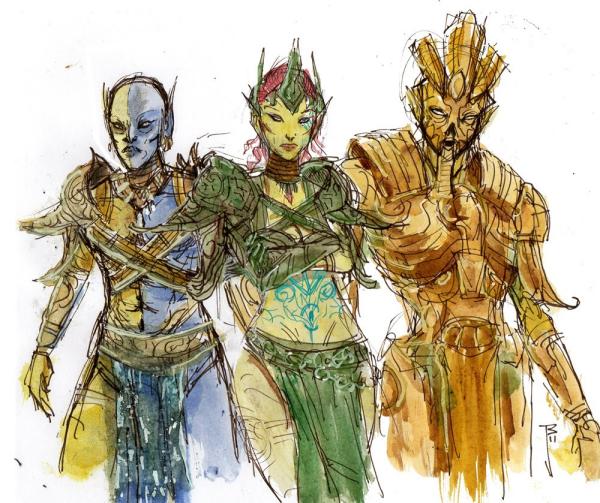
I think a big tipping point was writing the Project Forest Moon post. This was when all the ideas and things I liked really became one coherent concept. That’s when it clicked and I realized which of my many inpirations I really want to set the overall tone for the world. Endor, Morrowind, Kalimdor, and Planescape (Beastlands and Pandemonium). I want the Ancient Lands to feel like those, and everything that doesn’t have anything to do with bringing that style to life can go. No empire, even when it’s lizardmen. No deserts, no steppes, no tundra. Certainly no criminal organizations, multinational mining consortiums, or national borders. But as I now recently realized, also no stone age hunters. In my quest for making a more solid tribal society and animisitc religions in a largely unsettled world I regularly kept forgetting that it’s still supposed to be a Bronze Age level setting. But now it finally all looks right.

There’s still a good amount of things to be done. The first priority being the creation of a sandbox for my next campaign that I’ll hopefully be starting before the summer. The setting I have created now is a set of rules, monsters, cultures, and general geographic overview. Creating adventures for it is another step entirely. The other thing I want to do is to actually get all the ideas that mostly exist in my head and on some indecipherable notes into a coherent text that can be shared and used by others. I am still not putting any hope in any kind of commercial success with this setting, but I definitely want to release it to the public. Over the many years of working on the Ancient Lands I’ve been getting a considerable number of comments and also messages from people simply wanting to tell me that they really like my ideas and would love to play in such a campaign. And that’s really all the confirmation I need that this isn’t a completely pointless undertaking. Even if nobody else ever runs an Ancient Lands campaign, it can still be a useful sourcebook for material or at the very least a source of inspiration for GMs wanting to start making their own settings.

And that’s what it’s all about

This last week I have been doing a lot of thinking about my work on the Ancient Lands setting so far. Going by my oldest notes that I could find, the whole idea started pretty much exactly six years ago, give or take a week or two. And after all this time of expanding, revising, and discarding and two short campaigns I find myself with almost nothing concrete to show for. Almost all the major elements like races, classes, technology level, magic, and religion have been there from the very start and I don’t really have much more written down than I had back then. As of now there are no maps, no settlements, no dungeons, abd no NPCs. They all ended up discarded because they just didn’t work for what I really wanted to make.

But it’s not like the years had been wasted and all the work been futile. Rather the opposite. I’ve learned so much about running games and building settings that I had no idea of back then and that helps me know to understand what it really is that I want and what I have to do to get there. And this process has given me more insights and made me more capable at realizing my vision up to right now. Or three days ago, to be more precise.

Last month I’ve been working on my Forest of High Adventure sandbox and despite having a really good feeling about it I ended up once more realizing that I had made somethin that really isn’t at all what I wanted. Instead of going straight back to the drawing board, I’ve spend much of the past days thinking about what went wrong and hunting down what other people have written about the process of creating wilderness sandbox campaigns. A mind with ADD tends to wander all over the place and into multiple directions at once, but when it comes to exploration and creativity that’s not actually a drawback. I really don’t remember how I got there, but the first conclusion I came to was that I had once more lost sight of my goal. The Forest of High Adventure was an attempt to make a wilderness sandbox out of the material from The Savage Frontier, which I consider to be the best setting sourcebook I’ve ever come across. But really, the original spark that got me into worldbuilding was not the thought that the High Forest is a great place to set a campaign in. It was the idea that the ancient past of the High Forest always sounded like a much more interesting setting to play in than the actual material that is described in the books. Including The Savage Frontier. So what have I been doing preparing an Ancient Lands campaign by reconfiguring the building blocks of The Savage Frontier?

The second thing I realized is that I really have to nail down what the core elements and assumptions are that are defining the setting and give it its unique character that distinguishes it from other worlds. I’ve spend a lot of work on figuring out such things as the tradenetworks of key resources, the main political powers of the region, the histories that led to the major conflicts, and things like that, but these all reall have nothing to do with exploring ancient ruins in the widerness and encountering the strange spirits that reside there. Even though its meant to be the central theme of the setting, I did almost nothing with spirits. So I scrapped all that for now and instead begin the creatio of new content with defining the relationship between people, the environment, and spirits.

I’ve been asking people what it means for a setting to have depth. And the best reply, that really nailed it for me and many others, was that the difference between a deep and a shallow setting is that in a deep setting the world itself provides the reasons why things are as they are and people do what they do. In a setting with depth the stories and the characters are specific to that setting and really only work within that setting. They can not be simply ported over to another setting. My favorite examples of these are always BioWare’s Mass Effect and Dragon Age settings, but the Metal Gear Solid series also has strong elements of that. They all have a very strong and distinctive identity and they do that almost without any need for history, maps, and political and economic organization.

How do I do that for the Ancient Lands? As I said, the starting point for all of this was that I regularly found the lost realms of the distant past in many fantasy settings much more interesting than the present that is shown. The Lord o the Rings is a story about magic fading from the world and the end of the age of myth, to be replaced by our own world of rational progress. Which is a good story, but I would really love to also see a world in which elves and dwarves are not fading peoples and humans dominant, and in which dragons and giants still dominate. This idea evolved a bit further into a world that is animistic in nature and ruled by spirits, and I also like the atmosphere and aesthetics of exploring an almost uninhabited wilderness as in the D&D module The Isle of Dread, the continent Xen’drik in Eberron, and Kalimdor in Warcraft III. And yes, my favorite forest moon Endor also rears it’s green head again here. So I’ve been writing down notes for things that I thought are central to this vision and should be center stage in every adventure set in the Ancient Lands. And over the days they added up to a pretty decent list.

  • Civilization exists only because spirits protect it from the threats of nature.
  • Civilization ist precarious because spirits are alien.
  • The Wilderness is threatening because people are small.
  • The Spiritworld is not meant for mortal creatures.
  • All mortal endeavors are fleeting and nature will swallow up everything eventually.
  • Cities are unnatural. They are very unlike the way almost all people live and require the support of extraordinary powers.
  • Spirits do not prey on people but generally are not concerned about their wellbeing or that of animals or plants either. Usually it’s safest to not draw their attention at all.
  • Spirits have great control over their domains but can not act against their nature.
  • Sorcery can do things that spirits can not, but it poisons the land and the creatures on it.

The idea that civilization can never grow big or last for a long time came as a solution to having a wild world full of ruins while having the stubborn conviction to not make it another post-apocalyptical setting. There was no real practical reason for that other than wanting to be different. But I think this idea of perpetual collapse and the resulting certainty that the future won’t be different results in a very interesting mood for the setting. It also meshes well with the fact that for the vast majority of human history people couldn’t see any progress happening to their societies. People often complain about medieval stasis in fantasy settings, but for thousands of years that was how things felt for almost all people.

The idea to make cities alien places came to me just yesterday. I always knew I wanted to have a handful of cities but often thought about perhaps not describing them or having them appear in campaigns at all. But I was looking again at Chris Kutalik’s idea for Corelands, Borderlands, and the Weird in his Hill Cantons campaign and it seems like a very good approach to me. For the Ancient Lands, villages and towns and the small surrounding farmlands would be Corelands where everything is normal and adventures don’t usually happen.* The wilderness beyond the fields and pastures is the Borderlands, which are full of terrifying beasts and the challenge is to survive the treacherous journey to the dungeons. The Spiritworld and most dungeons are the Weird, where magical creatures can be found and the normal rules no longer apply. (*Adventures in the Corelands would mostly revolve around witches and cults, whose lairs are also Weird.) And cities in the Ancient Lands are clearly not places where you can rest in peace and safety and no real adventures happen,which disqualifies them for being Corelands. So instead of having the PCs be county bumpkins in the big city, why not make the cities outright strange and alien places? After all, they are kind of a violation of the natural relationship between people and the wilderness and it’s already established that sorcery is able to overcome the natural rules of the world. Making people believe that all cities are sorcerous places (and in many cases that’s actually the case) seems like a great way to make them fun in a wilderness campaign and it’s another thing to make the setting distinctive. I think I have to read Vornheim again. (And look what someone just did!)

So yeah, I am feeling really good about this whole worldbuilding thing. I have no gameable material right now (except for a 100 entry bestiary without pictures or typed out descriptions), but I feel like I have another major milestone reached. And perhaps now I’ll get a working sandbox put together.

I think some people would call coming across this image while writing this post syncronicity. I call it coincidence.

XP for magic items?

While I am usually rather against mechanics that are obviously made for gameplay reasons and not for getting reasonably realistic results, encumbrance is one element where I make a big exception. I am a huge fan of inventory slots in pen and paper games. Not because they are in any way realistic but simply because any attempts to measure items by weight or volume end up as such bothersome bookkeeping that people usually end up ignoring encumbrance entirely.

Which in a game of exploration expeditions and treasure hunting is a real shame. You lose so much of the experience of dungeon crawling and wilderness travel when you don’t have to worry about being slowed down by carrying too many supplies. And even worse, when the PCs can carry as much supplies (which are dirt cheap) as they want, then it also becomes redundant to track how many more torches and rations they currently have with them. And really: What’s left then? A Pathfinder adventure! I mean combat! Bookkeeping is not fun, but having to worry about running out of light or throwing away all your food to be able to outrun a monster while still hanging on to all your gold is something I never would want to miss again. And in AD&D 1st Edition and the Basic/Expert gold is not primarily money. Most importantly gold is experience. Your XP take up inventory space and can slow you down on your way to safety.

It always amazes me how deeply interconnected the various elements. Encumbrance, XP for treasure, and random encounters only look like completely different things but they are all a single unit of resource management that really is at the heart of the oldschool experience. If you drop one, the other two no longer work either and there’s nothing to keep the party from having 15 minutes adventuring days and rest after every fight, which is the huge glaring flaw of 3rd Edition and Pathfinder.

As such,I am really a big fan of the Encumbrance system in Lamentations of the Flame Princess which gives each character a number of inventory slots and every item takes up one slot. It doesn’t adjust the item limits based on character Strength but otherwise it’s clearly the right approach. The typical character sheet has a section for items with one line available for each item. Just mark after how many lines the encumbrance limits are reached and you never need to even count how many items your character carries. As long as you leave no lines empty you just have to check whether your item list passes the marked lines. That’s an encumbrance system you can actually use at the table without annoyance.

But now finally to XP: In my Ancient Lands campaigns there is very little use for money. It’s really only needed for big bribes, tributes, ransoms, or for buying really big things. And most people rarely use coins in daily life. So I don’t even bother with individual coins anymore. Instead I simply go with treasure items. In LotFP,a bag with 100 coins takes up one inventory slot. Like LotFP, I think silver is a much more sensible standard coin for normal business and it makes finding gold much more exciting when it’s not something people see every day. So the standard treasure item is worth 100 XP, with a bag of silver coins being the benchmark for how valuable such items commonly are on average. In addition to that I am also using great treasure items that are worth 1000 XP, or as much as a bag of gold coins. This reduces bookkeeping again by a lot. (I really hate bookkeeping.)

XP for treasure is a great system because it rewards players for behavior that you want to see as the GM. It rewards them not for slaying a monster but for getting the treasure guarded by the monster. It seems a bit silly that characters would get better at fighting by collecting coins, but then it’s no more realistic to learn more spells by shoting people with a crossbow. XP for gold encourages players to explore and sneak. XP for combat encourages combat. It actually discourages sneaking and negotiating except as means to get an advantage for a coming fight. I like XP for treasure much better, but the concept behind the Ancient Lands is not just one of treasure hunters but a game of knowledge seekers. Gold and jewels are not meant to be actually that thrilling for the PCs who are striving for a higher goal. Something else is needed to which the players are encouraged by the lure of XP.

By default characters get no XP for magic items. Magic items are useful to the party and give them advantages while in an oldschool game money usually doesn’t. Unless you eventually get into building castles,there’s not really much to do with all the massive piles of gold characters gain on their progression to higher levels. But in my campaigns the search for and fighting over rare magic items takes center stage and so I want to reward it with XP as well. Since magic items are meant to be rare, the players won’t getting their hands on a lot of them. At the same time gold and silver are meant to be less lustrous so I can simply hand out less of mundane treasure to even out the total gain of XP. The main difference is that magic items are worth much more XP but still take up only one inventory slot. But again,this can be countered by giving more silver treasues (100 XP) and fewer gold treasures (1000 XP).

Now assigning specific values to magic items is difficult as they don’t have a value that could be measured in coins. But in the end the XP are awarded for the challenge of getting them and so I consider it a good solution to simply set the XP for retrieving a magic item to 1000 times the dungeon level on which it was found. By which I don’t mean the actual physical story of the dungeon but the difficulty of the Wandering Monsters table that is used for the dungeon level. Often that will be just three or five times the value of a regular gold treasure,but then the players can also actually use the item’s power to their advantage, making it worth more to them than just the XP. I think it’s also a nice rule of thumb for special treasure items like huge gems.

A Snake and a Rose

Totally random thought of the day:

Could you run a D&D campaign set in fantasy wilderness inspired by the style and themes of Metal Gear Solid?

As absurd as it first seems, I think this might actually work really well. Snake is an extraordinary warrior and thief who ends up in remote desolate places where evil madmen with their quirky superhuman henchmen prepare their villain lairs for devastating attacks with mad superscience. Make the big bads sorcerers and the weird gadgets into magic artifacts and it all should work just as well in an Iron Age tech fantasy world.

I think the best thing about MGS that makes it such an amazing series are the characters, especially the villain’s henchmen.Every single one of them is completely fucked up in the head, but occasionally sympathetic and even reluctant to help the villain. I think that would make for excelent NPCs in an open ended adventure with a lot of potential for really unexpected turns. And what player wouldn’t love to deal with an antagonist like Ocelot? That’s a guy you just have to love to hate. And then there’s also the betrayal by friends who don’t want to see you harmed but have other greater loyalties. Not being able to tell friend from foe (even after they’ve shown their cards) and conflicting loyalties from NPCs who are carrying various personal burdens is just the stuff behind ideas like Against the Wicked City and Blue Rose.

Speaking of Blue Rose, the pdf of the new second edition has just been released. Didn’t get it yet but really looking forward to seeing what they did with it.

But back to Metal Gear Solid antagonists. Another great aspect of them is that every single one of them is a completely different type of opponent with unique abilities and powers. Not just unique within the respective game, but unique within the world of the series. In Dungeons & Dragons there’s always the common tendency to make opponents based on the rules for making PCs. They tend to have classes, levels, and spells that are all available to the players as well. And for a great number of NPCs that works perfectly well. But I am a fan of mythic fantasy and the otherworldly and in such a campaign there is no need to have the main NPCs be ordinary people who have trained their skills. Making a decent number of opponents completely unique entities with distinguishing powers might do a great deal to make the world seem more magical.

I just started my three weeks off from work and plan to really throw myself into working on the Forest of High Adventure sandbox. Thinking of the main dungeons as Metal Gear Solid lairs is already getting my imagination bubbling.