Three Degrees of Civilization

Over the last couple of months I have been steering the design of the  Ancient Lands away from true sandbox environments towards something more of an expedition focused nature. Adventures more in the style of David Cook’s The Isle of Dread and Dwellers of the Forbidden City. Civilization and culture is increasingly moving into the background in favor of greater attention to environments in which actual adventures are playing out. But the setting is not just aimed at being a stage for dungeon crawls, but for entire expeditions from the planning to the eventual triumphant return laden with gold. This makes the settlements through which the party passes along the way an important and integral element of both the adventures and the setting.

During a discussion about the development of the setting I mentioned that all proper civilization is located along the rivers and coast, which led to the natural question what the deal is with all the communities not located directly on this primary trade network of waterways. While trying to express how I was imagining minor settlements, this idea of Three Degrees of Civilization evolved naturally while I was typing a response. (Which is why I always love writing about my design process. A lot of great ideas arise from that.) It all goes back to the Hill Cantons idea of Corelands, Borderlands, and the Weird, with which it overlaps, but is not identical. In the Ancient Lands, the starting towns would be corelands where everything is ordinary; the wilderness is the borderlands, where things are getting strange and threatening; and the ruins and caves of the main adventure sites would be the weird, where the Mythic Underworld is fully realized. In a slight twist, cities are not part of the corelands but of the borderlands. So many people living together in a massive construction of stone is just not natural and alien to the ordinary clanspeople from which PCs come.

But not all villages are equal. While the towns from which expeditions start are clearly part of the corelands and some of the early settlements are welcome islands of safety in the wilderness, the further away from the main waterways of civilization you get, the more foreign even the villages become. As the title indicates, I came up with three categories of settlements that are meant to make the players experience their gradual transition into the weird.

First Degree Communities

Settlements of the first degree are all places that are regularly visited by travelling merchants and who are part of the international network of trade. They import goods from foreign places and in turn export local products to pay for them. Almost all first degree settlements have some kind of port or pier where merchant ships traveling on the major rivers and along the coasts can trade their goods. Even though cities are strange places, they are also communities of the first degree.

The first thing that is of importance to player characters in these settlements is that business is done with coins. These settlements have stores, taverns, and sometimes inns near the port where they can get any supplies and services they need by simply paying for them with money. If they require mounts and pack animals, there are traders who sell them.

The other main feature of these communities is that visitors are common and that most of the locals enjoy some social mobility. This makes them the best places to easily recruit hirelings, guards, and other specialists. The idea of paid labor and going on long journeys is not foreign to these people, even if the majority of them has never traveled furthern than one or two settlements away from their home.

Bronze is a common material in these communities and soldiers are regularly equipped with lamellar cuirases and bronze spears, axes, and swords.

Second Degree Communities

Communities of the second degree are not directly on the trade network that transports goods across the world but they have regular contact with settlements that are. These are almost universally fully argarian communities that are mostly self-sufficient but have some frequency of bartering surplus food and animal skins for manufactured goods with their neighbors.

Second degree communities don’t normally use money for everyday transactions but as they have regular contatact with places that do it has still value for them. While there are no stores to buy supplies, parties can stock up on food and other basic necessities by offering coins to locals that can spare some. Getting new equipment in these places can be quite difficult as there simply aren’t many tools or weapons with which the locals would part.

Ocassionally traders from neighboring settlements might arrive with a few ogets carrying some goods for barter, these communities don’t see any regular visitors and as such there are no inns and taverns. The center of the community is usually the hall of the chief and the only accomodations are those offered by local families who invite the PCs as guests. If they are travelling with a considerable party of hirelings and guards, this hospitality probably won’t extend to them. Usually getting such an invitation is not difficult, as hosting travellers is widely considered a previlege among wealthy families who are proud to have such honored guests.

Since labor is limited and everybody needed, recruiting new hirelings in these communties is difficult. Player’s might be able to find one or two people eager to leave before they are being cast out, but other than that a local guide to show the path to a nearby ruin is usually the most that they can get unless they have become close friends with the village leaders.

Bronze is a rare and valuable material in these communities and lamellar armor or swords are uncommon, while leather scale armor and bronze spears dominate.

Third Degree Communities

These villages are almost always very small and isolated and located far from any major trade routes. Their only contact with civilization is through neighboring comunities of the second degree and even that could be very limited.

Unsurprisingly, these settlements have no use for coins but might accept gold and silver jewelry when bartering for food. Outsiders are often invited into such villages only if the locals are desperate for help with outside threats and then it is only the chief who has the right to make such invitations.

Hirelings can not be recruited in such communities but if one of the PCs somehow ends up having a strong relationship to specific NPCs these could still join the party as henchmen.

Most such communities have very little bronze and as such large numbers of spears and arrows are using stone blades. Only high ranking warriors have bronze weapons and armor is generally limited only to shields and small numbers of bronze helmets taken as trophies.
What does an Ancient Lands adventure look like?

In the end, a campaign setting really is just a stage for adventures. And adventures are generally the only way through which players are interacting with it. This really deserves an article of its own, but when it comes to designing a campaign setting you really need to start with chosing the kinds of adventures that will be set in it. I believe the fact that I am only explicitly making such a list now has a lot to do with all my worldbuilding work only really taking shape in the last half year or so.

So here you go. When I think of the Ancient Lands as a stage for adventures, these are what I have in mind:

  • The Lost City
  • The Isle of Dread
  • Quagmire!
  • Against the Cult of the Reptile God
  • Dwellers of the Forbidden City
  • The Forgotten Temple of Tharizdun
  • Death Frost Doom
  • Deep Carbon Observatory
  • Slumbering Ursine Dunes
  • Aliens
  • Apocalypse Now
  • Dark Souls
  • Princess Mononoke
  • Red Nails
  • Stalker
  • Super Metroid

You could say a microsandbox. Or a mesodungeon.

Domains and Endgame in the Ancient Lands

These last couple of days I’ve been thinking about and rereading the rules for high level characters and ruling over domains in the Expert and Companion rules. Domain play has always been something of an elusive beast that few people seem to have any real experience with. Got there once but didn’t stay with it long seems to be the most common statement.

When you look at the Cook Expert rules (1981), domain play is almost completely absent. It tells you that characters at 9th level can become rulers of a domain, tells the GM to handwave a monthly tax income, and has a half page of price lists for constructing a castle. But it doesn’t really go into what play as a ruler would be like.

In the Companion set, a lot more ink has been spilled about it. There’s lots and lots of rules for management and accounting. But as far as I am able to tell, there still is no real guidance of any kind what players would actually be doing in play. Doing the accounting for a domain and occasionally fixing the mess caused by raiders or disasters? How would this be appealing to players who so far have been exploring exotic places, navigated deadly dungeons, and had dealing with monsters and evil sorcerers?

It could be a fun game to some people, but doesn’t seem to mesh at all with what D&D has been up to that point. And much more importantly, it’s not a group activity. One player rules a domain and makes all the descisions for it. If all the players have their own separate domains, how would they be playing together? You can of course play a game of warlords, but that would be a competitive game, not a cooperative one. And a group of characters who have been working together for years wouldn’t suddenly become rivals and send their armies against each other. The only practical way I can see for having PCs become rulers over domains would be to have them retired from play and have them occasionally appear as quest giver NPCs played by their old player. Who would then be playing a new adventuring character to actually go on that adventure. If you have a large scale campaign with dozens of players and multiple GMs I could see that working for a handful of high level characters. But this simply isn’t the reality of how D&D is played. I wouldn’t be surprised if the number of such groups that still exists today could be counted on the fingers of one hand. If there even are any.

One argument for domain play in a campaign with more Sword & Sorcery leaning that occasionally comes up is that Conan was a king. Kane was a sorcerer-warlord and Elric was an emperor. But the important part is that their stories are never about ruling and managing their domains. Sword & Sorcery tales about rulers are always about leaving the court with a sword in hand and fighting monsters. If you want to emulate the high level adventures of popular Sword & Sorcery heroes then domain management rules are completely irrelevant and out of place.

Occasionally there are big battles between armies, but even then those stories are not about being a field commander. It’s always about personally going after the enemy commander or pulling awesome stunts to destroy the enemy forces without having your own troops stab them dead one by one. Mass combat isn’t something that happens in Sword & Sorcery either. What you get is raids with a group of maybe up to a dozen people. Which would be a group of PCs and their henchmen.

So I’ve come to the descision that the high level elements of the Ancient Lands setting will simply assume that there is no such thing as domain play. Taking control of a stronghold and gathering followers will simply be down to players actually fortifying a place and talking to people. It may be done at any level and take whatever scale seems appropriate for a given situation. But for all intents and purposes characters will pretty much stop to advance after 9th level and only gain small increases in hit points at a very slow pace from their continued adventures, plus skill points for specialists and spell points for witches. (In my War Cry of the Flame Princess rules fighters reach maximum attack bonus and witches maximum spell level at 9th level, and scouts maximum Bushcraft and Stealth skills at 10th level.) I only ever had two campaigns reach 11th level and that was both in 3rd edition which has pretty fast level progression. So chances are pretty high I won’t ever see a 10th level character in the Ancient Lands anyway.

Eldritch Lore: Undead

This is hopefully going to be the first enty in a new series of post. I’ve often been talking about having a pretty much complete monster book for the Ancient Lands lying around that only needs the various monster descriptions typed down but so far I’ve never got around to actually do it. This hopefully is going to change now. There are close to a hundred monsters I’ve created for the Ancient Lands (and probably that many again that ended up cut) and they more or less fall into two basic categories. Supernatural monsters and fictional animals. While I really love my weird animals, there’s not really much interesting to say about them. A hippo with horns is stills just a hippo and a big hadrosaurus that has the stats and behavior of a camel is still just a camel. Not terribly exciting to read, nor to write. For the final document I am probably going to cover them with just two or three sentences each.

That still leaves the spirits, demons, undead, and other magical critters, and those are where all of the real meat is. I am kind of starting this at the very end with the undead, who don’t actually play much of a significant role in the greater design of the setting and which are by far the fewest in number. Though this is what is actually making them the easiest to cover, and I’m always the first to admit that I am really lazy, so here you have them. I admit that there is nothing drastically new or original about them and they are in fact the most mainstream depictions of undead you can get. But I think most undead in fantasy are really just slight modifications of these and since undead are not going to be a real focus of the setting they should be sufficient. Also, given the way that undeath works in the Ancient Lands, having numerous highly specialized forms of undead wouldn’t feel really appropriate.

General Undead Information

Undead are rare and terrifying monsters in the Ancient Lands and only come into being through the effects of sorcery and demonic corruption. There is no single definition of undeath, but all these creatures share in common that they originally used to be living people (or animals) but have been transformed into something neither fully living nor dead. Animated corpses, wights, shades, and wraiths are the remains of people who have unquestionably died and whose spirits are forever gone. With ghouls and darklings things are much less clear as they have never truly died but share many of the other traits common to undead creatures. They might more accurately be described as corrupted rather than undead but this is a distinction that only matters to sages who have never actually encountered them in person.

While ghouls and darklings are still consisting of a unified body and spirit and sustain themselves through consuming the flesh of the living, the other types of undead are fully magical beings that can not exist independently of the source of sorcerous power that created them. Walking corpses are usually close to the sorcerer or demon that created them while wights, shades, and wraiths are eternally linked to the corrupted energies of the place that spawned them. In fact they are more part of the place than separate beings and as such it is impossible to exist beyond its borders. This is widely seen as a blessing as these undead horrors have the ability to turn the slain into more of their own.

Animated Corpse

XP: 20
No. Appearing: 2d4 (4d6)
Armor: 12
Move: 90′
Hit Dice: 2 (9 hp)
Attack: Claw +2 (1d6) or weapon +2 (1d6)
Saving Throws
Paralysis: 14
Poison: 12
Breath: 15
Device: 13
Magic: 16
Morale: 12
Special: Immune to disease, poison, charm, paralysis, and sleep.

Animated corpses are known under many names but in the end they are effectively just that. The remains of living people and beasts that have magically been giving a semblance of life by the magic of a sorcerer or demon. They have no spirit of their own and are nothing more than empty shells made to rise and move pulled by magic strings. While terrifying to look at, animated corpses pose no greater threat than living beasts and can simply be cut down by any blade, but as there is no blood running in their veins they tend to continue fighting until they are hacked to pieces.

Ghouls

XP: 25
No. Appearing: 1d8 (3d6)
Armor: 14
Move: 120′
Hit Dice: 2 (9 hp)
Attack: Claw +2 (1d4 + paralysis) or weapon +2 (1d6)
Saving Throws:
Paralysis: 14
Poison: 12
Breath: 15
Device: 13
Magic: 16
Morale: 8
Special: Immune to disease, poison, charm, paralysis, and sleep.

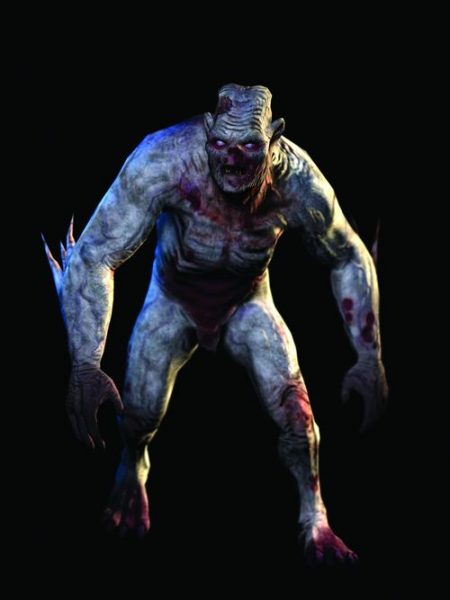
Ghouls are elves, yao, or other humanoids who have been corrupted by the dark magic of sorcery or demons. Though they have never truly died, they resemble the undead, existing in a state between life and death. They grow gaunt with pale skin and dark sunken eyes and are suffering from madness, but are also filled with unnatural vigor and are much more cunning than any beast. Their clawed fingers can crush a mans throat and leave deep rends in the flesh of their victims, and their teeth have the strength to bite through bones, as they regain their strength by feeding on the flesh of humans and beasts.

Many ghouls once were adventurers and treasure hunters who delved too deep into ancient places where the living are not meant to tread, or what remains of those who become slaves of dark sorcerers or demons. The corruption that warped their bodies also affects their minds and all of them are clearly unhinged, but most of them seem to retain the memories of their former lives and traces of their past selves.

A living creature hit by a ghoul’s claws must make a saving throw against paralysis or collapse to the ground unable to move for 2d4x10 minutes.

Darklings

XP: 35
No. Appearing: 1d8 (2d8)
Armor: 14
Move: 120′
Climb: 90′
Hit Dice: 3 (13 hp)
Attack: Claw +3 (1d6 + paralysis)
Saving Throws:
Paralysis: 14
Poison: 12
Breath: 15
Device: 13
Magic: 16
Morale: 10
Special: Immune to disease, poison, charm, paralysis, and sleep.

Darklings are ghouls that not only have survived in their undead state for decades but actually managed to gain additional strength from it, losing their last traces of humanity in the process. While still roughly the size of a person, darklings are are powerfully build beasts with pale gray hide that run on all fours and have become truly feral in their madness. Darklings are almost always found underground and never go outside during the day. Their small black eyes can see perfectly even without any kind of light. They have never be seen to follow commands of other creatures or communicating in an intelligible manner but have been known to be magically goaded by sorcerers to patrol the area around their lairs or attack the strongholds of their enemies in large packs. Continue reading “Eldritch Lore: Undead”

Heroic Fantasy Handbook and Barbarian Conquerors of Kanahu for ACKS.

Autarch is running a Kickstarter campaign for two new books for the Adventurer Conqueror King system. They are already funded, which I guess was pretty much a given, but I’ve heard of the announcement only now.

The Heroic Fantasy Handbook is an ACKS supplement for campaigns set in more low-magic settings, such as the Hyborian Age or Middle-Earth, and contains three new magic systems. It also has 10 new classes (as it is the ACKS way) and also some other rules for running a more literature inspired game. While I am usually sceptical of “Sword & Sorcery” OSR games, as they usually end up just being D&D without demihumans, the announced content for this one sounds actually really good. I am pretty sure I am going to buy it when it’s out. As these things go, I expect it probably some point in 2019.

Barbarian Conquerors of Kanahu appears to be a campaign setting based on a mashup of Conan, Barsoom, and Star Wars. The announcement doesn’t sound nearly as good as for the other book, but I am a huge Conan and Star Wars fan and love Barsoom as a concept as well. While I don’t have high expectations for it, I am probably going to end up buying it on release as well, simply out of curiosity.

Once more with feeling

This is another post that started out as a way too rambly first draft and that I completely rewrote to make it something more readable. For about the last two months I’ve been occupying myself with thinking about ways to give the Ancient Lands some greater depth and making it more compelling by adding a stronger emphasis on mystical elements and some kind of subtext that is woven into the world itself. To make it more than just another make belief land and something which feels truly wondrous and magical. Something that isn’t just a servicable tool for running campaigns but an artistic expression of my own personal creativity.

When I look at fantasy in books, movies, and videogames, I am always most fascinated when I come across elements that are strange and unexpected and that seem to invite you to think about their meaning within the story. But it is important that “strange” in this context is something very different from “random”. In a lot of old RPG material, or recent material that embraces the old tropes, you can find a lot of crazy stuff with very little rhyme or reason that seem to be there only for the sake of being funny. (Which in Jeff Rient’s threefold model probably would be “retro-stupid”.) While I am totally on board for a short blast of campy fun, this is not something that I would want to deal with when going down to serious business. The strange gives a work a greater depth and makes it more intriguing when its presence has meaning and stands for something.

Very often the strange and weird in fantasy takes the form of monsters. The very concept of monsters in western culture goes back to the Romans who traced the origins of the word monstrum back to either the verbs “to show” or “to warn”. And the original meaning was the occurance of violations of the known natural order – in particular the appearance of creatures of unnatural appearance – which were believed to be the manifestations of something greater and supernatural going on. Seneca described the concept of monstrum as “a visual and horrific revelation of the truth”. And all the things in fantasy and horror that we today consider to be “weird” are forms of such monstrums. They don’t have to be creatures, but can also be objects, environments, events, and phenomena.

What does this mean for the creation of fiction? How can this be translated into an artistic method? For this purpose I want to point to Christopher Nolan’s seminal work on communicating messages and making a point in narrative art.

Contrary to popular believe, Inception is not an illogical heist movie but actually a lecture on communicating abstract concepts to an audience through the telling of an entertaining story, rather than preaching from a soap box. That’s the very concept of “Inception”: You can’t make someone believe something by telling them that they should believe it. Instead you need to show them examples that make them see the issue from your perspective and then let them draw their own conclusions from that experience. And if you’re setting it up right it wil be the same conclusion that you made about the issue. Yes, it’s totally and blatantly manipulative. But that’s what all narative and visual art has always been. The whole point of artistic expression is to communicate ideas.

My goal with the Ancient Lands is to create a world that is compelling and intriguing to explore because there are deeper layers and meanings to discover and experience. Now I am really not sure whether this is defeating the purpose when I am giving a guided tour behind the courtain and outright tell what I am trying to represent with the setting and what the symbolic meaning behind the various strange elements is intended to be. But I don’t regard it as a riddle to be solved and see it more like a method to give the setting a distinctive feel that is consitently evoked by numerous elements that are strewn throughout it. And this post isn’t just about my own setting, but about this approach to worldbuilding in general, so I find it a good way to better illustrate what I mean.

Now let’s get more specific: What are the underlying meanings that I want to be symbolically illustrate through the supernatural elements of the setting? I have some ideas about the meaning of life, the pursuit of happiness, and the structural flaws of western culture. You could perhaps call existentialist eco-socialism or something like that. But nobody wants to hear a critique of western capitalism in a fantasy game about exploring magical ruins. That’s a terrible idea! Instead let me quote Nolan here: “The subconscious is motivated by emotion, not by reason. We need to translate this into an emotional concept.” The best messages that art can communicate are not “do things this way!”, but “think about things this way”. Good fiction that is making a point doesn’t make a specific call to action (that usually just ends up preachy and alienates the audience) but attempts to encourage a certain perspective.

So how could my opinions that I would like people to adopt be translated into an emotional concept? After thinking about it for a few days, I’ve come to see it as “pride and greed are the root of all ills that plague the world”. To perform this inception through the world of the Ancient Lands, this concept needs to be visible within the things that make up the setting. As players are exploring the world and interact with it, they need to encounter threats that stem from pride and greed and see humility and compassion as the source of strength that allows heroes to oppose them.

Immediately two of my primary bad guy monsters spring into my mind. Naga and wights. The naga in the Ancient Lands are a race of serpent spirits from whose ranks the dark art of sorcery was developed. Sorcery is the power to ignore the rules of nature that limit ordinary abilities and regular magic. The naga are also few in numbers but rule over vast armies of slaves. They are the prime example of a hunger for power over both nature and people. They are the perfect candiate for a monstrous manifestation of pride. Wights are undead who have retreated into their crypts where they spend eternity with the riches they amassed in life that they guard fiercely against robbers. They can make for a very great manifestation of greed. Another idea I had today was the old concept of the cursed gold. Greed makes people turn against each other and the sudden possession of great wealth changes people and makes them feel elevated over others. Familair motifs and great showcases of greed being closely tied to pride. Rich people being bad people would be rather blunt and so obvious to make it offputting. But displays of opulent extravagance as indicators for self-destructive madness? That’s more subtle.

As a supporting counterpart to this, humility and compassion would be the sources of of good. This can be incorporated into the world by making the good rulers and helpful allies of setting humble people who don’t display their riches and don’t demand recognition from others. Reaching out to others should be a reliable way to gain powerful supporters and dispays of compassion should return to the players through unexpected aid. I am still at a rather early stage with this idea but it’s one I am very excited about further developing.

Another emotional concept I like to include comes from a realization I had from my university classes in cultural studies. Pretty much every major religion I know about regards bodily existance as hugely problematic. The body is the crude shackles of the pure and exalted spirit. If we could just exist without flesh, we would be gloriously divine beings of perfection. Christianity is one of the more extreme cases of body hating, but it has been a central element of Indian theology for thousands of years as well. And of course it’s everywhere throughout mythology and from there spread into fantasy. The flesh is impure and sinful and holds the spirit back. I find this very nonsensical. Sartre once condensed the central idea behind existentialism down to “existance preceds essence”, and while he probably wasn’t thinking about the body-mind duality I find it applicable to this situation as well. We are not preexisting spirits that become manifest in a physical body (essence precedes existance) but our minds are the result of the experiences made by our bodies. It’s a banal statement from a rational scientific perspective, but quite important in a branch of philosophy that concerns itself with the meaning of life and the nature of existence. The relationship between physical instinct and rational morality has been of interest to me for a very long time and was one of the early philosophical problems of my young inquisitive self. In Germany in the 80s and 90s, I experienced an approach to raising boys that attempted to suppress their violent instincts to the point they would eventually be extinguished. But what I found was that boys some years younger than me appeared even more out of hand than boys of my age had been. Also, while I have been told that I’ve refused to retaliate to violence in a Ghandi-like fashion from a very early age (which actually got me through childhood and youth very smoothly), I still loved playing with toy guns and really enjoy violent movies and videogames to this day, even though that would have been seen as a big no-no in 80s pedagogy. My conclusion to this was that any attempt to teach responsible use of physical force has to aknowledge the instinct to violence instead of trying to suppress it. Same thing with sexuality. Attempting to suppress natural instincts only leads to a lack of control over those very same instincts. Therefore I regard the self as an extension of the physical instincts. “Instinct precedes reasom.” Yet I am not aware of any religion that puts the body at the center of being. I thought that there should be some religions of this type in fantasy well before I started working on my own setting.

It’s a philosophical concept that has been part of my worldbuilding from the very start. The Ancient Lands have no afterlife and no ghosts. There are wraiths and shades, but these are not actually remnants of living people. They are distorted echoes of people who have ceased to exist, composed of sorcerous energy. It’s a simpler and more straightforward concept than pride and greed being the source of all ills, and I already got a couple of ideas how to represent it symbolically through supernatural elements within the world.

  • Powerful spirits are physically imposing. Feeble looking spirits have little magical power.
  • Magic items are not crafted, but the remains of powerful spirits and witches that contain traces of their original magical powers.
  • Sorcerers are in great physical shape, like Xaltotun or Kane, not frail and weak.
  • I always wanted to do something with blood magic. The body is the source of the mind and therefore the source of magic.
  • Places of natural magical energies are often invigorating or have healing powers.
  • Undead are always insane.

These are two examples of how you can take abstract concepts and turn them into motifs that you can use to create a consistent theme within the supernatural and also mundane elements of a fantasy setting. I hope some of this might be useful to someone and didn’t turn out too much of a rambling mess,