The Difference between Conan d20 and Barbarians of Lemuria

Yesterday someone had been asking me why I consider the descision to base the Conan d20 roleplaying game on the d20 system to be the biggest mistake the developers had made. I think the d20 system is not suited for any game based on fantasy literature, movies, or videogames and only gets in the way of everything that defines the Sword & Sorcery genre in particular. It’s all about fast action and outrageous stunts and is deeply set in a mindset that is all about emotion and not rational consideration. It’s not the smart and calculating guys who win, but the ones who are courageous and daring. It takes place in worlds that work by the Rule of Cool. And the d20 system is the total opposite of that. You can play in a world that looks just like a Sword & Sorcery world, but it does not play like a Sword & Sorcery world.

This is something that requires explanation if you are not familiar with rules light Sword & Sorcery games like Barbarians of Lemuria and especially when all you ever played is d20 games. I couldn’t see how the choice of system makes a difference either until I really started to learn some other games as well.

Conan d20

GM: While you are sitting at your table in the tavern, an officer of the guard and two guardsmen approach you. The officer steps next to your chair and orders you to come with him to the palace.

Player: Is the officer within 5 feet of me so I can strike him?

GM: Yes, he is right next to your chair, looking down at you.

Player: Is he wearing a helm?

GM: Yes.

Player: What kind of helm?

GM: It’s a type of steel cap.

Player: How close are the two guardsmen? Am I in the area they threaten to make Attacks of Opportunity?

GM: They are too far away to attack you from where they stand.

Player: Okay, I want to take my mug and bash the officer in the head with it to knock him out.

GM: Make a Sleight of Hand skill check to see if you can grab your mug without drawing suspicion.

Player: 12.

GM: The officer has a 15 on his Spot check and notices you reaching for the mug. Roll Initiative.

Player: I got a 15.

GM: The officer has a 9, the two guardsmen have a 17 and a 6. The first guard is too far away to see what is going on so you go first.

Player: I try to hit his head with my mug.

GM: Are you still sitting or do you stand up first?

Player: Can I still draw my sword in the same round when I stand up and make an attack?

GM: No, standing up and drawing a weapon are both Move Actions. But since your Base Attack Bonus is +1 or higher you could draw the weapon while you are standing up as a single Move Action.

Player: Okay, so I try to hit the officer with my mug while still sitting, then stand up and draw my sword at the same time.

GM: Since the officer has not had a turn in this fight yet he can not make an Attack of Opportunity because you use an improvised weapon. Do you have a special ability that allows you to make attacks with improvised weapons without a penalty for not being proficient with it?

Player: No.

GM: Okay, then make an attack roll with a -4 penalty for using an improvised weapon and a -2 penalty for sitting.

Other Player: Is there even enough light in this smoky tavern to make a normal attack roll or should the attack have a 20% miss chance from Concealment?

GM: They are standing right next to each other, I think that’s good enough to not have a miss chance.

Player: My attack roll is 12.

GM: Since the officer has no weapon in his hand he can not parry. But as he is still flat-footed he also loses his Dexterity bonus and Dodge bonus to his Dodge Defense, reducing it to 10. You hit him. The mug deals 1d3 points of nonlethal damage plus your Strength modifier.

Player: Since he is flat-footed I also get my extra 1d6 Sneak Attack damage, right?

GM: Yes.

Player: Okay, that’s 1d3+3+1d6… 9!

GM: Since you said you specifically want to bash him in the head, I only apply the Damage Reduction for the helm, but not the armor he is wearing. So that’s 8 points of nonlethal damage.

Player: Does that knock him out?

GM: No. As it is his turn now he draws his sword and makes an attack against you.

Player: Oh well, was a fun idea though.

Barbarians of Lemuria

GM: While you are sitting at your table in the tavern, an officer of the guard and two guardsmen approach you. The officer steps next to your chair and orders you to come with him to the palace.

Player: I bash him in the head with my mug!

GM: Roll attack.

Player: 11!

GM: Your mug shatters on his face and he drop down cold. The other two guardsmen raise their spears in panic.

Player: Come and get it!
Roll 3d6, in order

One of the things I noticed about the Dungeons & Dragons Basic rules is that the game uses the same modifiers to rolls for all six abilities just like 3rd edition does and which is quite different from the chaos that is ability modifiers in AD&D. However, the modifiers are smaller and more spread out than in 3rd edition, giving only a +3 for a score of 18 instead of a +4.

The actual ability scores in Basic are almost meaningless. As far as I am able to tell, everything really comes down to the modifiers. The reason that you have ability scores at all is that you can easily generate them with 3d6, but they are really just the first of two steps to get your ability modifiers. In theory, once you have the modifiers written down, you could erase the ability scores from the character sheet. They are no longer being needed for anything.

The super oldschool way to generate ability scores is rolling 3d6 six times and applying them to the six abilities in the order you roll, with no moving around to suit your taste. In 3rd edition, but also AD&D, that was pretty brutal and you could very easily end up with crap. When I generated 16 sets of ability scores, all but the first one looked pretty bad. (It was 13, 16, 10, 14, 16, 16! I wish that one was for an actual game.) But when I wrote down the actual modifiers you get from these scores and added them up, it almost always came down to a total between +1 and -1, which really is very average.

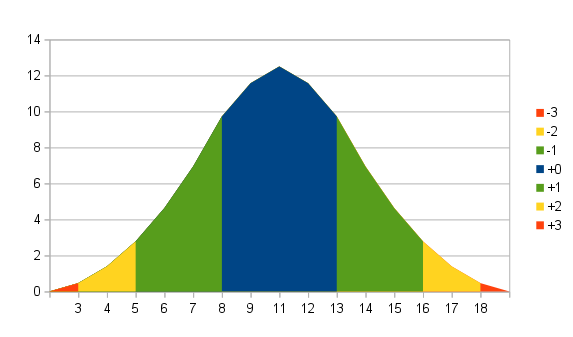
So I went ahead and made this graph to show the chances not to get the ability scores but only the ability modifiers:

snapshot107(It’s not entirely accurate because I took a shortcut and did not convert the 17 data points into 16 ranges, but it should be pretty close, with only the blue area being a slightly bit wider in reality.)

As you can see, the chance to get a modifier of +/-2 or 3 are actually pretty small. The chance to get a modifier of 0 or +/-1 is 86%. The chance to roll a 3 or 18 is under 0,5% each. That is not too bad and even if you do end up with a -2 or -3 in a stat, it often doesn’t hurt a lot. Only the Wisdom modifier is added tone one of the five saving throw types and there are no skills to which modifiers would be added. Even thieves don’t get any bonuses or penalties to their thieving skills. Also no skill points, so low Intelligence doesn’t hurt much. Strength is only added to the chance to hit but not the damage you do (and no +50% bonus when using both hands and any Power Attack shenanigans). Minimum ability scores to play a class exist, but only to play a dwarf, elf, or halfling, and then that minimum score is just 9 (everything starting from the line at “8” on the graph). Even a low Intelligence wizard or low Dexterity thief still works just fine, they just would level up somewhat slower than usual.

So I think in Basic, 3d6 in order really isn’t any bad. The odds to get truly terribly stats that make your character really suck or make you unable to play your prefered class are pretty low and when it really doesn’t work I probably would let a player roll again. (Better then to wait until the character charges heroically to his suicidal death in the very first encounter.) But a character with lots of 9s and 10s and another 6 really are no reason to complain in this game. May not be great, but still would be perfectly playable.

Now AD&D on the other hand is completely different story. Even the Player’s Handbook says that it is essential that any character has at least two 15s. Except for the one set I generated with the three 16s, I don’t think I had any 15s in the other fifteen.

A total noob explores BECMI: Part 1 – Abilities and classes

About a week ago I stumbled on a forum thread in which some veteran fans went through all the setting material of the Known World/Mystara setting, which had been the default setting for the B/X and BECMI editions of Dungeons & Dragons. Knowing nothing about that world I took a peek out of curiosity and quickly got very much interested. I had some vague familiarity with some retroclones based on it, mostly Adventurer Conqueror King and Lamentations of the Flame Princess, and even though they looked very well made, they just seemed very weird. Very much unlike D&D as I had known it for the 10 or so years before I left it behind me.

But now I got myself really interested in that old game, mostly because it seemed pretty rules light, and the amount of complicated rules had always annoyed me the most about AD&D and made me leave behind 3rd Edition/Pathfinder and look for greener pastures. And I really hate the magic system so much that I never want to run any edition of D&D again and only play it if someone else is GM and wants to run it. But I am still very much interested in how that game really worked and what I can learn from it about running rules light games and how to make dungeon exploration as exciting as the tales I often read. So I got myself the original Basic and Expert rules as pdf and went ahead to really learn how that game actually works and was supposed to be played.

116578The first impression where so interesting that I thought about making this a series of post for other people like me, who really don’t know anything before 3rd Edition and perhaps a bit about AD&D.

Continue reading “A total noob explores BECMI: Part 1 – Abilities and classes”

Why clerics in D&D can use heavy armor

This is something that I always thought to be somewhat odd, and I think many of the people I played with did too. Why are clerics in D&D the third best frontline fighters? (Excluding self-buffing shananigans from 3rd edition which simply make them the very best.) Heavy armor is not something one would usually expect from a priest. Shouldn’t he be dressed in robes like a wizard? In 3rd edition, only three of the standard classes get proficiency with heavy armor, the other two being fighters and paldins. Why do clerics get it?

clericarmorI’ve been reading and dabbling in the old Basic Rules these past days, and considering the whole design paradigm of the game, I think it makes perfect sense. Clerics can fight in heavy armor not because it’s their speciality, but because there is no reason for them not to wear it. The way armor proficiency works in 3rd edition is the opposite of how it originally was. The older editions worked by a logic that all characters can do everything unless there is a reason why they could not. Wizards don’t wear any armor because it interferes with their spells, and thieves don’t wear heavy armor because it limits the mobility they need for sneaking and climbing. Cleric spells are not restriced by armor and they usually don’t try to be extra stealthy or do any fancy acrobatics. So why shouldn’t they be wearing the best protection they can get?

When later wearing armor became something that needs a speical ability to use, clerics got that ability simply because they always had been wearing heavy armor. Even though under the new logic of the game it didn’t really make any sense anymore.

Why I love published adventures. And why I don’t use them.

I’ve recently found an old piece on Hill Cantons about an exchange with Rob Kuntz, who was among the people who working on Dungeons & Dragons in the early years. In it, Kuntz is quite outspoken against published modules, which he regards as clearly a step into the completely wrong direction which turned the game into something very different from what they had thought to be the spirit of D&D.

I have always thought that the DM’s route to any fantastic achievement in such literature was through a very personal course, most certainly inspired by reading and study or other such related matter, but not actually “implanted” or done for them.

I first thought of this as a highly negative and overly criticizing view bordering on being elitist and snobbery, even though I am not really a fan of published adventures myself. But that had me wondering how I actually have been using modules over the 15 years that I’ve been running games. I am one of those rare and elusive people who actually got into RPGs without anyone to introduce me to it and teach me how it works, and worked myself through the rules the hard way. There was an introductory scenario which I used for the first shaky steps and then tried to start a real campaign with The Sword of the Dales using the 3rd edition rules which had just been released a few weeks before. Some years later I did run City of the Spider Queen, which we thought was very cool (because we were young and stupid), and was the only time I’ve ever seen characters of 11th level or higher. But as far as I can remember, that really was it as far as running published adventures went.

However, I did use a lot of other adventures. The last game that I ran was based on Flight of the Red Raven by Paizo, using a different rulesset, being set in a homebrew setting, there was no winter and ice, I made my own dungeon, created my own encounters, the jinn was an oni, and the Red Raven was a completely different guy. But the idea why the party went to that dungeon and what situation they were encountering there, that was pretty straight up taken from Flight of the Red Raven. I started that campaign with an adaptation of The Automatic Hound and Depths of Rage from Dungeon magazine. A blend of The Disappearance of Harold the Hedge Mage and Raiders of the Black Ice was plannes for later. I also did Escape from Meenlock Prison with an earlier group, which I think that was the best game I’ve ever ran. So yeah, I do love them and get a lot of use from them.

But I think this approach actually matches very well with what Kuntz said. “Inspired by reading and study or other such related matter, but not actually “implanted” or done for them.” That the related matter was a published RPG adventure and not a novel or book doesn’t really change anything in my view. There are plenty of other published adventures I very much love. Master of the Desert Nomads, Rahasia, Night’s Dark Terror, and Steading of the Hill Giant Chief, and The Styes, to name a few. And Savage Tide has just full awesome all over it. But I never use the floorplans. I don’t use the NPC stats and I rebuild all the encounters from scratch using creatures that fit my setting and are of a difficulty that works well for the particular group of PCs I am currently playing with. Most of the time I actually use a different game edition or even an entirely different game.

So yeah, I think I am kind of in agreement with Kuntz here. Published adventures, as they are, are pretty much unusable for the kind of games that I run and I wouldn’t advice any new GM to run them out of the book. What I am getting out of them is really the description of adventuring sites, the motivation and goal of the antagonists, and the outline of their plans to achieve their goal. Everything else I can do myself, and even though I don’t consider myself a great GM, I can do it better myself. Not because the writers of published adventures are all total hacks who don’t know anything, but because only I know the level and composition of the party and the setting in which the campaign takes place. Publish adventures cannot account for this. And what I really would love to see is adventures that don’t even try. Just give me the setup, the location, and the antagonists plan. That is really the most difficult part of creating a good adventure for a group. Leave all that number stuff to me, that part is easy once you know what you’re trying to do.

B/XoL: First draft (mostly) done!

My first draft for the Barbarians and Explorers of Lemuria hack for Barbarians of Lemuria is (mostly) done. You can take a look at it here.

The one part that is still missing is the section on how to deal with doors, light, thirst and hunger, and so on but I’ll be doing that in the following days. If you have any thoughts or suggestions for this hack, please share them in the comments.