The greatest thing that D&D forgot

Now this is not going to be a big, or even any, revelation to many people who are reading sites like this, but over the last weeks I’ve been doing more research on great adventure location design, which led me many times into dead ends because of the same single preconception the people writing have about D&D as a roleplaying game. So here you have it from my mouth:

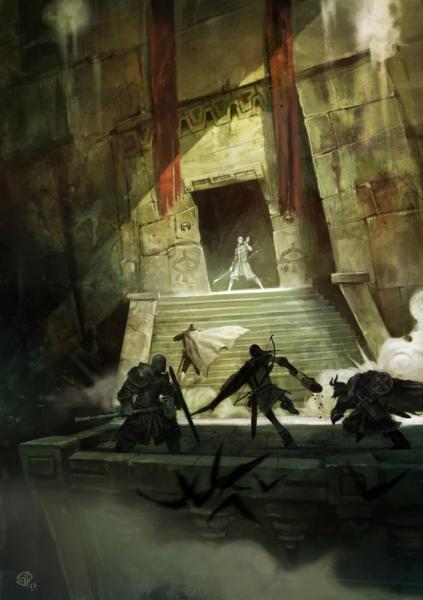
Early D&D* was an exploration game, not a combat game.

I think this is probably the single most important aspect that distinguishes oldschool roleplaying from “modern games”. With AD&D 2nd Edition it’s a bit muddy, but we can safely say that 3rd to 5th Edition and Pathfinder are all combat games first that have some additional rules for non-combat situation tacked on to them. But with oldschool games, the situation is really very different. Combat is something that can happen, but the whole game is build in a way that you really don’t want it to happen. Except if it is for dramatic reasons, of course. Stopping a major villain and slaying a terrible monster is great. But the rules as a whole are all set up to make combat a bad thing for the characters.

Combat provides very little XP, except when it opens the way to treasure that gives the party a lot of XP. Getting access to the treasure without combat is always preferable. Combat is the primary pressure put on players to not spend too much time in dungeons rooms and not simply dealing with obstacles by destroying them. Because both these things attact potential combat. Encumbrance exist to slow characters down, which means they take longer to explore the dungeon and are less capable of escaping from a fight. Encumbrance only is a bad thing if players don’t want to fight.

Combat also is deadly and gets characters killed, even if the party wins a fight. But combat also isn’t necessary. Any time the party encounters living things in a dungeon and there is no good reason why those creatures and NPCs are hostile, the rules have a reaction roll to determine how they react to the party. And the creatures attacking on sight is the least likely reaction. The next most unfriendly reaction in the Basic Set is “Hostile, possible attack”, which I regard as being most sensibly interpreted as “attacks if provoked by the party’s actions”. There is a chance that a monster actually reacts friendly and the next most positive result is that the monster leaves or considers offers. Because the monster does not want to risk a fight with likely dadly consequences either. And if a fight breaks out, there is also the Morale check, which is used to determine whether monsters who are taking casualties decide that they would rather abandon the fight than risk now even more possible looking death.

The whole game is set up so that combat hold almost all risk and no reward for the players and that even their oppponents prefer not to fight. Combat is what happens when an encounter ends in catastrophy.

D&D being a game of exploration instead of combat also explains the majority of traditional spells that keep getting carried on by each new addition even though they seem to be pretty much useless. They are useless in a combat game. But hold portal, levitate, and speak with animal all make so much sense in an exploration game.

* That is pre-Dragonlance, 1974-1984.

We’re gonna need a bigger mule

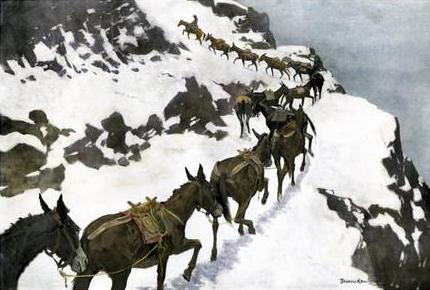
In a discussion about henchmen and retainers I mentioned that oldschool D&D characters at higher levels would need to bring pack animals with them to get all their treasure back to civilization and gain XP from it, which means also people to care for and guard them while the PCs are going into dungeons. Not having played higher level games with XP for treasure myself yet, I got curious how many animals you’d actually should plan for.

In B/X, a mule can carry up to 4,000 coins of weight. Assuming that’s mostly gold and the rest is 1 platinum coin for every 10 silver coins, this is worth 4,000 XP. Which isn’t bad, but given the amounts of XP needed to advance at higher levels it’s actually not that much. People always say that that characters at higher levels advance really slowly, which I would take as perhaps something like 10 extended expeditions to a distant dungeon far out in the wilderness. To me, 30 sessions to level up would qualify as a snail’s pace. On average, characters from 8th level onward need 120,000 XP to reach the next level. Divided by 10 that’d be 12,000 XP per adventure or 3 mules. For every PC in the party!

Send mules!

What about bags of holding? While certainly useful inside a dungeon and to carry home treasure at lower levels, these no longer make any real difference at higher levels. 10,000 coins for the weight of 600 sounds really nice, but at these levels you’d need a dozen or so of them to stash all your loot from a single adventure. For every bag of holding you can reduce the needed number of mules by two, but whether you travel with 10 or 20 of them hardly makes any difference for the logistics involved.

I also calculated the average dragon hoard and came up with enough coins to load 15 mules. But potentially (and statistically almost impossible) it could be as much as 60 mule loads.

Then there’s also the interesting matter of food. Mentzer Expert gives us a weight of 70 coins for 1 week of rations. Which is virtually nothing compared to mail armor having a weight of 200 coins. One of the PCs can carry all the food needed by a 10 head party for a one week return trip all by himself and barely experience any encumbrance at all. Though you have to consider that this is the weight of 100 daggers. Perhaps it’s not the weights that are too low but the carrying capacity of characters that’s too high. But that’s another topic.

Let’s do the same calculations for Lamentations of the Flame Princess, which uses a much simpler encumbrance system that I find highly preferable. It makes the common mistake of assuming that mounts walk twice as fast as people, while really they just can carry a lot more stuff at the same speed, but I’ll let this slide for now and go with severely encumbred mules traveling 12 miles per day: Under these conditions the animal can have an encumbrance rating of up to 25, which is 125 items. When packed by a professional animal handler this increases to 150 items. (As nice as the system is, the distinction between encumbrance rating and items carried is an unnecessary nuisance.) 100 coins are one item, which gives us a total of 15,000 coins or 15,000 XP. That is a lot more than in B/X, almost four times as much. But with 10 adventures to reach the next level, that’s still one mule for each party member.

It looks very different when you look at food. To feed 10 people for 7 days you’d need to carry 70 items and the maximum number for an armored character is 20 items. You’d really want to bring a pack animal for that and not haul it around yourself. Letting a mount carry 8 times as much stuff as a person at the same walking speed seems a bit much to me. I don’t think a group of heavily loaded soldiers will be moving much faster if they all put their backpacks on a single mule.  I think for my own campaign I rather go with the average common pack goat carrying twice as much as a Strength 10 character, a riding deer three times as much, and a small hadrosaur ten times as much. Yes, you wouldn’t need a lot of these giant lizards to haul your loot, but on the other hand you can ride into town on a dinosaur.

But as you see, adventuring without retainers at higher levels is not just impractical but close to impossible. To gain meaningful amounts of XP from adventures, you have to approach them as large scale expeditions. In addition to animal handlers you’re also going to need guards and loyal henchmen who keep watch over them while the PCs are away from the camp. And once you have that whole gang together, there’s no need to not travel in sstyle. Get a bunch of servants and cooks as well.

Domains and Endgame in the Ancient Lands

These last couple of days I’ve been thinking about and rereading the rules for high level characters and ruling over domains in the Expert and Companion rules. Domain play has always been something of an elusive beast that few people seem to have any real experience with. Got there once but didn’t stay with it long seems to be the most common statement.

When you look at the Cook Expert rules (1981), domain play is almost completely absent. It tells you that characters at 9th level can become rulers of a domain, tells the GM to handwave a monthly tax income, and has a half page of price lists for constructing a castle. But it doesn’t really go into what play as a ruler would be like.

In the Companion set, a lot more ink has been spilled about it. There’s lots and lots of rules for management and accounting. But as far as I am able to tell, there still is no real guidance of any kind what players would actually be doing in play. Doing the accounting for a domain and occasionally fixing the mess caused by raiders or disasters? How would this be appealing to players who so far have been exploring exotic places, navigated deadly dungeons, and had dealing with monsters and evil sorcerers?

It could be a fun game to some people, but doesn’t seem to mesh at all with what D&D has been up to that point. And much more importantly, it’s not a group activity. One player rules a domain and makes all the descisions for it. If all the players have their own separate domains, how would they be playing together? You can of course play a game of warlords, but that would be a competitive game, not a cooperative one. And a group of characters who have been working together for years wouldn’t suddenly become rivals and send their armies against each other. The only practical way I can see for having PCs become rulers over domains would be to have them retired from play and have them occasionally appear as quest giver NPCs played by their old player. Who would then be playing a new adventuring character to actually go on that adventure. If you have a large scale campaign with dozens of players and multiple GMs I could see that working for a handful of high level characters. But this simply isn’t the reality of how D&D is played. I wouldn’t be surprised if the number of such groups that still exists today could be counted on the fingers of one hand. If there even are any.

One argument for domain play in a campaign with more Sword & Sorcery leaning that occasionally comes up is that Conan was a king. Kane was a sorcerer-warlord and Elric was an emperor. But the important part is that their stories are never about ruling and managing their domains. Sword & Sorcery tales about rulers are always about leaving the court with a sword in hand and fighting monsters. If you want to emulate the high level adventures of popular Sword & Sorcery heroes then domain management rules are completely irrelevant and out of place.

Occasionally there are big battles between armies, but even then those stories are not about being a field commander. It’s always about personally going after the enemy commander or pulling awesome stunts to destroy the enemy forces without having your own troops stab them dead one by one. Mass combat isn’t something that happens in Sword & Sorcery either. What you get is raids with a group of maybe up to a dozen people. Which would be a group of PCs and their henchmen.

So I’ve come to the descision that the high level elements of the Ancient Lands setting will simply assume that there is no such thing as domain play. Taking control of a stronghold and gathering followers will simply be down to players actually fortifying a place and talking to people. It may be done at any level and take whatever scale seems appropriate for a given situation. But for all intents and purposes characters will pretty much stop to advance after 9th level and only gain small increases in hit points at a very slow pace from their continued adventures, plus skill points for specialists and spell points for witches. (In my War Cry of the Flame Princess rules fighters reach maximum attack bonus and witches maximum spell level at 9th level, and scouts maximum Bushcraft and Stealth skills at 10th level.) I only ever had two campaigns reach 11th level and that was both in 3rd edition which has pretty fast level progression. So chances are pretty high I won’t ever see a 10th level character in the Ancient Lands anyway.

War Cry of the Flame Princess: Wilderness Travel

Wilderness travel is one of the things I always wanted to include as a major element of my campaigns but the rules as written in either B/X or LotFP require too much on the spot calculation and conversion of movement speeds in different terrains that I just can’t handle at the table with my ADD when the players are talking about what they are going to do next at the same time. Adding the attack bonus to a d20 roll and subtracting hit points I can manage, but doing divisions and fractions while paying attention to conversations just ends up with me getting brain locked. All my homebrew systems and my choice of LotFP as the system I am using have been done as means to compensate for my impairment in this regard. Making game mechanics more accessible for people with neural impairments is something I’ve never seen anything written about and might be worth dedicating a post or two to in the future.

Last year I already tried my hand at coming up with a simpler and faster solution, but it’s still based on the underlying assumptions of a hexcrawl with way more precision and granularity than I need for Sword & Sorcery adventures. But a great idea for something much better comes once again from Angry-sensei, who just has some kind of gift for making methods that are practical to use instead of being best suited to programm a computer with. There are two big things of beauty in his proposal. The first one is that it doesn’t require a map with precise measurements or any degree of accuracy. In addition to being quite a lot of work for GMs, the current design standard for maps is basically satelite photography which is something that wouldn’t be available to people within most fantasy world but in my own experience also create a sense of the world being fully explored and tamed. Which is the complete opposite you’d want in a mythic bronze age Sword & Sorcery world. Tolkien’s hand drawn map for The Lord of the Rings is what I consider the ideal form of fantasy map. It’s a tool for navigation that provides an idea of the general layout of the lands but also has a level of abstraction that inspires the viewer to wonder what marvelous places might be hidden in all those blank spots that noboy alive has ever set foot in. The second great thing about it is that it works without any calculations and requires only looking up a single number in a simple table. This post is an adaptation of this concept to the rules of LotFP with some tables for actual use in play.

Travel Times and Distances

When a party makes an overland journey, the first step is deciding on the path they want to foollow from their starting point to their destination. The GM then makes a quick rough measurement on the map (which can be as sketchy as you want) or makes a judgement call how long this path is in miles. At the start of each day, the GM decides which type of terrain the party will mostly be travelling through on that day. Knowing the encumbrance rating of the slowest character or pack animal in the party, the GM simply looks up on the following table how many miles the party covers on that day.

Terrain Unencumbered Lightly Encumbered Heavily Encumbered
Road 24 miles 18 miles 12 miles
Heath/Moor/Plains 16 miles 12 miles 8 miles
Desert/Forest/Hills 12 miles 9 miles 6 miles
Jungle/Mountains/Swamp 8 miles 6 miles 4 miles

Soldiers throughout history have been marching at about 3 miles per hour on good roads, so with 8 hours of marching you get 24 miles per day. While those soldiers would have been encumbered by gear, they also wouldn’t be travelling through untamed wilderness, so I think this table makes a decent enough approximation of plausible travel speeds.

Mounts

Contrary to movies and books, horses do not cover greater distances in a day than a human can. While they can run much faster at short distances, humans (and dogs) are the world’s best endurance runners and can keep on walking with much less need for rest than other animals. The distances covered by humans and horses are about the same. The big important difference is that horses can carry a lot more weight than humans and are much less slowed down by the same loads. Riding and pack animals should have the same movement rates as humanoids but with double or tripple the carrying capacity of an average person for calculating encumbrance,

Water Travel

17 different types of ship with different sailing and rowing speeds, 5 classes of quality, and 9 degrees of weather conditions is a bit more than needed when dealing with travel at this level of abstraction. I reduced it all down to this simple table.

Type Favorable Conditions Average Conditions Unfavorable Conditions
Canoe 24 miles 18 miles 12 miles
River Boat 80 miles 60 miles 40 miles
Sailing Ship, Slow 120 miles 90 miles 60 miles
Sailing Ship, Fast 160 miles 120 miles 80 miles

I’ve done some researching of my own about the speeds of (admitedly modern) sailing ships and the numbers in the Expert rules and LotFP seem to be way off. These numbers for distance travelled in a day are much closer to what you could actually expect from real ships. For canoes the distance is given fr 8 hours, as for marching, but for the others the distance is for a span of 24 hours since they are powered by wind and people can take turns with steering while the others rest. For canoes and river boats favorable and unfavorable conditions means going downstream or upstream. Average conditions would be on lakes. For sailing ships these apply to the weather and the wind in particular. Whether they are favorable or unfavorable can be determined with a simple roll of a d6, with a roll of a 1 or a 6 indicating that less or more distance has been covered that day. On the seas travel distances can vary greatly, but this is a good enough approximation for a game.

Wilderness Encounters

Another suggestion by Angry that I also take pretty much as is is rolling for wilderness encounters by rolling a number of d6 bases on how how much monster traffic is present in an area the party is travelling through on a given day. For every die that rolls a 1 there will be an encounter sometime during the day. At what time during the day and in what terrains these encounters will take place is up to the GM to decide. I got curious and calculated the odds for wilderness encounters with this method:

Threat Level No Encounters 1 Encounter 2 Encounters 3 Encounters
1 Settled or desolate 83% 17%
2 Wilderness 69% 28% 3%
3 Hostile Wilderness 58% 35% 7% 1%
4 Hostile Patrols 48% 39% 12% 2%

They are not actually as high as I expected. Not having any encounters at all still remains the most likely outcome by a good margin and even at higher threat levels the chance to have multiple encountes in a single day is very low. As Angry explains it in a much more elaborate way, this is actually a pretty nice addition to the regular wilderness encounter rules. It raises the number of factors players have to consider when picking a route to three: “How long would we be at risk at encuntering monsters in that area?”, “How dangerous are the monsters we might encounter in that area?”, and now also “How many monsters are in that area?” Go through the swamp that is choking with giant spiders or risk the shortcut over the mountains where almost all creatures have been killed by a dragon?

I  very much encourage using the rules for foraging and starvation. Carrying a large amount of rations means the party wil be slowed down but make consistent progress each day. Not packing enough rations for the whole journey (to make room for treasure for example) means that the party is travelling lighter and at a faster speed. While finding enough food in the wilderness is relatively easy with a trained specialist or a scout, the time it takes is highly unpredictable and can cause the party to actually make even less progress in a day. It’s a nice layer of added uncertainty that the players can consider in their planning for wilderness journeys.

Since more than a single encounter per day is very unlikely even in the more crowded regions, the encounter tables should be stocked in a way that there is real danger for the party. If the players have no reason to expect the possibility of a character dying or the party getting captured then they also have no incentive to hurry up, making the whole exercise of wilderness encounters moot.

Encounter Distances

If an encounter happens, use this table to determine the distance as which surprise rolls are being made by both sides.

Terrain Distance
Forest/Jungle 2d6 x 10 yards
Desert/Hills/Swamp 3d6 x 10 yards
Heath/Moor/Mountains/Plains 4d6 x 10 yards
Lake/Sea 4d6 x 10 yards

When travelling on rivers, use the row for the surrounding terrain. The distance for encounters on sea or lakes are for encounters with monsters. Ships can be seen from much larger distances.
Am I done?

Certainly feels like I am done. Despite saying just a few weeks ago that I felt I barely had made any real progress over the last six years of working on the Ancient Lands, I think that I now have all the pieces togther. Not ready for a publication by any stretch, but you could say the setting has reached the beta stage, where it’s completely playable.

Some monsters still need proper names and a handful still needs their stats written down, but I got a 100 entries bestiary. The gods still need naming, but I have them all together and religion properly worked out. The four character classes are all ready to play and the magic system is complete. I got all the races and an outline for the culture, and good sounding names for almost all of them. The map is an ungly sketch but it has all the countries that I want to include.


This thing can be played.

This week I was reading through the older posts I’ve written here about the Ancient Lands in more detail, and while it is true that almost all major elements of the setting where already in place in early 2011, the vast majority of them had a sometimes quite significantly different shape and appearance back then. Based on what I’ve been writing about the process, the setting really grew into the world I want it to be in the last 8 months. Many things I now consider crucial to the theme and style of the setting I wrote about only last summer. Looking back a full year before now, there’s still a lot of stuff that now seems completely out of place to me. Deserts, empires, trade networks, criminal organizations, humans! What was I thinking?!

I think a big tipping point was writing the Project Forest Moon post. This was when all the ideas and things I liked really became one coherent concept. That’s when it clicked and I realized which of my many inpirations I really want to set the overall tone for the world. Endor, Morrowind, Kalimdor, and Planescape (Beastlands and Pandemonium). I want the Ancient Lands to feel like those, and everything that doesn’t have anything to do with bringing that style to life can go. No empire, even when it’s lizardmen. No deserts, no steppes, no tundra. Certainly no criminal organizations, multinational mining consortiums, or national borders. But as I now recently realized, also no stone age hunters. In my quest for making a more solid tribal society and animisitc religions in a largely unsettled world I regularly kept forgetting that it’s still supposed to be a Bronze Age level setting. But now it finally all looks right.

There’s still a good amount of things to be done. The first priority being the creation of a sandbox for my next campaign that I’ll hopefully be starting before the summer. The setting I have created now is a set of rules, monsters, cultures, and general geographic overview. Creating adventures for it is another step entirely. The other thing I want to do is to actually get all the ideas that mostly exist in my head and on some indecipherable notes into a coherent text that can be shared and used by others. I am still not putting any hope in any kind of commercial success with this setting, but I definitely want to release it to the public. Over the many years of working on the Ancient Lands I’ve been getting a considerable number of comments and also messages from people simply wanting to tell me that they really like my ideas and would love to play in such a campaign. And that’s really all the confirmation I need that this isn’t a completely pointless undertaking. Even if nobody else ever runs an Ancient Lands campaign, it can still be a useful sourcebook for material or at the very least a source of inspiration for GMs wanting to start making their own settings.

Amulet of Life Protection

I love wraiths. I also love wights. I love how their attacks can permanently cripple their victims who can get away with their lives. While this is all cool when dealing with one such creature in a campaign once or twice, this does cause a major problem if you want to use them frequently in large numbers. Thematically, energy drain is a nice threat, but it’s not actualy that interesting or fun if there isn’t really anything the players can do about it other than “don’t get hit”. Always running away and using only arrows and spells isn’t tactical fun. It’s just annoying.

Given how the XP requirements for gaining levels work in B/X, I consider level loss to not be terribly bad as a mechanic. Since the required XP for each new level are doubled, you will very quickly catch up to your companions who didn’t get drained while at the same time always lagging behind just a little bit. I just wish it could be more interesting instead of something that just happens to you more or less at random.

The Companion Set introduced the spell restore, that can heal the lost levels but requires a 17th level cleric. Which don’t exist in the Ancient Lands. It also does not add anything tactically and makes energy drain less of a threat and even more of an annoyance. There is also a new magic item called the ring of life protection, which is a ring of protection +1 that can negate a total of 1-6 level losses. That’s a start, but throughout a longer campaign with many PCs, you’d be needing a lot of these things and end up with a sack full of rings of protection.

Way back in my first Ancient Lands campaign I was trying out the Taint mechanic, which I think was from the 3rd edition Unearthed Arcana. It drained a character’s Constitution and Wisdom instead of levels (which I now think was needless redundancy) and had more complex rules, but was a very similar concept that filled the same role from a narrative and worldbuilding perspective. Now I just use energy drains with a saving throw for going into demonically corrupted places for long periods of time. The cool thing about Taint was that it came with a more mundane counter than magic items. If you’re carrying pieces of jade on your body they will absorb the corruption and keep you safe until they reach their limit and crumble. But carrying more Jade didn’t mean that you were better protected, since at some point it just acted like a magnet for corruption and burned out even faster. I think that last detail made things actually too fiddly (this being 3rd edition after all), but it holds the general idea that I think can make energy drain a much more fun game effect.

Amulet of Life Protection

This simple amulet is made from special minerals, branches, herbs horns, feathers, or vials of magical water, often tied to a cord to hang around the neck. It is relatively simple to make with the right ingredients and does not require and actual enchantments.

The amulet can absorb and negate the corruption of demons and sorcery. When a character is hit by an energy drain attack or other level draining effect it automatically negates the level loss. The player has to roll 1d6 (or 1d4 or 1d8, based on the quality of the amulet) and on the roll of a 1 the amulet crumbles and loses its power. If a saving throw is allowed a roll still has to be made, regardless of whether the saving throw might have succeeded or failed. When a character is wearing or carrying multiple amulets at the same time, a roll has to be made for each one individually. Amulets left unattended in areas where a creature would be exposed to regular energy drain effects also have to make a roll against disintegration at each interval.

I think this should make fights against wights and wraith much more interesting. You still want to avoid getting hit, but even if you do get hit multiple times you still might make it through unharmed (other than hit point damage). But you can never know in advance how long your protection will last. As the amulets are easy and inexpensive to make you can always stock up on them before going into haunted places and demonic lairs. But carrying multiple ones doesn’t mean that you can be sure to not run out either.