Group Initiative and Spell Declaration

While I am a very big fan of Basic Fantasy, one of the things in which I believe it needlessly departs too much from B/X is the move away from the original group initiative. Which perhaps might have been a decision based on uncertainty about what you could get away with with the OGL and old TSR content back in the day when the first retroclones made their appearance.

Group initiative is a system that I really love. One of the main reasons is that I have always struggled with asking and recording every player’s initiative count and sorting them into the correct descending order, while at the same time everyone was chattering excitedly about the combat that has just brought out. On paper, this step seems like a trivial mental task, but it’s one of the situations where my ADD overwhelms my brain and I mentally freeze up. It’s stressful and it takes long, which only makes the players chatter more among each other, creating more distraction and more stress, which makes everything even worse. Group initiative neatly avoids this entire problem by reducing it all to me and one player rolling a d6 and the higher number goes first.

The other nice thing, which is even more significant, is how group initiative speeds up play. If you used the common “each player takes a turn in order” system, you’ll have seen countless times how this plays out: One player takes five minutes to decide what he wants to do with his turn. The other players get bored and find other distractions to keep themselves occupied while they wait. When the player finally makes his turn, the next player is totally surprised that it is his turn now. He has no idea what happened during the last three players turns and now has to spend five minutes taking up the completely new situation of the fight and then start pondering his options. Repeat for the next hour until the four goblins are dead. That does not happen with group initiative.

The Basic Combat Sequence
  • 1: The party and the enemies roll 1d6 for initiative.
  • 2: The side with the higher initiative takes their turns.
    • 2a: Morale checks are made if needed.
    • 2b: All characters do their movements.
    • 2c: Characters who want to make a ranged attack do it now.
    • 2d: Characters who want to cast a spell do it now.
    • 2e: Characters who want to make a melee attack do it now.
  • 3: The side with the lower initiative takes their turns.
    • 3a: Morale checks are made if needed.
    • 3b: All characters do their movements.
    • 3c: Characters who want to make a ranged attack do it now.
    • 3d: Characters who want to cast a spell do it now.
    • 3e: Characters who want to make a melee attack do it now.

In this system, all players have “their turn” at the same time. The moment when the most significant decision for the round has to be made is 2b/3b All characters do their movement. If and how you want to move really depends mostly on what you plan to do after that. But unlike with sequential initiative, all players have to think about their choice at the same time. Whichever player comes to a decision first performs the movement first. While this happens, the other players still have a bit of time to think about their own choice. The whole thing only takes as long as the slowest player needs to think. Not as long as the thinking time of all players combined. The actual execution of ranged attacks, spells, and melee attacks is really quite fast and uncomplicated in comparison.

There is however, one major hitch with this whole setup, on which Moldvay Basic, Cook Expert, BECMI, and Rules Cyclopedia are all in disagreement. Which is the handling of casting spells:

In Moldvay Basic, things are simple and just as I described them above.

However, Cook Expert, which is an addendum to Moldvay Basic and expands and adds to it. “The caster must inform the DM that a spell is being cast and which spell will be cast before the initiative dice are rolled. If the caster loses the initiative and takes damage or fails a saving throw, the spell is interrupted and lost.” Thankfully, the explanation here is very clear on how it is supposed to work. But I do not like it. It negates the neat feature that all players think about their actions at the same time, and instead you have everyone at the table wait on that one wizard player to decide if he wants to cast a spell before initiative is being rolled for that round. It also makes our poor vulnerable d4 HD wizard a target for all enemy combatants and introduces a considerable chance that the spell will be lost with no effect. Given how few spells the poor guy has to begin with, that is just sad.

Things get only messier with later editions, though. In BECMI, the combat sequence is printed in both the Players Manual (twice) and the Dungeon Masters Rulebook, but they are numbered differently. The Players Manual begins with Step A: Roll for initiative. The Dungeon Masters Rulebook begins with Step 1: Intentions: The DM asks each player what the character intends to do in the coming round, followed by Step 2: Roll for initiative. Bad, bad editor! As far as I am able to tell, the topic of the players declaring their intentions is never brought up anywhere in the actual text of either book, so there is no explanation of how it affects anything. My guess would be that the idea of declaring stuff before rolling initiative was thrown out during development, but that one line in the combat sequence in the DM’s book was not properly deleted before printing.

The Rules Cyclopedia doesn’t mention declaring any intentions anywhere. But it does still mention how spellcasting can be interrupted if the caster is being injured.

The only version that actually does what it seems to want to do it Cook Expert. But as I said, I really don’t like that procedure. So here, finally, is what I consider the best way to do it:

  • If a character has moved during the movement phase, he can not cast spells during the spellcasting phase. (“spells cannot be cast while performing any other action such as walking or fighting.” Moldvay Basic.)
  • If a character got hit or failed a saving throw during the enemy phase of the round, he can not cast spells during the party phase of that same round. (Assuming the enemies rolled higher initiative than the party.)
  • If the party and the enemies roll the same initiative number and the movement, ranged, spell, and melee phases of both sides happen simultaneously, and the character gets hit by a ranged attack, he can not cast spells during the spellcasting phase. Both PC and enemy spells all go off at the same time.

In this take on the rules, spellcasters can never be interrupted and lose a spell that they already started to cast. Which is fine with me. Not being able to cast a spell when there’s a perfect opportunity is already annoying enough, given how few spells wizards have and how it makes waiting for exactly the right moment a big part of its efficiency.
Planet Kaendor House Rules for Basic Fantasy

You know what the world really does not need? Another B/X retroclone. Well, I think it kid of does, but I know that nobody wants to see it. So instead, I am simply going to present my own adjustment to Basic Fantasy. BF has always ranked among my favorite retroclones of choice because it’s very close to the original B/X by Moldvay and Cook while at the same time using the sane rational system to attack rolls and armor class. I know the later is trivial to slap on any iteration of D&D, but I am petty about my hate for a resolution mechanic that is objectively bad and done wrong, so that’s counting a lot to me. BF is also very cleanly laid out and easy to read, and the whole thing is free so you can just hand out pdf copies to anyone you like.
Below is a list of all my modifications to Basic Fantasy that reflects my own impressions of actually having read Howard, Moorcock, Leiber, Moor, and Smith, rather than going by the grimdark Heavy Metal Album cover interpretation of what Sword & Sorcery is really about.

Characters
  • Roll 3d6 six times to generate six ability scores, but assign the six numbers to whichever attributes you like.
  • There are no racial modifiers and adjustments. PCs from all peoples just use the character classes as the are.
  • Characters get the maximum possible hit points at 1st level.
  • The character classes are warrior (fighter), thief, scholar (magic-user), and wilder (see below). Characters can be warrior/scholar or thief/scholar as by the Basic Fantasy rules for elves. (The XP to gain a level are the same as the XP for both classes combined, and the character gets whatever hit dice, attack bonus, and saving throws are better, as well as all spells and thief skills for the level.)
  • Maximum level for all PCs and NPCs is 10th level.
  • The thief skills all use a d20 instead of a d100 (since it’s almost always 5% steps anyway). They also start with considerably higher success chances at 1st level, but increase slower to be again identical to the odds in Basic Fantasy at 10th level.
  • The wilder class has the XP requirements and attack bonus as a warrior, d6 hit points, the thief skills move silently, climb sheer surfaces, hide in shadows, and hear noise, as well as track, and exceptionally good saving throws. (Based on the B/X halfling class.)
  • All characters can use any weapons and armor. Scholars can cast spells in light armor, thief/scholars can cast spells in medium armor, and warrior/scholars can cast spells in all armor.
  • Characters can establish a stronghold at any level. Money is the only limiting factor.
Equipment and Encumbrance
  • Encumbrance is counted in the number of items a character carries instead of pounds. If the number of items is greater than the character’s Strength score, the character is lightly loaded. If the number is greater than three times the character’s Strength, the character is heavily loaded. (Light armor counts as 2 items, medium armor as 4 items, and heavy armor as 5 items.)
  • Up to 100 coins count as one item.
  • Shields provide a +2 bonus to AC instead of +1.
  • The default metal for weapons is bronze. Special blades made from iron function as silver weapons for the purpose of harming creatures resistant or immune to normal weapons.
Experience
  • There are no adjustments to XP based on prime requisite ability scores. (Neither 5% nor 10% makes any noticeable dent in the advancement speed and are just a cause of confusion and errors.)
  • XP for defeating enemies are based on the original numbers from B/X. Characters also get one XP for every gp worth of treasure they bring back from a ruin. (One of the few thing that Basic Fantasy really got wrong.)
  • Reward money for completing tasks in ruins also counts as treasure for calculating XP. Turns out this is not a house rule but a default mechanic of the game.
  • Magic items also count as treasure for calculating XP.
Combat
  • Combat is done using the B/X initiative system for group initiative. (The other thing Basic Fantasy really got wrong.)
  • Poison attacks do not kill instantly. Instead, a poisoned character makes a saving throw against poison every round or takes the indicated amount of damage. Once one of these saving throws succeeds, no damage is taken and the poison ends.
  • Energy drain works just as it does in B/X. You get hit, you lose one level.
Magic
  • Spellcasters do not have to announce the spells they cast before initiative is rolled for the round. (A rule that only exist in Cook Expert, but not Moldvay Basic, BECMI, or the Rules Cyclopedia, and really complicates things.) Spellcasters who were hit in the first phase of the round can not cast spells in the second phase, but otherwise act normally.
  • Spellcasters have separate “preparation slots” and “casting slots” in equal numbers. Spending a casting slot to cast a spell does not remove it from the preparation slot. The same number of spells can be prepared and cast as by default, but spells are not forgotten after casting.
  • The Scholar spell list combines magic-user and cleric spells, but does not include a range of different spells, such as cure light wounds, continual flame, raise dead, magic missile, fireball, fly, ice storm, and wall of fire, to make magic a more elusive and mystical force.

The Scholar class for Planet Kaendor

As I am falling again deeply into the B/X hole, I have once again found myself having to deal with the question what I want to do about the issue of Clerics. Planet Kaendor is ultimately my own take on Sword & Sorcery, and with the passing of (many) years, I am seeing more and more the meaning and relevance of the typical conventions of this particular style of fantasy. Early on, I was all in for various (A)D&D-isms, like having elves and gnomes, goblins and gnolls, dragons, powerful elemental magic, other planes to visit, and a classical pantheon of gods. That’s all long in the past by now and I’ve fully accepted our Lord and Savior Robert Howard into my heart. And I really find myself enjoying the abstract magic of Moorcock and Smith much more than magic missiles and fireballs.

Finally getting a good picture of what I want gods and spirits to be in my setting (I never had really made a decision on this aspect in all the years), it’s really become clear that clerics don’t have a place on Planet Kaendor. Temples and priests are cool, as are barbarian shamans, but a clear separation of arcane and divine magic just doesn’t make any sense in the context of the supernatural forces that shape the setting. (Which will be the topic of a different post.) My main concern had been how the game would change if you no longer have clerics in the party who can cast healing spells and the players will only rely on healing potions. But when you look at how much healing spells they can actually provide in B/X, it’s really not that much. No spells at all at 1st level, and even well along into a campaign at 7th level, it’s still only two first level spells and one fourth level spell. And you might want to sometime cast other spells than just cure wounds as well. So I think when you’re not too stingy with healing potions as the GM, there should be no real disruption from the lack of clerics.

The most interesting alternative approach to priests that I’ve seen is from the Conan d20 game, which is build on top of a D&D framework. It only has a single full spellcaster class called the scholar. What spells they learn and how they present themselves in public is entirely up to them. Sorcerers and witches are obviously scholars, but so are priests and shamans. They don’t get their magic powers from their gods, but through the same arcane study as everyone else. Priests may claim that they get their magic powers from their gods, and might even believe it, but except for rare cases of divine intervention, it’s all their own doing. That’s an approach I feel is right for Planet Kaendor as well.

The Scholar class is really just the default magic-user with a different spell list. In any other regard, it’s really identical, including hit points, attack chances, saving throws, and number of spell slots. I’ve never been a fan of spell slots as it’s too obviously a game mechanic and not an abstraction to represent a plausible magic system in game terms. But I really don’t want to work out a completely new magic system myself. The most convenient solution for me is the one that was introduced in the 5th edition of D&D. Casters really have two separate sets of “preparation slots” and “casting slots”. You prepare spells as you would always do, but when you cast them they don’t disappear for the rest of the day. You’re still limited in the number of spells you can cast by your casting slots, but you’re not limited to cast a spell only once per day, or forced to prepare it in two slots if you want to be able to cast it more than once. It solves the weirdness of spells being forgotten without actually requiring any modifications to the classes themselves.

Since I want to cap character levels at 10th, the list only goes up to 5th level spells, but of course you could always expand it to 6th level spells as well. It’s mostly spells from Basic Fantasy, which are almost identical to B/X, but I also included a few from OSRIC as well.

1st level spells
  • Cause Fear
  • Change Self
  • Charm Person
  • Command
  • Darkness
  • Detect Magic
  • Entangle
  • Hold Portal
  • Light
  • Protection from Demons
  • Read Languages
  • Remove Fear
  • Resist Cold
  • Sleep
  • Spider Climb
  • Ventriloquism
2nd level spells
  • Blindness
  • Charm Animal
  • Detect Demons
  • Detect Invisible
  • Detect Thoughts
  • Invisibility
  • Knock
  • Locate Object
  • Mirror Image
  • Fog cloud
  • Phantasmal Force
  • Resist Fire
  • Silence
  • Sorcerer Lock
  • Speak with Animals
  • Slow Poison
  • Stinking Cloud
  • Web
3rd level spells
  • Clairvoyance
  • Darkvision
  • Dispel Magic
  • Growth of Animals
  • Haste
  • Hold Person
  • Invisibility, 10′ radius
  • Protection from Demons, 10′ radius
  • Protection from Normal Missiles
  • Slow
  • Speak with Dead
  • Striking
  • Suggestion
  • Water Breathing
4th level spells
  • Bestow Curse
  • Charm Monster
  • Confusion
  • Growth of Plants
  • Hallucinatory Terrain
  • Polymorph Other
  • Polymorph Self
  • Remove Curse
  • Shrink Plants
  • Sorcerer Eye
  • Speak with Plants
5th level spells
  • Animate Dead
  • Cloudkill
  • Conjure Elemental
  • Contact Higher Plane
  • Dispel Demons
  • Feeblemind
  • Hold Monster
  • Insect Plague
  • Slay Living
  • True Seeing

Kaendorian Magic in Forged in the Dark

Some years ago I had already be thinking about how the supernatural abilities of Apocalypse World could be translated into a fantasy magic system. It had informed how I had been thinking about magic in Kaendor, but when the Inixon campaign ended up running in D&D 5th edition I didn’t want to bother the players with significantly altered spell lists. Offering none of the regular D&D character races had already been a significant change and I didn’t want to cause too much chaos for players who thought they were going to play D&D. But it turns out that my interpretations of AW powers maps very well to the Forged in the Dark rules.

The Wyrd

The concept of Wyrd describes the infinite and eternal web of connections between all beings and all living things. It surrounds us and penetrates us. It binds the world together. (Yes, not original, but if you steal, steal from the best.) Everything is connected to everything, and affects everything else. The Wyrd is a weave of fate, but it is not immutable nor inevitable. The Wyrd merely shows how being have been affected by other beings in the past, and will affect other beings in the future. The Wyrd shows where everyone’s steps are leading if they stay on their current paths. It can show what decisions people will make and what actions they will take in encounters that lie ahead of them if they don’t change their way of thinking. The Wyrd does not dictate what mortals and spirits will do. It only shows the paths they are on, both in body and in thought.

All beings sense the Wyrd, even if they are not aware of it. To most people, it is simply intuition, but wise ones know to trust the feelings in their guts. Spirits perceive the Wyrd just as they see, hear, and smell the world around them, which gives them the ability to sense both the future and the past. But it is an infinite number of futures that could lie ahead, and pasts that could have led to this present. Though most spirits pretend otherwise, the pasts and futures they see within the weave are not infallible.

(Wyrd is a Germanic term, while I am going for a more Indo-Iranian style with the setting, so the exact term might still change.)

Changing Fate and Fated to Change

Characters can use their connection to the weird to get a subconscious impression of the causes that led to a situation and the likely effects of an action about to be taken. This ability is open to all characters, regardless of whether they have any education or experience in magic. This covers the options to push yourself, assist another character, or lead a group action. It can also be used to resist and suffer only less severe consequences than would normally have followed from a failure or partial success.

When using any of these options, characters are listening to their intuition to give themselves an advantage in a tense situation, or advise others about things that feel like they would be important to overcome an obstacle. When using such actions to add additional dice to an action roll, characters are opening themselves up to the effects of the supernatural world that is usually kept out of their minds.

On Planet Kaendor, this replaces stress from FitD in the form of strangeness. Strangeness is mechanically identical to stress, but translated into terms that are more in line with the fiction of the setting. Any time characters reach 10 points of strangeness, they are affected  by a permanent change, which works the same way as trauma caused by stress. A change adds a new aspect to the personality of a characters. Players are free to choose how much and how often they want the changes to impact their characters’ behavior and actions, but any time they do, their character gains XP towards learning new special abilities.

Characters can have up to three changes. When characters get their fourth change, they either join the folk of the forests or turn into a ghoul, depending on how much they have been exposed to sorcerous corruption. (Player’s call.)

Characters can always try to reduce their current strangeness as a downtime activity. Many practitioners of magic use meditation rituals or prayer to calm their minds and ground themselves in their mortal nature. Though characters can choose to do whatever helps them keeping their minds from gradually unraveling. Characters who don’t take such actions after an adventure and have already gained a first change continue to accumulate strangeness even back in the comforts of their homes. (This works just like vice, except that there is no risk to overindulge.)

I am currently very much considering that changes will give characters additional options for special abilities to learn during character advancement. Changes don’t have to be negative things, and thinking more like spirits could be regarded as a beneficial transformation by many sorcerers. Having changes can also be used as a factor for determining the effect level for actions like Consort and Sway, reducing the effect when talking to ordinary mortals, but providing increased effect when talking with normally inscrutable spirits.

Rituals

When characters use the Attune action, they are attuning their minds to the Wyrd. Through the Wyrd they can sense the connections between all living things, and connect their thoughts to those of the spirits to see what they have seen, hear what they have heard, and rely on their ancient wisdom to make sense of the sensations. Divinations like these are the most common form of rituals.

Rituals can also connect to the minds of other people, altering their memories or giving them ideas that are not their own.

Alternatively, characters can attempt to make a bargain with a spirit or compel it to perform a service. Almost all magic that doesn’t fall into divinations or charms is of this kind. What services spirits can perform depends on their powers, but most commonly it relates to controlling the natural forces of the environment. Sending a demon to attack or abduct an enemy is also a possibility, though.

Performing rituals exposes characters to strangeness, the amount of which depends on the scope and strength of the desired effects.

Alchemy

While alchemical substances are inherently magical, working with them is a regular trade using the Tinker action and not relying on the Attune action. As alchemical creations are important components in many rituals, most sorcerers and shamans have at least some basic knowledge in the alchemical arts, and the nature 9f their work leads many alchemist to have a rating of one or two dice in the Attune action.

One of the most important alchemical substances is iron. When using implements made of iron, they have the standard potency against spirits. Items made from bronze, like most weapons and tools, only have limited potency when used against spirits.

Performing alchemy does not expose a character to strangeness.

Forged in the Dark Probabilities

The Forged in the Dark system from Blades in the Dark uses an action resolution system that is very similar to Apocalypse World but also slightly different. Just like in AW, all rolls are made with d6s and the possible outcomes are failure on a 1-3, partial success on 4/5, and full success on a 6. But instead of always rolling 2d6 and adding the appropriate attribute modifier to the result, FitD has you roll a number of d6s equal to the attribute rating and taking only the number from the highest dice as the result for the roll.

Usually I really don’t like dice pool mechanics (though I make an exception for Star Wars). I think my main objection is all the counting of dice, but in this system you don’t even have to do that. All you have to do is to look if you see any 6s, and if not if you see any 5s or 4s. There’s also a critical success if you have multiple sixes, but that still only requires you to tell the difference between “one six” and “multiple sixes”. This is stupidly simple. And still you get all the benefits from a dice pool system. Did any other games do this before? Did it take four decades of RPGs for someone to think of this?

The attribute rating a character can have for anything can range from 0 to 4 dice, but there are fairly simple ways to get another 2d on top of that. You could even get higher than that through situational modifiers, but here I’ve only taken it up to 6 dice. Starting characters probably have some points in about half of the 13 ratings, and it’s always up to the players which of their abilities they want to use. When you get attacked by enemies, nothing says that you have to cross swords with them to end the fight with a Skirmish roll. You can also end the fight by talking them down with a Skirmish roll, or make a daring escape with a Prowl or Finesse roll. It will lead to widely different results coming from a success or failure, but if you have the same ratings in the different abilities, the mechanics make no difference between them. And you can always chose to get a bonus die to any roll by adding to your character’s stress level. So if you don’t want to, you barely ever have to make a roll with less than 2 dice. Though if for some reason you want to make a roll with 0 dice, you roll 2 dice and take the lower number as your result.

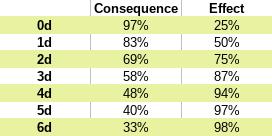
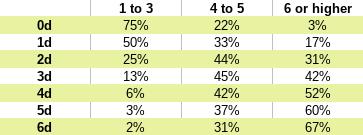
Reading about the probabilities for 2d6 on Jeff’s Gameblog had me wondering how the actual odds are really looking for Forged in the Dark rolls, and I came up with this. (I don’t know how to easily calculate for two or more 6s for critical successes, but they are really just a slightly stronger versions of full successes on a single 6.)

A result of 4 or 5 is a partial success, which means that you do the thing you wanted to do (an effect), but you also suffer a negative complication (a consequence). This can mean that you effectively get both a success and a failure at the same time, but the consequence can also simply be that you get a weaker version of what you intended to accomplish.

When rolling a single die, there is only a 50% chance of a full failure, which means a 50% that you get at least some success at what you tried to do. When you go to 2d, you’re already at 75% to get some kind of success. Above that, the probability that you just straight fail at your attempted action quickly becomes negligible. However, the chance to just get a full success with no negative consequences does not improve nearly as much.

In this table, I added the chance for a partial success both to the odds for a failure and a full or critical success. This is the table that matters when you’re asking yourself “How much do I need to do what I want to do?” or “How much do I fear the possible consequences?” And I find the result very interesting. If you have invested some of your advancement points into an ability and take the stress penalties for an extra dice or two, the chances that your character succeeds at doing what you wanted to do are very high. But the odds that you will have to deal with a consequence starts at an extremely high level and always stays significant.

Overall, the odds for the possible results are hugely different between 0d and 6d, or even just between the more commonly encountered range of 1d to 5d. But regardless of what you roll, the partial success result in the middle means that you always have a good shot of getting what you want with your actions, but never rest assured that it will go smoothly. I think that’s actually brilliant for making a game always exciting.

Forged in the Dark

Looking over my older posts, I’ve started talking about Barbarians of Lemuria some five years back, and been thinking about how to combine elements of it with aspects of Apocalypse World basically since I first learned about that game two years ago. Both are pretty rules light, and while they are both presented with quite distinctive settings, the mechanics have always struck me as having great potential for a very wide range of campaigns. They are both rules systems that have mechanics to figure out the outcome of uncertain situations when the PCs try to do something in the face of opposition from other people or the environment, which they do quick and painlessly and then are out of your hair to let you go on with the developing story. I really like this approach to what an RPG should be and do.

Some kind of hybrid of the two games has long been a vision of an ideal game for me, but since I have little personal experience with both BoL and AW, cobbling something entirely new together never seemed like a real option. And the way my groups form, getting a number of players together to play the weird homebrew system of a GM they never played with never really had any promise of success.

When I was looking into fantasy games based on the mechanics of Apocalypse World, there were really only two that have any popular presence. The first of course being Dungeon World, which I found to be very disappointing as it is an attempt to recreate the experience of D&D adventures with different dice rolling mechanics instead of doing anything with the very different approach to what a campaign can be that is promised by the Apocalypse World rules. And the other one is Blades in the Dark.

This game had been recommended to me by some people in the past and I had taken a look at it some time back. I don’t recall what I had been looking for back then when I took a peek, but I remember that I mostly looked at the setting, which is very post-apocalyptic Victorian steampunk. It’s basically Thief and Dishonored the Roleplaying Game, which really is cool, but at the time made me write it off as not being useful to whatever I was trying to do. I also remember seeing it has only three attributes, which made me go eww… Which turns out was a real shame.

Because looking at the system again from a mechanics focused perspective, it really strikes me as the closest thing I have yet encountered to that idealized blend of Barbarians of Lemuria and Apocalypse World, I had been dreaming of. It’s of course not exactly the game that I want to run for my next Kaendor campaign. There are all kinds of peripheral rules in this game about the gang of the PC’s increasing their reputation in the underworld, fighting for turf, and dealing with the police putting pressure on their activities, which really wouldn’t have any place in my campaign. But the core mechanics for making characters, character advancement, task resolution, and character durability is really solid.

While it’s not necessarily being more compact than Apocalypse World, it is much more straightforward and easy to grasp, even though at first there seem to be a lot of new mechanical concepts and principles you have to dig through. And Blades in the Dark really is quite a big book that doesn’t scream rules light. But I tried to write down the basics of character creation and action resolution as a simple introductory handout for new players, and I managed to get it all on only two and a half pages. (Excluding the rules for running a criminal empire.) That’s really quite impressive.

The Basics of the System

Characters in Blades in the Dark are really very simple. They mostly come down to 12 action ratings and 3 derived attributes. But these are not like attributes and skills like you see them in most other skill based systems, where you add your attribute scores to your skill rank to determine what dice you roll. Instead you have twelve basic actions, which in other games would be skills, or moves in Apocalypse World. Anything that PCs might do that has a chance of failure and negative consequences falls under one of these twelve actions.

  • Attune (do magic stuff)
  • Command (order people around)
  • Consort (chat with people)
  • Finesse (climbing, jumping, picking pockets, …)
  • Hunt (tracking, trapping, …)
  • Prowl (sneaking)
  • Skirmish (fighting)
  • Study (inspect or research a thing or person)
  • Survey (observe people or places)
  • Sway (convince people of things)
  • Tinker (work with machines)
  • Wreck (break stuff)

These actions are not methods or techniques, but arranged by outcomes. Skirmish is the action for the vast majority of ways that you can fight, regardless of weapons, armor, fighting style, and so on. Sway can be debating, deceiving, seducing, pleading, or whatever else you can think of to make people change their mind with your words. I can’t really think of anything to do with Prowl other than sneaking past people without being detected, and Study and Survey do overlap quite a bit, but I can’t really think of anything that might come up in a game where you need any other category of action as a player. Characters have a rating for all these actions that goes from 0 to 4.

What I really like is that there are twelve equal actions and only one of them is combat. Hunt and Wreck can also be used for violence in some situation, but that’s not their primary purpose. Treating fighting as equal to all other actions is something that really appeals to me and makes it a very inviting system for games where fighting is not the main event of adventures.

Unlike Apocalypse World, where you always roll 2d6 and add your attribute score to the result, Blades in the Dark has you roll a number of d6 that is equal to your rating, plus and minus additional dice for various circumstances. (If you end up with less than 1 die, you roll 2 dice and take the lower one.) The die with the highest number is your result for the roll, with a 6 being a success, a 4 or 5 giving you a success but also negative consequences, and 1 to 3 being only the bad consequences with no success. I’m not generally a fan of dice pools, but picking the highest number out of only up to 6 or 7 dice at the most with no additions is really quick and painless.

While there are attributes, they are not very similar to attributes in other games. Instead the 12 action ratings are grouped into three groups of four, resulting in four Insight actions, four Prowess actions, and four Resolve actions. The attribute score is simply the number of actions for which you have a rating of 1 or higher, resulting in a score of 0 to 4, which increases over time as you put a first point into the skills of that group. Attributes are mostly used when you roll to reduce the severity of negative consequences from a failed or partially successful action roll, and for tracking which action ratings you can improve when you get XP.

Characters also start with 1 special ability selected from a long list of options, and probably gain a new one that can also be freely selected every 1 to 3 game sessions.

And that is mostly it. There are of course a lot more bells and whistles regarding items, wealth, the injury and stress mechanic, but attributes and special abilities are more or less all the character creation and character advancement for this game.

Action Resolution

Taking an action in Blades in the Dark work the following way.

  1. The player describes what his character is trying to do.
  2. The player declares which of his character’s action ratings he will use for the roll.
  3. The GM judges the positioning for the action, which is the potential severity of the consequences should the action roll fail or only be a partial success.
  4. The GM judges the effect if the roll will be a success. Based on the approach the player described, the GM decides if it should result in the ordinary outcome for such an action, or the result will be of limited or greater magnitude.
  5. The player can decide to push himself to get an extra die for the roll, and another player can decide to assist and also add an additional die.

Basically this come down to what happens in most games with a GM who isn’t a jerk. The player ask “Could it work if I…” and the GM replies “Yes, but the chance is…”. Then the player might take it and make the roll, but could also decide that he really wants a greater effect than the GM declared and change the action to something more daring that also results in a worse positioning by increasing the danger resulting from a failure. Or the other way around, the player might decide that the danger is too high and instead change the action to something with a better positioning and accepting a reduced effect.

To keep things simple, there are only three categories of position: Controlled, Risky, and Desperate. And only three categories of effect: Limited, standard, and greater. This is easy to follow without any math involved. Do you want risk high or low danger and do you want to go for high or low reward? It’s not always a simple trade-off. Sometimes things are so much in your favor that you only have the low risk of controlled positioning and the expectation of a greater effect as the outcome. Or things look extremely bleak and you can only expect a lesser effect even though the positioning is desperate.

But these things don’t come down to only luck. Players have quite a lot of room to control the damage a failed action roll leads to. At any time, a player can declare that the severity of an injury or complication resulting from a roll is reduced by one category. The GM can say “You fall from the roof and badly hurt your leg. Is it broken?” And the player can decide to reduce the damage and say “No, fortunately it just seems sprained.” You can always do this, but it comes at the expanse of added stress. And when a character reaches 10 stress during an adventure, the character has some kind of mental breakdown that takes him out of the adventure and leaves a permanent mark on his mind. You also gain stress when pushing yourself or assisting another character to add additional dice to an action roll. Stress can also result from exposure to the supernatural, just like it does in Darkest Dungeon. Injuries will heal, but damage to the mind sticks around. So you might not always want to reduce the severity of your injuries or complications.

Forged in the Dark

The really neat thing that I found out today is that there is an SRD for the system that contains most of the rules that are not specific to the Duskwall setting of Blades in the Dark. It does not include the seven playbooks (character templates in PtBA games), but simply has all the special abilities put into a big single list from which GMs can put together their own lists for different character archetypes in their campaign. The SRD even has a template to make your own playbooks, and I think it has everything you need to fully recreate the ones from BitD. (Not sure what difference it makes, but there surely must be some copyright considerations behind this.) The only other thing from outside the setting chapter I’ve found to be not included are the four types of undead in Duskwall, but again the mechanics for making your own are there.

There also is of course a license to make your own stuff with the material from the SRD and using the Forged in the Dark label for it. The License is extremely generous and only requires you to include an attribution to John Harper and One Seven Design and not claim any official connection or endorsement by them. The Duskwall setting remains copyrighted, but everything in the SRD is fair game. And that’s all there is. Which I think is really cool.

Nothing set in stone yet, but right now I really want to give this a try for my next campaign. Aside from the criminal empire rules, this seems like a really well rounded system not just for fantasy but in general, and I think you could run a campaign even with just the basics. I can absolutely see myself making up some new rules for paranormal investigation, but I don’t think that’s even necessary to start a campaign. Really looking forward to trying this out.