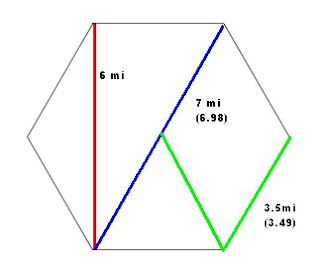
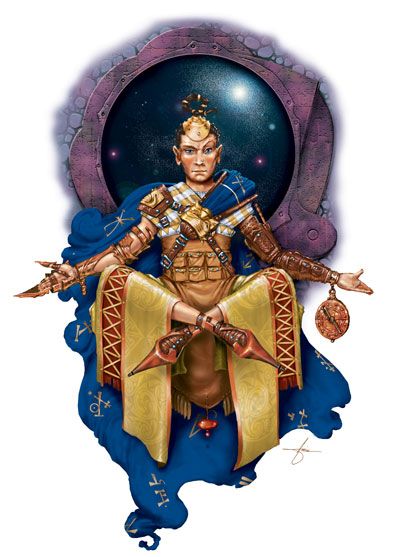
The 6-mile hex has long ago established itself as the default size for overland travel on hex grids for a number of reasons. And I rally quite like it myself. I like consistency.
From Hydra’s Grotto (click for more detail)
Hexes are a nice aid for GMs in that you can break down all distances in easy to track chunks, and more importantly can note down where the party of PCs is currently at by simply marking the hex they are in.
One thing that D&D has always gotten annoyingly wrong however, is that the various systems for overland travel speeds all don’t work with 6-mile steps. This whole thing is getting really rambly, but I don’t know how to get it more concise right now, and I really want to get some new stuff on the site.
In B/X, movement speed outdoors is either 24, 18, 12, or 6 miles, depending on a character’s encumbrance. Great. But if you are traveling through forests, deserts, hills, and broken lands, this speed is reduced to 2/3 the normal progress. So 16, 12, 9, or 4 miles. Only one of these is a multiple of 6. Same issue even now in 5th edition. Movement speeds of 30, 24, and 18 miles work great. But not if you cut them to half in any kind of difficult terrain and you get rates of 15, 12, and 9 miles per day.
You don’t actually get the most convenient feature that using a hex grid can provide. You still have to track how many half hexes or even third hexes the party has moved in a given day.
The most convenient for GMs would be a system in which all possible distances are increments of 6 miles. And the only way in which this really works is using base speeds of 36, 24, and 12 miles per day, with all forms of difficult terrain reducing that by half to 18, 12, and 6 miles per day.
Encumbrance
Easy Terrain
Difficult Terrain
Unencumbered
36 miles
18 miles
Encumbered
24 miles
12 miles
Heavily Encumbered
12 miles
6 miles
However, 36 miles is really quite a lot.
But how unrealistic is it really? There are plenty of sources for military references for marching armies that put good progress somewhere in the 24 to 30 miles per day range, though often much less than that. And if you look around for advice on how far people can expect to hike for a day, those 24 to 30 miles numbers show up as well as recommendations for beginners who might be unsure how far they can actually make it in a day. 36 miles in a day is significantly more than that.
But a party of PCs in a wilderness exploration game is usually not an army on the march. Nor are they inexperienced hikers. Also, all those numbers assume 8 hours of moving per day. That leaves 8 hours of resting in camp and 8 more hours of… what exactly? If you’re on vacation and hiking for fun, there’s plenty for you to do during that last third of the day. But moving through dangerous territory to get to an even deadlier dungeon is very much not a vacation. I think adventurers crossing the wilderness would do a bit more walking each day than tourists. And another very important factor is that in most systems, being “unencumbered” usually translates to very light gear with very little weapons, tools, and supplies. When a party is crossing through the wilderness for several days, they won’t be unencumbered. If using the numbers I’ve proposed above, 36 miles in a day would be something that only really happens for messengers in a hurry. No loitering around, carrying only the barest necessities, sticking to roads and easy ground. And in that context, 36 miles in a day does not seem that implausible. Much more common, at least for the campaigns that I run, would be traveling with a medium load, mostly going through forests and swamps, which would reduce the usual distance per day down to 12 miles. A much smaller number.
And at the end of the day, we’re talking about a game that has hit points as one of its basic mechanics. We’re not running an actual simulation of anything here. Also, any amount of miles really is just a made up number in an almost undefined virtual space, not any actual physical distances. Might some people think that 36 miles in a day is a bit of a stretch? Sure, why not. And I am not going to argue with anyone on whether that can actually be sustained for more than a day or two. But having to bother with only full hexes and not dealing with any fractions or partial hexes is a big convenience for running fantastical adventures in a made up space, and that’s the part that really matters.
I originally wrote this as a history of the Six Lands, but after a while thought that it was really terrible in that function and went back to rewrite it. History is one of those aspects of worldbuilding in general and for campaign settings specifically that I find highly overrated, or at least greatly overemphasized. What it is good for is to help establishing an internal logic for a world and serve as a useful reference frame when placing important locations and establishing a plausible pace for gradual changes that have happened in the world. It helps when you want to have a consistent order of the ruins of different civilizations that have been build on top of another, so that players can actually try to make sense of their discoveries.
The following is all stuff that players really don’t need to know, and probably even shouldn’t know. It’s stuff that I won’t be putting into any campaign guide or setting introduction. The purpose of this timeline is to provide me with some reference information on when a site would have been originally build, by who, and for what purpose, and what the overall situation was around it while it decayed up to the present day. This is meant as a gamemaster tool to assist with creating specific dungeons for actual adventures. I thought it might be interesting to some people to see how I am doing this, and maybe get ideas for how they could do a similar thing for their own campaigns.
A General Timeline of the Shattered Empire
1: The city states of Aktaras are united under the rule of the Emperor.
59: The Emperor’s White Host conquers the woodlands of Western Miskoiya, north of the Red Sea.
112: The Golden Host conquers the plains of Vaikar and their vast grain fields on the river Hakemes, establishing the Aktarans as a true Empire.
157: The Iron Host drives the asura from the eastern reaches of the Miskoiya woodlands, but never fully subjugates the small clans of Miskovai barbarians.
204: The Green Host defeats the giants of the Korenya highlands and drives them higher into the mountains. The Empire enslaves large numbers of Kozai barbarians to mine silver and iron for the imperial hosts, both in Korenya and Aktaras.
238: The White Host crosses the Mistwoods from western Miskoiya into Venlat to begin the conquest of the Kuri clans, but their progress always remains slow.
281: The Black Host is established in the south of the Vaikar plains to prepare for an invasion and conquest of the forests of Mangal.
321: The General of the Iron Host kills the Emperor in the imperial capital and declares himself to be the new emperor. The other five generals unite to turn against him, beginning the Wars of the Successors.
320: After a long siege, the Golden Host of Vaikar, the Red Host of Aktaras, and the Green Host of Korenya completely destroy the imperial capital with terrible sorcery, turning it into the Gray City. The Iron General is killed and the Golden General declares himself the rightful successor of the Emperor. The Red General, Green General, and Black General refuse to accept him as their new ruler and recall their hosts to their provinces to create their own kingdoms.
335: Even though the Golden Host is fighting a war against the other remnants of the Empire on three sides, it manages to destroy the small Black Host, that never managed to gain control over significant portions of Mangal.
351: Without any support from the Empire, the White Host is driven out of the southern regions of Venlant that it had manged to conquer by an army of Kuri warriors led by the newly appeared immortal Witch Queen Meiv of Halva, and is driven back towards the Mistwood at the norther edge of Miskoiya. Some of the people people from the White Hosts main stronghold in Elwai flee east instead and become the Kaska of the Witchfens.
362: After fighting both the Red Host of Aktaras and the Green Host of Korenya for over 40 years, the Gold Host is finally destroyed and the False Emperor killed. The two victorious armies continue to fight each other over the control of the Vaikar plains.
429: In Miskoiya, the White Host is annihilated in the Mistwood by another Kuri army led by Meiv, and reminding imperial soldiers flee south to Aktaras to join the Red Host, completely abandoning western Miskoiya.
430: Taygur nomads from the east begin migrating into the plains of Vaikar, and take control over most of the land south of the Hakemes, which have been almost entirely depopulated by the continuous fighting between the Red Host and the Green Host.
472: The large port cities of Aktaras rise up in rebellion against the General of the Red Host and overthrow him, reverting back to independent city states and signifying the final end of the Shattered Empire. One of the generals most trusted lieutenants claims to be his rightful successor, but only claims the title of King of Ateia. Taygur clans increasingly cross the Hakemes with their herds and slowly start to establish settlements of their own in the empty ruins of imperial farming towns.
521: What has remained of the Green Host in Korenya by this point is destroyed by hordes of Kozai barbarians who establish their own small tribal kingdoms in the highlands.
683: The present year.
This is about as much detail as I think I want to put into this aspect of the setting. It provides some decent guidance for how old the ruins that scatter the various regions of the Shattered Empire are, who build them, what their original purpose might have been, and who might have used them later.
With the top level worlduilding for the Shattered Empire having reached a pretty concrete and solid stage, I’ve started turning back to thinking about specific details for an actual sandbox campaign set somewhere in this world. And while discussing some ideas, we happened to talk about players spending the money they get from all the dungeon crawling, travelling merchants as random wilderness encounters, and how generic magic weapons are boring compared to setting up your gear to fight a specific monster. It got me thinking about how the Witcher games don’t let you drink potions or put poison on your weapon while a monster is trying to claw your eyes out. You got to do your alchemical preparations before you step into the monster’s lair, perhaps even brewing up some special brews you didn’t normally keep stocked in your inventory.
And that discussion gave me an idea: Let’s have alchemical ingredients that can be used to create potions to help fight specific monsters, but these ingredients are hard to get and can each be used for a number of different potions.
Usually in videogames with crafting systems, you have basic ingredients that you can pick up from defeated enemies or growing in the environment in practically infinite amounts, and special ingredients that are only dropped from a single monster in the whole game to make one specific item, or make you choose one of two possible items that can be made with it. For the record, I hate crafting in videogames. It’s mostly a pointless waste of time that clogs up inventory space to drown you in junk that is worse than stuff you find. And I think one of the main flaws with these mechanics is the way they treat the ingredients.
But let’s approach this differently to make it something that is narratively meaningful and doesn’t turn into a convoluted minigame. The really badic ingredient, which are dirt cheap and just grow everywhere in the environment, are not even worth tracking. They have negligible costs and require no effort to acquire. And to make the special ingredients much more interesting and meaningful, make them both limited and expensive and make them useful for multiple different things. Letting the players fight a monster and take ingredient A from it, which they can turn into item X is really just a different way for giving them item X from the monster’s treasure. But say instead that there are maybe a dozen of the monster in the whole sandbox and the players might end up with anywhere from 0 to 12 of ingredient A, depending on how they explore the world and interact with the creatures, and that each of the ingredients can be used to make item X, Y, or Z. If these items they can make have limited uses that mostly shine in quite specific situations, the players will have to make a choicd if they want to use the three ingredients they have to make one of each item, three of the same item, or two of one and one of another. Since they don’t know what situations they will be dealing in the future, the correct answer is to keep them stored and make whatever item is needed, once they know it is needed. This adds a few additional scenes to adventures in which the PCs are making specific preparations for the adventure ahead, based on the information they have of what they arw getting into. That’s always great to make a world become more alive and present.
But also, you can make these ingredients available in small quantities for high prices at merchants. If it’s travelling merchants, it’s going to be a one-time offer as well. If the objects that can be made are sufficiently strong and have appropriately limited uses before they are used up, then these ingredients might be worth quite a lot to the players. And asking to take a look at the alchemy chest of each merchant they encounter can be a highlight of each shoping trip.
Buying the ingredient isn’t the same as buying the final item. There’s still alchemical work to be done. If it’s something that takes longer, it can be useful to employ an alchemist, especially when this kind of work comes up regularly. Which also costs money. And that alchemist is going to need a lab. Don’t let him do that stuff over a campfire with a little box of alchemy supplies. A proper lab best fits into a permanent base, which can be a much bigger source of expense for the party.
I’ve not done any work yet on either ingredients that could be found on adventures or be one-time offers by travelling merchants, or the kinds of items that could be made with them. But I think it’s a really interesting direction to follow that could potentially add a lot to sandbox campaigns.
You know all these kids these days, with their battle maps, miniatures, and VTTs? I think it’s one of the worst aspects in which RPGs have gone into the completely wrong as they developed, following right behind the total mistake of adventure paths, campaign books, and “telling a story” (the curse of Dragonlance).
It’s gonna be this kind of post.
Now I am not that old. I actually played way more videogames than I’ve run RPGs in my life, and been doing it for much longer. Baldur’s Gate was my first introduction to D&D, and in my early days as a GM I spend way more time as one of the admins on a German Neverwinter Nights server than playing at a table with my first group. It’s not that I am opposed to any of that on principle. But in my opinion, when it comes to playing an RPG with character sheets and dice, and having a thinking GM running the show, all this stuff like highly detailed battlemaps and fancy looking tokens don’t actually work as visual aids, but instead are serious distractions from the game.
This also doesn’t have anything to do with 5th edition or how kids these days are playing the game. The whole issue goes back to at least the launch of 3rd edition over two decades ago, when the game was designed from the ground up to revolve around position markers on a square grid. (Which was a really strong incentive to entice players to give the publisher more money for miniatures, which were already a money printing machine for Warhammer at that point.) But it seems to me that even with 5th edition significantly cutting back on that as the game mechanics are concerned, all the tools available to make very impressive looking maps yourself, various brands of plastic dungeon floors and walls being around, and the ease with which people can show of images of all swag (I know, “old man”…) seem to have made all this stuff much more prominent.
But my stance is that all this superfluous stuff does not make your campaigns better, but instead detracts from them. It might very well be that this perception is impacted significantly by how ADD affects the brain processes information, but to me, highly detailed battlemaps or fancy toy soldiers don’t inspire my imagination. Instead, they lead to a greater abstraction and create distance and detachment from the scene. I am very much in favor of running adventures with basically an empty table. To me, the table is a surface to roll dice and put your papers down to write. Indoor maps can – and should – be nothing more than a simple sketch to communicate the general layout of the area when explaining it verbally woul be too cumbersome, and regional maps are best handled as props in the form of sheets on paper that look like someone in the game world drew them by hand.
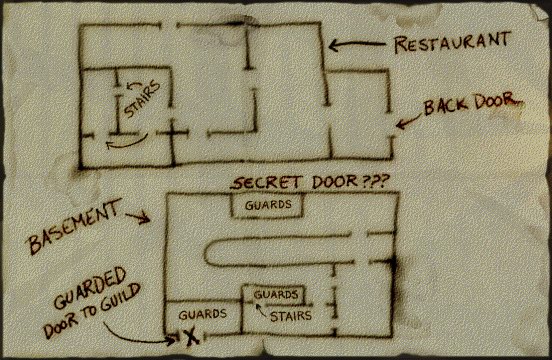
Ingame map from Thief.
The less visual input you get from stuff that is on the table, the more the mind is encouraged to create an environment in your head that reflects the details in the GM’s description of what you see. At least in my own personal experience, when you shove tokens around on a square grid, you start perceiving the encounter as a logic puzzle that is to be solved by computing an optimal sequence of moves.
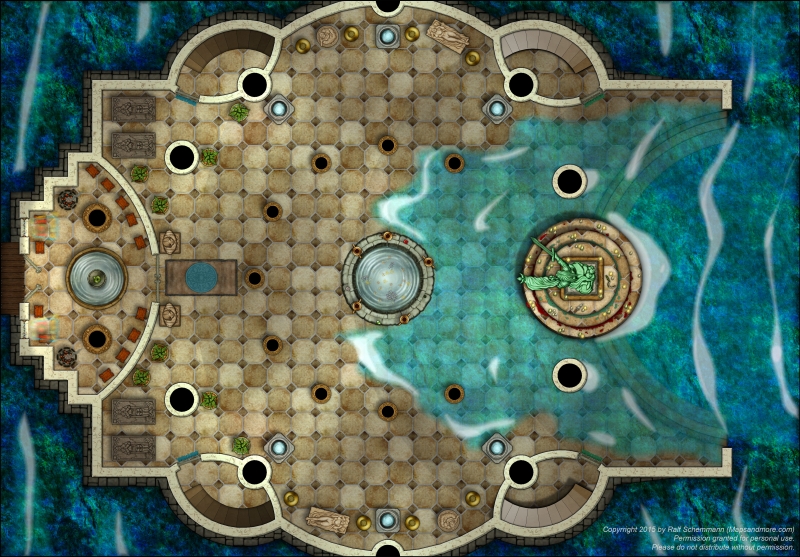
Something like this looks very fancy and perhaps even evocative. When you first look at it, you might even start imagining for a moment what the place would look like if you were a person stepping into it through a door. But as the encounter progresses, all of that color that hints at an environment starts to fade away, and the only thing you really keep seeing is the grid lines and the barriers that block ranged attacks and spells. Because those lines are what is relevant information if you play like that. The grind lines are the signals, while the colors that hint at a stunning and memorable environment are only noise.
To take the most extreme case, who ever imagines the battlefield, hordes of peasant levies, mounted knights, and war elephants that are represented on a chess board? It doesn’t happen. They are simply a grid on a board and abstract tokens that can be moved within certain rules. And even when you have the action of a fantasy RPG being connected to a non-mechanical story, I see this mental process of abstraction happen all the time. In an RPG, encounters should be scenes. They should not be logic puzzles. Or as someone phrased it many years ago, “don’t look for solutions to obstacles on your character sheet”. That’s not what RPGs are supposed to be for. That’s not where their amazing unique potential lies.
Moving tokens around on a terrain map is something that goes back to wargaming before roleplaying games were ever a thing, so it’s not like there ever was a moment in which they were introduced. But wargames have a completely different intention to RPGs. Their whole point is to be an abstraction and a simulation, to play out how battles might have turned out differently if certain tactical decisions had been made. Making things more objective was the goal for both military planners and armchair generals. Imagining yourself as an officer on a hill talking with messengers delivering reports and orders was never the goal. But that’s exactly what fantasy RPGs are about. To imagine yourself stepping through great ancient gates, or descending down a damp stone staircase into the darkness. To see vague forms slithering in the shadows and staring into the face of a demon as it rises from a burning pit. Putting a toy demon on a square grid just doesn’t deliver that.
There are many situations where less is more. And less visual aids means a more vivid imagination. (If the GM is doing a decent job with descriptions, but that’s a different story.)
Another thing that keeps happening to me is that any time I work on a new world map, I always get fed up with whatever shiny map making program I have and keep going back to go grab a pencil and some graph paper. Not quite sure why, but the process of designing environments always goes so much better and faster by just using a pencil. I guess in some part, it might be because of the limitations of the tools. There is no choice of colors or different line strength. Putting down a line is really easy, as is adjusting one. And there is no temptation to make everything right and good looking the first time so you don’t need to redo it all later, because you know the result will be a smudgy mess and making a nice handout to show the players has to wait until all the placement decisions are locked in. I’m not even hyperbolic when I say designing maps is probably 10 times faster on paper than doing it on a computer.
There’s probably some great, witty title for this, but I can’t think of any right now.
One of the lesser known, but really common effects of ADD that isn’t much talked about, is a significantly delayed development in people becoming functioning, independent adults, even if they don’t show any other apparent mental development issues. From what I’ve heard from other people, it is widely seen as something that will eventually work itself out, it just takes noticeably longer than for other people. (I think I recently saw a study that some 60% of university students with ADD drop out at least once.) I finally started my first regular, full-time and full-pay job, that isn’t some kind of occupation training or work integration measure, at the start of this year, now being in charge of quality control and inventory maintenance at a major online retailer or pond and garden plants.
Last Thursday, at the end of my fourth week, I was quietly working away on some regular busywork, when I had the sensation of having arrived at my destination, after wandering aimless in the wilderness for some 15 years. And to me surprise, the place where I arrived looks just like where I originally started. Having recently combed through my whole music collection to fill my phone with as much stuff as I can fit on it for my car rides to work, I rediscovered a lot of old music that I’ve been playing up and down back when I had finished school but hadn’t listened to in years, and I’ve also been playing a lot of my old favorite videogames from back in the day. And just in the last two months, since I started working on my new Shattered Empire setting, I’ve been rereading various old D&D books that hugely inspired me back when I first started learning the game in the early 2000s. It really feels a lot like my life is just like it was back when I set out to see where life would take me, except that now I got a much better grasp of my life, I’m a trained professional in a field with severe labor shortage, and got a decent income.
This man knows where it’s at.
It currently feel a lot like picking up back where I left off all those years ago. Turns out you can go home again!
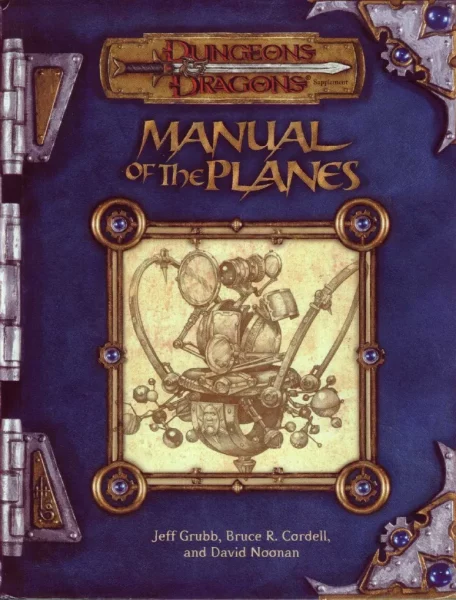
Which finally brings me to my actual point. This book.
Somehow this completely slipped my mind when I made the list of reference sources to use as inspirations for the Shattered Empire. The Manual of the Planes is the only 3rd edition book that isn’t a setting book that I still own in print. This book came out very early in 3rd edition’s run, only a year after the three rulebooks, and was hugely influential to me. I had played some Planescape: Torment before, which certainly was a very memorable experience for me, but also a game that’s really hard to get into. (I still have not completed it to this day.) The Manual of the Planes was my first comprehensive introduction to the planes of D&D. While it shows all the planes and describes many of the locations from the Planescape setting, its version of the planes is deliberately made much more generic, to easily plug into any campaign and appear more streamlined with the other 3rd edition supplements. For example, Sigil is only mentioned in a short paragraph, and the Factions aren’t covered at all. Which back then I found somewhat frustrating, but I now think really made this book, and the concept of planar adventures as a whole, much more accessible.
I think it’s quite fair to say that together with the Monsters of Faerûn, the Manual of the Planes is my favorite D&D book that I ever read. I was young and impressionable, and there is something about this book that really made it stick in my mind ever since. The whole art direction and presentation is an advanced glimpse at what would become the dungeon punk style that really takes off in the revised 3rd edition a few years later, and in my opinion had a huge impact on the perception of what D&D is ever since, but I think in this book it feels very appropriate and really works.
While the Great Wheel arrangement of the planes from Planescape is of course a classic, the Shattered Empire is very much meant to be just another generic D&D setting. Informed and inspired by D&D, but not a representation of D&D. And I’ve been on record that the alignment symmetry of the Great Wheel actually leads to it being crammed full with really boring stuff. (Whose ever been on adventures to Bytopia or Arcadia in a non-Planescape campaign?) I played around in the past with the idea to run a campaign that only uses some of the less popular planes that I find the most compelling, but nothing ever actually came of that. But now that I need to figure something out to do with the other realms of reality from which warlocks gain their powers, this feels like another great opportunity to take out that old idea again.
The Shadows
One thing that has always bugged me about the planes in 3rd and 5th edition is that the Ethereal Plane is just so damn boring. The concept is interesting, but by it’s very nature, the plane is completely empty. There’s been some attempts over the years to at least populate it with monsters, but those bizarre weirdos never got any traction, being just too weird while also being too bland. In contrast, the Plane of Shadows is a much more interesting place, that has actual terrain in it. For the Shattered Empire, I made the decision to combine the two planes into one, called for simplicity The Shadows.
The Shadows behave mostly just like the Plane of Shadows does. (Or the Shadowfell, exactly the same thing.) It’s a dark world without color whose terrain almost mirrors the world of the Material Plane, but not quite. It’s subtly distorted and not a completely perfect match in where everything is and how its shaped. It’s an imperfect reflection that can slowly and gradually morph into slightly different shapes and arrangements. One cool idea, that I’ve never actually seen much done with, is that there is only a single Plane of Shadows that connects to all Material Planes, not just the one the PCs are from, and that you can simply keep walking through the shadowy landscape and eventually come out in areas that correspond to completely different worlds.
To this baseline, I am adding the trait of the Ethereal Plane that you can actually see from the Shadows into the Material Plane and observe the living creatures moving around in the other world. Looking through the Player’s Handbook for 5th edition, it seems like any magical effects that target the Ethereal Plane can simply be redirected to the Shadowfell without causing any meaningful changes or complications. The aspect of the Ethereal Plane that you lose with this setup is that the Shadows have a ground and gravity, so you can’t simply fly around by the force of your will. Having buildings exist in corresponding locations in the Shadows also means that you can’t use the Ethereal Plane as a means to move through walls or doors. However, if the Shadows are only an imperfect and warped reflection of the Material Plane, there can still be large enough gaps and holes in the Shadows that allow passage through barriers that are impenetrable in the Material Plane. And I believe this only really becomes a factor with etherealness spell, which is at a level way beyond the scope of the Shattered Empire setting.
The Void
The Ethereal Plane also happens to be divided into the Border Ethereal, from where you can see into the Material Plane, and the Deep Ethereal, which is just a vast void of nothingness. This actually corresponds very well with the concept that you can travel through the Plane of Shadow to reach other Material Planes. This Shadow version of the Deep Ethereal is called The Void in the Shattered Empire. Though without the ability to float through the emptiness, things get a bit more wonky. My idea is that there are patches of darkness found throughout the Shadows where the reflected environment of the Material Plane fades away rapidly, and as you keep moving forward into the blackness, the whole concept of a ground beneath your feet becomes increasingly abstract, until you eventually find your feet no longer making contact with anything solid and you no longer need to even move your leg to continue moving forward. With no more visible landmarks to follow, finding your way in the Void by ordinary means becomes effectively impossible. It’s easy to become lost in the Void forever, and even if you happen to eventually reach the Shadows again, it might very likely not be the Shadow of your own world. And even if it is, there is no way of telling which area of the Material Plane your new position corresponds to.
Other Worlds
The number of other worlds that can be found by traveling through the Void could potentially be limitless. But a few of them are known, which are the homes of aberrations and fiends. I don’t think I’ll be using the concept of layers for planes. Instead every such other plane is only a single layer, just like the Material Planes. I’m not even sure if the distinction between material plans ad outer planes has any meaning in this kind of planar setup. I’m also not sure what really becomes the difference between aberrations and fiends, and what’s the difference between supernatural creatures from the Material Plane, such as lamias or unicorns. Maybe there won’t be any. Before 3rd edition, there really weren’t any such distinctions and classifications to begin with, and that worked just fine for decades.
The worlds of fiends and aberrations are a great place to finally make use of some of my favorite places from the Great Wheel. Gehenna, Carceri, and Pandemonium all fit quite perfectly with the kinds of horrific hellscapes that I have in mind. But Ysgard and the Beastlands also make for good places that could be found by traveling through the Shadows and passing through the Void, which are not quite as hostile but still home to strange beings not normally found in the Material Plane.
What I think this setup really doesn’t need is either an Astral Plane, as this function is already well covered by the Void, and any elemental planes. I like the four elementals as monsters, but creating a whole new class of planes just to justify their existence really doesn’t seem necessary. I like this basic setup quite well as it already is.
Maybe there will be a more detailed update on this in the future. But I see it as very possible that the future parties exploring the Six Lands will never make it any further than short diversions into the Shadows of their own world, and as such these things might never actually need to be made more specific.