Hit point increases in B/X

I somewhere saw people discussing the question whether the thief in B/X would be better having a d6 for hit dice instead of a d4, and one point that was brought up against that is that the thief gains new levels very quickly and as such has more Hit Dice than other characters with comparable XP, and that this would even things out already.

I’ve long felt that the speed of thieves gaining new levels has been greatly overstated, and so I went to check how the average hit points over time for the different classes actually look like.

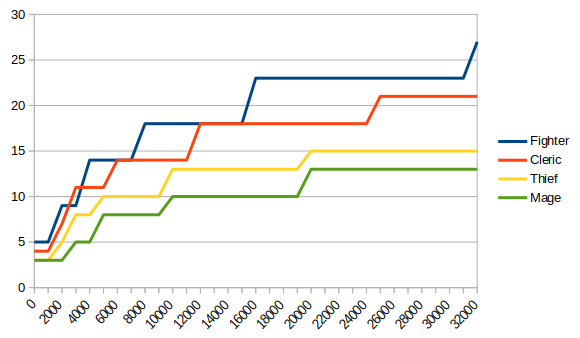
Average hit points from 0 to 32,000 XP.

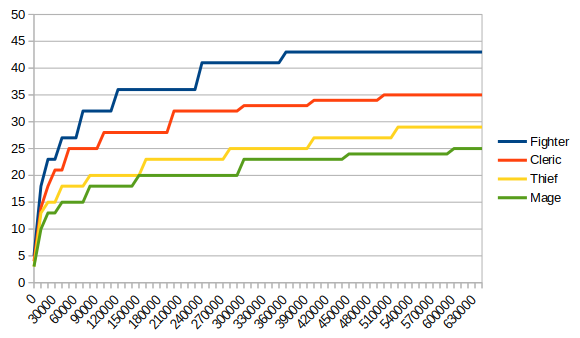
As can be seen here, a thief’s average hit points do get very close to those of a cleric on reaching 4th and 5th level, but the cleric almost immediately surges ahead again.

Average hit points from 0 to 640,000 XP.

And after those initial first levels, the gap between thieves and clerics only widens until 10th level when the cleric continues to gain only 1 hp each time compared to the thief’s 2 hp. Now a 6 hit point gap on average towards the end of the B/X progression is not that big, but at these small numbers that’s still +20% for the cleric. And a +50% for the fighter, compared to the thief.

Does that make thieves too fragile at higher levels? I don’t know, I’ve not enough experience at play at those levels. But I think this also shows that the thief’s faster level advancement rate does not negate the difference in Hit Die size to the cleric at all.

Random hit point ranges

A few years ago I read something about the value of always rolling for the hit points of creatures and NPCs that the players get to fight and not always taking the average by default. I really like the idea of using different hit points to give individual opponents a bit of a personalized description even though otherwise they have completely identical stats with the same AC, saving throws, hit chance, and damage on a hit. In a fight against some random orcs or bandits, it can be a neat and convenient inspiration to have those with 7 hp look much larger and more menacing and approach the fight different from their otherwise identical buddies with only 2 hp.

But sometimes, you might want to know what actual hit points numbers might be realistically expected for a given number of d8s. So I made this little table. The math magic behind calculating 2 standard deviations for normal distributions isn’t really important here. What this table shows is the range of hit points into which 96% of all random rolls will fall. There is only a 2% chance that a randomly rolled number will be lower than the shown range, and a 2% chance that a number will be greater. It will still happen occasionally, but even then most likely only by 1 or 2 points, and for the purposes of encounters in an RPG, I consider the odds negligible. You can just assume that pretty much all randomly rolled hit points on a d8 will fall into the shown ranges.

Hit Dice hit points
1 HD 1-8
2 HD 3-15
3 HD 6-21
4 HD 9-27
5 HD 12-33
6 HD 16-38
7 HD 19-44
8 HD 23-49
9 HD 27-54
10 HD 31-60
11 HD 34-65
12 HD 38-70
13 HD 42-75
14 HD 46-80
15 HD 50-85
16 HD 54-90
17 HD 58-95
18 HD 62-100
19 HD 65-105
20 HD 70-111

Planes for the Ice Ages and some History

I’ve been thinking more about my ideas for a Pleistocene inspired setting and how I can combine it with the general outline I’ve already drawn out for my new mystical wilderness world. And I really like where things are going.
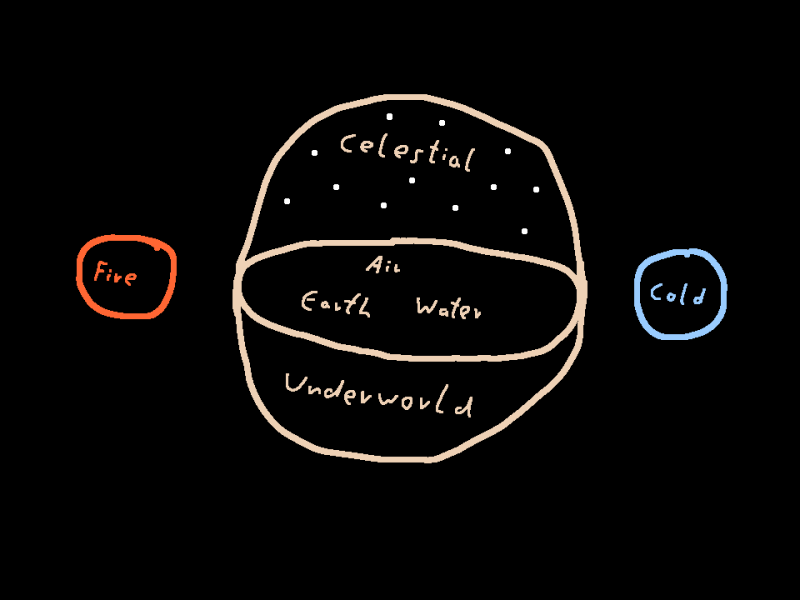
The world consists of three primary realms. The natural world of Earth, Water, and Air sits at the center as the home of humanoids, animals, and various nature spirits. It’s the realm of the elements from which druids draw their magical powers.

Above the natural world exists the celestial realm. It’s the world of stars and moons, home to strange and elusive beings that are pure spirits with no physical substance, and the source of the magical powers wielded by mystics (clerics).

Beneath the natural world is the underworld. It’s the realm of demons and infernal fire. The infernal fire is found in the essence of demons and volcanoes. Sorcerers and warlocks gain some of their magical power from the infernal fire, but also draw on the energies of the celestial sphere.

In addition to the three main realms, there are also the forces of elemental fire and elemental cold. They are the driving forces of the seasons but also the cycle of the ages. The elemental fire is manifested in the sun, while elemental cold seems to come from both everywhere and nowhere. Nobody really knows for sure if fire and cold are equal but opposite forces, or if cold is simply the natural state of the world that will reassert itself whenever the warming influence of the sun is waning. But some people believe that there is a counterpart of the sun beneath the eternal ice of the north pole.

Ancient myths shared by most temples and cults tell that for most of the existence of the world, all the lands were covered in ice and snow, cast in eternal darkness without the warming light of the sun. But like the changing of the seasons, there is a cycle of the ages, and after hundreds of thousands of years, the sun will reappear and the world awaken from its long sleep. Glaciers melt and forests grow back, and new animal life returns to the world. But eventually, these ages of the sun will end, and the world return to its natural state of lifeless cold and darkness.

The oldest tales of known history begin with the end of the last Great Frost. This world became inhabited by the fey, giants, and serpentmen who made its wild forests and plains their home for many thousands of years. However, their world ended with the beginning of the Long Winter some 10,000 years ago. The Long Winter was not a true Great Frost that would end all life on the surface of the world, but the sun became dim and the great glaciers in the far north began to grow and expand south, covering much of the known world under their ice. During the Long Winter, the fey went to slumber in burrows under the earth. The giants survived in small nomadic clans roaming the cold tundra at the feet of the glaciers. And the serpmentmen fled far to the south where the warmth of the sun allowed for forests to survive. During this time, even the gods went to sleep, with only the celestial goddesses of moonlight and darkness watching over the frozen world.

The Long Winter lasted for 6,000 years until spring finally returned to the known world and the great glaciers began to melt. Plants and animals returned to the warming lands, but this time they were also accompanied by people. As they explored these new lands, they came upon old ruins of the elder races and discovered in them the secrets of magic. These first sorcerers became the first mortal kings, establishing both the Western and the Eastern Kingdoms, which became the centers of the newly rising civilizations. Not all barbarians were happy with the rule of kings, and many clans continued traveling further north into the expanding forests to evade their reach. With the Western Kingdoms and the Eastern Kingdoms regularly fighting among themselves, with each other, or against the ancient Serpentmen Kingdoms that have survived in the South, there are always people looking to the wilderness in the North to seek a new life among the barbarian clans. A vast land promising freedom and adventure.
Magical Pleistocene

After spending a month with a really deep dive into The Savage Frontier and having recently started playing Skyrim again, I am currently having a lot of subarctic environments wandering in my mind. My first thoughts for a new setting had been to fall back on trying something in an Indo-Iranian Bronze Age style with perhaps some Mediterranean elements again, since I really don’t think anyone needs yet another Viking setting. But I had also set out to start something new and fresh instead of just stirring around the same pot of ideas that had gotten somewhat stale after ten years. And I did tinker around a bit with Baltic and Slavic setting elements in the past, though ultimately nothing really came from that. Instead of doing more Bronze Age stuff, which I still think is greatly underserved in fantasy, I think doing something more influenced by late Iron Age and Migration Period Northern and Eastern Europe could also be really cool. Also a pool of ideas for fantasy that barely anyone ever seems to go fishing in.

I already had the idea for the new setting that there was a fairly recent Ice Age that erased all the ruins of the Ancients from the surface, leaving the few remnants of their empires hidden away in underground caves. And I really love the common thing in lots of old Sword & Sorcery art to have human barbarians alongside long extinct animals from much more ancient aeons. The idea of having a late Pleistocene environment combined with broadly 4th century Baltic and Slavic people actually does sound pretty fun to me.

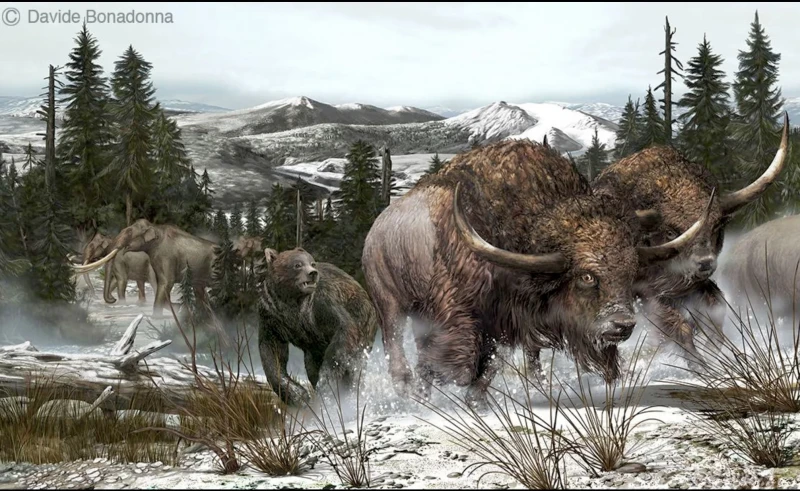
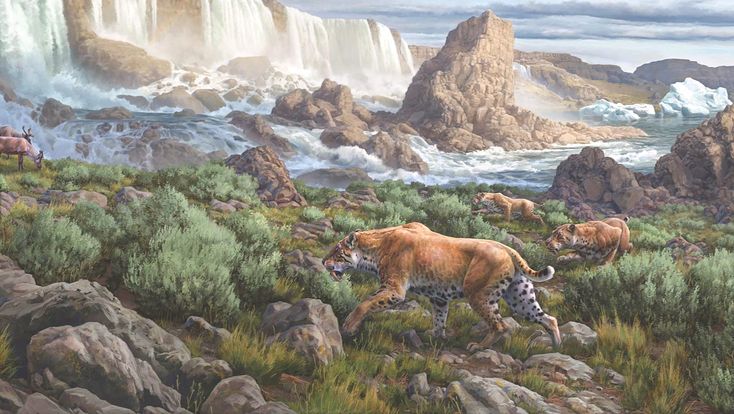
I’ve been thinking for a long time that the typical European lineup of animals in Fantasyland is pretty boring. Wolves, bears, horses, cows, and wild pigs are just so everyday pedestrian for someone from central Europe. There is nothing really fantastical about it. But you don’t really have to go that far back and you have mammoths, ancient bisons, and sabre-toothed cats in the same places. Which are still perfectly realistic animals because they were real, but also much more foreign and exotic.

Growing up in Northern Germany, pretty much smack in the area where the massive glaciers of the last three ice ages reached their greatest extend, Ice Age stuff popped up quite a lot in my childhood. Often in school, but of course natural history and archeological museums around here usually had Ice Age exhibitions as well. I thought that stuff was pretty cool, but when you’re seven years old it’s not nearly as interesting as dinosaurs. Way more awesome than fluffy elephants. Back then at such a young age, I had no frame of reference for the time scales involved. But looking into these things now, I find it really fascinating that all the lands around here and to the north were nothing but bare rocks and sand under hundreds or even thousands of meters of ice only 12,000 years ago. And had been in that state for some 100,000 years. Everything that exists north of the German central hills and the mountains of Czechia is less than 12,000 years old. Even all the wilderness of Scandinavia that seems as ancient and untouched as anything can possibly be in Europe goes only back that far. All the plants and animals that exist there migrated to these lands only very recently from warmer lands to the south. And the Ice Age wasn’t a short temporary exception that disrupted the natural environment. The last three Ice Ages each lasted for about a 100,000 years each, with the periods between them only some 20,000 years in length. The fact that Northern Europe has an ecosystem right now is actually weird and not typical for this part of the world. I find this hugely fascinating and a great source of inspiration.

I am now considering stepping somewhat away from having the main civilization of the new setting consisting of warring city states ruled by immortal sorcerer-kings like Dark Sun or Morrowind, and instead putting the focus squarely on the wilderness beyond the border of civilization. The lands in the largely untamed wilderness where the clans that rejected the new structures of civilized kingdoms retreated to, and where people fleeing the reach of the current kings attempt to find refuge.

Studying The Savage Frontier in much greater detail than I ever did before has given me a lot of insights about how that region of the Forgotten Realms is structured and how its map can be a great inspiration for adventures that are not spelled out in the texts. But it also made me notice various aspects of where the design falls short and things could have been set up in much more interesting ways. So at this moment, I am very much considering to take the ideas I already came up with for a new setting and turn them into something that could be regarded as my own take on the overall concept of the Savage Frontier and Skyrim. But more alien and more weird like Hyperborea. And without Vikings.

Two more maps of the Savage Frontier

The ancient borders of Eaerlann, Netheril, and Delzoun are fairly well described in the material. In contrast, the borders of Illefarn and the Fallen Kingdom are only mentioned very vaguely and the outlines here are purely my own personal guess.

One discrepancy in the description of the elven realms is  with the inhabitants of Eaerlann. “For millennia, gold elves dwelt in Illefarn (where
Waterdeep now stands) and Eaerlann (along the River Shining).” This sentence seems to state that the people of both Illefarn and Eaerlann were gold elves. However, it is stated in other places that the half-elven renegades of the High Forest are descended from moon elves. It is also stated that the only known group of elves still living in the North are moon elves in Ardeep Forest. And Ardeep Forest is one of the explicitly mentioned places belonging to the Fallen Kingdom, which was founded by elves from Earlann long after the elves of Illefarn had all left for Evermeet. I believe this to be a case of editorial error and that Eaerlann was in fact a realm of moon elves. Wood elves are never mentioned at all in any of the 1st edition sources for the region.

I have never actually seen any maps showing the areas that the Uthgard tribes are calling their homes. All we’ve ever been given explicitly are the locations of their holy ancestor mounds and the towns of Griffon’s Nest and Grunwald. However, the descriptions given on each tribe in The Savage Frontier does provide quite a bit information to work with, which resulted in this interpretation of where the Uthgardt would commonly be encountered. Not much information is given on the way the Uthgardt live, but it appears that they do not practice any kind of farming, and so probably rely on a combination of hunting, gathering, and possible some herding.

When comparing this map with my earlier map of the areas where towns are located and most farming would be done, the areas where the two overlap happen to be the ones of the Grey Wolf, Griffon, Elk, and Blue Bear tribes. Which also are just the tribes that most commonly come in conflict and attack the new settlers. Which makes me think that there really was some thought put into the placement of towns and tribes, and gives me more confidence that my interpretations are pretty good.