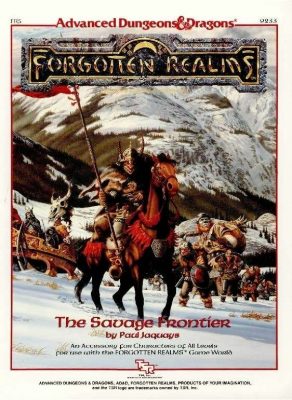
Playing Baldur’s Gate back in 1999 was really my first introduction to fantasy. My childhood had been full of medieval and fairy tale stuff, and I even had read The Lord of the Rings, but I merely thought it was neat and it was very much a one off thing for me. There were plenty of fantasy videogames around before that, but I never gave them a second look and was all into sci-fi stuff. Baldur’s Gate was what really opened the gate to high fantasy as a genre and a major hobby. As such, Forgotten Realms dominated my early years of getting into RPGs. Back in the early 2000s, I had a very considerable collection of Forgotten Realms sourcebooks, both 3rd edition and 2nd edition. I was so much into The North, as was every other D&D fan around me at the time, that I even got the 1st edition The Savage Frontier to get every bit of existing material on the region, but found it very disappointing since at 64 pages it barely seemed to pass as a leaflet.
Looking back at more than 20 years now, my love for the setting didn’t actually last that long. By the time 3rd edition ended, I had already very much moved on and sneered at whatever passed as the 4th edition version of the setting just out of snobbery. All that dungeon punk stuff that spread through the revised 3rd edition also made it into later Forgotten Realms books, and that just didn’t feel right to me, whose first references had been Baldur’s Gate and the 2nd edition campaign setting box. And even that version of the Forgotten Realm had lost its spark, coming across as overly quaint and cozy.
 It was only much, much later, I think when I started getting interested in classic oldschool D&D, that I first got somewhat curious about the very first incarnation of the Forgotten Realms. At some point I directly compared the 2nd edition The North box with the 1st edition The Savage Frontier, and one thing that stood out to me that the new edition had killed off all the most interesting threats from the older version. Everyone slightly interested in the history of the setting knows that in 2nd edition they killed off all the cool evil edgelord gods. But it actually went much further than that. The demons in Hellgate Keep, the cursed adventurers in the Stronghold of the Nine, the Blue Bear barbarians who are manipulated by a disguised night hag, the orcs in the Citadel of Many Arrows, the mind flayer in the Ruins of Dekanter. The box even dedicates a paragraph with its own heading to The One, which informs us that he’s just not around anymore. Why even tell us about an interesting setting element that is not even part of the setting anymore?
I had been thinking occasionally about running a campaign in The Savage Frontier as it was originally presented, but I had hesitated for a very long until I got into 5th edition last year (and didn’t like it) and I never had any desire to actually try to run a campaign using the AD&D rules. I quite fell in love with B/X, but that game doesn’t have the bard, druid, and ranger classes, whose absence I think would really change the feel of the campaign. But recently I started taking a look at the Advanced rules for OSE and that stuff looks exactly like the perfect way to run an AD&D setting without all the AD&D mechanics. And being in a bit of a lull with my homebrew setting and not quite sure how I want to revamp it before I take it on another run, the idea to finally give that Savage Frontier campaign a shot came to my mind very quickly.
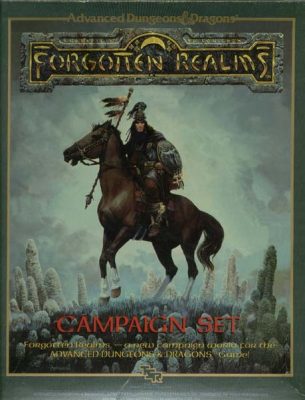 The idea I have is to run a campaign in the 1st edition version of the Forgotten Realms, ignoring all material that was released later, and simply taking the Forgotten Realms Campaign Set Grey Box and The Savage Frontier at their word. Of course, there would be a lot of blanks to fill in, since both sources are very sparse on specific details. The Grey Box only has about half a page on Waterdeep and Neverwinter, and The Savage Frontier has a total length of 64 pages. But as I can’t emphasize enough, the density of inspiring material is fantastic. It’s another Jaquays classic.
Having picked up the old setting again and going through it with an eye on how the original presentation of the setting differs from what was presented later on, I quickly noticed that it’s actually a really different place. The introduction of the Grey Box, we are informed, by I assume Ed Greenwood himself, that the Forgotten Realms are a world similar to Europe in the 13th and 14th century. I fully understand if this means nothing to anyone who isn’t a serious medieval history nerd, but right out of the door, this is a big one. 13th and 14th century is a completely different reference frame from what we’re actually seeing in the 2nd edition material. This is the time of seventh and eighth crusades, the Mongol conquests, the beginning of the Hundred Years War, the founding of the Hanseatic League and the Teutonic Order, and the conquest of the pagan Balts and Prussians. In contrast to that, the 2nd edition setting is much more in the style of Shakespeare and the English Civil War without guns, which places the reference time frame into the 17th or even 18th century. I don’t know how well the writers of the Grey Box were familiar with medieval Europe or how good available material in public libraries would have been in the mid 80s, so there really is no way to tell how much weight should be given to that claim and how much of a shift there really was in the minds of the people working on the 2nd edition boxes. But as I said, my idea is to take these sources as literal and attempt to use the material as it is presented, not as it has later become commonly interpreted. This already changes my perception of the world noticeably.
The same introduction also tells us that the contemporary civilizations are fairly new, and most of the land of the Forgotten Realms has until recently been uninhabited wilderness. From the perspective of a 21st century armchair historian that sounds rather implausible, given that a 13th century level society doesn’t spontaneously crawl out of caves and tree hollows, but I am still willing to make the effort to interpret the intended purpose of that statement. Maybe we can assume that some already existing advanced cultures in some core regions of the Realms have spread their knowledge to various barbaric societies beyond their borders over the last couple of centuries, similar to how the Romans interacted with the various Iron Age societies of central Europe. But to the writers’ credit, it is stated specifically that civilization primarily consists of independent city states. And true kingdoms like Cormyr are actually rather rare. At the end of the day, it’s fantasy, and there is no long detailed timeline of historic events to further scrutinize. What matters at the end of the day is that we have a tech-level and local social structures resembling the 13th century, and that people live in city states scattered across a vast wilderness. And it really is vast. The Savage Frontier itself is the size of the American Northwest, British Columbia, and southern Alaska, which I also think are the intended reference for the geography and environment of the region.
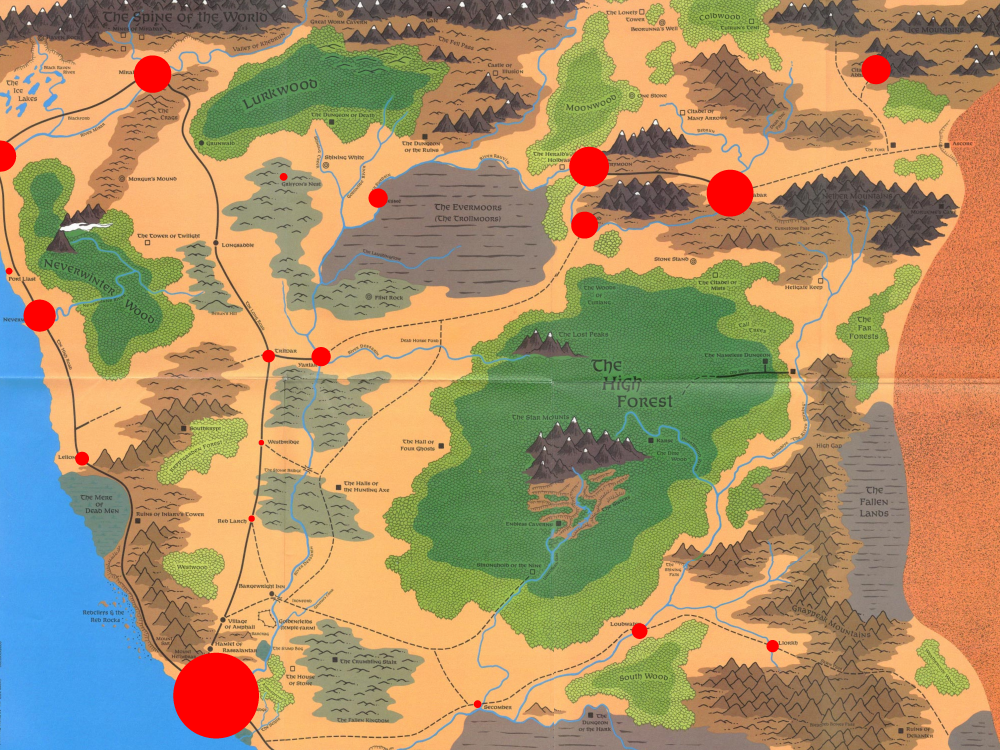
In The Savage Frontier, some more details are given on the demihuman and humanoid race that inhabit the North. Like the setup in Gygax’ game rules and Greyhawk setting, it’s made quite clear that is a setting not just predominantly, but nearly exclusively inhabited by humans. I’ve always envisioned the North as a region where elves and dwarves still have one of their strongest presences, but the actual presence described here is extremely slow. Dwarves really only have one major city, the Citadel Adbar, which is on the very edge of the map, in the most remote corner possible that you could find. And in this case, “city” refers to 14,000 dwarves, which puts it behind such famous metropolitan center as Luskan and Mirabar. The only other significant dwarves settlement is the mining town Ironmaster near Icewind Dale, which hardcore fans might remember having seen on the maps, but probably never heard anything about either. Citadel Felbar is still the Keep of Many Arrows, and at this point Bruenor Battlehammer is still only planning to reclaim the abandoned ruins of Mithril Hall. For the elves it looks even bleaker. For all intends and purposes, the elves of the North are gone. Their only significant presence is a clan of “elderly” elves in Ardeep Forest outside of Waterdeep. The description of Silverymoon mentions that it’s such a magical city that you can even meet elves there, a statement that is even deserving an exclamation mark! Gnomes are mentioned once by stating that there aren’t any in the North. Halflings are, but not much more is said about them other than that they are rare because they don’t like the bad weather. A personal guesstimate by me about relative populations in the North would be 93% humans, 3% half-elves, 2% dwarves, 1% elves, and 1% halflings.
Considering again that the Forgotten Realms as a whole are described as a fairly desolate place were most places have been settled only recently, it really makes to call the North “the Savage Frontier”. This place is really remote and even more sparsely settled than most other regions. To me, this is just shouting “wilderness campaigns”. One thing, that I am sure is very deliberate, is that it seems that the majority of ruins that are listed and described, are clearly stated as being former elven or dwarven strongholds. The history of the North is quite vague, but it appears to establish that the disappearance of the majority of elves from the region took place over 6,000 years ago. The prime of the dwarven kingdom was 2,000 years ago. That means those ruins are all incredibly ancient, and with no elven society remaining in the region, their true histories would be completely unknown. They are not simply known old ruins that have dangerous tunnels beneath them. Most ruins in the region would probably be ancient stones of which nobody has any shred of knowledge what they once were. That paints a very different picture than I always had about the “famous” ruins of the Forgotten Realms. With the current human civilizations being quite new, it is very likely that many of these ruins have not been seen by anyone for thousands of years.
Regarding humanoids, orcs get a good number of mentions and are described as having a significant presence in the northern mountains. Goblins are mentioned, but no real details given about them, and gnolls, kobolds, and kuo-toa aren’t mentioned at all. There is a single mention of a mind flayer, but actually several on beholders. Not quite sure what to make of that. That could indicate that humanoid monsters other than orcs don’t have a meaningful presence in the region, but it is also quite likely that they simply don’t get mentions because they are assumed to be generic dungeon critters.
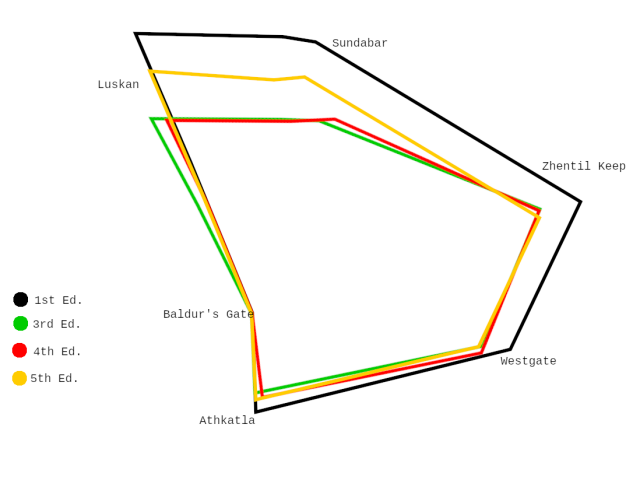
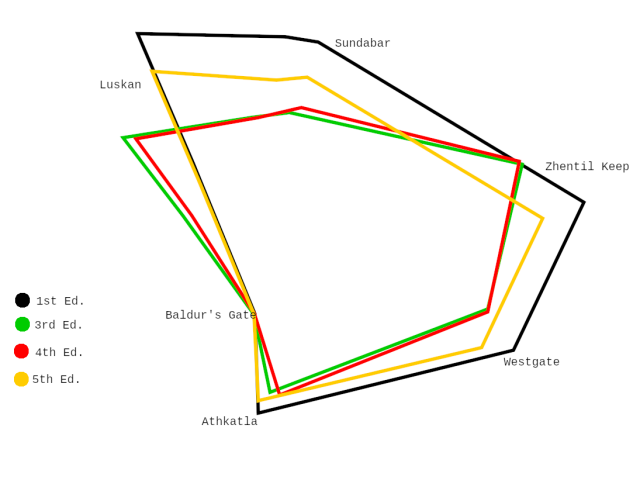 As can be seen here, 3rd edition both scaled down and squished the map significantly. Even with all the major overhauls of the setting in 4th edition, the overall geography remained effectively untouched. In 5th edition, it appears they returned the overall shape of the landscape to its original form, but not its original size. Luskan and Sundabar have moved further North, but if you tilt it a bit, the distances between Baldur’s Gate, Atkatla, Westgate, and Zhentil Keep have not really changed at all.