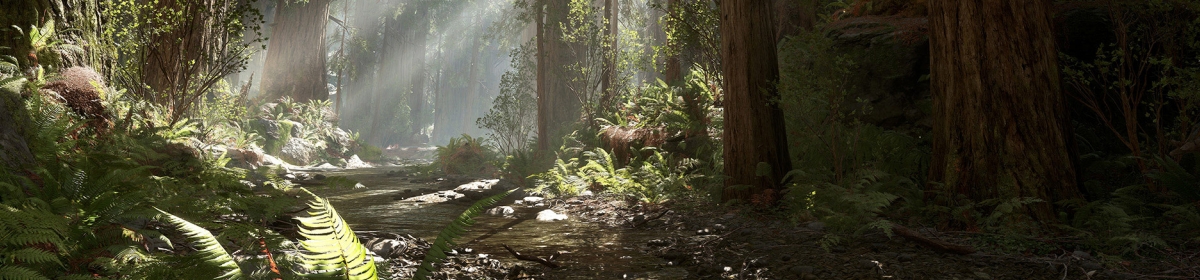
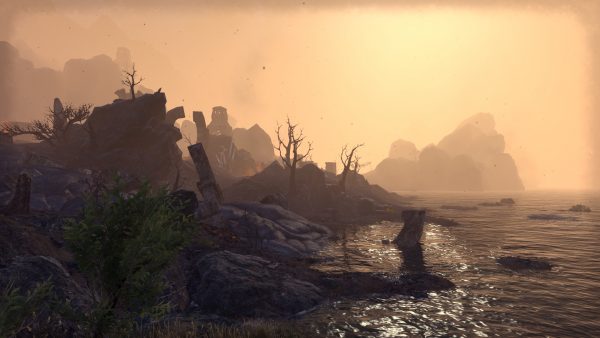
I saw this picture and had to turn it into a creature. Took just an hour to create this.
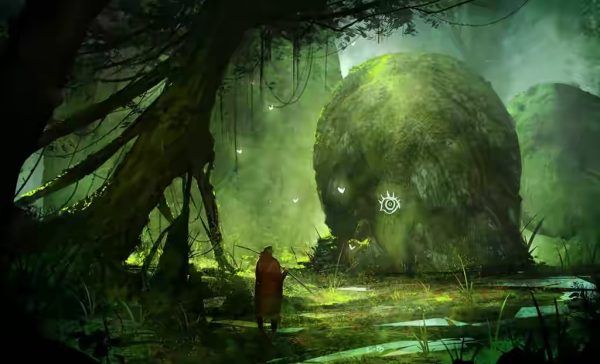
The swamp sage is a spirits that lives in swamps, marshes, and other wetlands. Its body consist of a large shell that often looks like a boulder overgrown with moss and lichen and can easily be mistaken for such when its small crustacean legs are tugged in below it under the water. There is a small opening in the shell at the creature front that houses its face, which consists of four small black eyes and its maw. Swamp sages are reclusive and rarely seek interaction with people, but are of a calm and nonthreatening demeanor and occasionally come together to consult with each other when something is causing disturbances in their territory. They usually try to avoid fights and use their fetid cloud and entangling plants abilities to retreat from attackers. If forced to defend themselves, they can spit a spray of acid from their mouths and strike out with one of their four long tongues.
Swamp sages know almost everything that is going on in their homes and know much about a swamp’s or marsh’s history and inhabitants. If something is threatening their territory, they usually prefer to advise others on how to deal with the situation than engaging threats themselves.
Swamp Sage
Large fey
Armor Class 15 (natural armor)
Hit Points 78 (8d10 + 24)
Speed 20 ft.
STR 17 (+3), DEX 8 (-1), CON 16 (+3), INT 15 (+2), WIS 17 (+3), CHA 14 (+2)
Skills Stealth +2
Damage Resistances bludgeoning, piercing
Damage Immunities poison
Condition Immunities charmed, poisoned
Senses darkvision 60 ft., passive Perception 13
Languages telepathy 60 ft.
Challenge 4 (1,100 XP)
Special Traits
Amphibious: The swamp sage can breathe air and water.
Magic Resistance: The swamp sage has advantage on saving throws against spells and other magical effects.
Innate Spellcasting: The swamp sage’s innate spellcasting ability is Charisma (spell save DC 12). It can innately cast the following spells, requiring no components:
At will: dancing lights, druidcraft
1/day each: commune with nature, confusion
Swamp Camouflage: The swamp sage has advantage on Dexterity (Stealth) checks it makes in swampy terrain with ample obscuring plant life.
Actions
Multiattack: The swamp sage uses either its Acid Spray, Entangling Plants, or Fetid Cloud, then makes a tentacle attack.
Tentacles: Melee Weapon Attack: +5 to hit, reach 10 ft., one target. Hit: 7 (1d8 + 3) bludgeoning damage.
Acid Spray (Recharge 6): The swamp sage spits acid in a 15-feet cone. Each creature in that cone must make a DC 13 Dexterity saving throw, taking 10 (3d6) acid damage on a failed save, or half as much damage on a successful one.
Entangling Plants (Recharge 5-6): Grasping roots and vines sprout in a 30-foot radius centered on the swamp sage, withering away after 1 minute. For the duration, that area is difficult terrain for non plant creatures. In addition, each creature of the swamp sage’s choice in that area when the plants appear must succeed on a DC 13 Strength saving throw or become restrained. A creature can use its action to make a DC 13 Strength check, freeing itself or another entangled creature within reach on a success.
Fetid Cloud (Recharge 6): A 15‐foot radius cloud of disgusting green gas extends out from the swamp sage. The gas spreads around corners, and its area is lightly obscured. It lasts for 1 minute or until a strong wind disperses it. Any creature that starts its turn in that area must succeed on a DC 13 Constitution saving throw or be poisoned until the start of its next turn. While poisoned in this way, the target can take either an action or a bonus action on its turn, not both, and can’t take reactions.


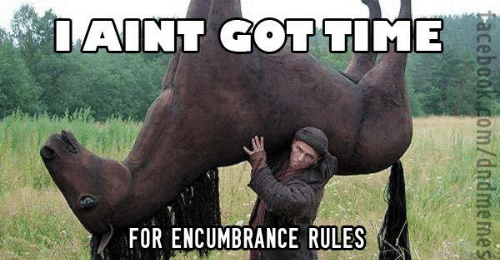 Encumbrance in D&D has always ranged from bad to terrible. The idea behind encumbrance is actually great. The default assumption for the first decade or so had been that the party enters a dangerous place, gets their hands on valuable stuff, and gets back out again, preferably with their loot and without anyone dying. When wandering monsters are a thing (look forward to part 3) and fighting battles is a negligible source of XP (look forward to part 4), then getting in and out quickly is of the essence. The longer it takes you, the greater is the risk of anyone dying with no benefit in trade. So as you keep delving deeper into the dark unknown, you are using up some of the tools and supplies you have brought with you, but at the same time get weighted down by the treasures you find. Which leaves you with two choices. Slow down and risk fighting more opponents and reducing your odds of being able to run away. Or reduce your weight, either by choosing to leave some of the treasure you’ve found behind, or by dropping some of the equipment that you hopefully won’t be needing on your way back to the surface. Hang on to all your potentially life saving tools and weapons as you slowly crawl back to the exit, or make a mad dash to safety? Or play it safe and leave some of your hard fought for rewards behind? This is a real question that players will have to face. There is no right answer which two out of these three you should choose and will greatly depend on the constantly changing situations. To me, this is one of the big things that make exploration adventures so exciting.