Book Review: Night Winds

Night Winds is the third Kane book by Karl Wagner that I’ve read. I already liked Death Angel’s Shadow and Bloodstone very much and so I had pretty high confidence that this one wouldn’t disappoint me either. Like Death Angel’s Shadow, Night Winds is a collection of several unconnected stories of various length. And as many others have already claimed before me, Kane seems to be at his best during these shorter tales when Wagner can get straight to the point. The more stories I read, the more I am surprised that only Howard, Leiber, and Moorcock are widely regarded as the great giants of Sword & Sorcery, but I think Wagner can easily stand among them as an equal. The stories of Kane are a lot more gloomy and less exhilarating fun compared to Conan, but I think when judging them by their own strengths they really come out pretty even.
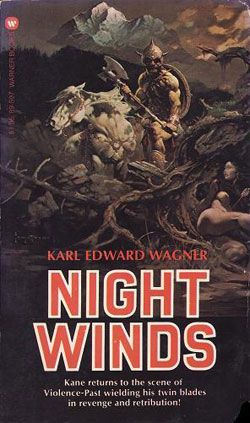
416b88d85f358107ee285b84612551ddJust like Conan, Kane is always the centerpiece of his stories and the defining element of the series. The stories are not just with Kane, but always about Kane. And as a character he is extremely fascinating. Kane is possibly one of the most extreme cases of anti-hero with a heart so black and cruel that he would easily be a villain in any other stories but his own. And from what what other people tell about the things he is doing between the stories, being a full out villain is apparently his normal mode. Not only is he an evil man, Kane is also cursed to be immortal. He does not age and recovers from injury and sickness much faster than any normal human. But he can still be killed and he does feel pain like any living man and that’s the true punishment behind his curse. Because the one thing that Kane hates more than his eternal life is the very idea of seeking escape in death. He probably could kill himself or allow others to kill him with no problems, but his pride drives him to cling on to his tormented life with bare hands and teeth until his very last breath. With all the time in the world and a powerful body, he mastered the arts of fighting and sorcery ages ago and is quite probably the most dangerous person in the entire world. But in the world of Kane, sorcerers don’t cast spells and are much more like Lovecraftian ocultists, and even a warrior like himself can not fight a dozen men by himself. He spends his eternity by gathering armies of mercenaries and bandits to carve out small empires to rule, but eventually he is always either defeated by his enemies or simply gets bored with it and walks off into the wilderness with nothing but his sword and his clothes to sink into sorrow or find himself some new kind of diversion. It is during these times where almost all of the tales of Kane are taking place.
Continue reading “Book Review: Night Winds”

Retro Game Review: Thief

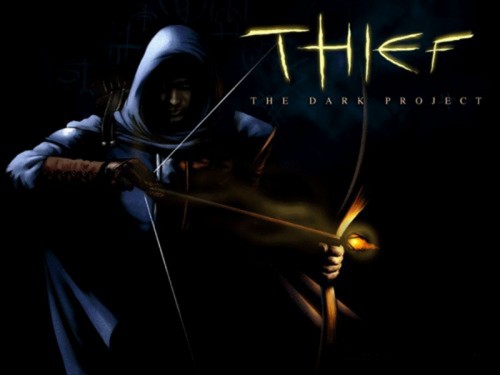
Thief: The Dark Project is one of the classic games from my teens, wich had gained an outstanding reputation back in the day, but for some reasons I’ve never really got very far past the first two levels. It’s a fantasy stealth game, and you could probably call it the stealth game that defined the genre for PC games. The same year, Metal Gear Solid was released for the Playstation, but even though they are completely different in almost any way, they both made the concept of games in which you secretly sneak around instead of killing all enemies popula. It was released way back in the great year 1998 (on the same day as Baldur’s Gate) for PC, and despite its age I was able to get it to run under Linux with WINE (with only an acceptable amount of trouble). I added some fan mods mostly for stability, but it also added some minor improvements like the night skies and water surfaces. I have to say it still looks pretty good for its age. Many games just a few years older have aged much worse when it comes to graphics. But this one is completely servicable. Audio is superb and I didn’t have any problems with controls or any glitches during play. My first impression had always been classic middle ages with a few anachronisms here and there, but as I got deeper into the story I discovered it to be actually following pretty closely to classic Sword & Sorcery traditions. It’s far more than breaking into castles and stealing gold coins and silver cups and candle holders.

Thief-the-Dark-ProjectThief is the story of Garrett, a master thief who in his youth was trained by the Keepers, a secret society of lorekeepers who also have knowledge of semi-magical stealth skills, which come extremely handy for Garrett during the game. Some halfway decent shadows are enough to make him practically invisible, even to people who are standing right next to him and looking straight at him. The other two important groups of the settings are the Hammerites and the Pagans, which is where the Sword & Sorcery elements really start to take center stage. The Hammerites are a religion of smite-happy fanatics who have tremendous power in the City, while the Pagans are a group of wild men and women who live deep in the woods outside the city walls and worship an ancient and dark god of fertility and chaos. During the course of the game, the Pagans become the main antagonists for Garrett. As he delves deeper into their hidden lairs and learns more of their ancient religion, the game is getting more and more surreal and fantastic. It reminded me a lot of some of the more bizare adventures of Fritz Leibers Fafhrd and the Gray Mouser. The intro should give you a pretty good impression.

Continue reading “Retro Game Review: Thief”

New books I got to read. And probably review.

As much as I love The Witcher, after three books I feel like taking a break for a while and look at some other books of Sword and Sorcery. I still feel like I am not really that well read in the genre and if you want to write some interesting stories it always helps to be somewhat familiar with what others have done with it and what might be interesting ideas to follow. So I actually got myself a decent stack of new books I will work myself through over the coming weeks. And most likely write reviews for them as well.

  • Night Winds by Karl Wagner. I really love Wagner. I think he’s the best Sword & Sorcery writer after Robert Howard and Andrzej Sapkowski. After reading a first story in an anthology (which was one of the few good ones in the book) I read and really loved Death Angel’s Shadow, and while Bloodstone wasn’t as great I still enjoyed it a lot. I’ve now seen people say that the stories are generally much better than the novels, so I am going with this one instead of trying out another novel.
  • The Black Company by Glen Cook. I’ve read one Black Company story in a Sword & Sorcery anthology last year and didn’t like it very much. It lacked both action and supernatural involvement and that just won’t do in Sword & Sorcery. But the series is regularly brought up as perhaps the most important one in recent Sword & Sorcery, so I’ve felt compelled to actually give at least the first book a chance. People joke that we Germans have so many snappy words for philosophy and other complex scientific concepts, and I have to admit that it is true. To me, not having read a Black Company book is a Bildungslücke, a gap in (basic) education. As a Sword & Sorcery fan and critic, you just have to know this series to be able to make any relevant comments.
  • The Lies of Locke Lamora by Scott Lynch. I’ve been actually quite surprised to see that this is already almost 10 years old. The way everyone keeps talking about it at Fantasy Faction made me think that it was very recent and one of the books everyone is talking about these days. While it goes against the Jordan Rule of not starting a fantasy series until it is completed, it does very much match my personal rule of paying real attention to books, movies, and games that people still talk about in high praise a year or two after release. I may not always be up to date, but this way I rarely read,watch, or play something that is not really great. And it’s generally much cheaper. (I think the last game I bought within a month after release was Mass Effect 3 and I was already a huge fan of the series. Before that I can’t even remember. Probably over 10 years ago.)
  • Throne of the Crescent Moon by Saladin Ahmed. I don’t really know anything about it, except that a few people recommended it, both in reply to me looking for Sword & Sorcery and nonstandard fantasy settings.
  • Trollslayer by William King. I’ve read his book Stealer of Flesh last winter and thought it was pretty entertaining. His Grotek and Felix books seem to be more well known and have been recommended to me by several people, so I’ll be giving the first one a try.

Other books I have around and which I plan to get to eventually are Times of Contempt by Andrzej Sapkowski, Kull by Robert Howard, Warlords of Mars by Edgar Burrough, and the X-Wing series by Michael Stackpole. I also have started reading Tome of the Undergates by Sam Sykes, but that has an infamous drawn out opening scene that I find indeed quite terrible. There’s a lot to complain so far but also some good things, which I think would all be very interesting to discuss. So maybe I can get myself to endure it and maybe it gets better towards the end. I also want to write a review of the Thraw Series by Timothy Zahn in the next few days.

Book Review: Blood of Elves

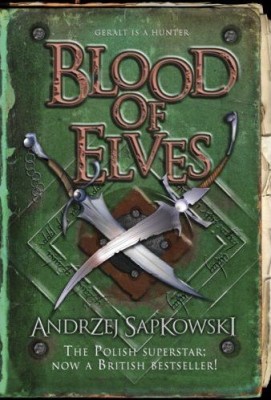
Blood of Elves is the third book of the Witcher, Geralt of Rivia, by Andrzej Sapkowski. Unlike the two previous books that were collections of stories, this one is the first novel, but they all can really be seen as a single series following a common storyline. In The Last Wish and The Sword of Destiny, continuity consisted mostly of regular characters that would travel alongside Geralt for a while and there were several references to previous story. In this book the plot begins to become concrete. Geralt and his friends stop wandering around wherever the road and coincidence take them and start pursuing a common goal. Now they have a purpose.

Blood_of_Elves_UKRight from the start it is made clear that this story is revolving around Ciri, a girl whose story began in The Last Wish and who first appeared in person in The Sword of Destiny. The one who is going to be Geralt’s Destiny, even though nobody knows what this is going to mean. But the circumstances of her childhood and previous encounters with Geralt are too strange for anyone to dismiss as coincidence. War is brewing in the Northern Kingdoms. The mighty empire of Nilfgaard has already conquered all the lands in the south and already devastated and occupied Cintra and nobody believes that they are going to stop. To make matters worse, the Nilfgaardians have open support within the Northern Kingdoms in the form of the Scoia’tael, radical young elves and dwarves who are hoping for autonomy as provinces of the empire instead of opression under the feudal lords and kings. Maybe they are impatient or under direct order of the emperor, but many have already begun striking at the human lords and their subjects wherever they can, causing chaos and destruction and forcing others of their kind to pick a side. All nonhumans become suspect and the situation in the towns is only going to get worse for them. In these dark times Ciri is having regular terrifying visions she can neither make any sense of nor remember, and out of ideas the witchers turn to their friends among the sorceresses for help. Meanwhile a mysterious assassin appears in the Northern Kingdoms, looking for both Ciri and Geralt.

Continue reading “Book Review: Blood of Elves”

Book Review: The Sword of Destiny

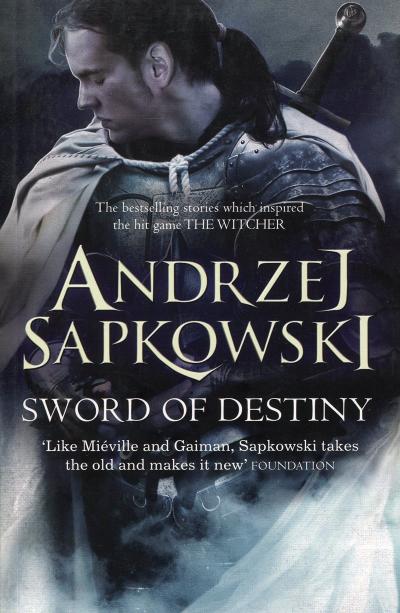
The Sword of Destiny is the second collection of stories of the witcher Geralt of Rivia by Andrzej Sapkowski that predate the novels. The events of the stories are only losely connected, but there are frequent nods to previous stories that establish some degree of chronological order, that appears to cover a couple of weeks or months, several years after the stories from The Last Wish. This is quite similar to how Fritz Leiber often connected his Lankhmar stories. Unlike the previous book, this one does not have an overarching “meta-story” in which the other stories are inserted as kind of flashbacks. I thought it was a pretty clever device (and I believe added long after the individual stories were originally written), would have been fun to see something similar done with this one as well.

I am having a bit of a hard time reviewing this book in my usual format, because frankly my main impressions pretty much comes down to “The Last Wish was much better”. Giving away my final opinion of the book right here at the start, I don’t think it’s a bad book. But not as great as The Last Wish, that comes before it in the series, or Blood of Elves, which comes after it and I have been putting on a break after being about two thirds through it to read this one first. And having read the entire thing as a whole, I think it’s really worth reading for fans of the first book who want to continue with the series. But more on that later.

The Last Wish
The Last Wish

The Sword of Destiny consists of six stories, which in a similar fashion to the first book all have titles that sound corny and pretentious at first, but have a real meaning that only becomes apparent after you completed them. You can’t get any more cliched with a fantasy book title than “The Sword of Destiny”, but though the term comes up several times there isn’t any actual magic blade to be found anywhere. The Witcher is not that kind of fantasy. Overall, the book is a lot more introperspective than the other two books I’ve read so far, which I think is a major reason why it felt so odd, especially at first. For stories about a monster hunter in a brutal world, the Witcher always has remarkably few and often quite subdued action scenes, but here even more so than usual. Very little is done and the center of the book is really Geralts inner life. Which particularly in the first two stories is not very well done. Geralt is gloomy, talks almost nothing, and I can’t help to think of the word “moody” or maybe even “moping”. He’s always there, but all the talking and acting is done by other characters while the main hero stays in the background with a bleak mood. In the third story he seems to have gotten over it and from then on I enjoyed the book a lot more. But even then I never felt like “Fuck, yeah! Geralt is badass!” However, Dandelion appears in half the stories and he’s always having a blast. Continue reading “Book Review: The Sword of Destiny”

Awesome future novel idea #2

We were just talking about possible action movie sequels we would like to watch, and someone brought up this piece of pure genius:

Djingis Khan vs. Predator

It sounds like Frankenstein vs. Space Vampires at first, but I think it’s actually a briliant idea. I thought the Predator series had already done everything that could be done with the concept by having 1vs1 in the Jungle, 1vs1 in L.A., and Team Death Match on a Jungle Planet all covered. But who is to say that the Predator from the first movie was the first that ever came to Earth for hunting? All these dudes care about is finding the biggest baddest motherfuckers in the universe and challenging them to a fight to the death. And the whole point of the series is that these fights are not about fancy weapons but about the challenge. When one of the Predators sees a guy with a sword in an open field in the third movie, he’s all up for it and doesn’t use any of his high tech gear. And there have been plenty of badass warriors throughout all of human history, which a Predator probably would enjoy very much to fight. Doesn’t have to be the Mongols and it could just as well be the Romans, the Celts, ancient Indians, or pretty much anybody else.

Since I don’t expect it to be made into an actual movie, I think it’s still a great idea that could be made into a novel, and a completely serious one. A classic fantasy monster hunt, but it turns out that the demon is actually an alien and it’s supernatural powers are actually the result of the strange artifacts it carries. I think it could work either as a pseudo-historical story or be set in an all out fantasy world. Mixing fantasy and science-fiction is no new idea, but that always had a 30s or 60s retro-style to it. This seems like a very interesting way to explore the idea in a more modern style.