Miners, Magnates & Mercenaries: Hyperspace Opera 2022

All the way back in September, I wrote about how once or twice a year, I keep taking a break from the Sorcerers & Dinosaurs fantasy stuff I spend most of my time with and go tinkering with ideas for space adventure campaigns. I outlined an idea I had which I had given the production title Hyperspace Opera, but didn’t develop it very much further. Well, it’s been eight month since then, and here we are again.

Space. The Final Frontier.

While I didn’t create anything presentable to share, I did keep thinking about my initial ideas and concepts over the months. Discovering new source material to use as references. Discarding elements that didn’t really quite fit with the new sharper image that was emerging. Considering options for rules systems and how the setting could build on and support their game mechanics diagetically. And just overall refining the general idea into something more concrete that you can actually start creating content for. The main underlying inspirations are still the same, but in many ways I think the concept has evolved quite a bit. The term space opera doesn’t even really make any sense anymore, but since it’s a working title anyway I’m sticking with it until this thing gets an actual name. So forget about whatever I might have mentioned about an idea for a setting once over half a year ago and consider all of this with new eyes.

Inspiration and Concept

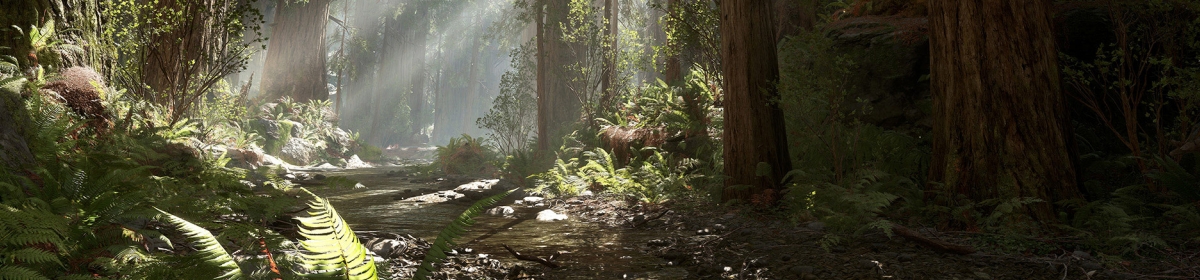
Everything started with the idea that I am a huge fan of classic Star Wars, but I think the original setting has been expanded in ways that are stylistically and thematically mismatched since 1999. It’s okay for me to just ignore all the Clone Wars stuff and everything made for Star Wars after 2003 as if it’s an alternative timeline, but you can’t really expect that from players you invite to play a Star Wars campaign. And there were plenty of terrible ideas being introduced even in the classic EU period. So my idea was to create a new setting that takes all my own favorite elements from Star Wars and expands them into something new, unconstrained by all the baggage of material I’m not particularly fond of. Of course, for me the ultimate gold standard for Star Wars is The Empire Strikes Back. Cloud City, Lando, Boba Fett, and the Millenium Falcon are the main touchstone for the overall style, tone, and atmosphere I am trying to pursue, followed by Jabba’s Palace and the forests of Endor from Return of the Jedi. As such, the overall campaign structure that the setting is going to be build around is “daring Scoundrels with a cool Ship”. No superiors ordering the characters what to do, and the law really is more like guidelines than actual rules.

I had also been thinking about both Cyberpunk 2077 and Dune at the time and somehow ended up with the image of 1920s industrialists as the new aristocracy of space. What’s really the difference between Leto Atreides and Saburo Arasaka? The terms magnate, mogul, and tycoon all originally meant nobles of outstanding influence and power, with baron being of more modest means but still referring to the same idea. The aesthetics of cyberpunk and many interpretations of Dune are rich with influences from Art Deco, which happens to be the mainstream design style going into the 1920s. And also influenced Cloud City in The Empire Strikes Back.

The time of the industrial barons was also the prime of the Labor Movement, and the cyberpunk of the 80s was all about economic inequality and the tyranny of the rich. So with these influences, it comes very easy to expand the concept for the setting in that direction as well. Season 1 of The Expanse and the movie Outland make for great sources for ideas in that regard, though their aesthetic is very different. It’s very easy to make stories about the people uniting to revolt against the evil industrialist that exploit and oppress them, but that’s banal because right and wrong are obvious and there’s no interesting conflicts. What I have long been very interested in is the repeated corruption of the labor movement, with communist leaders becoming the very tyrants they were meant to topple while still feeding the starving masses slogans about equality, unions being turned into pawns in political games, and left wing militias degenerating into drug cartels primarily fighting each other. Which isn’t a unique issue of the labor movement. The same thing happens all the time with vile hate preachers calling for violence and vengeance in the name of Jesus and his message of compassion, love, and forgiveness. (Seriously, have any of these people read the Sermon on the Mount?! He’s talking about you, my dearies. But I digress…) But touch your own nose, clean up your house first, and all of that. Infighting among the exploited and the rise of wannabe tyrants who relish their power over those even weaker than themselves is where I am looking for the main sources of conflicts that players can find themselves entangled with.

Scum and Villainy

And when your campaign concept can be summarized as “moral corruption and infighting among the 1920s labor movement, but in space”, you know that PtbA is really the only acceptable choice for a rules system. I’ve been fascinated with Apocalypse World ever since I first encountered it and the underlying system and approach to running and playing an RPG is really something remarkable. Blades in the Dark is widely regarded as the most sophisticated iteration of the system and Scum and Villainy is basically a repainted version of that, which takes the game from a Dark Fantasy Steampunk Crime Syndicate setting to Space Smugglers and Scoundrels. I’ve been notoriously fickle throughout the years about sticking to specific rules systems as I am developing new campaign ideas, but I don’t think there are really any other serious contenders in this case. Stars Without Number would certainly be a viable option, which I did originally tinker with when I started last year, but when there’s already a PtbA game tailored to this campaign style, I don’t see any real benefit in using a D&D retroclone based system instead.

Known Space

The setting of Hyperspace Opera is a region of a galaxy that is home to a dozen intelligent species that are engaged in interstellar travel and trade. As interstellar space settings go, the technological level in Known Space ranges from moderate to low. The greater civilizations all have extensive space industries and infrastructure that maintain large fleets of commercial space ships in the tens or hundreds of thousands, but a good number of planets do not have the technological capabilities to build hyperspace drives or artifical gravity systems of their own and rely on components or even entire ships purchased from other species.

The full population of Known Space is estimated to be around 100 billion people, the vast majority of which live on the homeworlds of their species or within the home systems. While there are large numbers of planets throughout Known Space where people can survive, they never quite match all the environmental factors that each species has evolved to for millions of years. While there are always people drawn to travel to the stars and live on alien planets, they are never more than a small majority, and since all civilizations that are capable of leaving their homeworlds and colonize other planets have fully industrialized many generations ago, there simply isn’t much population growth on newly settled worlds. Even though there are dozens of colonized planets with populations in the millions, they barely register in comparison to the eleven home systems with populations of billions.

The driving force behind space commerce and colonialization is the endless need for vast amounts of cheap metal in the home systems. While hyperspace jump drives are very complicated pieces of technology, the cost of manufacture and making hyperspace jumps is relatively modest. The costs for transporting huge amounts of material between star systems is so low that it is cheaper to mine easily accessible resources of high purity in distant star systems than trying to fully exploit hard to access resources of lower purity within the home systems. Huge industrial mining fleets are swarming throughout Known Space, harvesting the most easily accessible resources for a few years, and then moving on to greener pastures where profits are higher.

In their wakes they leave behind planets they considered depleted and of no further value to their high profit margin operations. They leave behind piles of broken and worn out equipment not considered worth repairing, but often also whole communities of miners and independent support workers running local businesses. Those who can afford to often pack up their things and follow soon after, leaving only those without the means to leave or nowhere else to go. Even though these planets are no lnger considered commercially viable by the great mining companies, they usually still contain large amounts of resources that simply require a greater amount of work to extract, reducing the amounts of profits that can be made by selling them. These resources are what is keeping the many small frontier outposts alive once the great fleets have moved on. They are also what attracts the vultures, companies much smaller than the mining giants, which have specialized in trading pretty much any kinds of goods and equipment imaginable in exchange for resources of any purity grade. They are usually organized in cartels that divide the frontier systems between them to avoid competition that would drive down the extortion level prices they offer to the independent mines. Far away from the home systems, there are no commercial regulations to stop them.

The settlers of small frontier worlds frequently attempt to pool their resources to form commercial cooperatives to increas their bargaining power with the trade companies or enable the manufacture of goods theh would no longer have to trade for exorbitant prices. Obviously the companies have no interest in seeing this happening and don’t shy away from bribery, sabotage, intimidation, and outright assassination to undermine any such efforts. This is where the Player Characters enter the picture. In this environment, people with fast small ships who aren’t afraid of company goons and mercenaries are exactly the kind of people the settlers need. Or which the companies could have use for when they don’t want their machinations to be too obvious.

Technologies

The most important technology for interstellar space travel are hyperspace drives. These engines allow ships to jump in and out of another dimension with very different laws of physics, including a much higher speed of light and vastly reduced energy requirements to rapidly accelerate. Jumping between systems usually takes only a few hours and all of known space can be crossed in a few days. Though unfortunately, ships in hyperspace are completely blind, and the gravity of stars and planets can severely send ships off course in unpredictable ways, which makes it necessary to travel to the outer reaches of a star system at sublight speed first, which for most ships takes several days. Predicting the exact arrivial point in the vicinity of the destination star is also impossible, leading to additional hours to possibly weeks of reaching the intended planet at sublight speed.

Communication through hyperspace is impossible. The only way to send messages between systems is to carry prerecorded messages one space ships. Highly populated systems have hundreds of mail barges traveling between them every hour, but in the frontier system, days or even weeks can pass between their arrivials.

Since communication within systems happens at lightspeed, all planets have their own independent and separate communications network. In the home systems, these networks are accessible from anywhere on the planet, but on colony worlds access is usually limited to only the vicinities of major settlements. Smaller frontier settlements often have only local radio communication and nothing else.

Two two main weapon systems are railguns and missiles. Railguns come in all kinds of sizes, from small pistols up to huge cruiser cannons. Most planets do not allow the carrying of guns in public and the energy cells of railguns are quite easily detected by security scanners. Railguns are also generally a bad thing to use inside space ships as they can cause catastrophic damage to survival critical equipment. For these reasons, large knives and short swords are very common weapons for people working and living in space.

And that’s the general baselines for the setting. Not drastically changed since the last time, but this is hopefully a more cleaned up version of how things are currently looking and what I intend to build upon in the comming months.
Character motivation in a game with no goals

There have been two thing about campaigns that have been torturing me for many years and caused me endless frustration about never really getting to run the kind of game I really want to. The first of the two is how to make dungeons interesting places to explore, which I finally did discover eventually. (In short, it’s the tension of being careful but not lingering too long in dangerous places, and rewarding poking around in dark holes with treausre as the main XP source.) The other one is the question of what motivates characters in campaigns centered around rogues and scoundrels to go on dangerous adventures other than unashamed selfish greed. You don’t need any additional reason to fight evil snd save the innocents in campaigns in which the party consist of chivalrous heroes, but for many types of campaigns such characters really wouldn’t be fitting the basic premise.

I was recently thinking about how Kenshi could provide useful ideas for the B/X campaign I am working on. It is a videogame with no victory conditions, no quests, no plot, and no real dialogs, but the way the mechanics of the game are set up, it automatically creates the most fantastic stories full of tension and drama all the time. Amd that got me thinking about push and pull factors when it comes to motivating characters in any kind of story.

Typical stories of heroism are all about pull factors. The heroes see an evil, injustice, or threat against others, and being heroes feel compelled to get involved and do something about it. The fact that they choose to take action when everyone else didn’t care or didn’t dare, amd they themselves don’t really have to either, is what makes them heroic. Heroic characters are always popular and characters who are motivated by pull factors tend to charge towards the greatest danger, where all the cool action is. Which is why we see stories with pull incentives being so dominant in fiction. Pull factors also make things easy for GMs since you know what the PCs will be attempting to achieve and which possible paths can lead there even before the players have been introduced to the adventure. Adventures motivated by pull factors are very predictable.

Push factors work rather different. A push incentive is anything that makes it impossible for characters to remain in the situation they are in and force them to leave their default starting position. In most media, a simple push incentive can be that characters hate their current life and want to head out to head for excitement. This works very well in most narrative media where the writer is always in complete control of the whole story and nothing bad will happen to the characters unless the writer wants it to. Players in an RPG have no such control and there are real dangers for their characters that can cause severe damage up to death even when the players really don’t want that at that moment. Within the context of an RPG, players have a strong incentive to minimize the risks to their characters. At the same time, it’s a medium that’s at its strongest during scenes of external action, while being generally very weak at internal reflection. You can write inner monologs and characters struggling with their emotions, and there are many great techniques to communicate such things visually in film. This is something that just doesn’t translate to RPGs.

While internal push factors like unhappiness, dissatisfaction, and boredom don’t really work in RPGs, there are still external push factors. In Kenshi, there is a single external push factor, which is the need for food. All characters need food, and with Kenshi being a desert moon, there is ver little available. It is very easy for your characters to stay safe in a spot where they won’t be spotted by wirld predators or raiders. But there is no food in the barren desert and so you have no choice but to try getting some. You can try killing wild animals, stealing food from settlements, taking food from unconscious NPCs, or buying food from shops. The first three require skills and come with considerable risk. The last one only takes money, but to make money you also need skills and expose yourself to risk. You can try to reduce your risk by getting better weapons and armor, which again costs money, or you can try building a farm to produce your own food. But then your new farm will attract raiders like flies, so you need to build fortifications and get more characters to keep your food from getting stolen. And those new characters also need better equipment, which means finding ways to make money. And you can see how this snowballs very quickly until you might end up with dozens of characters, several strongholds, and multiple ore mines and workshops to equip your people with the best gear possible. All of this hinges on that little hunger bar on each character that is alwsys going down slowly.

For an RPG, the best push incentives can be the ones that continue pushing indefinitely. Something that just keeps forcing PCs to get up, move out, and do something. The other RPG thing I’ve been tinkering with on and off besides Planet Kaendor is a space campaign about a group of PCs with a small ship cruising around a frontier region of known space. The idea I have for the campaign is one with little room for idealistic charity workers with big guns, but I am also not really interested in making it a campaign about outright nasty criminals. Characters who are mostly just trying to get by but keep ending up in exciting situations is more what I have in mind. Such a premise really needs motivations in the form of push factors. A very convenient one in this case is spaceship maintenance costs. If at any point the players don’t really know what their characters would be motivated to at that moment, when they are set up nicely and life is good away from any immediate danger, simply advance the time a couple of month and deduct the maintenance cost for their ship from their money. Eventually money will start to run out and they have no other choice than start asking around for something that will pay.

Rangers were a mistake

Rangers were first introduced to Dungeons & Dragons in AD&D 1st edition. They’ve been in the four editions that followed, got a major overhaul in 3.5e and there is a revised ranger for 5th edition. They are a long established core element of D&D, just like dwarves, wizards, and beholders. You can’t really imagine a new edition of D&D without them.

But rangers should never have been introduced in the first place. Rangers were a mistake.

Rangers have always been a somewhat popular class, but I don’t recall ever hearing anyone say that they are happy with the abilities of the class. Many classes had disappointing versions in one edition or another, but rangers have been bad every time. (Though I hear it’s good at combat in 4th edition.) Rangers always being bad has a simple reason. The whole concept it bad. What role are rangers supposed to fill in a party?

Rangers as a class came into existence for a single reason. Someone wanted to play Aragorn from The Lord of the Rings. In D&D terms, Aragorn is a fighter, except that… Well  nothing except! He lives in the wilderness and is friends with elves? Fighters can do that. He has special herbalism skills? Well, that’s actually a race ability of Numenorians, not a class ability. From what I remember, the book doesn’t mention him doing any sneaky stuff. But of you want a fighter who also sneaks, that’s a multiclass fighter/thief. That’s been an option since first edition.

So Aragorn brings nothing to the table in regards to making a class. Already at that point, the idea of rangers as a class should have been discarded. But it wasn’t, and so generations of game designers tried coming up with things that can make rangers different from fighters. And that’s the problem. Generations of game designers have been trying to find something for rangers to do that doesn’t already fit other classes. So they’ve been throwing everything wilderness themed they could think of at it to see what sticks. Animals as henchmen. Following tracks. Maybe some druid spells. Attack bonus against certain monsters. Well, Drizzt was fighting with two swords… Now you’re no longer eve  trying.

The ranger is a bundle of abilities that a warrior living in the wilderness might have, but there is no underlying concept for what what role the class is to fulfill in a party. It’s a bunch of abilities that are all weak in their own right, to not step on the toes of fighters, rogues, and druids who all have their respective niches, but which don’t synergize together to create something more useful than the sum of their parts.

The ranger is a class in search for a justification for its own existence for 43 years. And there isn’t any.

Monsters and Treasures in the B/X Dungeon

Getting to work on some dungeons for my next campaign, I want to stick as close as possible practical to what the Basic and Expert rules actually advise as guidelines to see how that really plays out in actual play. I have found that most of the moving pieces in this game are set up very deliberately to form a larger system, and not everything does what you first expect them to do coming from later games. I have learned that it’s almost always best to first pinpoint what you don’t like about the results of a mechanic before you start modifying the mechanic. It’s hard to improve something when you don’t know how it actually performs as designed, and you can easily miss out on something cool if you replace it before having it properly tested. So straight up B/X with only the TSR attack roll procedure replaced it will be for the start of the campaign.

The GM guidelines for making a dungeon in the Basic Rules recommend about 1/3 of rooms to have creatures, 1/2 of which possess treasure; 1/6 of rooms to have a trap, 1/3 of which are guarding a treasure; 1/6 of rooms with a special feature like magical effects or weird machines; and 1/3 of rooms being empty, 1/6 of which have a hidden treasure. For simplicity, lets assume here reaction rolls are made with no Charisma modifier, so half of all creatures encountered will be hostile. In practice, it’s can be considerably less.

In an 18 room dungeon, these fractions come out as nice even numbers, and it’s also a good scale for a mid-sized dungeon or level of a larger dungeon. This gives us the following lineup of rooms.

  • 3x monster with treasure
  • 3x monster
  • 1x trap with treasure
  • 2x trap
  • 3x special
  • 1x hidden treasure
  • 5x empty

Assuming the party spends 1 turn in each of the 18 rooms and 6 turns exploring and mapping the corridors, we get a total of 24 turns. After every 5 turns, the party needs to rest for one turn, which is 4 additional turns for a total of 28. There is a 1 in 6 chance for a wandering monster every 2 turns (or just 1 in 12 every turn), so we can expect 2 random encounters over those 28 turns. With the six monster rooms, that’s a total of 8 monster encounters, and rolling their reaction gives us an average of 4 fights.

(Those 4 fights cause additional wandering monster checks, which at a 1 in 6 chance produce an average of 2/3 encounters, or a 1/6 chance for another hostile creature. Small enough to ignore here.)

I think thia is quite an interesting tally for an 18 room dungeon: We can expect about 30 turns spend in the dungeon, with 4 fights, 4 nonhostile encounters, 3 traps, 3 special features, and 5 treasures. This is much less than I expected. And I love it! With a distribution of content like this, I can see how a place can feel like an old abandoned ruin. Very different from the fortified outposts that make up most dungeons I am familiar with.

Something that had never occured to me before is that 2 out of 5 treasures located in a dungeon will be in the possession of creatures that mean the party no harm. That puts the players into an interesting position. They probably won’t try to rob a group of nonhostile elves who are exploring the dungeon themselves, but what about a pair of ogers who can’t be bothered to try beating up the PCs? Players might still want to steal from them, and perhaps even kill them to prevent future attacks on travelers on the nearby road. Very interesting stuff.

The Basic Rules also recommend that about 1/4 of XP players gain in a dungeon should come from monsters, the rest from treasures. You could use the treasure tables to generate treasure hoards, but that’s something I always found too bothersome, as a dungeon full of simple insect monsters would have completely different amounts of treasures than a dungeon that is a big bandit lair. My prefered method is to tally up the XP values of all the room creatures and multiply that by 3 to get the amount of gp for all the treasure in the dungeon. (Nothing for wandering monsters, because those are supposed to be undesireable to enconter.) Then I just put the coins in the treasure hoards on the dungeon map as seems appropriate, with the arbitrarily chosen magic item added here and there. (I actually put another amount of treasure equal to the XP of the room creatures into hidden secret rooms that I don’t expect the players to find most of the time, as an additional challenge.)

Interesting stuff. I can’t wait to see how this will play out in practice.

Goblins

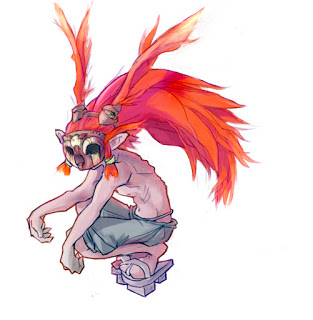
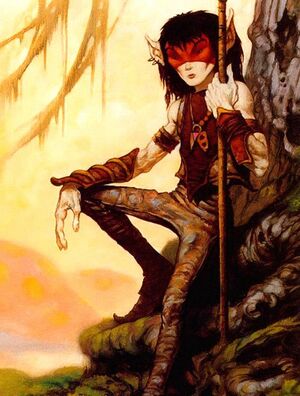
Goblins are one of the many peoples populating the lands of Kaendor but they are barely seen in the cities and towns of Senkand, making their homes well beyond the edges of civilization. A large number of goblin villages exists west of the mountains in the forests of Dainiva, particularly in the caves of the lower mountain slopes and foothills, but they can also be found further west in places where the dense forest blocks out most of the sun, all the way up to the great river cutting the vast woodlands into two halves. Other settlements are located beneath the rocky highlands of the Yao, and they are also said to live in the far northen lands of Venlat.

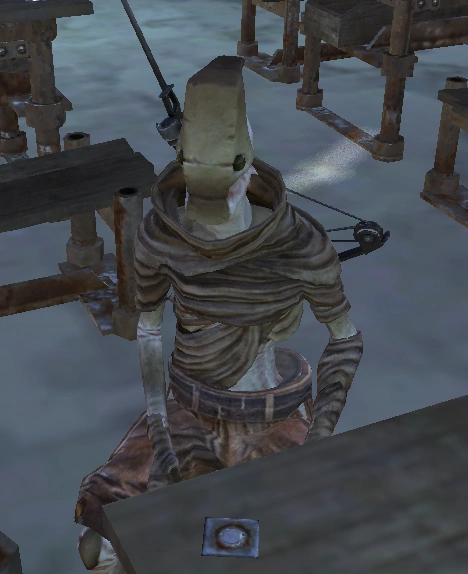
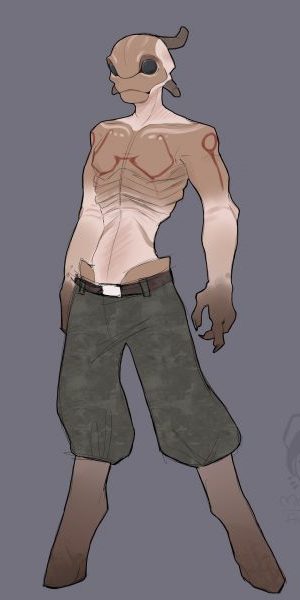
Goblins are humanoid creatures of short stature, usually standing around four foot tall but occasionally reaching up to five feet in height. They have tough hides ranging from a dusty brown to grey that helps them blending in with rocky environments as they oftn wear nothing more than loose trousers and perhaps a simple shirt in similar natural colors. While goblins have faces similar to other humanoid peoples with small noses and big black eyes, most people regard them as rather expressionless and blank. Goblins that could be considered chatty are rarely encountered, giving them a reputation for being somewhat dull, but they are no less smart than other peoples. Many Yao who have had dealings with goblins describe them as refreshingly composed and unobstrusive.

While goblins frequently come outside to the surface, they mostly do so during the evenings and at night and prefer to stick to densely forested areas as their true home is found underground. Not only are they well adapted to living in caves, they also follow ancient customs of adapting underground spaces to their own needs. As they don’t make any metal tools of their own, and bronze blades and chissels from the surface are limited, their masonry and sculpting looks very primitive to the stonework of asura and naga and even the cities of Senkand, but their constructions are often much more sophisticated than their rough looks seem to imply.

Being fully at home in caves, goblins are incredible rock climbers, and their small and thin statures allow them to move through very tight spaces with relative ease. Many caves in Kaendor, particularly below the great mountain ranges, go incredibly deep, with many of them reaching all the way down into the Underworld. While being an incredibly dangerous environment to most peoples other than goblins, the goblins themselves make frequent journeys into the greatest depths of the Earth and are familiar with many of the main passages. Explorers trying to reach caverns and ruins deep underground without goblin guides face little chance of success, or returning.

In the woodlands of Dainiva, goblins are the only people truly native to the land. The more northern reaches of the forest close to the mountains have become home to a number of Fenhail villages, but these have only appeared in the recent centuries, after the First Sorcerers were already gone. The goblins of the forest have called Dainiva their home for much longer than that, even during the time of the Asura Lords. They still possess much ancient knowledge about parts of the woodlands that no Fenhail has ever set eyes on. While few goblin villages are exactly welcoming of visitors, few are openly hostile or ambush strangers found passing through their territory. They are most likely to stay out of sight amd wait for intruders to be on their way, but some are more open to talk, even if rarely enthusiastic. Many goblin villages are very interested in bronze blades and tool, though they rarely have much to trade other than food and leather. As one is moving deeper into the forests and away from the mountains, things are further complicated by very few goblins speaking any languages other than their own.

Goblin
Armour Class 13
Hit Dice 1-1 (1-7 hp)
Attacks Weapon +0 (1d6)
Movement 30’
Saving Throws D14 W15 P16 B17 S18 (0)
Morale 7
XP 5
Number Appearing 2d4 (6d10)

Infravision: 90′.

Hate the sun: –1 to-hit in full daylight.

Goblin king and bodyguards: A 3HD king and 2d6 2HD bodyguards live in the goblin lair. The king gains a +1 bonus to damage.

Surprise: Goblins surprise characters on a 3 in 6 chance in caves and rocky surroundings.

Source

Handling Random Encounters

I created a new tag for articles named “The Yora Rules” and pinned it to the top of the page. Over the years I developed a number of small mechanics and tweaks to the B/X rules and interpretations of rules that don’t clearly spell out a specific procedure. A big reason behind many of my procedure is to reduce the mental workload on my own brain in regard to how I am personally affected by ADHD. Some of my changes might seem superflous and no more easy or faster than the default rules, but they do work often a lot better with the way my brain works, resulting in a much faster and smoother game. I still think they are more elegant in some ways and could be very useful to anyone.

Some I’ve shared here before and have gotten a quite positive reception, so I thought it might be useful to have them all in one place. Frequently I lay out my entire thought process in excessive detail, which I think might be of interesting to some, but isn’t very useful to just looking up how I do certain things or to share it with other people. A year ago I wrote about how I handle random encounters, but that one’s just a wall of text, so here is the actual mechanics in one simple bit.

Step 1 (Preparation): Roll up groups of Creatures

Consider which areas of wilderness the party will likely travel through, how many random encounters are likely to happen on the way, and which dungeon levels they will be exploring in the next game. Use the respective Wandering Monster tables to roll up the creature type and creature number for as many encounters as you expect you will need and put them in short lists for each area.

Step 2 (Preparation): Roll Surprise for the Creatures

Roll 1d6 for each creature group on the list. On a 1 or 2, mark them as being surprised when the party encounters them.

Step 3: The Players roll for Wandering Monsters

In the Wilderness: Roll a die four times per day spend in the wilderness. One for morning, noon, evening, and night. Roll a d12 for most wilderness, or a d10 or d8 for particularly densely populated areas. If the party is in a dungeon at the time of an indicated random encounter, either ignore it or have the creatures run into the camp outside with the hirelings, mounts, and pack animals.

In a Dungeon: Roll a d12 at the start of every exploration turn. (The total number of encounters will be the same as rolling a d6 every two turns, but you don’t have to remember if you rolled last turn or not.)

Causing Attention: If the party does something to draw attention to them, like causing a big fire in the wilderness or making loud noise in a dungeon (such as fighting), make an extra wandering monster check right then and there. Any creatures allerted that way will arive in the next turn or later, in addition to the regular wandering monster check every turn in a dungeon.

Something always happens on a 1: When the die roll is a 1, a random encounter happens. Tell the players that a 1 means encounter before rolling the die in the open. Or better, let a player roll the die. Show the players plain to see that you didn’t make this encounter happen at a moment in the game that you thought would be fun. You’re not making things hard for them when they are weak, or delay challenges until they are ready for them.

Step 4: Referencing the Prepared Encounter List

I am putting this here as step 4, but actually you don’t need to look at the list at this point. Because you already prepared the list in advanced, you knew the kind of creatures and number of creatures in this encounter and whether they will be surprised or aware since the previous random encounter was completed. This is the reason why I prepare this list in advance. Any time the players are talking among themselves to decide on their next step, I can put some thought on how I would use this group of creature if it is encountered in one of the two or three rooms the players might choose to explore next. I do not have to make something up on the spot right as I roll the die on the wandering monster table, which usually ends up just being “there are X number of Y standing in the middle of the room”, which is boring. Having just a minute or half to think about it without all the players staring at you waiting in anticipation to hear what they just ran into can make a big difference.

Step 5: The Players roll for Surprise

One of the players rolls a d6. On a 1 or 2, the party is surprised. (For some creatures encountered, it’s on a 1 to 3.)

If the players are not surprised but the creatures are, the players have one round to act before the creatures spot them. They can use that round to quickly retreat back around the corner they just passed or move into a nearby suitable hiding spot. If they do, the creatures remain unaware of the party until the players do something to reveal their presence.

Step 6: Roll for Distance

In the Widerness: Creatures that are not surprised spot the other group from 4d6 x 30 feet away. If both groups are surprised, they spot each other at 2d6 x 30 feet.

In a Dungeon: Creatures that are not surprised spot the other group from 2d6 x 10 feet away. If both groups are surprised, they spot each other at 1d6 x 10 feet.

Step 7: The Players make a Raction Roll

If the creatures’ attitude towards the party is not obvious because of circumstances (like mindless undead or guards searching a castle on alert), have the players make a reaction roll.

If the party has been surprised but the creatures are not, roll 2d6 for the reaction roll. (No Charisma modifiers apply.)

If the party is not surprised, one character may greet the creatures. That character rolls 2d6 plus the Charisma bonus to reaction rolls.

2: The creatures start to attack immediately.

3-5: The creatures are hostile. They threaten the party with violence to hand over their treasure, be taken prisoner, or to immediately leave the area, depending on what seems appropriate in that situation.

6-8: The creatures are uncertain and observe what the party does next. After the party has reacted in some way, the character doing the talking makes another reaction roll with a bonus or penalty depending on what was said or done.

9-11: The creatures don’t want trouble. They might ignore the party of leave the area, depending on if they seem to be a threat or not. Intelligent creatures might be cordial but not interested in further interactions beyond common pleasantries.

12+: The creatures are friendly. They might invite the party to their camp or lair, offer useful information, or propose to join forces.

Step 8: Resolve the Encounter

The encounter either ends in a fight or a conversation. (Which might result in a fight later.)

Additional Note: Surprised Parties

There is one kind of encounter situation that the B/X procedure does not enable, and that is creatures spotting the party without being noticed and following them around for a while. When the players make the wandering monster check and it rolls a 1, they know something is there. You can’t tell them “you don’t notice anything”. Also, the players are supposed to roll the reaction roll themselves where they can see it. When that 1 is rolled for wandering monsters, the encounter has to happen now.

This is one of the main reasons I don’t roll up the creatures and their number in the middle of play after a wandering monster check and prepare them in advance instead. Same for rolling their surprise.

If I know I have a creature that would stay hidden if it catches the party by surprise, and that creature will not be surprised itself, then I can spend some thought on what it will do if the party fails their own surprise roll, depending on the reaction roll:

Immediate Attack: The creature has been stalking the party for a while and decides to jump them now, getting a free round to attack before the party can react.

Hostile: The creature decides this is a good moment to confront the party. It’s positioned in a way that is most advantageous to itself and no roll for encounter distance is necessary.

Uncertain: Keep rerolling until you get a different result. The creature has been observing what the players do while it was hiding.

Avoiding Trouble: This is inconvenient since the creature can just escape without the players ever knowing it was there. I guess the best option is to let one player catch a glimpse of it before it disappears, and if the party pursues they won’t find any trail to follow.

Friendly: The creature just comes out in the open to greet the party.

Only the first two really depend on the geometry of the area they are encountered in. If the players end up not being surprised for that encounter, they will run into the creature in the middle of doing whatever it is doing. So there are really just three possible things worth considering in light of the next environment the players decide to enter.