
I always had a lot of fun converting existing gridless maps into hex maps in GIMP, and I really like the way they look at the end. But trying to design a map that looks interesting and pretty in GIMP or Photoshop is just a joyless chore in general and only gets worse if you try working on a hex grid. While it’s nice that you can erase anything you draw without smudging, the process of using an eraser in software always takes way too long and too many steps. It’s just not been working for me.
So I decided to make an investment in time and money to get myself some nice big sheets of hex grid paper that I can free hand draw on with pencil. It’s always been much easier and faster to just sketch and erase outline until I get the shapes into an arrangement that I like. I can then scan the final map that I like and put it through my hex map conversion process like I did with my other hexmaps.
After some searching and asking around for the best way to do this, I got a recommendation for Free Online Graph Paper / Hexagonal. This is a really neat tool. It allows you to set custom dimensions for whatever paper you want to print on, size of the hexes, size of a blank border, and strength of the lines. It then exports the file as a pdf, which I believe stores the grid in vectors instead of pixels, so it will remain sharp regardless of how much you zoom it.
The default setting for line width is 0.7 mm, which I thought sounded a bit chunky. So I made a file with line with 0.7, 0.5, and 0.3 mm each, with the dimensions of A2 sheets which we use in Germany, and took them to a printer. I had one sheet printed of each of them, and liking the 0.5 mm best had a bunch more of those printed as well.
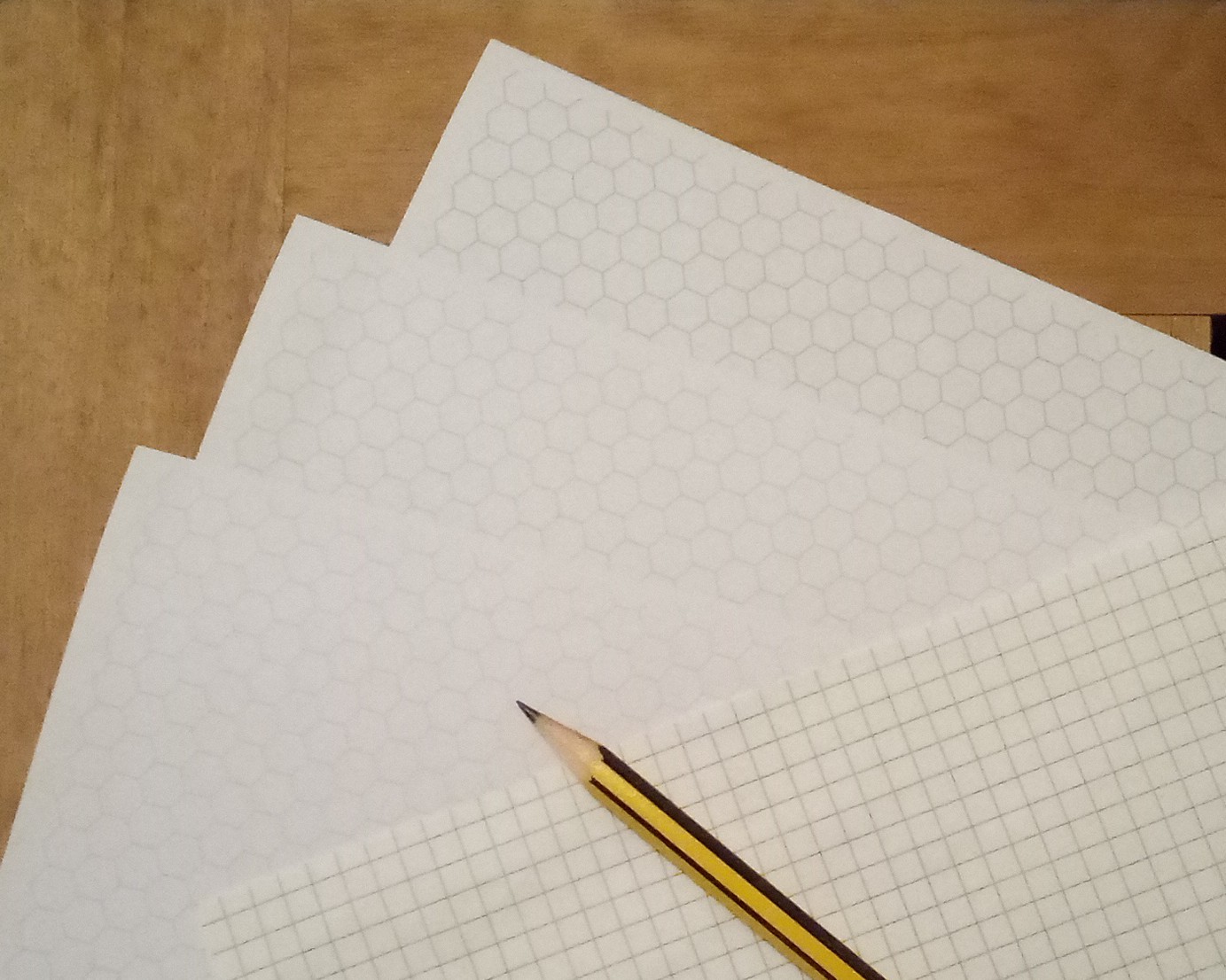 I really like the way they came out. (Which doesn’t come out so well in my photo.) I think 0.5 mm lines will work best for the way I want to use these. But when making maps to use at the table, either for GM notes or as a player handout, and you want to use it to track the exact position of the party as it travels, I think 0.7 mm might be better visible. Especially when you color in different areas.
The only downside with the whole approach is that the price the printer was asking for a simple printer paper print in A2 size was ridiculous. Yes, they want to make their money back on that printer that can handle oversized paper and probably do much fancier things than just grayscale on printer paper. But 4€ per sheet is ridiculous. But if you’re going to make these on regular A4 sheets on your home printer, this method is probably as cheap a way to get nice custom hex grid paper as it gets.